

What Is ADHD?
ADHD stands for attention deficit hyperactivity disorder. It is a neurodevelopmental condition that affects how the brain manages attention, impulse control and activity levels. Symptoms begin in childhood, usually before age 12, and often continue into adult life. ADHD is recognised as a medical condition, not a personality type or a behaviour problem.
Most people arrive at this question one of two ways. Either a teacher, partner or GP has raised it, or something clicked while scrolling and a lot of small things suddenly made sense at once. Both are reasonable starting points, and both deserve a proper answer rather than a checklist.
This guide covers what ADHD actually is, what the letters stand for, how it presents differently between people, and what the Australian clinical picture looks like. It does not diagnose anyone, and it does not cover medicines.
What Does ADHD Stand For?
ADHD is short for attention deficit hyperactivity disorder. That is the full form. The term is used in the DSM diagnostic framework and is consistent with the terminology in Australian ADHD clinical guidance, which recognises both DSM-5 and ICD-11 as diagnostic classification systems (Australian ADHD Professionals Association, 2022).
The name is widely considered a poor description of the condition, and it is worth saying why. Attention deficit implies a shortage of attention. The difficulty is better understood as a difference in attention regulation rather than an inability to concentrate: some people with ADHD sustain intense attention on highly engaging activities while struggling to maintain it on routine or less stimulating tasks. Hyperactivity is also only part of the picture, and it is absent altogether in a large share of people who meet criteria.
You will still see older terminology in circulation. ADD, attention deficit disorder, is an older term that is no longer used as a separate formal diagnosis. What was historically described as ADD is now generally captured within ADHD, particularly the predominantly inattentive presentation.
The ADHD Definition, in Plain Terms
ADHD definition: ADHD is a neurodevelopmental disorder characterised by a persistent pattern of inattention and/or hyperactivity-impulsivity that interferes with functioning or development (Australian ADHD Professionals Association, 2022). That word neurodevelopmental matters. It means the differences are in how the brain develops and functions, they appear early in life rather than arriving suddenly in adulthood, and they are not the result of parenting, screen time, diet or lack of discipline.
Clinically, ADHD is defined by a persistent pattern of inattention, hyperactivity and impulsivity that:
- began in childhood, with several symptoms present before age 12
- shows up in more than one setting, such as home and school, or work and relationships
- interferes with functioning rather than simply being noticeable
- is not better explained by another condition, a life circumstance or a period of stress
That last point does a lot of work. Nearly everyone is distractible when underslept, overloaded or grieving. What distinguishes ADHD is that the pattern is long-standing, cross-situational and disproportionate to circumstances.
Why the definition is stricter than it looks
The threshold is not “do you relate to this?” but “has this pattern been present since childhood, across settings, at a level that gets in the way?” Relating to individual traits is common. Meeting the full pattern is considerably less so.
The Two Symptom Domains
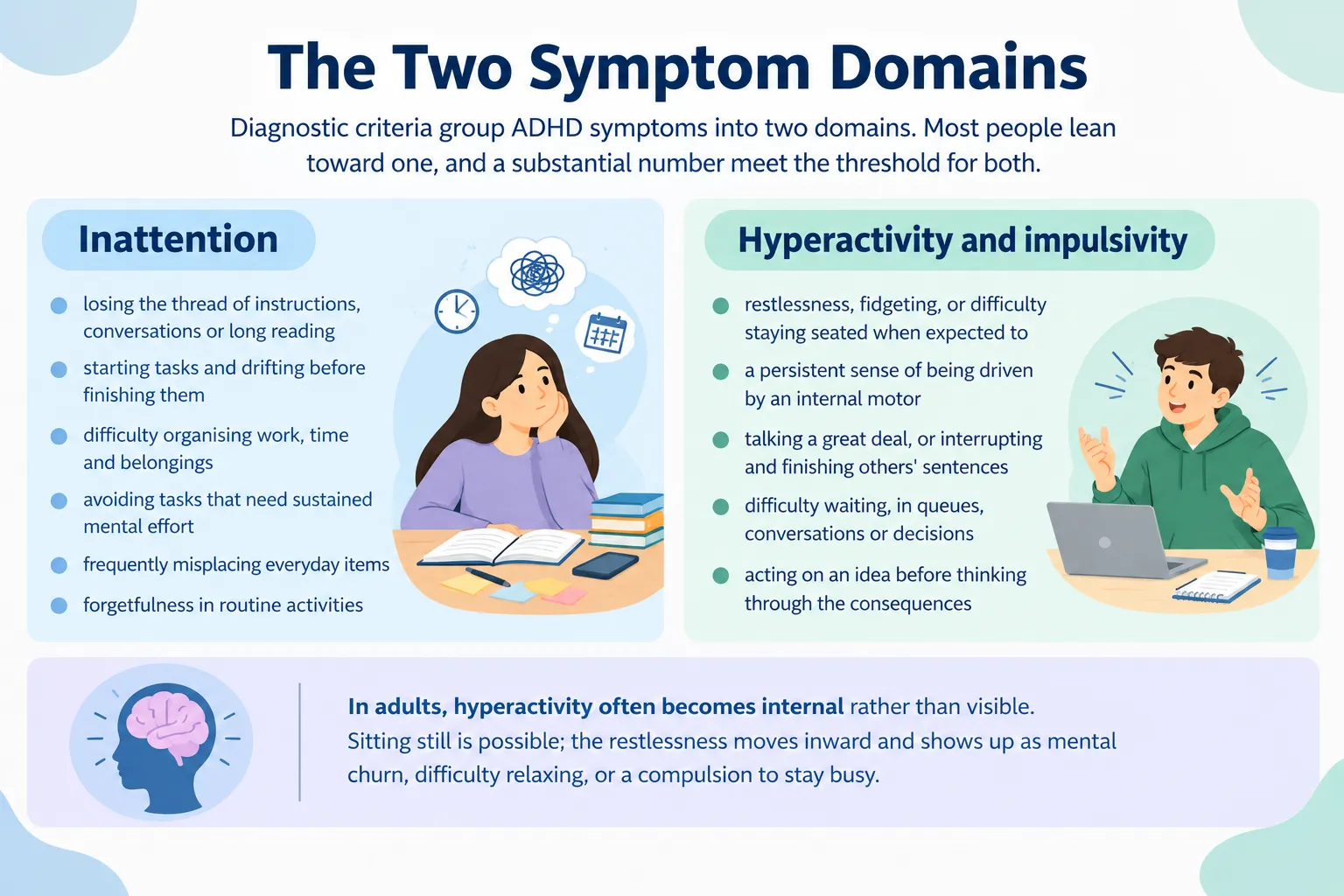
Diagnostic criteria group ADHD symptoms into two domains. Most people lean toward one, and a substantial number meet the threshold for both.
Inattention
- losing the thread of instructions, conversations or long reading
- starting tasks and drifting before finishing them
- difficulty organising work, time and belongings
- avoiding tasks that need sustained mental effort
- frequently misplacing everyday items
- forgetfulness in routine activities
Hyperactivity and impulsivity
- restlessness, fidgeting, or difficulty staying seated when expected to
- a persistent sense of being driven by an internal motor
- talking a great deal, or interrupting and finishing others’ sentences
- difficulty waiting, in queues, conversations or decisions
- acting on an idea before thinking through the consequences
In adults, hyperactivity often becomes internal rather than visible. Sitting still is possible; the restlessness moves inward and shows up as mental churn, difficulty relaxing, or a compulsion to stay busy.
The Three Presentations of ADHD
ADHD is not one uniform thing. Australian clinical guidance and the DSM framework describe three presentations, and which one applies can shift over a lifetime.
| Presentation | What it looks like | Commonly missed in |
| Predominantly inattentive | Attention regulation difficulties without significant visible hyperactivity. Often quiet, internally distracted, described as a daydreamer. | Girls, women, and quiet children who do not disrupt the classroom |
| Predominantly hyperactive-impulsive | Restlessness and impulsivity dominate; attention difficulties are less prominent. More visible, so more often picked up early. | Adults, where hyperactivity has become internalised |
| Combined presentation | Meets the threshold for both domains. | People whose difficulties were attributed to personality or effort |
Presentation describes the current picture rather than a permanent label. A person’s presentation can change over time as symptoms and functional demands change, because visible hyperactivity commonly declines with age while attention difficulties often persist (Australian ADHD Professionals Association, 2022). Our guide to types and presentations of ADHD covers severity levels in more detail.
How Common Is ADHD in Australia?
Estimating prevalence precisely is difficult, because diagnosis rates and true prevalence are not the same measure. The figures below are the ones most often cited in Australian clinical and policy work, with the source and date attached to each.
- More than 800,000 Australians are estimated to live with ADHD, the figure used in the development of Australia’s clinical guideline (Australian ADHD Professionals Association, 2022; May et al., ANZJP, 2023).
- In Australia’s 2013 to 2014 Young Minds Matter survey, ADHD was the most commonly reported disorder among children aged 4 to 11, at 8.2 percent (Australian Institute of Health and Welfare). This is the most recent national child survey of its kind, so it should be read as historical data rather than a current estimate.
- ADHD is often lifelong, with persistence into adulthood reported in roughly 60 to 86 percent of individuals (May et al., Australian and New Zealand Journal of Psychiatry, 2023).
- Adult diagnosis rates in Australia have risen over the past decade, with considerable variation between regions.
That last point is where most public argument sits. Increased recognition of ADHD in adulthood may reflect improved identification of people whose symptoms were not recognised earlier, particularly quieter inattentive presentations in girls and women. Changes in diagnostic practice, public awareness and access to assessment may also contribute. Diagnosis rates alone cannot establish a change in underlying prevalence.
What ADHD Is Not
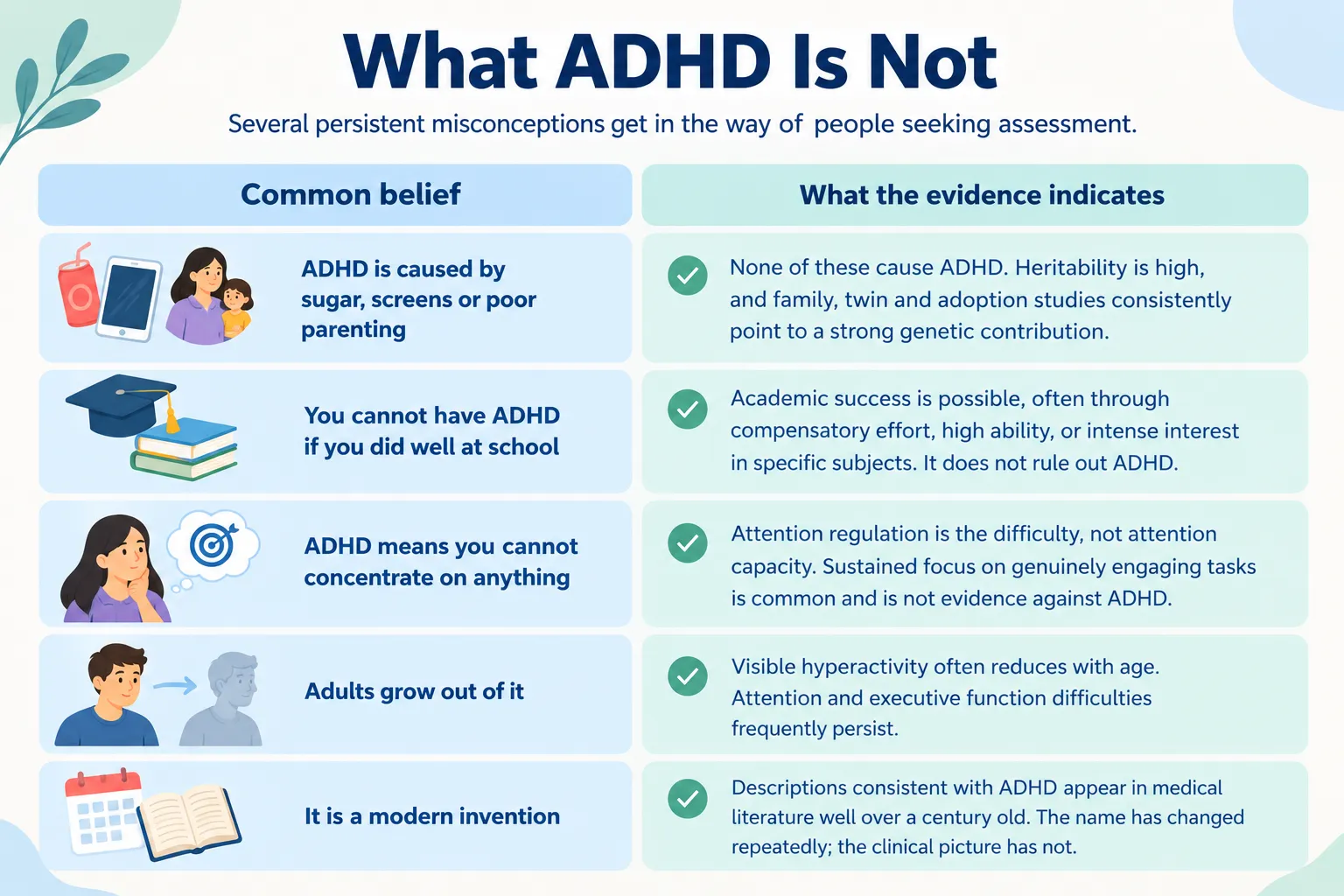
Several persistent misconceptions get in the way of people seeking assessment.
| Common belief | What the evidence indicates |
| ADHD is caused by sugar, screens or poor parenting | None of these cause ADHD. Heritability is high, and family, twin and adoption studies consistently point to a strong genetic contribution. |
| You cannot have ADHD if you did well at school | Academic success is possible, often through compensatory effort, high ability, or intense interest in specific subjects. It does not rule out ADHD. |
| ADHD means you cannot concentrate on anything | Attention regulation is the difficulty, not attention capacity. Sustained focus on genuinely engaging tasks is common and is not evidence against ADHD. |
| Adults grow out of it | Visible hyperactivity often reduces with age. Attention and executive function difficulties frequently persist. |
| It is a modern invention | Descriptions consistent with ADHD appear in medical literature well over a century old. The name has changed repeatedly; the clinical picture has not. |
What Causes ADHD?
There is no single cause. The current understanding is that ADHD arises from a combination of genetic and early environmental factors that influence brain development, particularly the networks involved in attention, inhibition and executive function.
Genetic factors account for a substantial share of risk. ADHD runs strongly in families, and it is common for a parent to recognise their own pattern while their child is being assessed. Environmental factors associated with increased likelihood include very premature birth and low birth weight (Australian ADHD Professionals Association, 2022). These are associations across populations rather than causes in any individual case, and none of them are deterministic.
Our guide to what causes ADHD covers the genetics, brain development and environmental research in more depth.
How ADHD Is Recognised
There is no blood test, brain scan or single questionnaire that diagnoses ADHD. Diagnosis is clinical, which means a qualified practitioner builds a picture across several sources of information.
In Australia, assessment generally involves a detailed developmental and personal history reaching back to childhood, standardised rating scales completed by the person and often by someone who knows them well, evidence that difficulties appear across more than one setting, and careful consideration of other explanations including anxiety, depression, sleep disorders, trauma and autism. This multi-source, function-focused approach is what Australia’s NHMRC-approved clinical guideline sets out (Australian ADHD Professionals Association, 2022). The exact process varies by age, clinician and clinical setting.
Online screeners are useful for deciding whether to pursue an assessment. They cannot diagnose, and a high score is a prompt to seek proper evaluation rather than a result in itself.
ADHD Across the Lifespan
The condition does not change, but its consequences move as life demands change.
| Life stage | How it commonly presents |
| Early childhood | Restlessness, difficulty following multi-step instructions, emotional intensity. Often mistaken for immaturity. |
| School years | Incomplete work, disorganisation, difficulty with sustained reading. Quiet inattentive presentations are frequently missed. |
| Adolescence | Visible hyperactivity often declines. Organisation, deadlines and emotional regulation become the pressure points. |
| Adulthood | Workplace and household demands expose executive function difficulties. Frequently identified after a child’s diagnosis, or after a change in workload. |
| Later adulthood | Under-researched. Symptoms persist for many people, though the presentation and the supports that help both shift. |
Is ADHD a Disability?
The answer depends on which framework you are using. Clinically, ADHD is a neurodevelopmental disorder. Under the Disability Discrimination Act 1992, a condition that substantially affects everyday functioning can meet the legal definition of disability, which is what makes workplace and educational adjustments relevant. This does not mean ADHD is automatically recognised as a disability for every purpose. Many people with ADHD also describe genuine strengths alongside the difficulties, and hold both views without contradiction.
What Support Looks Like
Support for ADHD is multimodal, meaning it usually combines several approaches rather than relying on one. Australia’s clinical guideline sets out recommendations across psychological, behavioural, educational and medical supports for children, adolescents and adults (Australian ADHD Professionals Association, 2022). Depending on age, presentation and what is actually getting in the way, that can include psychoeducation so the person understands their own pattern, behavioural and environmental strategies, workplace or educational adjustments, support for co-occurring conditions such as anxiety or sleep difficulties, and psychological therapies with an ADHD-informed focus.
Medical treatment options exist and are discussed between a person and their treating clinician. This guide does not cover medicines, and nothing here should be read as treatment advice.
Related Guides
- What ADHD feels like: living as a person with ADHD
- What Is ADHD? Meaning, definition and full form
- ADHD, IQ, intelligence and giftedness
- Is ADHD a disability, a disorder or a difference?
- ADHD symptom in adults: the complete Australian guide
- ADHD in Australia: the complete guide
References
- Australian ADHD Professionals Association. Australian Evidence-Based Clinical Practice Guideline for ADHD. NHMRC-approved, 2022. adhdguideline.aadpa.com.au
- American Psychiatric Association. Diagnostic and Statistical Manual of Mental Disorders, Fifth Edition, Text Revision (DSM-5-TR). 2022.
- May T, et al. The Australian evidence-based clinical practice guideline for attention deficit hyperactivity disorder. Australian and New Zealand Journal of Psychiatry. 2023. doi:10.1177/00048674231166329
- Australian Institute of Health and Welfare. Australia’s children: children with mental illness. aihw.gov.au
- National Institute for Health and Care Excellence (NICE). Attention deficit hyperactivity disorder: diagnosis and management. NG87.
Last reviewed: September 2026. Next scheduled review: September 2027. This article is general information and is not a substitute for individual medical advice, assessment or diagnosis.