

What Are ADHD Symptoms in Adults?
The diagnostic symptoms are the same at every age. In adults, inattention typically dominates, visible hyperactivity is often replaced by internal restlessness, and impulsivity appears more in decisions than in movement. Adults need at least five symptoms in a domain rather than six, and several symptoms must still trace back to before age 12 (Australian ADHD Professionals Association, 2022).
Most published symptom lists describe children. That is a problem for adults, because the wording of the criteria was developed with classrooms in mind, and an adult reading about climbing on furniture reasonably concludes it does not apply to them. Adult ADHD symptoms are the same criteria, described for a life stage the wording was not written for.
The search phrasings vary and the question does not: ADHD adult symptoms, symptoms of ADHD in adults, ADHD in adults symptoms, ADHD symptoms adults, symptoms of adhd adult, ADHD symptoms adult, ADHD adults signs, signs of adult ADHD, signs of add adhd in adults, signs of add and adhd in adults, ADHD in men symptoms, ADHD symptoms men and ADHD symptoms in male adults all point at the same thing.
This guide covers how each of the 18 diagnostic symptoms actually presents in adult life, what changes with age, and what commonly brings adults to assessment. Our full symptoms guide covers the criteria themselves.
What Changes in Adulthood
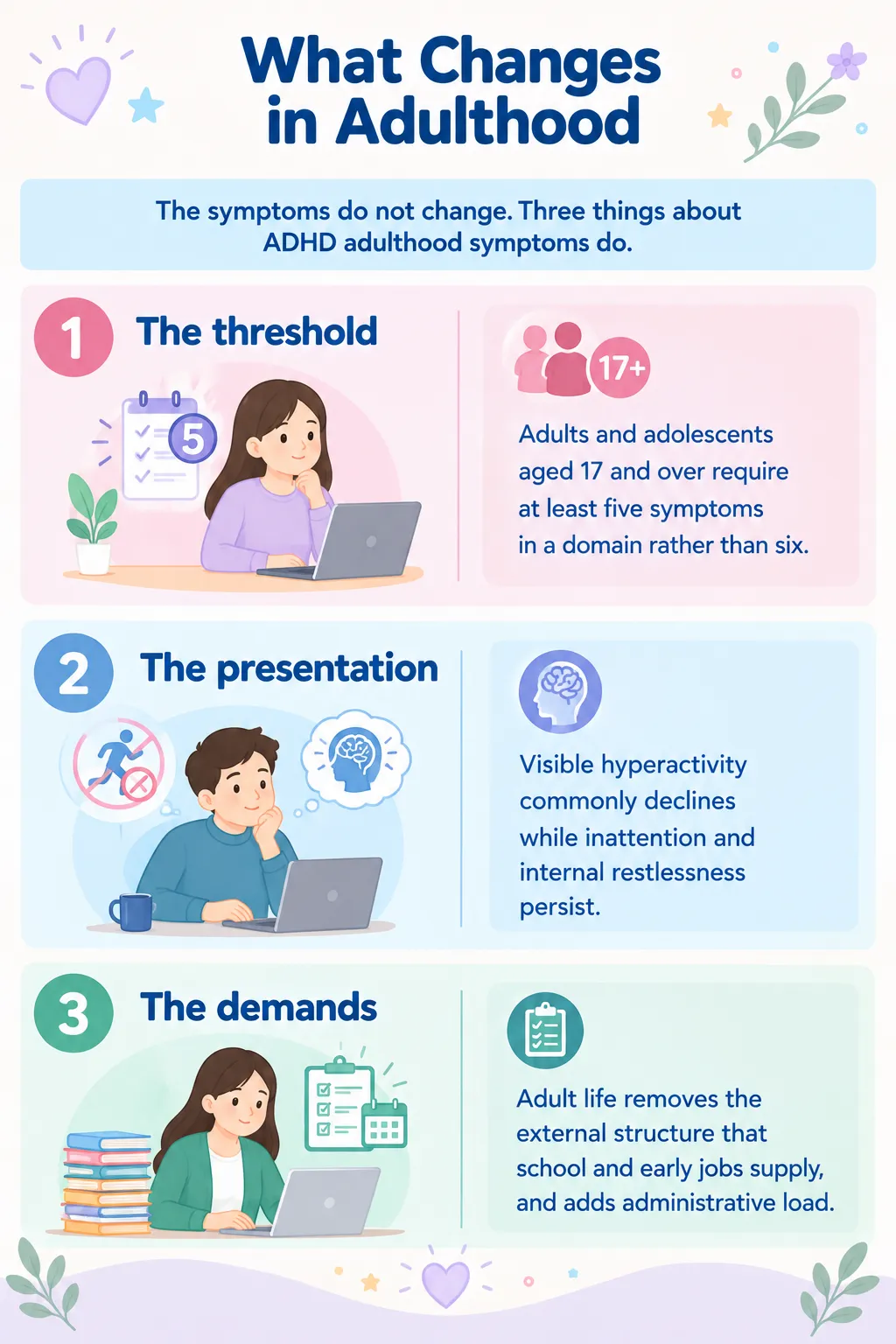
The symptoms do not change. Three things about adhd adulthood symptoms do.
| What changes | Detail |
| The threshold | Adults and adolescents aged 17 and over require at least five symptoms in a domain rather than six |
| The presentation | Visible hyperactivity commonly declines while inattention and internal restlessness persist |
| The demands | Adult life removes the external structure that school and early jobs supply, and adds administrative load |
That third point is part of why people are identified in adulthood despite the condition beginning in childhood. Where structure was absorbing the difficulty, its removal can make the underlying pattern more apparent.
ADHD Adult Symptoms: Inattention in Adults
How the nine inattention symptoms commonly present in adult life. These are illustrative descriptions rather than diagnostic criteria.
- Careless mistakes in work well within your capability, missed on rereading
- Difficulty sustaining attention through meetings, long documents, lectures or conversations
- Appearing not to listen: hearing the words, and realising afterwards that nothing registered
- Not following through: projects that stall near completion, side-tracking mid-task and not returning
- Difficulty organising: sequencing multi-step work, managing deadlines, keeping materials in order
- Avoiding sustained mental effort: reports, forms, tax, lengthy reading. Often experienced as inability to start rather than unwillingness
- Losing things: keys, wallet, phone, glasses, documents, at a frequency that stands out
- Distractibility, which in adults explicitly includes being drawn away by unrelated thoughts, not only external noise
- Forgetfulness: appointments, returning calls, paying bills, commitments made in passing
ADHD Hyperactivity Symptoms in Adults
This is where adult presentation diverges most from the childhood wording, and where people most often rule themselves out incorrectly.
The diagnostic criteria explicitly note that in adolescents and adults, hyperactivity may be limited to feeling restless rather than physical movement. That wording matters, because the absence of visible hyperactivity is a common reason adults rule themselves out.
| Childhood wording | Adult presentation |
| Fidgets or squirms in seat | Restless hands, tapping, shifting position, difficulty sitting through long meetings |
| Leaves seat when expected to remain seated | Standing during meetings, finding reasons to leave the room |
| Runs or climbs inappropriately | An internal sense of restlessness rather than visible movement |
| Unable to play quietly | Difficulty with sustained stillness, discomfort relaxing without an activity |
| On the go, driven by a motor | A persistent internal drive, difficulty settling, discomfort with unstructured time |
| Talks excessively | Difficulty stopping once started, particularly on topics of interest |
| Blurts out answers | Finishing others’ sentences, answering before the question lands |
| Difficulty waiting turn | Impatience in queues, in conversations, and with slow processes generally |
| Interrupts or intrudes | Interrupting despite intending not to, taking over tasks, using others’ things without asking |
Impulsivity is the component that persists most consistently. In adults it shows up in decisions more than in movement: spending, career changes, commitments, and conversations. These are examples of how impulsivity may affect adult life rather than additional diagnostic criteria.
Signs of ADHD in Adults: Where They Show Up
Assessment considers functional impact rather than whether behaviours occur. In adults, that impact concentrates in predictable places.
| Area | What difficulty commonly looks like |
| Work | Missed deadlines, difficulty with administration, underemployment relative to capability, frequent job changes |
| Study | Difficulty with independent work, essays started late, reading that does not retain |
| Household | Bills, appointments, renewals, and the accumulation of small unfinished tasks |
| Relationships | Forgetting things that matter to others, interrupting, difficulty with sustained listening |
| Finances | Impulsive spending, unopened mail, late payments on money that was available |
| Self-management | Sleep, exercise and routine that are difficult to establish and easy to lose |
Signs of Untreated ADHD in Adults
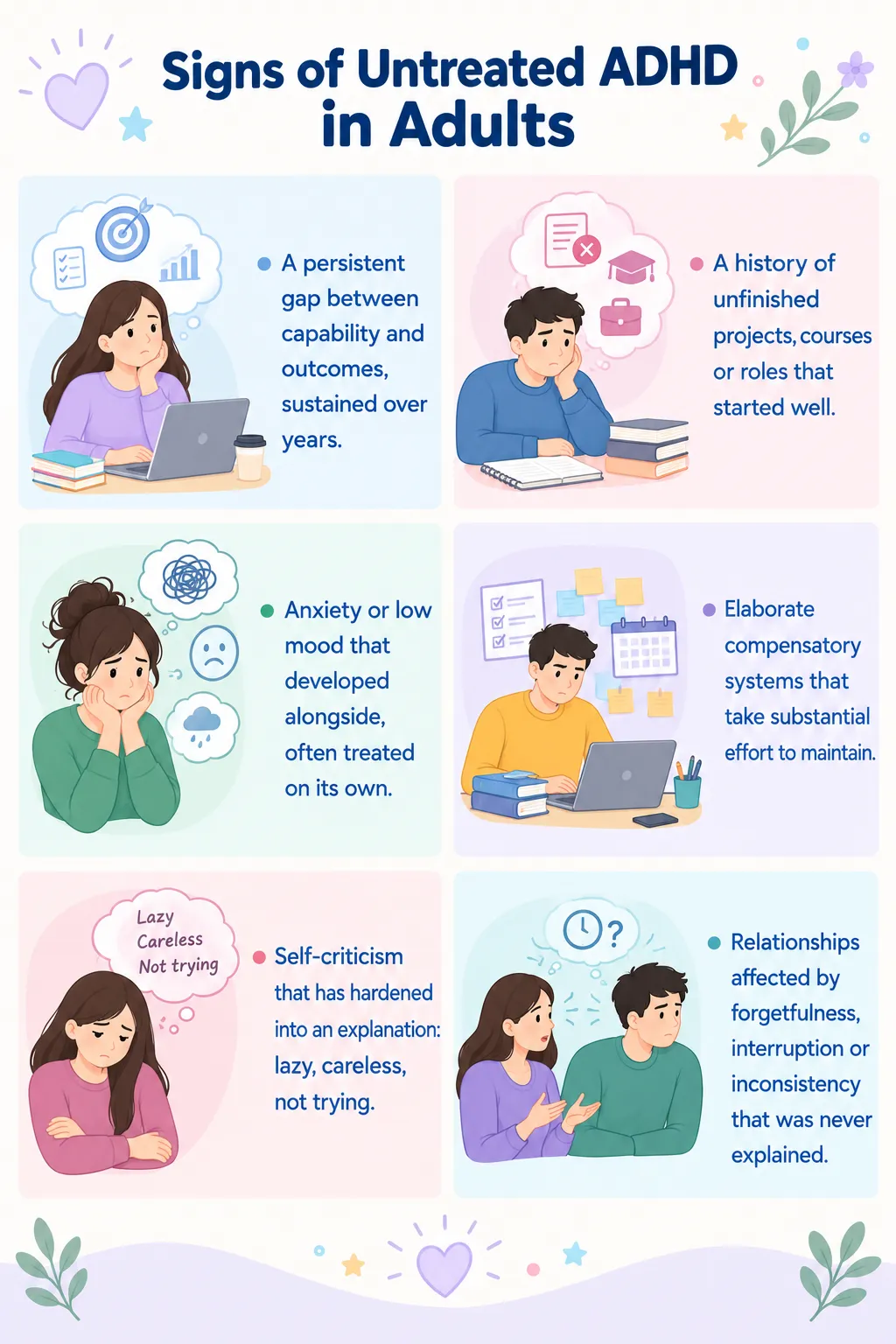
People search for signs of untreated ADHD in adults looking for what long-term unrecognised ADHD tends to look like. What accumulates is often not the symptoms themselves but their consequences. The list below reflects experiences commonly described by adults assessed late, rather than diagnostic indicators.
- A persistent gap between capability and outcomes, sustained over years
- A history of unfinished projects, courses or roles that started well
- Anxiety or low mood that developed alongside, often treated on its own
- Elaborate compensatory systems that take substantial effort to maintain
- Self-criticism that has hardened into an explanation: lazy, careless, not trying
- Relationships affected by forgetfulness, interruption or inconsistency that was never explained
None of these are diagnostic criteria. They are consequences commonly described by adults who reach assessment late, and they are part of why identification matters even in adulthood.
ADHD Symptoms in Men
The diagnostic criteria are identical for everyone, so ADHD symptoms in men are not a separate list. Symptoms of ADHD in men follow the same criteria as for anyone else. Men are more commonly identified in childhood than women, which is generally attributed to hyperactive-impulsive presentations being more externally visible and more likely to prompt a referral.
Two things follow from that. Men with predominantly inattentive presentations can be missed for similar reasons to women, and an assumption that ADHD was ruled out in childhood may delay adult assessment. Some men identified in childhood also assume the diagnosis stopped applying once visible hyperactivity declined, which is not how presentation change works.
What Commonly Prompts Adult Assessment
Adults rarely seek assessment because symptoms worsened. More often, demands increased past the point compensation could cover.
- A child’s diagnosis, and recognising the pattern in your own history
- A promotion or role change that removed structure and added self-directed work
- Starting university or returning to study
- Becoming a parent, when sleep reduces and administrative load multiplies
- A period where existing coping strategies stopped being sufficient
- Treatment for anxiety or depression that helped the mood but not the underlying difficulties
That last one is worth taking seriously. If anxiety treatment has worked and the concentration, organisation and initiation difficulties remain unchanged, that is a reasonable thing to raise.
What Adult Symptoms Are Not
- Difficulty concentrating that began recently in adulthood with no childhood history. That warrants assessment for other causes
- Distractibility during a period of high stress, poor sleep or burnout, without a long-standing pattern
- Difficulty in one demanding setting only. Criteria require more than one
- Normal age-related change in memory or processing speed
Anxiety, depression, sleep disorders, thyroid conditions, trauma and perimenopause can all produce adult attention difficulties. Several of them also occur alongside ADHD. Distinguishing between them is a core part of clinical assessment.
Is It ADHD or Something Else?
Adult attention difficulties have several possible explanations, and more than one can apply at once. This is a simplified summary of why assessment matters, not a guide to distinguishing conditions yourself.
| Alternative explanation | What tends to distinguish it |
| Anxiety | Often has a clearer onset. Concentration difficulty tracks with worry rather than being lifelong |
| Depression | Usually episodic, with mood change central rather than long-standing attention difficulty |
| Burnout or chronic stress | Has an onset and usually improves when demand reduces. ADHD does not resolve with a holiday |
| Sleep disorders | Symptoms track sleep quality and may improve substantially when sleep does |
| Perimenopause | Onset relates to hormonal change rather than to childhood history |
| Thyroid conditions | Physical signs and blood tests identify these |
The distinguishing question in every row is the same: does the pattern trace back to childhood, and does it appear across more than one setting? These conditions also occur alongside ADHD rather than instead of it, which is common, so identifying one does not rule out the other.
When to Seek Assessment
- The pattern traces back to childhood rather than starting recently
- It appears in more than one area of life
- It is causing difficulty rather than simply being recognisable
- There is a persistent gap between capability and outcomes despite genuine effort
- You are managing, but the effort required is disproportionate and not sustainable
For most people the first step is a conversation with a GP about referral pathways. It helps to arrive with specifics: examples from childhood, school reports if you have them, and an account of what is currently not working rather than a list of traits. .
Related Guides
- ADHD symptoms in women and girls
- Inattentive ADHD (formerly known as ADD)
- What ADHD feels like: living as a person with ADHD
- ADHD in Australia: the complete guide
- ADHD, IQ, intelligence and giftedness
References
- Australian ADHD Professionals Association. Australian Evidence-Based Clinical Practice Guideline for Attention Deficit Hyperactivity Disorder (ADHD). Released October 2022. adhdguideline.aadpa.com.au
- American Psychiatric Association. Diagnostic and Statistical Manual of Mental Disorders, Fifth Edition, Text Revision (DSM-5-TR). 2022.
- May T, et al. The Australian evidence-based clinical practice guideline for attention deficit hyperactivity disorder. Australian and New Zealand Journal of Psychiatry. 2023. doi:10.1177/00048674231166329
- National Institute for Health and Care Excellence (NICE). Attention deficit hyperactivity disorder: diagnosis and management. NG87.
Last review: September 2026. Next scheduled review: September 2027. This article is general information and is not a substitute for individual medical advice, assessment or diagnosis.