

How Many Types of ADHD Are There?
ADHD is a neurodevelopmental disorder with three recognised presentations: predominantly inattentive, predominantly hyperactive-impulsive, and combined. DSM-5-TR also uses mild, moderate and severe severity specifiers. “Presentation” is preferred to “type” because a person’s symptom pattern can change over time (Australian ADHD Professionals Association, 2022).
Most people searching for types of ADHD are trying to work out which one applies to them or their child. That is a reasonable question, and the answer is more useful once you understand two things: what the three recognised presentations actually are, and why clinicians deliberately stopped calling them types.
This guide covers all three presentations, the severity specifiers that sit alongside them, how presentation shifts across a lifetime, and which widely circulated ADHD categories are not part of any diagnostic system.
Types or Presentations? The Terminology Matters
Short answer: they describe the same three groupings, but presentation is the current clinical term and it carries a meaning that type does not.
DSM-IV used the term subtypes. DSM-5 changed the terminology to presentations, and Australia’s clinical guideline uses the same wording (Australian ADHD Professionals Association, 2022). The change was deliberate. Subtype implies a fixed category you belong to permanently. Presentation describes how ADHD is showing up at a given point, which is more accurate, because the picture can change with age and circumstances.
You will still see type used widely, including in search and everyday conversation. It is not wrong enough to matter in casual use. It matters clinically because a person’s presentation can change over time as symptoms and developmental demands change. Someone who met criteria for the combined presentation in childhood may later meet criteria for the predominantly inattentive presentation. The diagnosis remains ADHD; the recorded presentation reflects the symptom pattern at that point in time.
The Three Presentations of ADHD
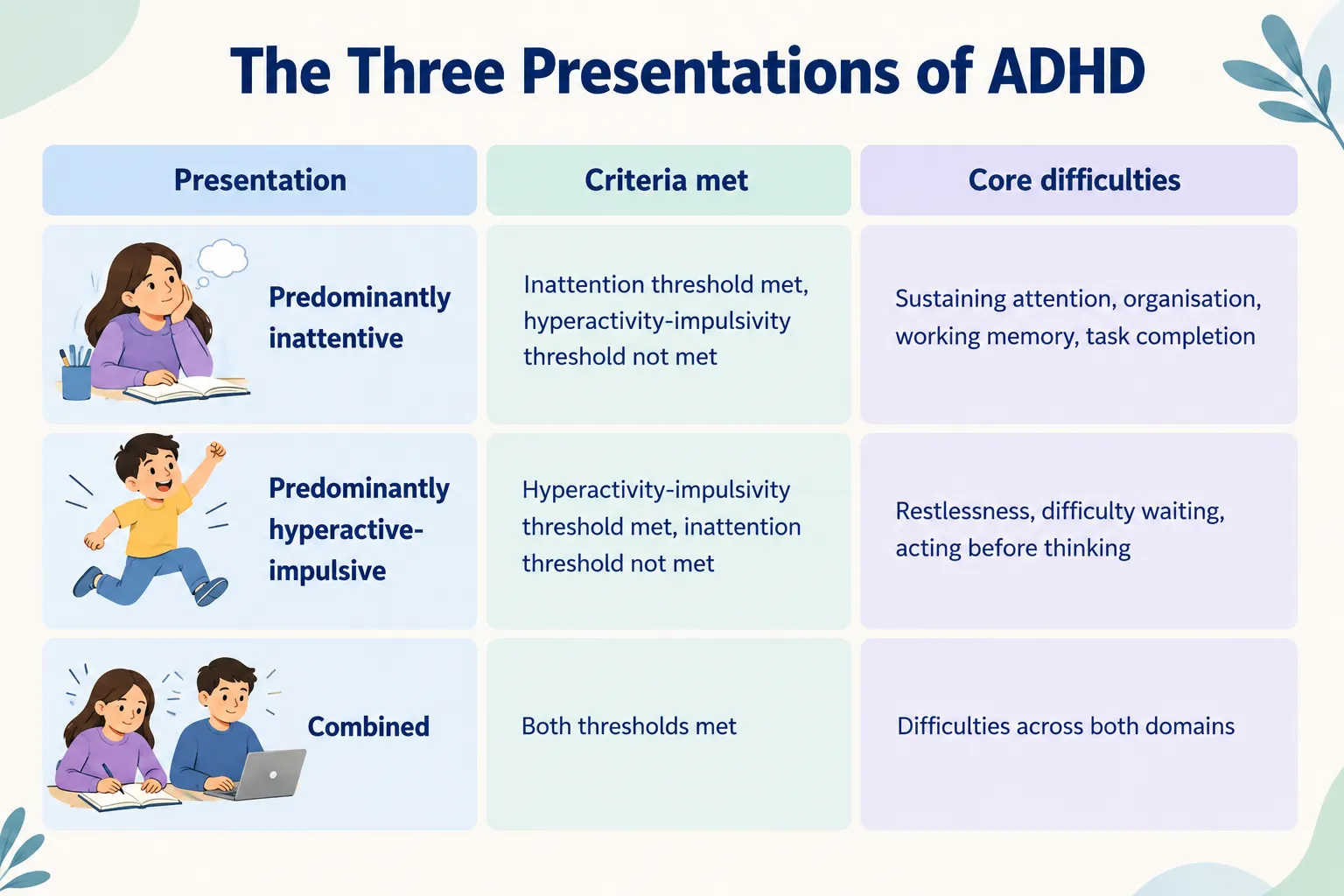
DSM-5 lists nine inattention symptoms and nine hyperactivity-impulsivity symptoms. Under DSM-5 criteria, children need at least six symptoms in a domain and people aged 17 and older need at least five. Symptoms must have persisted for at least six months, several must have been present before age 12, they must appear in more than one setting, and they must interfere with functioning (Australian ADHD Professionals Association, 2022).
| Presentation | Criteria met | Core difficulties |
| Predominantly inattentive | Inattention threshold met, hyperactivity-impulsivity threshold not met | Sustaining attention, organisation, working memory, task completion |
| Predominantly hyperactive-impulsive | Hyperactivity-impulsivity threshold met, inattention threshold not met | Restlessness, difficulty waiting, acting before thinking |
| Combined | Both thresholds met | Difficulties across both domains |
Predominantly Inattentive Presentation
Attention regulation difficulties dominate, with little or no obvious hyperactivity. This is the presentation people often still call ADD. Because it produces less disruptive behaviour, it can be easy to miss in childhood, and Australia’s clinical guideline notes girls and women are at risk of under-recognition where symptoms are predominantly inattentive.
Our dedicated guide to inattentive ADHD covers this presentation in depth, including why it is missed and what assessment involves.
Predominantly Hyperactive-Impulsive Presentation
Restlessness and impulsivity dominate, while attention difficulties do not reach the diagnostic threshold. Because visible hyperactivity tends to become less prominent with age while attention difficulties often persist, some people who present this way in childhood meet criteria for a different presentation later.
- in young children: constant motion, difficulty remaining seated, climbing or running when it is not appropriate
- in older children and adolescents: fidgeting, difficulty with quiet activities, talking a great deal
- in adults: an internal sense of restlessness rather than visible movement, a strong need to stay occupied, or difficulty relaxing
- across all ages: interrupting, difficulty waiting, answering before a question is finished, acting on an idea before considering the consequences
Impulsivity often persists into adulthood and can show up in decisions rather than in movement: spending, career changes, conversations, or commitments made faster than they were considered. These are examples of how impulsivity may affect adult life, not additional diagnostic criteria.
Combined Presentation
Both thresholds are met. The combined presentation is commonly identified in childhood clinical settings, although prevalence estimates vary by population, setting and study methodology.
Combined does not mean more severe by definition. Severity is a separate specifier, covered below. A person with the combined presentation and mild severity may function better than someone with the inattentive presentation and severe impairment.
ADHD Severity Levels
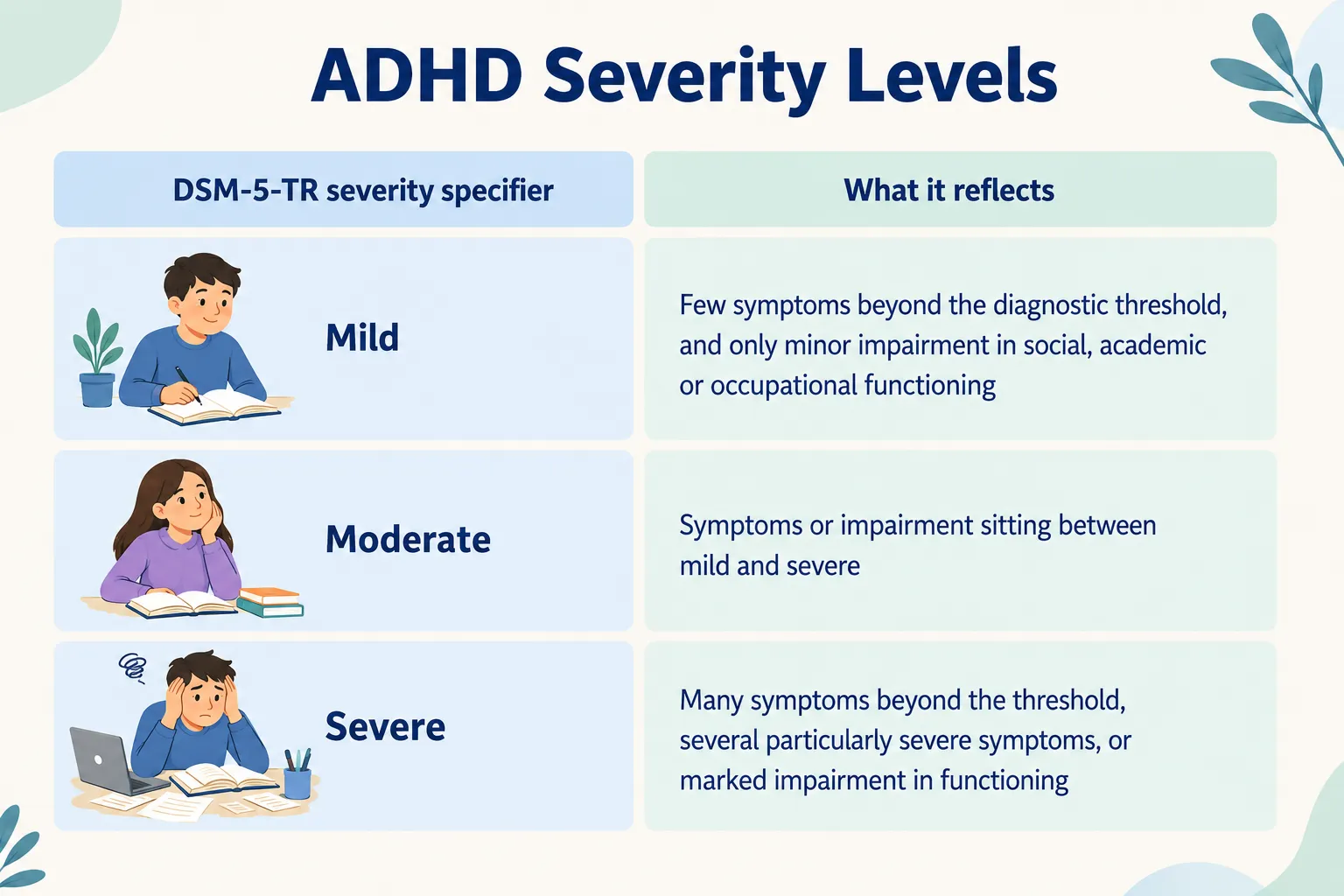
Alongside presentation, ADHD is specified as mild, moderate or severe. This is the part most people miss when they focus on which type they have, and it is often the more useful piece of information.
| DSM-5-TR severity specifier | What it reflects |
| Mild | Few symptoms beyond the diagnostic threshold, and only minor impairment in social, academic or occupational functioning |
| Moderate | Symptoms or impairment sitting between mild and severe |
| Severe | Many symptoms beyond the threshold, several particularly severe symptoms, or marked impairment in functioning |
Two points worth understanding. Severity considers both the number of symptoms beyond the diagnostic threshold and the degree of functional impairment, not simply how many boxes are ticked. And severity can change over time as symptoms, functional demands and impairment change. Clinical assessment considers the person’s current symptom burden and level of impairment.
Why presentation is only part of the clinical picture
Presentation describes which symptom domains meet threshold. Functional impairment helps determine clinical severity and support needs. Two people with the same presentation can need quite different support, and the presentation label rarely decides that on its own.
The two specifiers answer different questions, and confusing them is common.
| What it describes | |
| Presentation | Which symptom domains currently meet the diagnostic threshold |
| Severity | How many symptoms exceed the threshold and how much impairment they cause |
What is mild ADHD?
Few symptoms beyond the diagnostic threshold, with only minor impairment in social, academic or occupational functioning. Mild does not mean the difficulties are trivial, and it can change if demands increase.
What is moderate ADHD?
Symptoms or functional impairment sitting between the mild and severe descriptions. This is a clinical judgement rather than a fixed symptom count.
What is severe ADHD?
Many symptoms beyond the diagnostic threshold, several particularly severe symptoms, or marked impairment in social, academic or occupational functioning.
Do ADHD Presentations Change Over Time?
Yes, and this is the main reason the terminology changed from subtype to presentation.
| Life stage | What may change |
| Childhood | Hyperactive-impulsive and inattentive symptoms may both be prominent |
| Adolescence | Symptoms may become less externally visible as demands and environments change |
| Adulthood | Difficulties may become more apparent through work, organisation, relationships and self-management demands |
Important: a change in presentation does not mean a change in diagnosis, and it does not mean an earlier assessment was wrong. The diagnosis remains ADHD; the recorded presentation reflects the symptom pattern at that point in time.
Types That Are Not Part of Any Diagnostic System
Searching for types of ADHD will surface several category systems that are not recognised in DSM-5, ICD-11, or Australia’s clinical guideline. It is worth knowing which is which.
Some websites and books promote additional ADHD types based on symptom patterns or proposed brain differences, including systems proposing seven or more categories. These are not part of DSM-5-TR or ICD-11 diagnostic classifications and are not used in Australia’s evidence-based clinical guideline. Routine brain imaging is not used to establish an ADHD diagnosis.
You will also see informal symptom-based or personality-style ADHD labels circulating online. None of these are formal diagnostic presentations. Some describe experiences people genuinely have, which is why they resonate, but they are not what a clinician will assess you against.
What this means practically
If a website or clinic offers to identify your ADHD type through a brain scan, that is not standard practice in Australia. ADHD is diagnosed clinically, through history, symptom assessment, evidence across settings and consideration of alternative explanations.
How Presentation Differs by Age and Sex
Presentation is not evenly distributed, and understanding why explains a lot about who gets identified and when.
By age
Hyperactive-impulsive features are often most visible in early childhood, while attention difficulties can become more apparent as academic and organisational demands increase. Not everyone follows the same course, and some adults continue to have significant hyperactive-impulsive symptoms.
By sex
Australia’s clinical guideline notes that girls and women are at risk of under-recognition, particularly where symptoms are predominantly inattentive (Australian ADHD Professionals Association, 2022). Because hyperactive-impulsive behaviour is more likely to prompt a referral, this may contribute to differences in who is referred for assessment and when ADHD is recognised.
Why Presentation Is Recorded at All
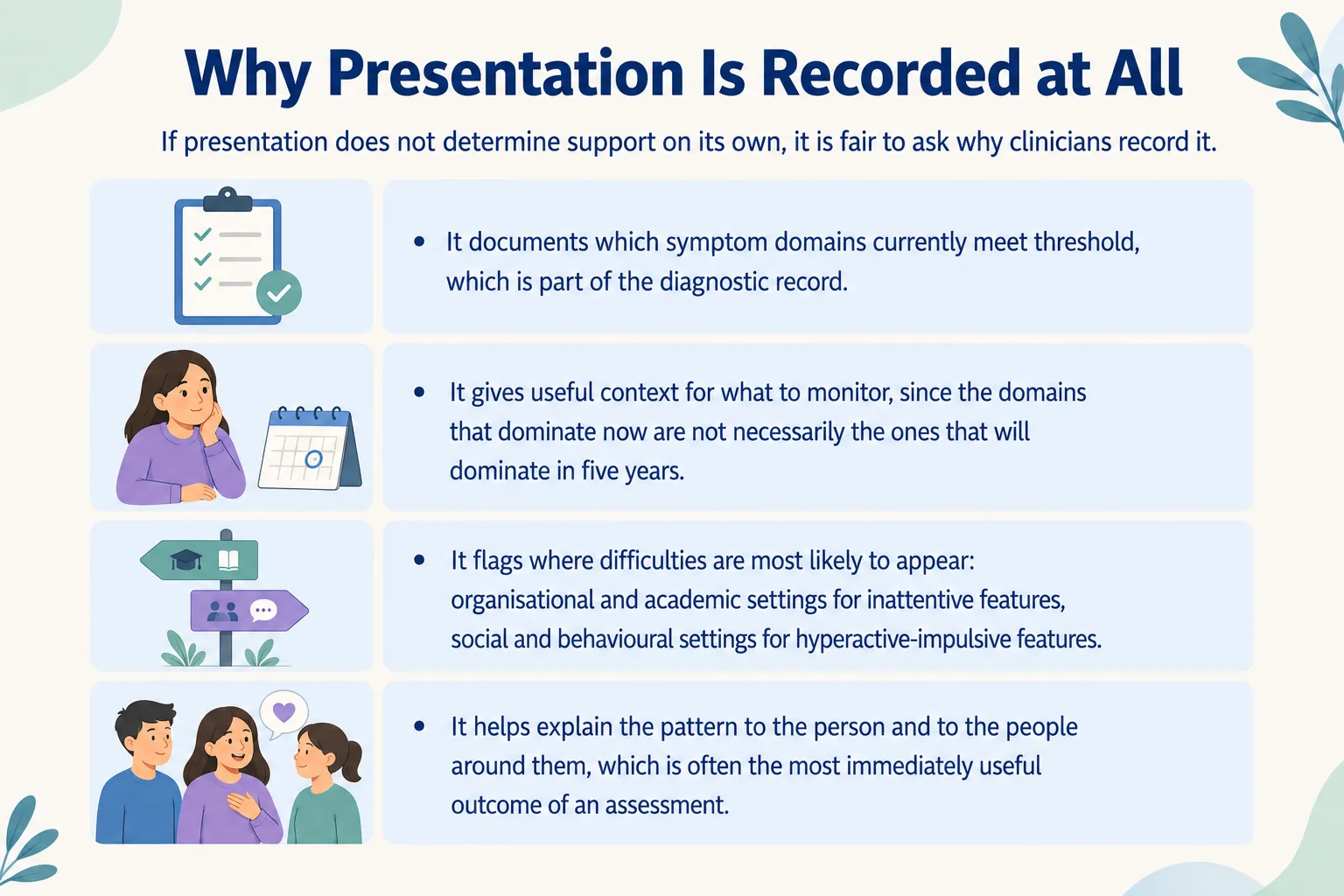
If presentation does not determine support on its own, it is fair to ask why clinicians record it.
- It documents which symptom domains currently meet threshold, which is part of the diagnostic record.
- It gives useful context for what to monitor, since the domains that dominate now are not necessarily the ones that will dominate in five years.
- It flags where difficulties are most likely to appear: organisational and academic settings for inattentive features, social and behavioural settings for hyperactive-impulsive features.
- It helps explain the pattern to the person and to the people around them, which is often the most immediately useful outcome of an assessment.
What it does not do is prescribe a treatment pathway. That comes from functional impairment, co-occurring conditions, age and the person’s own priorities.
How Presentation Is Determined in an Assessment
Presentation is not assessed separately. It falls out of the same clinical process used to diagnose ADHD at all.
- A developmental and personal history reaching back to childhood, since onset before age 12 is part of the criteria.
- Symptom assessment across both domains, usually with standardised rating scales completed by the person and by an informant. Rating scales support assessment but are not, on their own, sufficient to establish an ADHD diagnosis.
- Evidence that difficulties appear in more than one setting.
- Assessment of functional impairment across social, academic, occupational and daily-life functioning.
- Consideration of alternative and co-occurring explanations, including anxiety, depression, sleep disorders, trauma, autism and specific learning disorders.
Which domain thresholds are met determines the presentation. The severity specifier is applied based on symptom count and functional impact. The exact process varies by age, clinician and setting.
Related Guides
- What Is ADHD? Meaning, definition and full form
- ADD vs ADHD: are they the same thing?
- ADHD symptoms: the full symptom picture
- ADHD symptoms in adults: the complete Australian guide
References
- Australian ADHD Professionals Association. Australian Evidence-Based Clinical Practice Guideline for Attention Deficit Hyperactivity Disorder (ADHD). Released October 2022. adhdguideline.aadpa.com.au
- American Psychiatric Association. Diagnostic and Statistical Manual of Mental Disorders, Fifth Edition, Text Revision (DSM-5-TR). 2022.
- World Health Organization. International Classification of Diseases, 11th Revision (ICD-11). 6A05 Attention deficit hyperactivity disorder.
- May T, et al. The Australian evidence-based clinical practice guideline for attention deficit hyperactivity disorder. Australian and New Zealand Journal of Psychiatry. 2023. doi:10.1177/00048674231166329
- National Institute for Health and Care Excellence (NICE). Attention deficit hyperactivity disorder: diagnosis and management. NG87.
Last review: September 2026. Next scheduled review: September 2027. This article is general information and is not a substitute for individual medical advice, assessment or diagnosis.