

What Is It Like to Have ADHD?
People with ADHD commonly describe difficulty regulating where attention goes rather than an inability to concentrate, a sense that motivation depends on interest or urgency rather than importance, difficulty judging how long things take, and emotional responses that arrive quickly. Experiences vary considerably between individuals, and none of these descriptions are diagnostic criteria.
Diagnostic criteria describe ADHD from the outside: observable symptoms, counted and checked against thresholds. That is what they are for. What they do not convey is what the condition is like to live with, which is usually what people are looking for when they start reading about it.
This guide describes experiences commonly reported by people with ADHD in clinical practice and in ADHD communities. These accounts are descriptive rather than diagnostic, and most have not been formally studied as distinct clinical features. Experiences vary considerably between individuals. Recognising yourself in a description is a reasonable reason to seek assessment, and it is not a substitute for one.
How a Person With ADHD Thinks About Attention
The most common misunderstanding is that ADHD means being unable to concentrate. People who have it usually describe something different: attention that goes somewhere, just not reliably where they intended.
The same person can lose the thread of a short email and then work on something absorbing for hours without noticing time pass. This is not a contradiction. It is consistent with difficulty regulating attention rather than lacking it.
On the phrase interest-based attention
You will see ADHD described online as an interest-based nervous system, as opposed to an importance-based one. This is a popular framing rather than a clinical term, and it does not appear in diagnostic criteria. Many people find it a useful description of their experience, which is why it circulates. It is not a mechanism that has been established as such.
What Motivates People With ADHD
What motivates ADHD is one of the most common questions people ask about their own experience. A pattern many describe is that knowing something matters does not reliably translate into being able to start it. The gap between understanding importance and initiating action is one of the more difficult aspects to explain to people who do not experience it.
The following are commonly described by people with ADHD as making tasks easier to start, or as the things that motivate ADHD in practice. They are reported experiences rather than evidence-based strategies:
- Genuine interest in the task itself, rather than in its outcome
- A deadline close enough to generate pressure
- Novelty, including a new approach to an old task
- Another person present, whether working alongside or simply expecting an update
- Breaking a task down until the first step is small enough to be obvious
These are descriptions of what people report rather than clinical recommendations. What works varies considerably between individuals, and the same strategy can stop working once it stops being novel.
What People With ADHD Struggle With Most
When people describe what is hardest, it is frequently not the symptoms themselves but the gap between capability and output. The difficulties below are commonly reported rather than formally ranked.
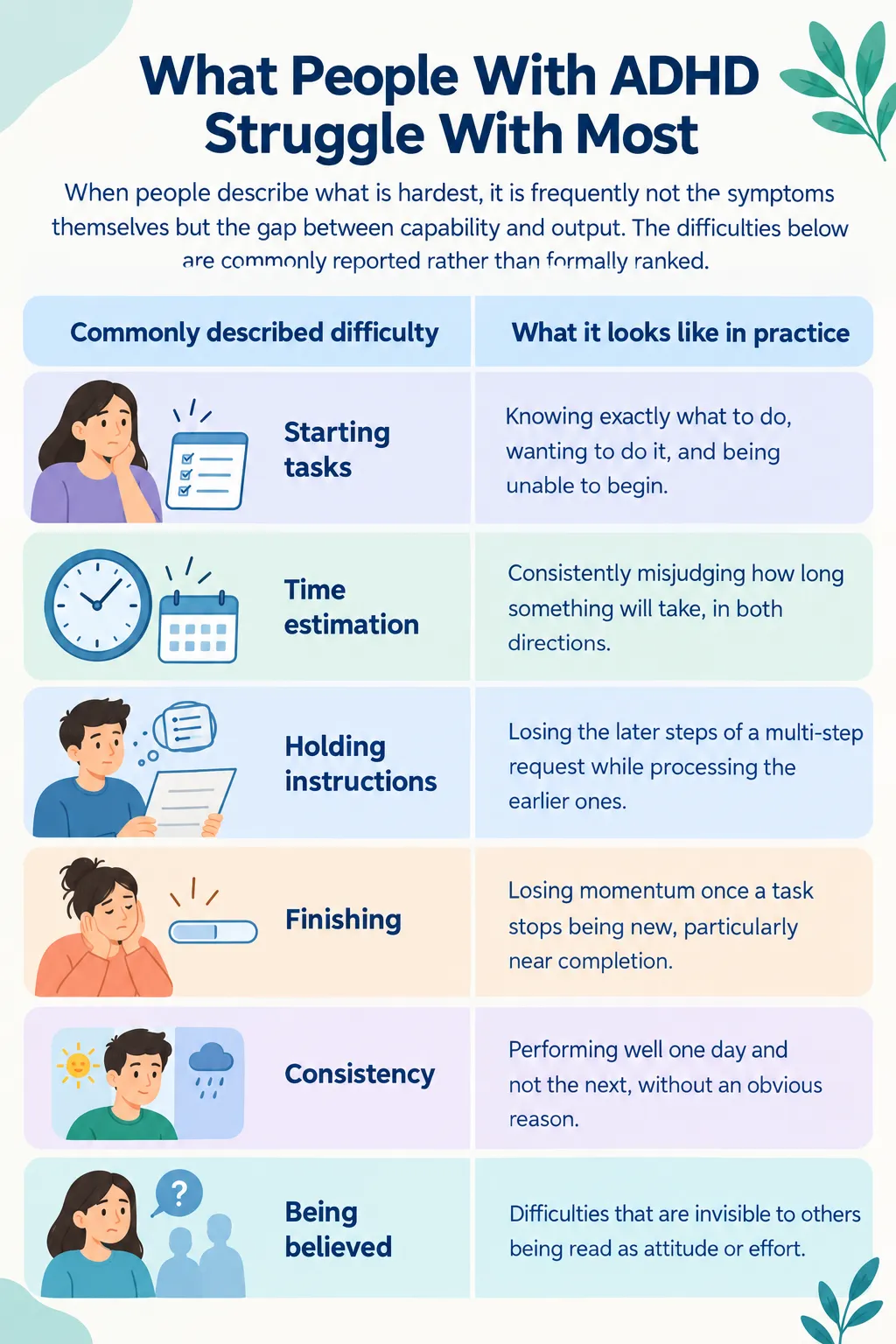
| Commonly described difficulty | What it looks like in practice |
| Starting tasks | Knowing exactly what to do, wanting to do it, and being unable to begin |
| Time estimation | Consistently misjudging how long something will take, in both directions |
| Holding instructions | Losing the later steps of a multi-step request while processing the earlier ones |
| Finishing | Losing momentum once a task stops being new, particularly near completion |
| Consistency | Performing well one day and not the next, without an obvious reason |
| Being believed | Difficulties that are invisible to others being read as attitude or effort |
That last row comes up repeatedly and is worth naming. Difficulties that produce no visible sign are frequently attributed to character rather than to a condition, both by other people and by the person themselves.
Time and ADHD
Many people with ADHD describe time as experienced in two categories: now and not now. This is a description commonly used within ADHD communities rather than a clinical construct, though difficulties with time management and planning are widely recognised in ADHD.
The practical effects are commonly described. Planning across weeks is often harder than planning across hours. Tasks either happen immediately or are at risk of not happening. And a five-minute job and a two-hour job can feel equally difficult to begin, because the barrier is starting rather than duration.
Emotion and ADHD
Emotional regulation difficulties are commonly reported in ADHD and are recognised in Australian clinical guidance as a feature associated with the condition, although they are not part of the formal diagnostic criteria (Australian ADHD Professionals Association, 2022). What people describe is usually intensity and speed rather than a different range of emotions: reactions that arrive at full volume, and often pass faster than expected.
Sensitivity to perceived criticism or rejection is also frequently described. You will see this called rejection sensitive dysphoria online. That term is not a diagnostic category, does not appear in DSM-5-TR or ICD-11, and is not a recognised condition. Many people find it a useful label for a real experience, which is why it spread. It should not be treated as a diagnosis.
Perfectionism and ADHD
People often assume ADHD and perfectionism are opposites. In practice, some people with ADHD describe both, and the combination is less contradictory than it appears. This association is commonly described rather than well established in research.
A common account is that years of inconsistent output produce very high standards as a form of compensation, and that those standards then make starting harder, because an imperfect beginning feels worse than not beginning. Others describe perfectionism attached specifically to work they find interesting, alongside difficulty completing anything they do not.
This is descriptive rather than established mechanism. It is included because people search for it and because assuming ADHD rules out perfectionism causes some people to dismiss the possibility of assessment.
Understanding ADHD: What Others Commonly Get Wrong
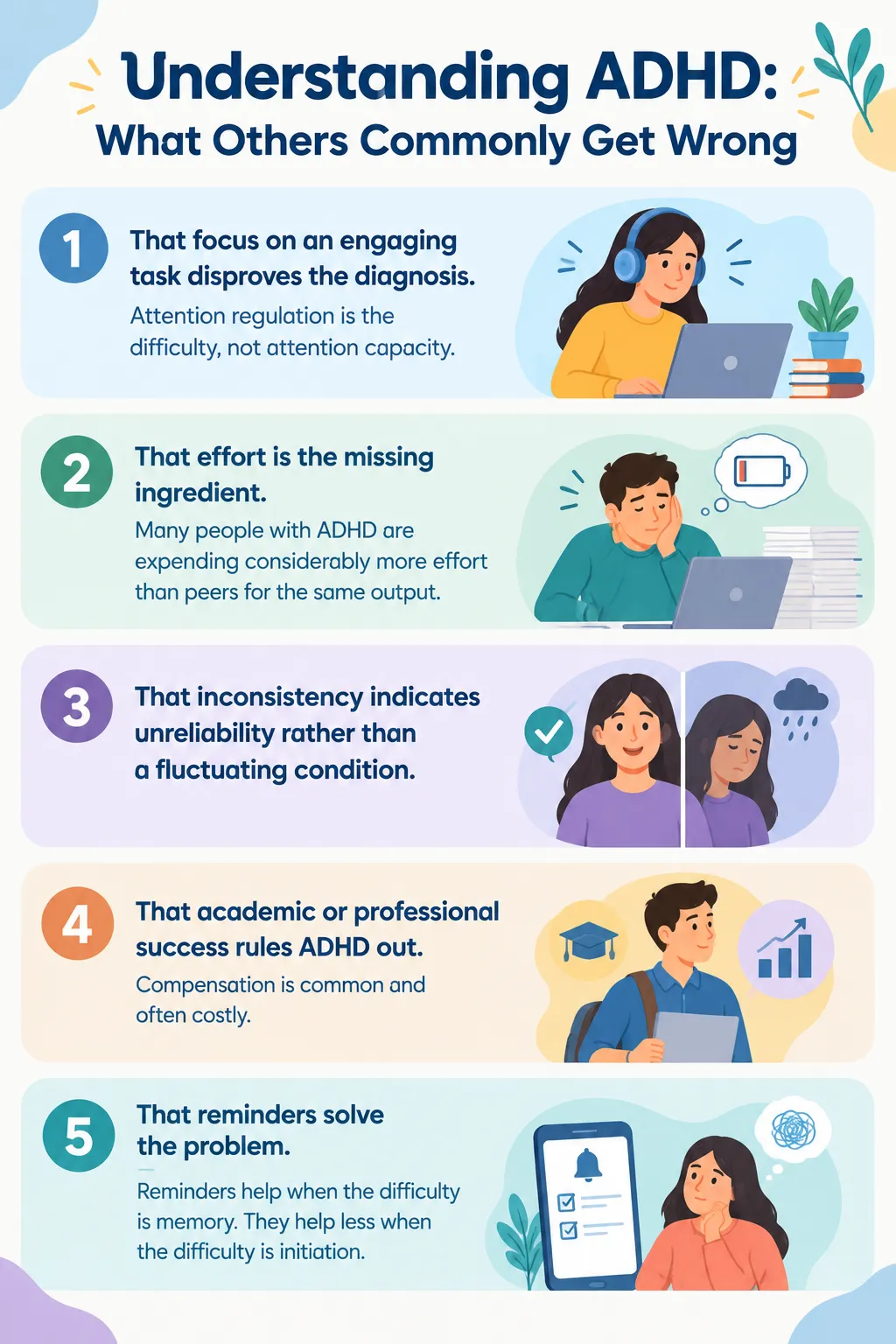
- That focus on an engaging task disproves the diagnosis. Attention regulation is the difficulty, not attention capacity.
- That effort is the missing ingredient. Many people with ADHD are expending considerably more effort than peers for the same output.
- That inconsistency indicates unreliability rather than a fluctuating condition.
- That academic or professional success rules ADHD out. Compensation is common and often costly.
- That reminders solve the problem. Reminders help when the difficulty is memory. They help less when the difficulty is initiation.
When These Experiences Are Not ADHD
Everything described on this page can occur without ADHD, which is why assessment matters more than recognition. Several conditions and circumstances produce overlapping experiences.
- Anxiety can impair concentration, produce restlessness, and make task initiation difficult.
- Depression commonly affects motivation, memory and the ability to start things.
- Sleep disorders and chronic sleep restriction affect attention, emotional regulation and time management.
- Chronic stress, burnout and periods of high demand produce many of the same difficulties temporarily.
- Trauma can affect concentration, emotional regulation and sense of time.
- Autism shares several features with ADHD, and the two frequently occur together.
The distinguishing questions are whether the pattern has been present since childhood, whether it appears across more than one setting, and whether it is disproportionate to circumstances. Those are clinical judgements rather than something a description can settle.
The Other Side of the Experience
Descriptions of ADHD focused only on difficulty give an incomplete picture. Many people also describe genuine strengths: intense focus on work that engages them, lateral thinking, comfort with situations others find chaotic, and a capacity for rapid problem-solving under pressure.
These accounts are commonly reported rather than formally established, and they do not offset the difficulties or make assessment unnecessary. Both things are usually true at once. Our guide to ADHD strengths and benefits covers this in more detail.
If You Recognise Yourself in This
How you know you have ADHD is not something this page can answer, and neither can any article. Recognising your experience in a description is a reasonable reason to seek assessment. It is not a diagnosis, and it cannot be, because several other conditions produce overlapping experiences.
Anxiety, depression, sleep difficulties, trauma and autism can all affect attention, motivation and emotional regulation. Distinguishing between them, and identifying where more than one applies, is what clinical assessment is for. Our guide to ADHD symptoms covers what is actually assessed.
What to Do Next
For most people in Australia, the first step is a conversation with a GP, who can discuss referral pathways for assessment. It helps to arrive with specifics: examples from childhood, school reports if you have them, and a clear account of what is currently not working rather than a list of traits.
If reading this has raised concerns about your mental health rather than about ADHD specifically, that is also worth raising with a GP. Attention and motivation difficulties are common features of several treatable conditions.
Related Guides
- What Is ADHD? Meaning, definition and full form
- ADHD symptoms in adults: the complete Australian guide
- Types, presentations and severity levels of ADHD
- Inattentive ADHD (formerly known as ADD)
References
- Australian ADHD Professionals Association. Australian Evidence-Based Clinical Practice Guideline for Attention Deficit Hyperactivity Disorder (ADHD). Released October 2022. adhdguideline.aadpa.com.au
- American Psychiatric Association. Diagnostic and Statistical Manual of Mental Disorders, Fifth Edition, Text Revision (DSM-5-TR). 2022.
- World Health Organization. International Classification of Diseases, 11th Revision (ICD-11). 6A05 Attention deficit hyperactivity disorder.
- National Institute for Health and Care Excellence (NICE). Attention deficit hyperactivity disorder: diagnosis and management. NG87.
Last review: September 2026. Next scheduled review: September 2027. This article is general information and is not a substitute for individual medical advice, assessment or diagnosis.