

What Causes ADHD?
There is no single cause of ADHD. ADHD is genetic to a substantial degree: twin studies produce heritability estimates of roughly 70 to 80 percent, with a mean of about 74 percent across studies (Faraone and Larsson, 2019). Some early-life environmental factors, including very premature birth and low birth weight, are associated with increased likelihood. ADHD is not caused by sugar, screen time or parenting.
This question usually arrives with something underneath it. Parents want to know whether they caused it. Adults newly assessed want to know where it came from. Both deserve a straight answer, and the straight answer is that ADHD has a substantial genetic contribution, with heritability estimates among the highest reported for psychiatric conditions, and that nothing a parent did or did not do created it.
This guide covers the possible causes for ADHD: what the genetic research actually shows, which environmental factors are genuinely associated, what is not supported by evidence, and why the word cause fits this condition awkwardly.
Is ADHD a Genetic Disease?
ADHD is highly heritable, but calling it a genetic disease is not quite right. A genetic disease usually means a condition caused by a specific identifiable genetic fault. ADHD does not work that way. There is no single ADHD gene, and no genetic test can diagnose it.
What the research shows is that genetic variation accounts for a large share of why ADHD occurs in some people and not others. Twin studies consistently produce heritability estimates in the range of 70 to 80 percent, with a mean of approximately 74 percent across studies using symptom count measures, and estimates of 77 to 88 percent in studies using categorical diagnoses (Faraone and Larsson, 2019).
Australia’s clinical guideline describes ADHD as having a strong genetic contribution alongside environmental and developmental factors (Australian ADHD Professionals Association, 2022).
What Heritability Actually Means
This is where the number gets misread more often than any other statistic in ADHD.
Heritability is a population measure, not a personal one
A heritability estimate of 74 percent does not mean 74 percent of your ADHD came from your genes. It means that, across a studied population, roughly that proportion of the variation between people is attributable to genetic differences. It says nothing definitive about any individual.
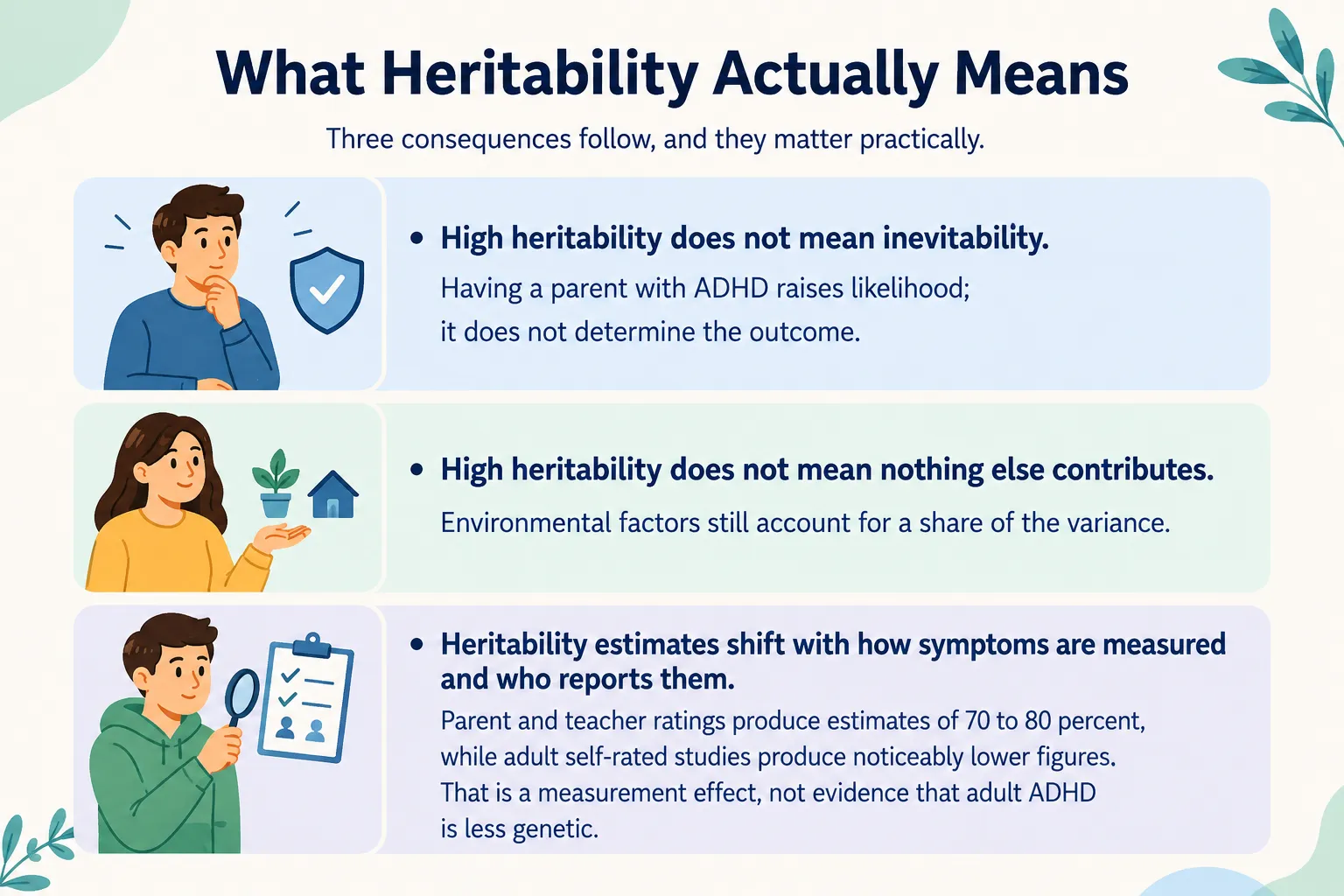
Three consequences follow, and they matter practically.
- High heritability does not mean inevitability. Having a parent with ADHD raises likelihood; it does not determine the outcome.
- High heritability does not mean nothing else contributes. Environmental factors still account for a share of the variance.
- Heritability estimates shift with how symptoms are measured and who reports them. Parent and teacher ratings produce estimates of 70 to 80 percent, while adult self-rated studies produce noticeably lower figures. That is a measurement effect, not evidence that adult ADHD is less genetic.
How ADHD Runs in Families
Familial aggregation is strong. First-degree relatives of a person with ADHD have an estimated five to ten fold increased relative risk compared with the general population (Faraone and Larsson, Molecular Psychiatry, 2019).
In practice this is why it is common for a parent to recognise their own pattern during a child’s assessment, and why clinicians ask about family history. Two things are worth saying about that experience. First, recognising yourself in your child’s assessment is not a coincidence and not a projection. Second, it is one of the more common routes to adult diagnosis in Australia, and it is especially common among mothers, since ADHD in women and girls is more often missed in childhood.
Which Genes Are Involved?
No single one. There is no one ADHD gene. ADHD is polygenic, meaning many ADHD genes each contribute a very small amount rather than one variant causing the condition.
Genome-wide association studies have identified genetic loci associated with ADHD at statistical significance, but the proportion of heritability explained by common variants identified so far is far smaller than the total heritability estimated from twin studies. In one large analysis, common variant heritability was around 22 percent (Demontis et al., 2019), against twin estimates of 70 to 80 percent. The gap between those figures is an active research question.
Why there is no genetic test for ADHD
Because the genetic contribution is spread across many variants of small effect, no genetic or blood test can diagnose ADHD or predict it. Diagnosis remains clinical. Any service offering to diagnose ADHD from a genetic test is not following standard practice.
Brain Development
Differences have been observed in the development and function of brain networks involved in attention, inhibition and executive function. These are differences in group averages from research studies, not something that can be identified in an individual through scanning, and routine brain imaging is not used to establish an ADHD diagnosis.
Our guide to the ADHD brain covers the neuroscience, including dopamine signalling and what brain imaging research has and has not shown, in more depth.
Environmental Factors Associated With ADHD
Genetic factors do not explain all of the variation in ADHD. Research also identifies environmental and developmental factors associated with ADHD risk. Most of what has been identified sits in the prenatal and perinatal period rather than in childhood upbringing.
| Factor | What the evidence indicates |
| Very premature birth | Associated with increased likelihood of ADHD |
| Low birth weight | Associated with increased likelihood |
| Prenatal exposures | Some prenatal exposures have been associated with increased risk in research, though findings vary between studies |
| Early-life adversity | Associated in some studies, though disentangling this from shared genetic factors is difficult |
Two cautions apply to everything in that table. These are associations observed across populations, not causes in any individual case. And association studies in this area struggle to separate environmental effects from shared genetics, because parents pass on both genes and environments.
What Does Not Cause ADHD
Several explanations circulate widely and are not supported.
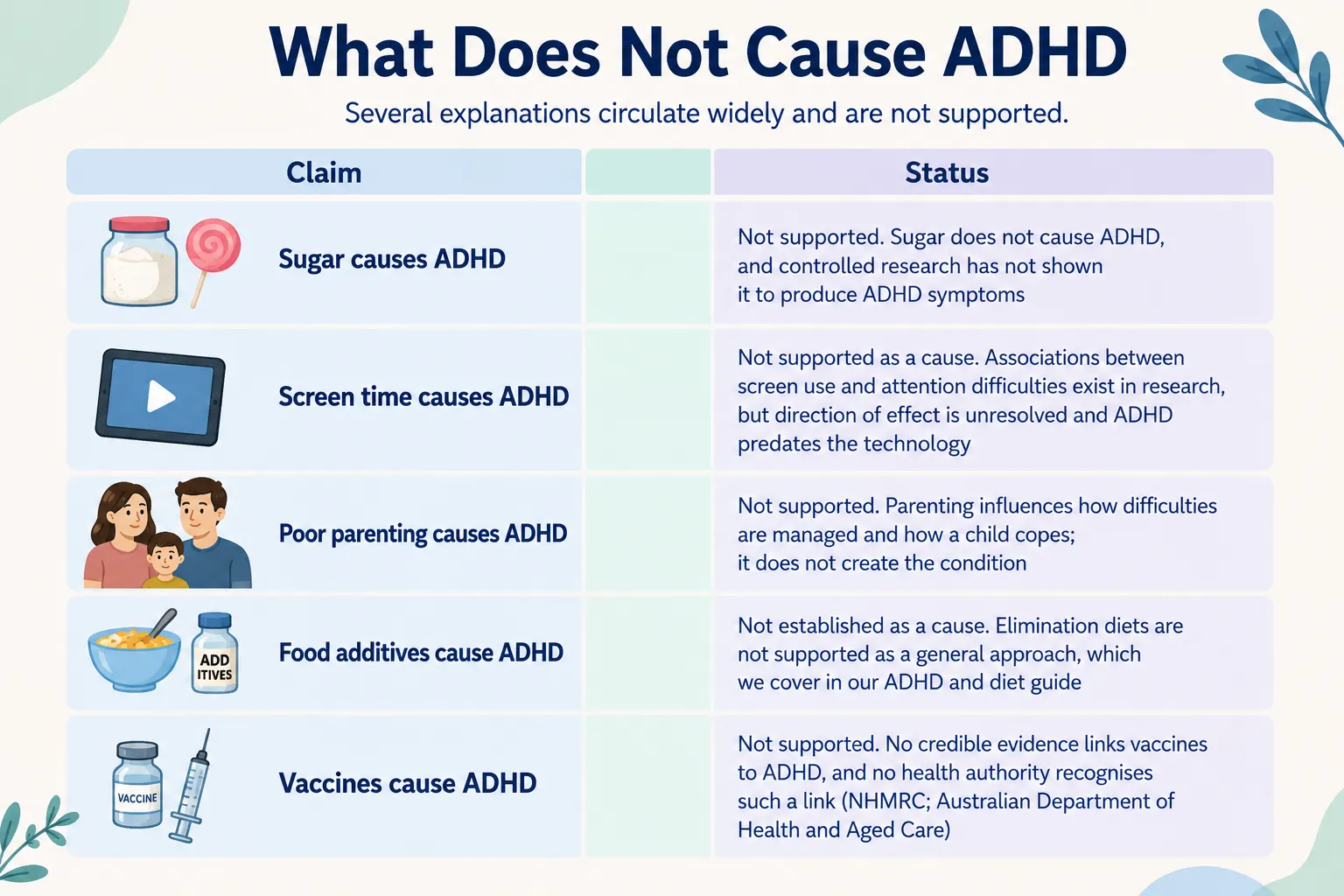
| Claim | Status |
| Sugar causes ADHD | Not supported. Sugar does not cause ADHD, and controlled research has not shown it to produce ADHD symptoms |
| Screen time causes ADHD | Not supported as a cause. Associations between screen use and attention difficulties exist in research, but direction of effect is unresolved and ADHD predates the technology |
| Poor parenting causes ADHD | Not supported. Parenting influences how difficulties are managed and how a child copes; it does not create the condition |
| Food additives cause ADHD | Not established as a cause. Elimination diets are not supported as a general approach, which we cover in our ADHD and diet guide |
| Vaccines cause ADHD | Not supported. No credible evidence links vaccines to ADHD, and no health authority recognises such a link (NHMRC; Australian Department of Health and Aged Care) |
It is worth being direct about why this section exists. Parents are frequently told, implicitly or explicitly, that their child’s ADHD reflects something they did. That belief delays assessment and adds guilt to a situation that does not need it.
Are You Born With ADHD?
ADHD has its origins in childhood neurodevelopment, with genetic and developmental influences present early in life. This is why diagnostic criteria require several symptoms to have been present before age 12 (Australian ADHD Professionals Association, 2022).
What that does not mean is that ADHD is visible from birth. It becomes apparent as demands increase: structured learning, sustained attention, organisation, self-management. Our guide to ADHD symptoms covers how that presents at different ages. This is why many people are identified at school entry, at secondary school, at university, or at the point where adult responsibilities exceed what compensation can absorb.
Can You Develop ADHD Later in Life?
No. ADHD cannot develop later in life under current diagnostic criteria, because ADHD begins in childhood by definition. What genuinely happens, and happens often, is that it goes unrecognised until adulthood.
If attention and organisation difficulties genuinely started in adulthood with no childhood history, that warrants assessment for a different reason. Anxiety, depression, sleep disorders, thyroid conditions, perimenopause and the effects of stress can all produce attention difficulties, and distinguishing between them is what clinical assessment is for.
Why Cause Is the Wrong Frame
The question what causes ADHD assumes a single mechanism with a clean answer. The research on causes of ADHD points somewhere different: many genetic variants of small effect, interacting with early developmental factors, producing differences in how attention and executive function develop. Asking what is the cause of ADHD in a single sentence will always oversimplify it.
A more useful question, particularly for parents, is what influences how much ADHD affects someone. That question has actionable answers: recognition, support, environment, adjustments, sleep, and treatment of co-occurring conditions. The cause is not something anyone chose or can change. What happens next is.
Related Guides
- Types, presentations and severity levels of ADHD
- ADHD symptoms in children: a parent’s guide
- ADHD, IQ, intelligence and giftedness
- Do I have ADHD? Making sense of your own symptoms
References
- Faraone SV, Larsson H. Genetics of attention deficit hyperactivity disorder. Molecular Psychiatry. 2019;24:562–575. doi:10.1038/s41380-018-0070-0
- Demontis D, et al. Discovery of the first genome-wide significant risk loci for attention deficit/hyperactivity disorder. Nature Genetics. 2019;51:63–75.
- Australian ADHD Professionals Association. Australian Evidence-Based Clinical Practice Guideline for Attention Deficit Hyperactivity Disorder (ADHD). Released October 2022. adhdguideline.aadpa.com.au
- American Psychiatric Association. Diagnostic and Statistical Manual of Mental Disorders, Fifth Edition, Text Revision (DSM-5-TR). 2022.
- National Institute for Health and Care Excellence (NICE). Attention deficit hyperactivity disorder: diagnosis and management. NG87.
Last review: September 2026. Next scheduled review: September 2027. This article is general information and is not a substitute for individual medical advice, assessment or diagnosis.