

What Is ADHD?
ADHD, or attention deficit hyperactivity disorder, is a neurodevelopmental condition affecting how the brain regulates attention, impulse control and activity. Diagnostic criteria require several symptoms to have been present before age 12, and functional difficulties persist into adulthood for many people. More than 800,000 Australians are estimated to live with it, and Australia has had its own NHMRC-approved clinical guideline since 2022.
ADHD is one of the most researched conditions in mental health and one of the most misunderstood in public conversation. It is simultaneously over-simplified in social media clips and under-recognised in clinics, which leaves a lot of people stuck between suspecting something and knowing what to do about it.
This guide is the starting point for the rest of our ADHD content. It covers what the condition is, how it shows up at different ages and in different people, how assessment works in Australia specifically, what support involves, and where the Australian system currently makes things harder than they should be. Each section links to a deeper guide.
What ADHD Actually Is
Short answer: ADHD is a neurodevelopmental condition characterised by persistent patterns of inattention and/or hyperactivity-impulsivity that begin in childhood and affect functioning across more than one setting (Australian ADHD Professionals Association, 2022). Neurodevelopmental means it relates to how the brain develops rather than to an illness arriving at a point in time. Diagnostic criteria require several symptoms to have been present before age 12, although the condition may not be recognised or formally diagnosed until much later.
The name is a poor fit for the condition it describes. The difficulty is not a shortage of attention but trouble regulating where attention goes and how long it stays there. This is why the same person can lose the thread of a two-minute conversation and then work uninterrupted for hours on something genuinely engaging. Clinicians sometimes describe it as a difficulty with executive function: the set of mental processes handling planning, prioritising, starting tasks, holding information in mind and regulating impulses.
Our full definition guide covers the terminology, the diagnostic wording and where the older term ADD fits.
The Three Presentations
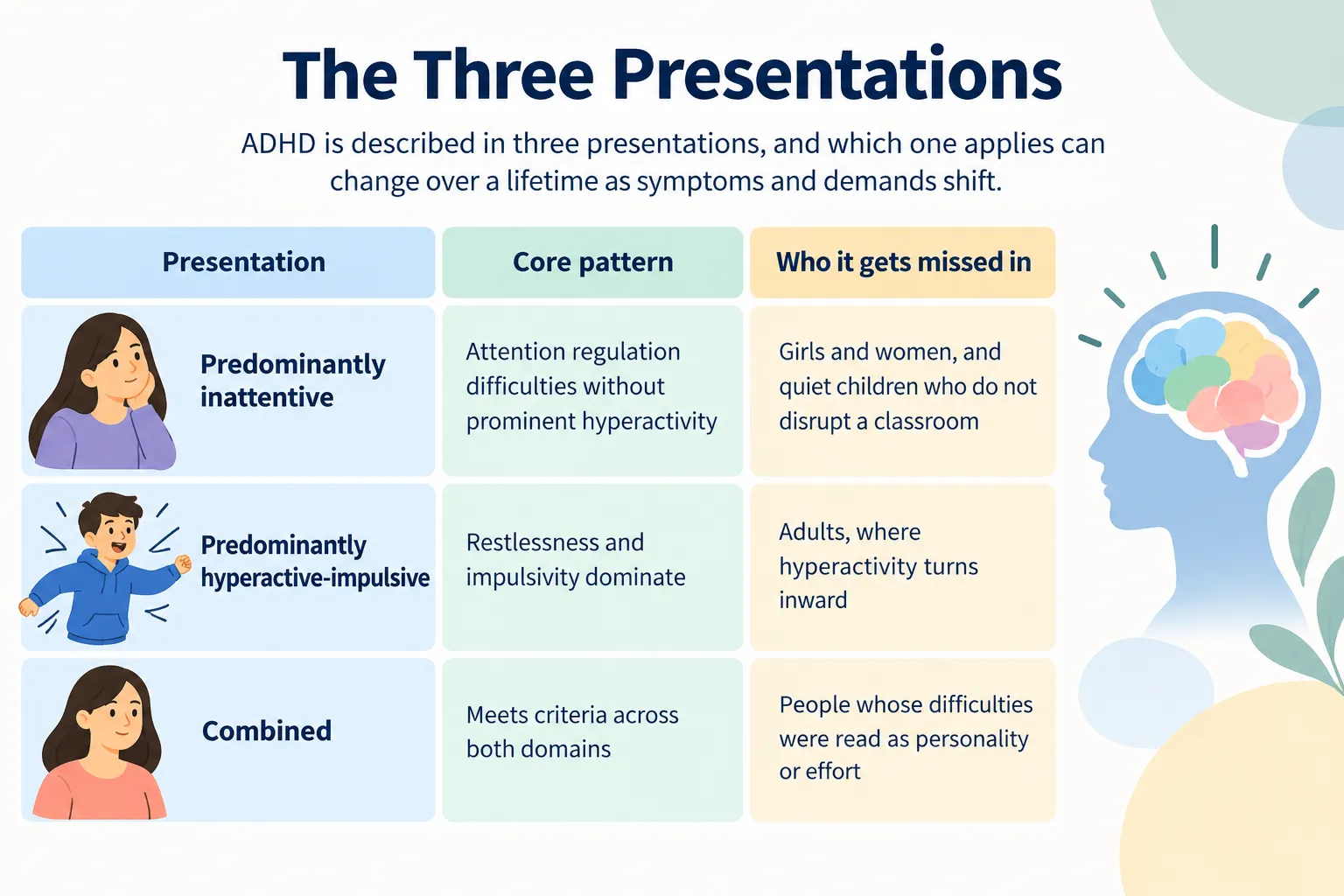
ADHD is described in three presentations, and which one applies can change over a lifetime as symptoms and demands shift.
| Presentation | Core pattern | Who it gets missed in |
| Predominantly inattentive | Attention regulation difficulties without prominent hyperactivity | Girls and women, and quiet children who do not disrupt a classroom |
| Predominantly hyperactive-impulsive | Restlessness and impulsivity dominate | Adults, where hyperactivity turns inward |
| Combined | Meets criteria across both domains | People whose difficulties were read as personality or effort |
Our types and presentations guide covers severity levels and how presentations shift with age.
ADHD Symptoms Across Two Domains
Diagnostic criteria group symptoms into inattention and hyperactivity-impulsivity. What follows is a summary; the full symptom picture, including how presentations differ between adults and children, is covered in our symptoms guide.
Inattention
- difficulty sustaining attention on tasks that are not intrinsically engaging
- starting things and drifting before completion
- disorganisation of time, work and belongings
- avoidance of tasks requiring sustained mental effort
- losing items and forgetting routine commitments
Hyperactivity and impulsivity
- restlessness, fidgeting, or difficulty remaining seated
- an internal sense of being driven, common in adults
- talking a great deal, interrupting, or answering before questions finish
- difficulty waiting, whether in queues or in decisions
Two things that matter clinically are frequently left out of symptom lists. Emotional regulation difficulties, including rapid frustration and intense responses to setbacks, are commonly reported in ADHD although they are not part of the formal diagnostic criteria. Hyperfocus, where attention locks onto something absorbing to the exclusion of everything else, is also widely reported by people with ADHD but is not itself a diagnostic criterion. Neither contradicts the diagnosis.
Executive Function: What Is Actually Affected
Many of the day-to-day difficulties associated with ADHD involve executive functions. These are the mental processes that sit above individual tasks and decide what gets done, when, and in what order. They are not a measure of intelligence or effort, and they can be significantly out of step with both.
- Task initiation: knowing exactly what to do, wanting to do it, and still being unable to start.
- Working memory: holding several pieces of information in mind at once, which is why instructions with four steps often lose the last two.
- Prioritisation: difficulty distinguishing what matters most, so everything can feel equally urgent or equally optional.
- Time perception: time tends to be experienced as now and not now, which makes planning across weeks genuinely hard.
- Emotional regulation: reactions arrive fast and at full volume, then often pass just as quickly.
- Self-monitoring: noticing in the moment that attention has drifted, rather than twenty minutes later.
This distinction matters clinically and personally. Difficulty initiating a task is not the same as lacking capability or motivation, and separating the two is often one of the more useful outcomes of an assessment.
ADHD at Work and in Study
Adult ADHD tends to become visible when external structure disappears. School and early jobs supply deadlines, supervision and timetables. Senior roles, self-employment, university and parenting all remove that scaffolding and hand the person responsibility for building it themselves, which is exactly the part that ADHD makes hardest.
Common pressure points include open-ended projects with distant deadlines, roles requiring sustained administrative follow-through, environments with constant interruption, and jobs where the interesting work and the necessary work are different things.
Adjustments that people commonly find useful include written rather than verbal instructions, breaking long projects into externally visible checkpoints, noise-reducing arrangements or flexible location, and agreeing on how progress is checked rather than relying on self-report. Under Australian disability discrimination law, reasonable adjustments can apply where ADHD substantially affects everyday functioning, and many people never ask because they assume they would not qualify.
Supporting Someone With ADHD
If you are reading this for a partner, a child or a colleague, a few things are worth knowing.
- Reminders framed as accountability tend to land better than reminders framed as correction. The difference is usually tone rather than content.
- Systems outperform willpower. Shared calendars, visible lists and agreed checkpoints move the load off memory, which is where the difficulty actually sits.
- Emotional intensity is often part of the condition rather than a reaction to you. It also passes faster than it appears it will.
- Interest-driven attention is real. Being able to focus intensely on something absorbing is not evidence that the difficulty elsewhere is chosen.
- For parents, the evidence supports structured behavioural approaches and consistent routines. Punitive approaches to symptoms that are neurological in origin tend to damage the relationship without changing the behaviour.
How Common Is ADHD in Australia?
- More than 800,000 Australians are estimated to live with ADHD, the figure used in the development of Australia’s clinical guideline (Australian ADHD Professionals Association, 2022; May et al., ANZJP, 2023).
- In Australia’s 2013 to 2014 Young Minds Matter survey, ADHD was the most commonly reported disorder among children aged 4 to 11, at 8.2 percent (Australian Institute of Health and Welfare). This is historical survey data rather than a current prevalence estimate.
- Persistence into adulthood is reported in roughly 60 to 86 percent of individuals diagnosed as children (May et al., Australian and New Zealand Journal of Psychiatry, 2023).
- Adult diagnosis rates in Australia have risen over the past decade, with considerable variation between regions.
The rise in adult diagnoses is the point most often argued about. Possible explanations include improved recognition of presentations that were routinely missed under older diagnostic habits, particularly in girls and in quieter children, alongside changes in clinical practice, public awareness and access to assessment. Diagnosis rates alone cannot establish a change in underlying prevalence. Regional differences in diagnosis rates may partly reflect differences in access to assessment and specialist services.
What Causes ADHD
There is no single cause, and none of the causes commonly cited in public conversation hold up. Sugar, screen time and parenting style do not cause ADHD.
Genetics account for the largest share of risk. Family, twin and adoption studies consistently show high heritability, which is why it is common for a parent to recognise their own pattern during a child’s assessment. Early-life factors associated with increased likelihood include very premature birth and low birth weight. These are associations across populations rather than causes in any individual case.
ADHD Across the Lifespan
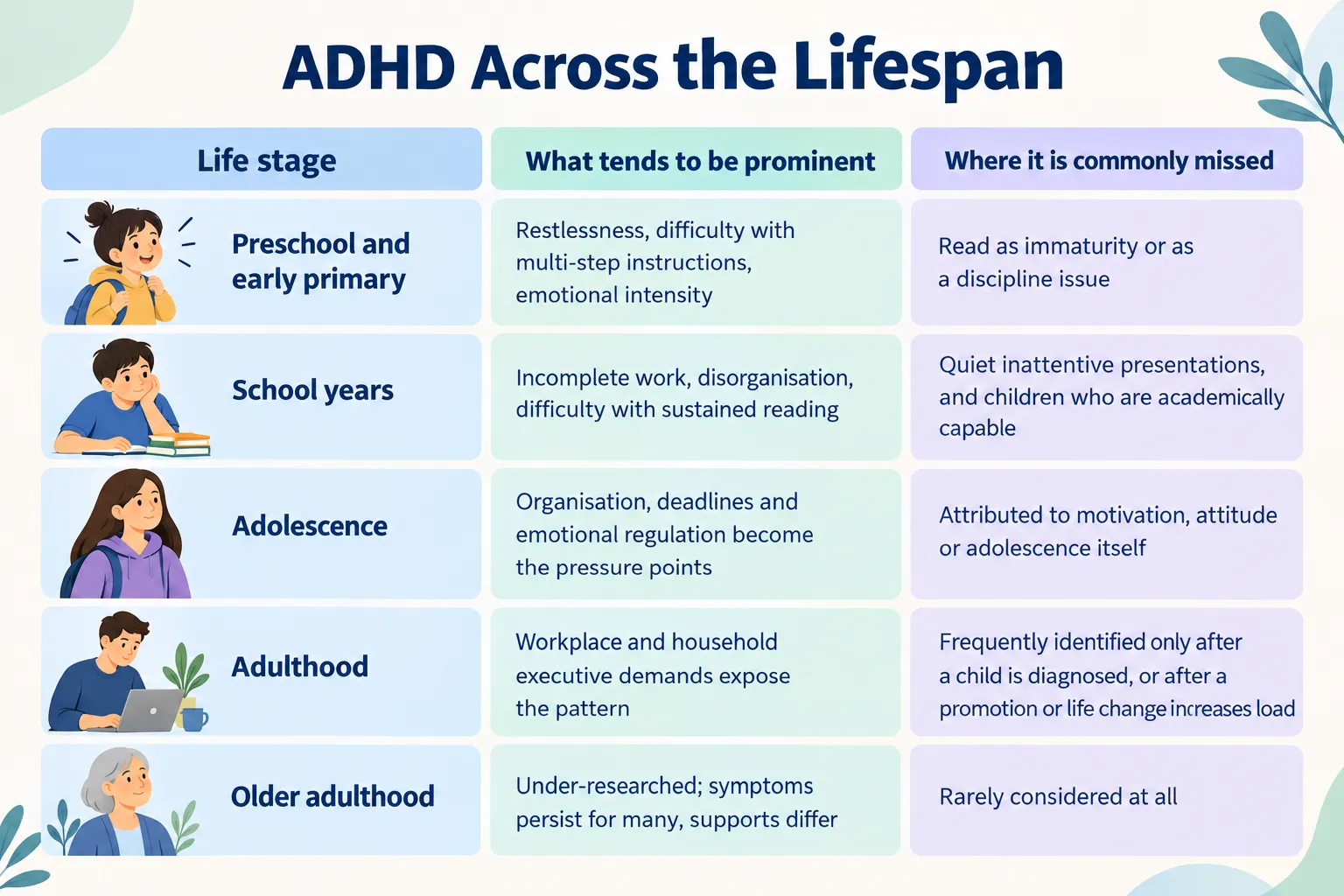
| Life stage | What tends to be prominent | Where it is commonly missed |
| Preschool and early primary | Restlessness, difficulty with multi-step instructions, emotional intensity | Read as immaturity or as a discipline issue |
| School years | Incomplete work, disorganisation, difficulty with sustained reading | Quiet inattentive presentations, and children who are academically capable |
| Adolescence | Organisation, deadlines and emotional regulation become the pressure points | Attributed to motivation, attitude or adolescence itself |
| Adulthood | Workplace and household executive demands expose the pattern | Frequently identified only after a child is diagnosed, or after a promotion or life change increases load |
| Older adulthood | Under-researched; symptoms persist for many, supports differ | Rarely considered at all |
We cover the adult picture and the childhood picture in dedicated guides, because what is useful at 8 and what is useful at 38 are genuinely different.
Why ADHD Presents Differently in Women and Girls
This is one of the clearest gaps in how ADHD has historically been identified. Diagnostic criteria were developed largely from research samples of hyperactive boys, and the inattentive presentation more commonly seen in girls produces far less classroom disruption. A quiet child who is not finishing work rarely triggers a referral in the way a disruptive one does. Australia’s clinical guideline specifically notes that girls and women are at risk of under-recognition (Australian ADHD Professionals Association, 2022).
Many women are identified only in adulthood, often after a child’s assessment or during a period when existing coping strategies stop being sufficient. Hormonal fluctuation across the menstrual cycle and through perimenopause has been reported to affect symptom intensity for some women, although this remains an area where the research base is limited. See our guide to ADHD symptoms in women
Conditions That Commonly Occur Alongside ADHD
ADHD rarely arrives alone, and untangling what is what is a core part of assessment.
| Condition | Why it matters |
| Autism | Substantial overlap, and both can be diagnosed together. Shared traits make careful assessment essential. |
| Anxiety | Common, and can either mask ADHD or be produced by years of coping with undiagnosed difficulties. |
| Depression | Frequently follows long periods of unexplained underperformance and self-blame. |
| Sleep difficulties | Common in both directions. Poor sleep also mimics inattention, which complicates assessment. |
| Specific learning disorders | Dyslexia and dyscalculia co-occur often enough that assessment should consider them. |
This is also why self-diagnosis is unreliable. Several of these conditions produce overlapping symptoms, and distinguishing them is precisely what a clinical assessment is for.
How ADHD Is Diagnosed in Australia
There is no blood test, brain scan or single questionnaire that diagnoses ADHD. Diagnosis is clinical, built from several sources of information by a qualified practitioner.
- A detailed developmental and personal history, reaching back to childhood, since onset before age 12 is part of the criteria.
- Standardised rating scales completed by the person, and often by a partner, parent or someone who has known them a long time.
- Evidence that difficulties appear in more than one setting rather than in a single stressful environment.
- Careful consideration of alternative and co-occurring explanations, including anxiety, depression, sleep disorders, trauma and autism.
- An assessment of functional impact, because noticeable traits and impairing traits are not the same thing.
Australia has had its own NHMRC-approved clinical practice guideline for ADHD since 2022, developed by the Australasian ADHD Professionals Association. It sets out best-practice assessment and support across the lifespan and is the reference point Australian clinicians work from.
On online ADHD tests
Screeners are useful for one thing: deciding whether to pursue a proper assessment. A high score is a prompt, not a result. No online test can account for the alternative explanations that a clinician is specifically trained to rule out.
What Support for ADHD Involves
Support is described as multimodal, which simply means it combines several approaches rather than relying on one. What is appropriate depends on age, presentation, co-occurring conditions and what is actually getting in the way day to day.
- Psychoeducation, so the person understands their own pattern. This is consistently one of the highest-value early steps and is frequently underrated.
- Environmental and behavioural strategies: externalising memory, reducing decision load, restructuring how tasks are started rather than relying on willpower.
- Workplace and educational adjustments, which are often available and often not requested.
- Psychological therapy with an ADHD-informed focus, particularly where anxiety, depression or long-standing self-criticism have developed alongside.
- Identification and management of co-occurring conditions. Sleep difficulties in particular can worsen attention and daytime functioning, so they should be identified and addressed as part of a broader assessment.
- Attention to sleep, physical activity and routine, which support function without being a treatment in themselves.
Medical treatment options exist and are a matter for a person and their treating clinician. This guide does not cover medicines, and nothing here should be read as treatment advice.
Where the Australian System Falls Short
Being honest about this is more useful than pretending the pathway is smooth.
Access is uneven. The number of psychiatrists and paediatricians per head of population is limited, and it is distributed unevenly across the country, which means where you live materially affects how long you wait. Australian reporting has described adult assessment waits commonly running many months, and in some cases beyond a year.
Cost is a real barrier. Assessment is a significant out-of-pocket expense for many people, and the figures quoted publicly vary widely between providers and states. Rural and remote access is worse again, which is the clearest argument for telehealth models in this area.
The regulatory picture is also changing. Several states have been expanding the role general practitioners can play in ADHD care, and the arrangements differ by state and are still being rolled out. Anyone told a blanket rule about what GPs can and cannot do should check the position in their own state, because it has been moving.
Living With ADHD
Two things tend to help more than any specific technique. The first is building systems that do not depend on remembering: written externally, visible, and set up so the default outcome is the right one. The second is reducing the number of decisions a day requires, because decision load is where a lot of ADHD difficulty actually bites.
Diet is a common question and gets its own guide. The short version is that elimination diets are not supported as a general approach, while adequate sleep, regular eating and attention to caffeine intake are reasonable things to look at.
It is also worth saying that many people describe genuine strengths alongside the difficulties: capacity for intense focused work on the right problem, lateral thinking, and performing well under conditions others find chaotic. Both things can be true at once, and neither cancels the other out.
What Changes After a Diagnosis
People often expect a diagnosis to change everything or nothing, and it usually does neither. What it reliably provides is an explanation that fits, which for many adults is the first coherent account they have had of a pattern going back decades.
The immediate effect is usually reinterpretation
A long history of missed deadlines, abandoned projects and unexplained underperformance gets reread. This is genuinely useful, and it is also frequently accompanied by grief about the years spent without an explanation. Both reactions are common and neither is a sign the diagnosis is wrong.
The practical effect depends on what you do next
A diagnosis opens access to supports, adjustments and treatment discussions that were not available before. It does not by itself change how any given Tuesday goes. The people who get the most from it tend to be the ones who treat it as a starting point for building systems rather than as a conclusion.
Disclosure is a separate decision
Whether to tell an employer, a school or family is a personal choice with real trade-offs. Adjustments usually require some disclosure, though not necessarily full clinical detail. It is reasonable to decide differently in different settings.
ADHD Myths That Get in the Way
Several misconceptions actively delay people from seeking assessment.
- That ADHD is caused by sugar, screens or parenting. It is not. Heritability is high and the evidence for these as causes is absent.
- That doing well at school rules it out. Capability and compensatory effort mask ADHD frequently, particularly in people who are academically strong.
- That you cannot concentrate on anything. Attention regulation is the difficulty, not attention capacity.
- That adults grow out of it. Visible hyperactivity often reduces; executive function difficulties commonly persist.
- That it is a recent invention. Descriptions consistent with ADHD appear in medical literature well over a century old under different names.
- That wanting an assessment means you are looking for an excuse. Assessment exists precisely to distinguish between explanations, which includes ruling ADHD out.
When to Seek an Assessment
Assessment is worth considering when a long-standing pattern is getting in the way rather than simply being recognisable. Practical markers include difficulties that have been present since childhood rather than starting recently, effects across more than one area of life, and a gap between capability and outcomes that has persisted despite genuine effort.
For most people the first step is a conversation with a GP, who can discuss referral pathways. It helps to arrive with specifics: examples from childhood, school reports if you have them, and a clear account of what is currently not working.
Explore the Full ADHD Guide Series
- What Is ADHD? Meaning, definition and full form
- Types, presentations and severity levels of ADHD
- ADHD symptoms in adults: the complete Australian guide
- ADHD symptoms in children: a parent’s guide
References
- Australian ADHD Professionals Association. Australian Evidence-Based Clinical Practice Guideline for ADHD. NHMRC-approved, 2022. adhdguideline.aadpa.com.au
- May T, et al. The Australian evidence-based clinical practice guideline for attention deficit hyperactivity disorder. Australian and New Zealand Journal of Psychiatry. 2023. doi:10.1177/00048674231166329
- American Psychiatric Association. Diagnostic and Statistical Manual of Mental Disorders, Fifth Edition, Text Revision (DSM-5-TR). 2022.
- Australian Institute of Health and Welfare. Australia’s children: children with mental illness. aihw.gov.au
- National Institute for Health and Care Excellence (NICE). Attention deficit hyperactivity disorder: diagnosis and management. NG87.
- University of Wollongong. A 12-month wait and a $1400 bill: ADHD diagnosis in Australia. 2026.
Last review: September 2026. Next scheduled review: September 2027. This article is general information and is not a substitute for individual medical advice, assessment or diagnosis.