

Are People With ADHD Smarter?
No. There is no credible evidence that ADHD is associated with higher intelligence. ADHD occurs across the full range of intellectual ability, including well above average. What is true is that ADHD and giftedness can occur together, a combination described in educational settings as twice-exceptional, and that standard IQ scores can underestimate ability in people with ADHD.
ADHD or high IQ, or both at once? This is one of the more common questions in ADHD content, and the claim that people with ADHD are smarter is flattering enough that it spreads easily. It is also not supported. Answering it properly matters, because the more useful finding sits underneath it: the relationship between ADHD with high IQ and measured intelligence is genuinely complicated, and standard testing can misrepresent what someone is capable of.
Are People With ADHD Smarter?
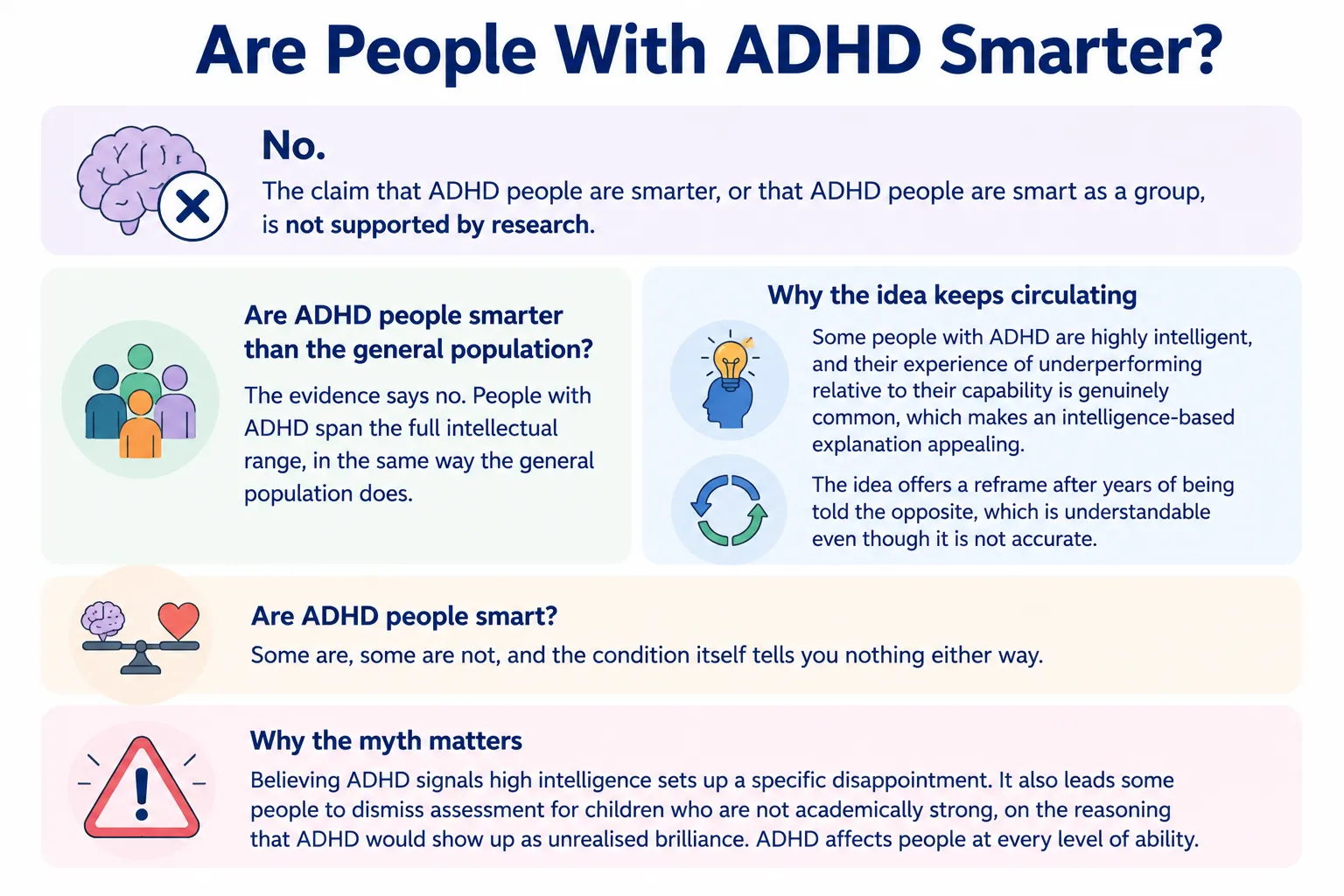
No. The claim that ADHD people are smarter, or that ADHD people are smart as a group, is not supported by research. Are ADHD people smarter than the general population? The evidence says no. People with ADHD span the full intellectual range, in the same way the general population does.
Two things probably keep the idea circulating. Some people with ADHD are highly intelligent, and their experience of underperforming relative to their capability is genuinely common, which makes an intelligence-based explanation appealing. And the idea offers a reframe after years of being told the opposite, which is understandable even though it is not accurate. Are ADHD people smart? Some are, some are not, and the condition itself tells you nothing either way.
Why the myth matters
Believing ADHD signals high intelligence sets up a specific disappointment. It also leads some people to dismiss assessment for children who are not academically strong, on the reasoning that ADHD would show up as unrealised brilliance. ADHD affects people at every level of ability.
What Is the Average IQ of Someone With ADHD?
There is no single ADHD IQ figure, and any source quoting one should be treated carefully. ADHD is not defined by intellectual ability and IQ is not part of the diagnostic criteria.
Some studies have reported slightly lower average measured IQ scores in ADHD groups compared with control groups. That finding is contested, and there is good reason to be cautious about interpreting it as a difference in underlying intelligence. Standard IQ tests require sustained attention, working memory and processing speed to perform well, and those are precisely the areas ADHD affects. A test that partly measures the thing being studied is difficult to interpret cleanly.
Why IQ Scores Can Underestimate Ability in ADHD
This is the part most discussions miss, and it is the most practically useful thing on this page.
Full-Scale IQ, the headline number from tests such as the Wechsler scales, includes working memory and processing speed alongside verbal and reasoning abilities. In ADHD, working memory and processing speed are frequently the weakest indices, which pulls the Full-Scale figure down even where reasoning ability is strong.
For this reason, psychologists may report the General Ability Index alongside or instead of Full-Scale IQ when assessing someone with ADHD. The General Ability Index excludes working memory and processing speed, and it can be substantially higher than the Full-Scale score. Whether it is reported depends on the assessment, the referral question and the clinician’s judgement.
An important caution
The General Ability Index is not a truer measure of intelligence. Working memory and processing speed are real abilities, and difficulty with them has real consequences in study and work. The point is that a single Full-Scale number can conceal a wide gap between reasoning ability and processing efficiency, and that gap is often the most informative part of the result.
IQ Testing Is Not Part of ADHD Diagnosis
Worth stating plainly, because it causes confusion. Cognitive testing is not required to diagnose ADHD, and an IQ score neither confirms nor excludes it. Diagnosis is clinical: developmental history, symptom assessment across settings, functional impairment and consideration of alternative explanations.
Cognitive assessment is sometimes included for a different reason, usually to identify co-occurring learning difficulties, to inform educational planning, or to answer a specific question raised by a school. That is a separate purpose from establishing whether ADHD is present.
Should I ask for the General Ability Index?
If cognitive assessment is being done and you are concerned that a Full-Scale score may understate ability, it is reasonable to ask the assessing psychologist whether index scores and the General Ability Index will be reported and discussed. Interpretation of any cognitive assessment is a matter for the qualified professional who administered it.
ADHD and Giftedness: The Twice-Exceptional Profile
Twice-exceptional, often shortened to 2e, describes someone who is intellectually gifted and also has a neurodevelopmental condition or learning disability. Giftedness and ADHD together, sometimes written as giftedness ADHD or high IQ with ADHD, is one of the most commonly discussed 2e profiles.
Two points are worth being clear about. Twice-exceptional is an educational and psychological construct rather than a clinical diagnosis: you will not find it in DSM-5-TR or ICD-11. And it does not mean twice as gifted or twice as impaired. It describes a profile in which ability and difficulty coexist and frequently obscure each other.
A meta-analysis of twice-exceptional cognitive profiles reported that, among individuals with giftedness and ADHD, processing speed was the index that differed significantly from gifted peers, a narrower difference than was found for giftedness combined with learning disabilities (Atmaca and Baloglu, 2022, as reported in a 2025 systematic review of twice-exceptional characteristics in Frontiers in Education). This is one meta-analysis rather than a settled finding.
Why ADHD Is Missed in Gifted Children
Where gifted and ADHD occur together, the masking works in both directions, which is what makes this profile difficult to identify.
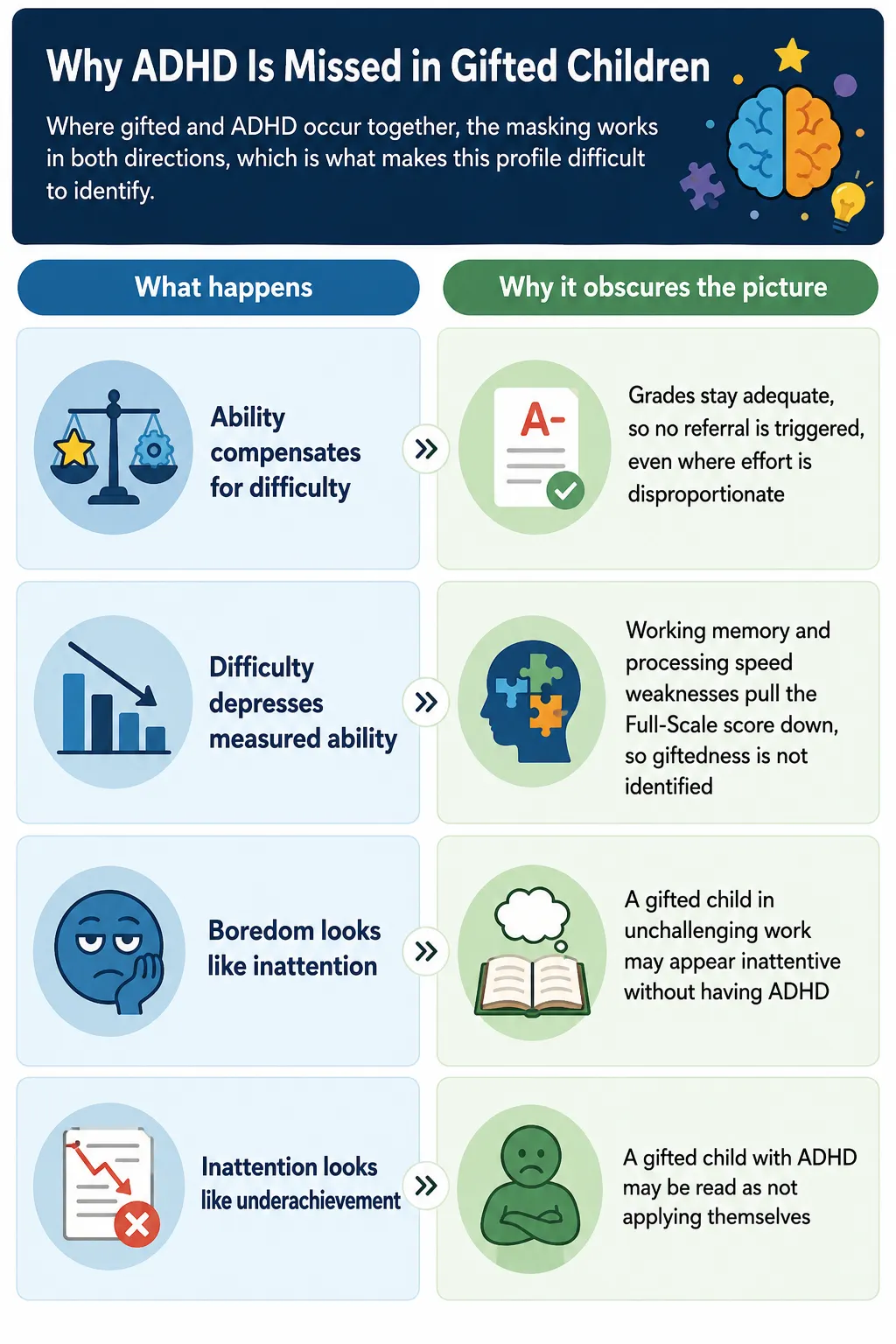
| What happens | Why it obscures the picture |
| Ability compensates for difficulty | Grades stay adequate, so no referral is triggered, even where effort is disproportionate |
| Difficulty depresses measured ability | Working memory and processing speed weaknesses pull the Full-Scale score down, so giftedness is not identified |
| Boredom looks like inattention | A gifted child in unchallenging work may appear inattentive without having ADHD |
| Inattention looks like underachievement | A gifted child with ADHD may be read as not applying themselves |
The practical consequence is that a child can be missed for both. Not identified as gifted because the composite score is unremarkable, and not identified as having ADHD because their results are adequate.
Can Giftedness Be Mistaken for ADHD?
It can. Gifted children in work well below their level may become restless, disengaged or disruptive, and those behaviours overlap with ADHD symptoms. This is one reason assessment considers whether difficulties appear across more than one setting rather than in a single classroom.
That said, the reverse error is more consequential. Assuming a bright child’s difficulties must be boredom rather than ADHD is a common route to a missed diagnosis. Distinguishing between the two is a clinical judgement, and it is exactly what a proper assessment is for.
Related Guides
- What Is ADHD? Meaning, definition and full form
- Is ADHD a disability, a disorder or a difference?
- ADHD symptoms in children: a parent’s guide
- ADHD strengths, benefits and positive traits
- What ADHD feels like: living as a person with ADHD
References
- Atmaca F, Baloglu M. Meta-analysis of cognitive profiles in twice-exceptional students. 2022. Cited here as reported in: Twice-exceptional students: a systematic review to outline the distinctive characteristics through a multidimensional lens. Frontiers in Education, 2025. doi:10.3389/feduc.2025.1696805
- Australian ADHD Professionals Association. Australian Evidence-Based Clinical Practice Guideline for Attention Deficit Hyperactivity Disorder (ADHD). Released October 2022. adhdguideline.aadpa.com.au
- American Psychiatric Association. Diagnostic and Statistical Manual of Mental Disorders, Fifth Edition, Text Revision (DSM-5-TR). 2022.
- National Institute for Health and Care Excellence (NICE). Attention deficit hyperactivity disorder: diagnosis and management. NG87.
Last review: September 2026. Next scheduled review: September 2027. This article is general information and is not a substitute for individual medical advice, assessment or diagnosis.