

Is ADHD Worse Before Your Period?
Many women describe it that way. Small studies and recent reviews suggest that some women with ADHD experience worse inattention, executive difficulty or emotional dysregulation during the luteal phase, the stretch after ovulation and before a period when reproductive hormone levels are changing substantially. PMDD also appears more common in women with ADHD than in women without it. What is not settled is the magnitude or the mechanism: the research base is small, and confident explanations about hormones and dopamine run ahead of the evidence. These are associations, not demonstrated causes, and ADHD is not a hormone deficiency.
PMDD and ADHD is one of the fastest-growing search topics in women’s health, and most of what is written about it sounds more certain than the research does. ADHD and female hormones, and the link between ADHD and PMDD in particular, now carry a great deal of confident explanation that the studies do not support. This guide separates three things that usually get blurred together: what the evidence supports, what PMDD actually is and how it is diagnosed, and what you can do about the pattern before any treatment conversation happens. For how ADHD presents in women more broadly, see the guide to ADHD in women and girls.
What the Evidence Actually Shows
What research shows
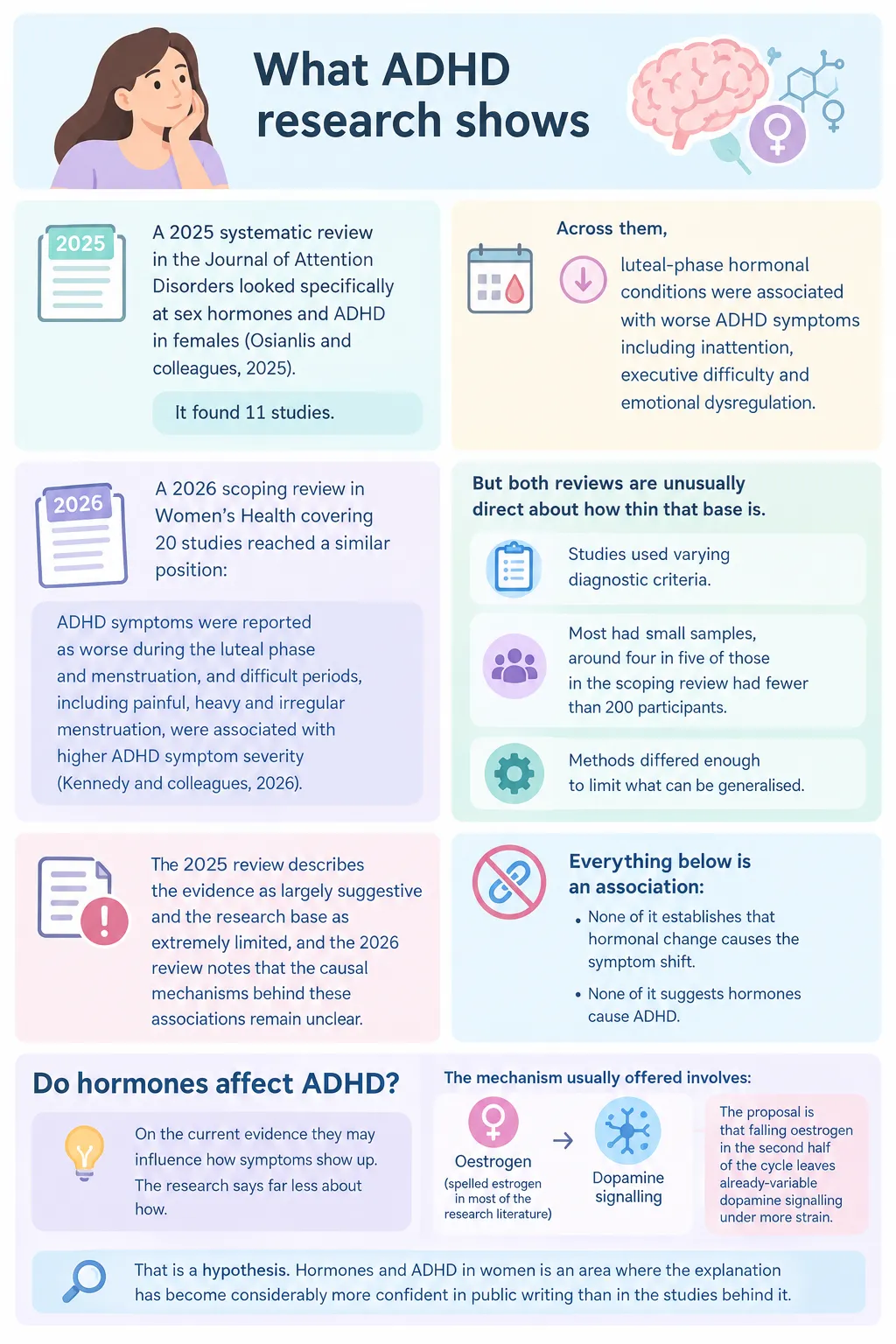
The most useful summary is a 2025 systematic review in the Journal of Attention Disorders that looked specifically at sex hormones and ADHD in females (Osianlis and colleagues, 2025). It found 11 studies. Across them, luteal-phase hormonal conditions were associated with worse ADHD symptoms including inattention, executive difficulty and emotional dysregulation. A 2026 scoping review in Women’s Health covering 20 studies reached a similar position: ADHD symptoms were reported as worse during the luteal phase and menstruation, and difficult periods, including painful, heavy and irregular menstruation, were associated with higher ADHD symptom severity (Kennedy and colleagues, 2026).
Both reviews are unusually direct about how thin that base is. Studies used varying diagnostic criteria, most had small samples, around four in five of those in the scoping review had fewer than 200 participants, and methods differed enough to limit what can be generalised. The 2025 review describes the evidence as largely suggestive and the research base as extremely limited, and the 2026 review notes that the causal mechanisms behind these associations remain unclear. Everything below is an association: none of it establishes that hormonal change causes the symptom shift, and none of it suggests hormones cause ADHD.
Do hormones affect ADHD? On the current evidence they may influence how symptoms show up. The research says far less about how. The mechanism usually offered involves oestrogen, spelled estrogen in most of the research literature, and its role in dopamine signalling. The proposal is that falling oestrogen in the second half of the cycle leaves already-variable dopamine signalling under more strain. That is a hypothesis. Hormones and ADHD in women is an area where the explanation has become considerably more confident in public writing than in the studies behind it.
What women themselves report
An Australian survey of 600 women with ADHD, run through Monash University, asked directly about symptom change across hormonal life stages (Osianlis and colleagues, 2026). Among premenopausal participants not using hormonal therapy, 88.6 per cent reported cyclical symptom change, most often worsening in the luteal phase. Seventy per cent reported worsening postpartum, and 97.5 per cent of those who had reached menopause perceived worsening during it.
The same study found something that deserves equal weight: cross-sectional symptom severity scores were broadly consistent across hormonal phases. The perception of worsening is close to universal; the measured difference was not. That does not mean women are imagining it. It may mean the instruments measure the wrong thing, or that what changes is how much difficulty the same symptom level causes. The gap between experience and measurement here is real and unresolved.
The PMDD finding
The strongest recent finding concerns PMDD specifically. A 2025 cross-sectional survey study in the British Journal of Psychiatry found provisional PMDD in 31.4 per cent of participants with ADHD, compared with 9.8 per cent of those without, a relative risk of about 3.19. Among participants with ADHD and no co-occurring anxiety or depression the figure was 20 per cent, roughly double the comparison group (Broughton and colleagues, 2025).
Two qualifications matter. The study recruited through an online research panel and relied on self-report for both ADHD and premenstrual symptoms, so it does not tell you how common PMDD is among women with clinically diagnosed ADHD in the general population. And provisional PMDD means screening-positive, not diagnosed, which for this condition is a meaningful difference explained further below. An earlier study of 209 women with ADHD aged 18 to 71 reported the same direction of effect for premenstrual and postpartum mood symptoms (Dorani and colleagues, 2021).
What this means in practice
The association is real enough to take seriously and too under-researched to explain confidently. A useful way to hold both:
| Claim you will see | What the evidence supports |
| ADHD symptoms worsen in the luteal phase | Suggested by several small studies and by consistent self-report, but the evidence base remains small and reviews describe it as suggestive rather than established |
| PMDD is more common among women with ADHD | Supported by recent cross-sectional evidence; the clinical prevalence is not established, because the strongest estimate used self-report screening rather than diagnosis |
| Oestrogen explains ADHD symptom change through dopamine | A plausible proposed mechanism rather than a demonstrated explanation |
| Hormonal change causes these symptom shifts | Not established. The research reports associations; causal mechanisms remain unclear |
| ADHD is caused by low levels of a hormone | Not supported. ADHD is not a hormone deficiency and is not diagnosed or monitored by hormone levels |
| Everyone with ADHD has a predictable cycle pattern | Not supported. Patterns differ substantially between individuals, and some women notice no cycle effect at all |
PMDD and ADHD: What the Overlap Actually Is
Is PMDD linked to ADHD? The association looks real, and understanding it depends on being precise about what PMDD is.
Premenstrual dysphoric disorder is a diagnosis in its own right, not a severe version of feeling irritable before a period. It requires at least five symptoms in the final week before menstruation, including at least one of depressed mood, anxiety or tension, marked mood swings, or irritability and anger. Symptoms must begin to improve within a few days of bleeding starting and be minimal or absent in the week after. They must cause significant interference with work, study, relationships or social life, and must be distinguishable from an existing condition simply getting worse.
How common it is depends entirely on how it was measured, and the difference is the clearest argument for taking the diagnostic process seriously. A 2024 systematic review and meta-analysis of 44 studies covering 50,659 participants found a pooled prevalence of 3.2 per cent using confirmed diagnoses based on prospective ratings, against 7.7 per cent using provisional, retrospective diagnoses (Reilly and colleagues, 2024). Restricted to community samples using confirmed diagnosis, the figure was 1.6 per cent, and that estimate had far less variation between studies than the others. Retrospective self-report inflates the number roughly two to five times over. PMS, by contrast, affects roughly a third of women at a level they find bothersome.
PMDD is not the same as ADHD getting worse before a period
This is the distinction that matters most and the one most articles skip entirely. Premenstrual exacerbation of an existing condition is not PMDD. The combinations are all possible and they lead to different conversations:
- ADHD all month, with a premenstrual worsening on top, and no PMDD
- PMDD without ADHD
- Both ADHD and PMDD, which can occur together
- Neither, with the symptoms explained by something else entirely
PMDD requires a cyclical pattern with a low-symptom interval after menstruation. A condition present all month that gets worse premenstrually does not meet that pattern, however severe the bad week is. ADHD vs PMDD, and ADHD and PMS alongside it, is what the table below separates.
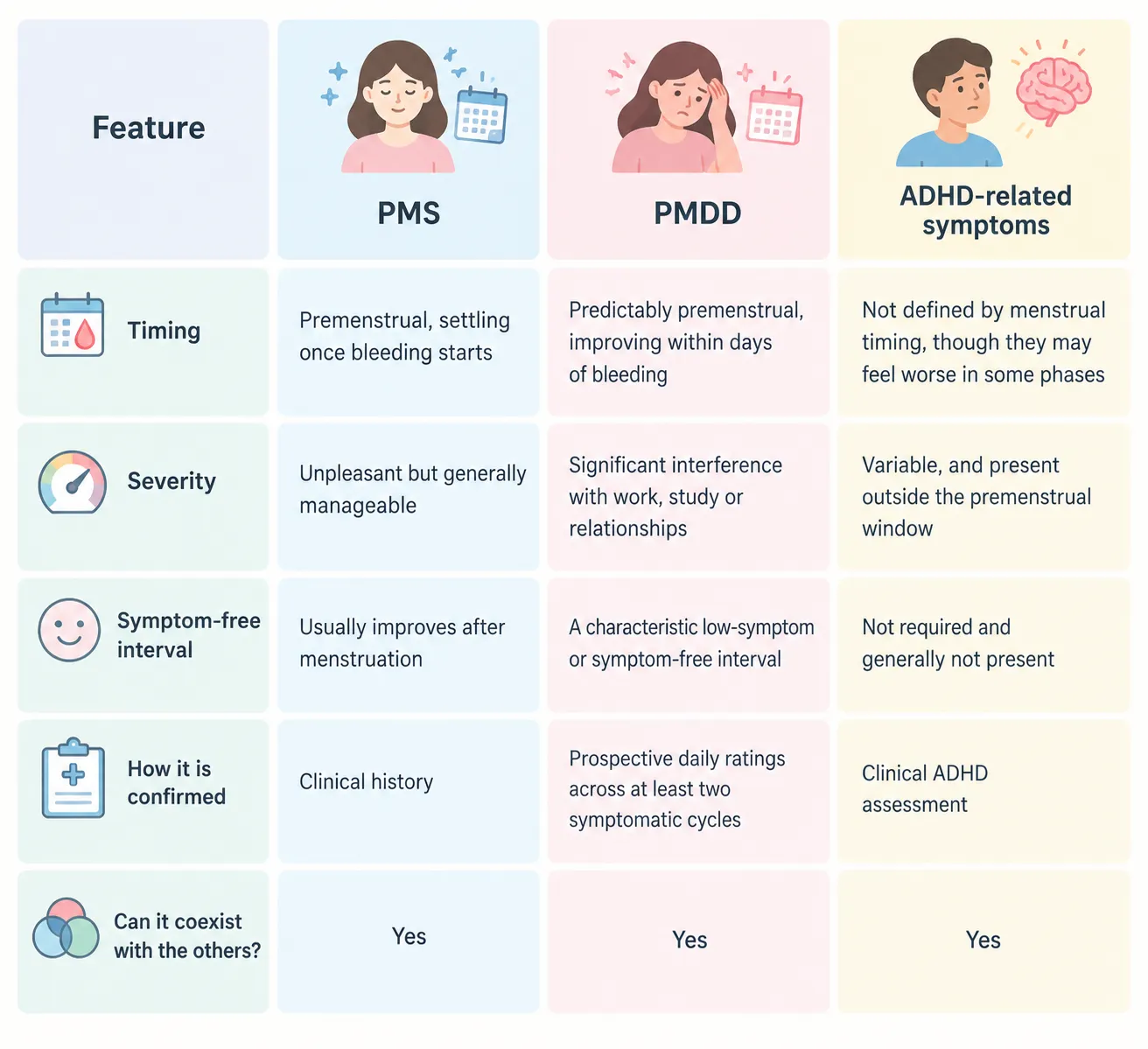
| Feature | PMS | PMDD | ADHD-related symptoms |
| Timing | Premenstrual, settling once bleeding starts | Predictably premenstrual, improving within days of bleeding | Not defined by menstrual timing, though they may feel worse in some phases |
| Severity | Unpleasant but generally manageable | Significant interference with work, study or relationships | Variable, and present outside the premenstrual window |
| Symptom-free interval | Usually improves after menstruation | A characteristic low-symptom or symptom-free interval | Not required and generally not present |
| How it is confirmed | Clinical history | Prospective daily ratings across at least two symptomatic cycles | Clinical ADHD assessment |
| Can it coexist with the others? | Yes | Yes | Yes |
ADHD-related emotional dysregulation is not defined by a menstrual timing pattern, although symptoms may still feel worse during particular phases. Running all month with a premenstrual spike on top is a common description, and it is one of the reasons tracking is more useful than recall.
How PMDD Is Actually Diagnosed
PMDD is one of the few mental health diagnoses that formally requires prospective data. The diagnostic criteria call for daily symptom ratings collected across at least two consecutive symptomatic menstrual cycles. A clinician can make a provisional assessment before those ratings exist, based on history alone, but that is a working hypothesis rather than a confirmed diagnosis. Confirmation depends on the prospective pattern.
Retrospective recall is unreliable for this specific question. Asked in the middle of a bad week whether the last few months followed a pattern, most people say yes, and studies comparing recall with daily records find the two often disagree. That is not a memory failing; it is what recall does with mood. Daily records over two cycles can show several things: a clear cyclical pattern, partial cyclicity, symptoms present all month with premenstrual worsening, or no cyclical relationship at all. Each of those points somewhere different, which is why the exercise is worth doing even when the answer is not PMDD.
What to track
- The date, and which day of your cycle it is, counting day 1 as the first day of bleeding
- Mood: low mood, anxiety or tension, mood swings, irritability or anger, each rated on a simple scale you use consistently
- ADHD-relevant items separately: concentration, task initiation, forgetting, restlessness
- Physical symptoms: fatigue, sleep, appetite changes, breast tenderness, headaches, bloating
- Interference: what you could not do that day, which is the part clinicians need and the part most people leave out
- Anything that clearly caused a bad day on its own, so an ordinary stressful week is not read as a hormonal pattern
Two cycles is the diagnostic minimum. Tracking a third is a practical suggestion rather than a requirement, and is worth considering if your cycles are irregular. Jean Hailes recommends recording symptoms, how they affect you and what helps across at least two cycles, and points to the printable tracking tools published by the International Association for Premenstrual Disorders (Jean Hailes: premenstrual dysphoric disorder). A notes app works as well as anything, as long as it is daily and takes under a minute.
Across the Rest of the Cycle
Phase-by-phase guides are popular and they overstate the precision available. What can be said is narrower. ADHD and menstrual cycle research mostly compares a follicular window with a luteal window rather than mapping four neat phases, and the individual variation within those windows is large.
- Many women in surveys describe better focus and steadier mood in the follicular phase, the stretch from the period to ovulation
- Many describe the harder stretch beginning after ovulation and peaking in the several days before a period, which is where adhd worse before period searches come from
- Others find ADHD worse during period bleeding itself rather than in the days before it
- Some describe no cycle-related change at all, which is neither unusual nor a sign of anything
- Some notice the change in emotional regulation and rejection sensitivity more than in attention
Which of those describes you is an empirical question about your own data, not something a general article can tell you. That is the case for tracking rather than reading.
Does ADHD affect periods themselves?
The relationship between your period and ADHD runs both ways in people’s minds, and this half comes up often: whether ADHD can cause irregular periods or worse period pain. Current evidence does not establish that ADHD itself causes either. Some newer studies do report associations: the 2026 scoping review found painful, heavy and irregular menstruation associated with higher ADHD symptom severity, and found that menstrual pain itself impaired performance on attention tasks. Those are associations, and an association cannot tell you which way the influence runs, or whether something else explains both.
The practical implication is the same either way: irregular cycles, heavy bleeding and severe period pain deserve assessment on their own terms. Polycystic ovary syndrome and endometriosis are common and often diagnosed late, and neither should be left unexamined because ADHD seemed to explain things.
Puberty, Pregnancy and Perimenopause
Puberty
Research on ADHD and puberty is scarce, and what exists is mostly about timing rather than symptom change. Whether puberty itself worsens ADHD symptoms, and why, remains an open question. What is better established is that girls are identified later than boys.
Pregnancy and postpartum
Self-reported experience during pregnancy varies in every direction, and postpartum mood difficulty appears to be more common in women with ADHD than in the general population. That period has enough specific considerations to belong in its own guide: see ADHD, pregnancy, postpartum and motherhood.
Perimenopause and menopause
This is where the gap between what women report and what has been studied is widest. In the Australian survey above, 97.5 per cent of participants who had reached menopause perceived their ADHD symptoms worsening during it, and surveys elsewhere describe the same, with time management, working memory, feeling overwhelmed and disorganisation named most often. The 2025 systematic review found no peer-reviewed empirical studies meeting its inclusion criteria on hormones and ADHD symptoms across the menopausal transition.
The honest position is that a great many women describe this, clinicians commonly observe it, and the evidence remains too limited to provide a robust basis for explaining or predicting symptom change across menopause. Worth knowing for two reasons: a worsening in your forties is not evidence that you are imagining the ADHD or that it was never there, and a clinician who cannot give you a confident answer is being accurate rather than dismissive.
Practical Things You Can Try While Tracking
Treatment decisions, including anything involving medicines or hormonal options, belong with your treating clinician and are outside what this guide covers. What follows are practical strategies rather than established interventions for ADHD or PMDD. None of them has been tested as a treatment. They are the things available to you before and alongside a clinical conversation.
- Track first. Two cycles of daily ratings changes the conversation more than any description of symptoms can, and it is the one thing a clinician cannot do for you
- Move what you can. If a predictable window is harder, stop scheduling the difficult conversation, the tax return or the job interview inside it when you have the choice
- Front-load the month. Anything with a deadline is easier finished in a good week than started in a bad one
- Protect sleep in the luteal window specifically, because sleep disruption and premenstrual symptoms compound each other
- Tell one person at work or at home what the pattern is, so a bad week is read as a pattern rather than as a change of character
- Treat the bad week as information rather than as evidence about yourself. Judgements made in that window about your job, your relationship or your worth are not reliable data
Talking to Your Doctor in Australia
Your GP can assess PMDD and other causes of menstrual symptoms, and decide whether referral to another clinician is appropriate. That makes a GP the practical starting point for both halves of this, and the tracking chart is what makes the appointment productive. Useful things to bring and to ask:
- Your daily ratings across at least two cycles, with the interference column filled in
- A clear statement of the pattern you think you are seeing, and what you want ruled in or out
- Whether your symptoms meet the criteria for PMDD, or are better explained by PMS, by ADHD emotional dysregulation, or by something else entirely
- Whether anything else should be checked, including thyroid function, iron, and the gynaecological causes of cycle symptoms
- What the options are, what the evidence for each is, and what a review point would look like
- Whether a referral is appropriate, and what that would involve in your circumstances
If you are having thoughts of suicide or of harming yourself:
Seek urgent help now rather than waiting for the next cycle. Call 000 in an emergency, or Lifeline on 13 11 14 at any hour. Tell your GP as soon as you can, and say plainly if the thoughts follow a cyclical pattern, because that is clinically relevant information.
Related Guides
- Late ADHD diagnosis in women
- Emotional dysregulation and rejection sensitivity in ADHD
- ADHD symptoms in adults
- ADHD treatment in Australia
References
- Osianlis E, Thomas EHX, Jenkins LM, Gurvich C. ADHD and sex hormones in females: a systematic review. Journal of Attention Disorders, 2025. doi:10.1177/10870547251332319. Eleven included studies; evidence described as largely suggestive, with no peer-reviewed empirical studies identified on the menopausal transition.
- Kennedy G, Baran-Goldwax M, Lippe S. Menstrual health and attention-deficit/hyperactivity disorder (ADHD) symptoms: a scoping review. Women’s Health, 2026. doi:10.1177/17455057261460285. Twenty included studies; associations reported between menstrual difficulties and ADHD symptom severity, with small samples and unclear causal mechanisms noted. PMID 42274016.
- Osianlis E, Thomas EHX, Li Q, Bellgrove M, May T, Chapman D, Kulkarni J, Gurvich C. ADHD in females: survey findings on symptoms across hormonal life stages. Journal of Psychiatric Research, 2026. Australian survey of 600 women with self-reported ADHD; self-perceived symptom change, with cross-sectional severity scores broadly consistent across phases. PMID 41330200.
- Reilly TJ and colleagues. The prevalence of premenstrual dysphoric disorder: systematic review and meta-analysis. Journal of Affective Disorders, 2024. doi:10.1016/j.jad.2024.01.163. 44 studies, 50,659 participants; 3.2 per cent confirmed and 7.7 per cent provisional pooled prevalence, and 1.6 per cent in community samples using confirmed diagnosis. PMID 38199397.
- Broughton T, Lambert E, Wertz J, Agnew-Blais J. Increased risk of provisional premenstrual dysphoric disorder (PMDD) among females with attention-deficit hyperactivity disorder (ADHD): cross-sectional survey study. British Journal of Psychiatry, 2025. Provisional PMDD 31.4 per cent with ADHD versus 9.8 per cent without, relative risk about 3.19; self-report via an online research panel. PMID 40528384.
- Dorani F, Bijlenga D, Beekman ATF, van Someren EJW, Kooij JJS. Prevalence of hormone-related mood disorder symptoms in women with ADHD. Journal of Psychiatric Research, 2021. 209 women with ADHD aged 18 to 71.
- American Psychiatric Association. Diagnostic and Statistical Manual of Mental Disorders, Fifth Edition, Text Revision. Premenstrual dysphoric disorder criteria, including prospective daily ratings across at least two consecutive symptomatic cycles.
- Jean Hailes for Women’s Health. Premenstrual dysphoric disorder (PMDD): symptoms, diagnosis and symptom tracking across at least two cycles. jeanhailes.org.au
- Australian ADHD Professionals Association. Australian Evidence-Based Clinical Practice Guideline for Attention Deficit Hyperactivity Disorder (ADHD). Released October 2022. adhdguideline.aadpa.com.au
Last reviewed: September 2026. Next scheduled review: September 2027. This article is general information and is not a substitute for individual medical advice, assessment or diagnosis.