

Can Adults Be Diagnosed With ADHD?
Yes. Adults are assessed against the same criteria, which require several symptoms to have been present before age 12 but do not require that a diagnosis was made in childhood. From age 17, DSM-5-TR requires at least five symptoms in a domain rather than six (American Psychiatric Association, 2022). Symptoms also have to cause meaningful impairment in more than one setting. The pathway usually starts with a GP, and who can assess depends on where you live and the clinician’s registration, training and experience.
Adult ADHD diagnosis differs from child assessment in one structural way: the person being assessed is usually the main source of information about a pattern that has to be traced back thirty or more years. Much of what makes adult assessment harder follows from that.
This guide covers the adult pathway specifically: what is different about assessment for ADHD in adults, the childhood evidence problem, what to prepare and what the outcome means. The full diagnostic pathway across the lifespan
At a Glance
- The pathway usually starts with a GP, though some services can be approached directly
- Diagnosis is a clinical judgement, not a single test
- Evidence that symptoms were present before age 12 is required, but a childhood diagnosis is not
- Symptoms must cause meaningful impairment in more than one setting
- Other explanations and co-occurring conditions are assessed as a matter of course
- Costs, waiting times and referral requirements vary by provider, state and territory
ADHD Assessment: Adults Compared With Children
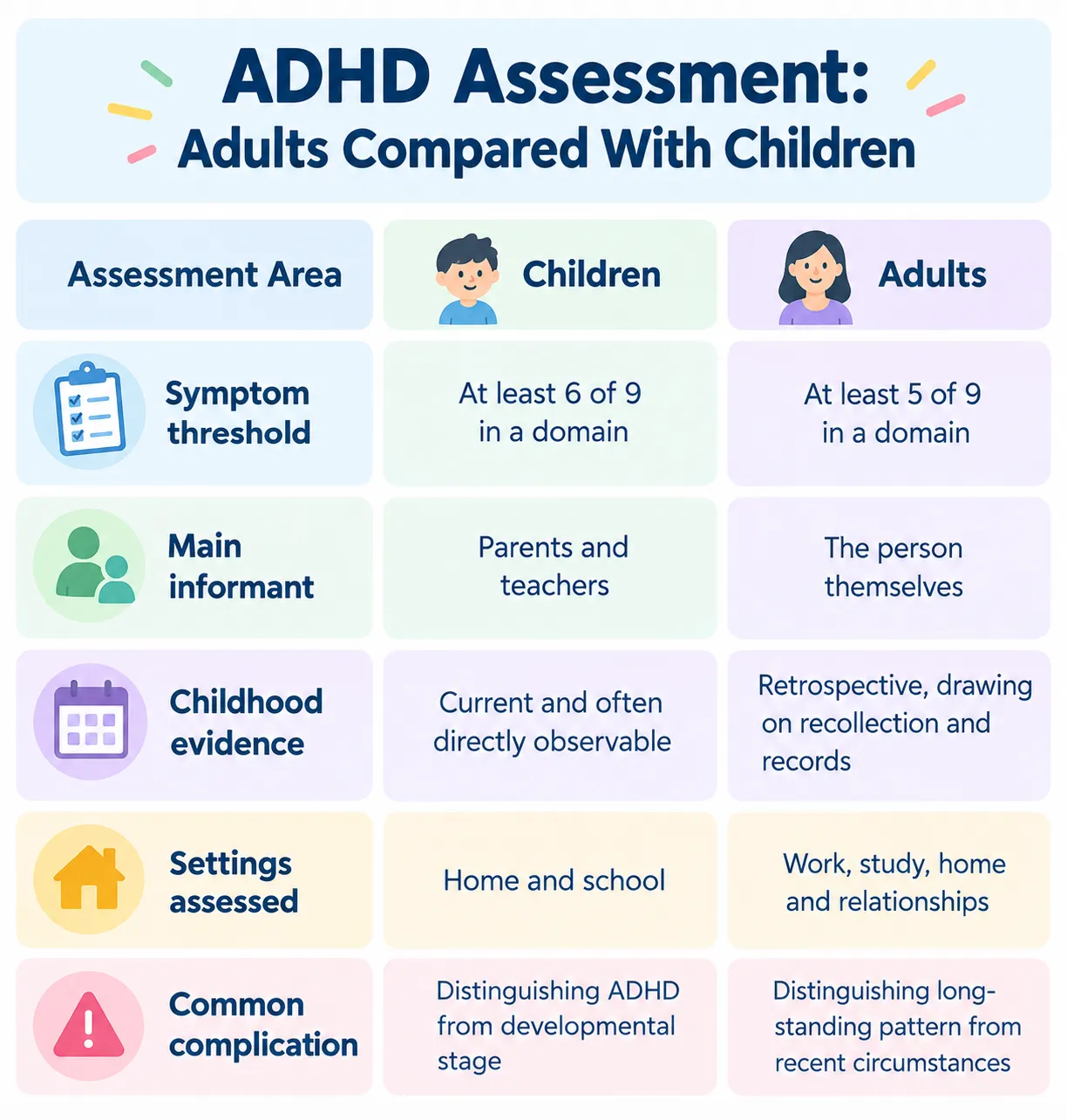
| Assessment Area | Children | Adults |
| Symptom threshold | At least 6 of 9 in a domain | At least 5 of 9 in a domain |
| Main informant | Parents and teachers | The person themselves |
| Childhood evidence | Current and often directly observable | Retrospective, drawing on recollection and records |
| Settings assessed | Home and school | Work, study, home and relationships |
| Common complication | Distinguishing ADHD from developmental stage | Distinguishing long-standing pattern from recent circumstances |
The lower adult threshold reflects how symptoms tend to present with age rather than how severe they are. Visible hyperactivity commonly declines while attention and executive difficulties persist, which is why an adult assessment looks different from a child assessment even though the criteria are shared (American Psychiatric Association, 2022).
What Clinicians Need to Establish in an Adult Assessment
Diagnosing ADHD in adults means gathering evidence about a fixed set of questions, whatever the setting. Knowing what they are makes it easier to give the clinician what they actually need.
- Enough current symptoms in the inattentive or hyperactive-impulsive domain to meet the adult threshold
- Evidence that several symptoms were present before age 12, even if nobody named them ADHD
- That symptoms have persisted rather than appearing recently
- That difficulties are evident in more than one important setting, such as work, study, home or relationships
- That they cause clinically meaningful impairment, not just inconvenience
- That another condition does not better account for the pattern, and which conditions may be present alongside it
The two settings requirement is often misunderstood. The difficulties do not have to look identical everywhere. What matters is that the pattern shows up in more than one part of life rather than being specific to a single job, relationship or period. Australia’s clinical guideline directs assessment towards symptoms and functioning across different domains and settings (Australian ADHD Professionals Association, 2022).
Which presentation applies, inattentive, hyperactive-impulsive or combined, follows from where the symptoms fall rather than being decided separately.
The Pathway
The broad shape is the same as for any ADHD assessment: a GP appointment, a referral where appropriate, then assessment with an appropriately qualified clinician. Australia’s clinical guideline frames this in terms of the clinician’s registration, training and ADHD diagnostic competence rather than a fixed list of professions (Australian ADHD Professionals Association, 2022). In practice an adult assessment may involve a psychiatrist, psychologist, or another appropriately qualified clinician working within their scope of practice. Registration can be checked on the AHPRA public register.
This is an area that is actively changing. Who can diagnose and assess ADHD, and what arrangements follow, differ between states and territories, and national work is under way towards greater consistency. Do not assume one nationwide rule. Check the current position where you live, and ask a service what applies before booking.
The Childhood Evidence Problem
This is the part adults find hardest, and it is worth understanding what is actually required.
The criteria require several symptoms to have been present before age 12. They do not require that anyone identified them, that a diagnosis was made, or that you can produce documentation. Many people were never assessed as children, particularly those with quieter presentations or who were academically capable.
What helps
- School reports, particularly the written comments rather than the grades
- What a parent, older sibling or long-term family friend remembers
- Old assessments, even for something else
- Specific memories: what was difficult, what took longer, what you avoided
- Family history, since ADHD has a substantial heritable component
If none of that is available
Tell the clinician. They can work with the developmental history that is available, together with recollections and other evidence, when considering whether the required childhood history is supported. Absence of records does not necessarily prevent assessment, but the clinician still needs sufficient developmental evidence to judge whether the criteria are met. Where that evidence is thin, the conclusion may be less certain, or further information may be sought.
What school reports often say
For people who were not disruptive, reports frequently say things like capable but does not finish work, disorganised, chatty, or could apply themselves more. Those descriptions are relevant evidence even though they do not sound like a record of ADHD.
Why Adults Seek Assessment
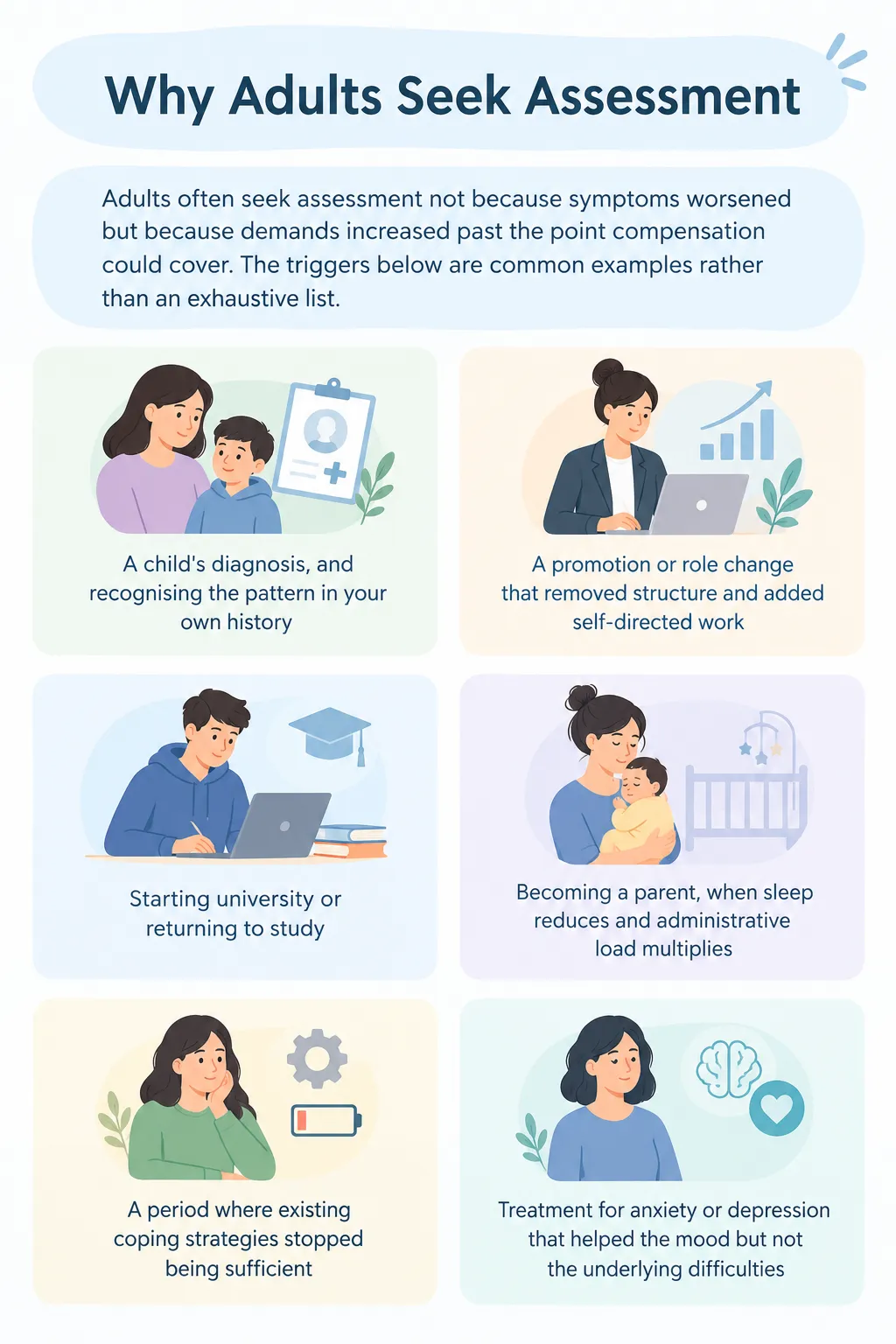
Adults often seek assessment not because symptoms worsened but because demands increased past the point compensation could cover. The triggers below are common examples rather than an exhaustive list.
- A child’s diagnosis, and recognising the pattern in your own history
- A promotion or role change that removed structure and added self-directed work
- Starting university or returning to study
- Becoming a parent, when sleep reduces and administrative load multiplies
- A period where existing coping strategies stopped being sufficient
- Treatment for anxiety or depression that helped the mood but not the underlying difficulties
That last one is worth raising explicitly. If anxiety treatment has worked and the concentration, organisation and initiation difficulties remain unchanged, that is a reasonable thing to describe to a clinician.
What the Assessment Covers
A clinical interview, developmental history, rating scales completed by you and where possible an informant, assessment of functional impairment, and consideration of other conditions. Duration varies by clinician, service and complexity; some comprehensive assessments involve interviews of two to three hours, sometimes across more than one appointment (Australian ADHD Professionals Association, 2022). Rating scales support the assessment and do not establish a diagnosis on their own; Australia’s clinical guideline is explicit that diagnosis should not rest on rating scales alone. The separate guide to what happens during an ADHD assessment covers the appointment itself.
Why Compensation Complicates Adult Assessment
Many adults reaching assessment have spent years building systems that make difficulties less visible. The output looks ordinary; the effort does not.
This matters for how you describe things. Someone who arrives on time by setting three alarms, preparing the night before and leaving forty-five minutes early produces the same outcome as someone who simply arrives on time. Assessment is interested in the second part.
When completing rating scales, answer for what happens without the systems you have built, not with them.
What Else Is Considered
Adults have more possible explanations than children do, which is why this part of assessment is substantial. This is a simplified summary rather than a guide to distinguishing conditions yourself.
| Considered | Why it can overlap |
| Anxiety | Concentration difficulty, restlessness, difficulty starting tasks |
| Depression | Reduced concentration, motivation and energy |
| Chronic stress or burnout | Has an onset and typically improves when demand reduces |
| Sleep disorders | Daytime inattention, irritability and executive difficulties |
| Perimenopause | Symptom change relating to hormonal transition rather than childhood history |
| Thyroid conditions and iron deficiency | Fatigue and concentration difficulty, identified by blood test where clinically indicated |
| Autism | Executive function difficulties can overlap, and both can be diagnosed together |
Several of these also occur alongside ADHD. Identifying one does not rule out the other.
How to Prepare
| Instead of | Bring |
| I am disorganised | I have missed three appointments this year despite calendar reminders |
| I procrastinate | I did the tax return at 11pm the night before, as I have every year |
| I struggle at work | I work an extra hour daily to produce what colleagues produce in normal hours |
| I was distracted at school | My reports said I was capable but did not finish work |
Also useful: what you have already tried and whether it helped, and what happens when the systems you rely on are disrupted.
How to Choose a Clinician for an Adult Assessment
Adult ADHD assessments vary considerably in what they include and how they are run. These are reasonable things to ask before booking.
- That the clinician is registered, which can be checked on the AHPRA public register
- What ADHD-specific training and assessment experience they have
- What the assessment involves and how many appointments it usually takes
- Whether informant questionnaires and school records are part of the process
- The total fee, what is included, and whether a written report costs extra
- Whether a referral is needed and what rebate, if any, is likely to apply
- Current waiting time, and whether telehealth is available
Cost and Waiting Times
There is no single national price, and advertised fees for private adult assessment vary widely. What the total comes to depends on the clinician type, the number of appointments, whether a written report is included and whether any follow-up is charged separately. Medicare rebates depend on the service, the clinician and your eligibility, and referral requirements can affect whether a rebate is available at all. Public pathways may cost little or nothing but usually have eligibility criteria and longer waits.
Ask about the total cost, what is included, the expected rebate if any, and the expected timeframe before booking. Waiting times vary by provider, location and whether the pathway is public or private, and arrangements change, so confirm rather than relying on figures published elsewhere.
After the Assessment
People often expect diagnosis to change everything or nothing, and it usually does neither.
For many people an adult diagnosis of ADHD provides an explanation that fits, and often the first coherent account of a pattern going back decades. It may also provide documentation that can support discussions about reasonable adjustments, depending on your circumstances and what the relevant organisation requires. What it does not do by itself is change how any given day goes.
A conclusion that ADHD criteria are not met is a valid outcome rather than a failed assessment. Depending on the findings, the clinician may identify another condition, a co-occurring difficulty, or recommend further assessment. Sometimes no single alternative explanation emerges straight away.
Related Guides
- Late ADHD diagnosis in women
- ADHD symptoms in adults
- DSM-5 ADHD diagnostic criteria explained
- Undiagnosed, misdiagnosed and over-diagnosed ADHD
References
- Australian ADHD Professionals Association. Australian Evidence-Based Clinical Practice Guideline for Attention Deficit Hyperactivity Disorder (ADHD). Released October 2022. adhdguideline.aadpa.com.au
- Healthdirect Australia. Attention deficit hyperactivity disorder (ADHD). healthdirect.gov.au
- American Psychiatric Association. Diagnostic and Statistical Manual of Mental Disorders, Fifth Edition, Text Revision (DSM-5-TR). 2022.
- Australian Psychological Society. ADHD in adults: how is ADHD assessed. psychology.org.au
- Australian Health Practitioner Regulation Agency. Check a practitioner’s registration on the public register. ahpra.gov.au
- Australian Government Department of Health, Disability and Ageing. Medicare Benefits Schedule and referral arrangements for specialist services. health.gov.au