

How Is ADHD Diagnosed?
ADHD is diagnosed clinically. There is no blood test, brain scan or single questionnaire that establishes it. A clinician assesses symptoms against diagnostic criteria, takes a developmental history, gathers information from more than one setting, evaluates functional impairment and considers other explanations (Australian ADHD Professionals Association, 2022). In Australia the process usually begins with a GP.
ADHD diagnosis is a clinical judgement built from several sources of information, not a test result. That is the single most important thing to understand about diagnosing ADHD, and it explains almost everything else about how assessment is structured. ADD is an older name for the same condition, so an ADD / ADHD diagnosis and an ADHD diagnosis describe the same clinical process.
This guide covers what a diagnosis has to establish, who can diagnose ADHD in Australia, how to get an ADHD diagnosis and what happens at each stage of the ADHD diagnosis process. It is the overview page for this topic. Separate guides cover adult ADHD diagnosis and getting a child assessed.
What a Diagnosis Has to Establish
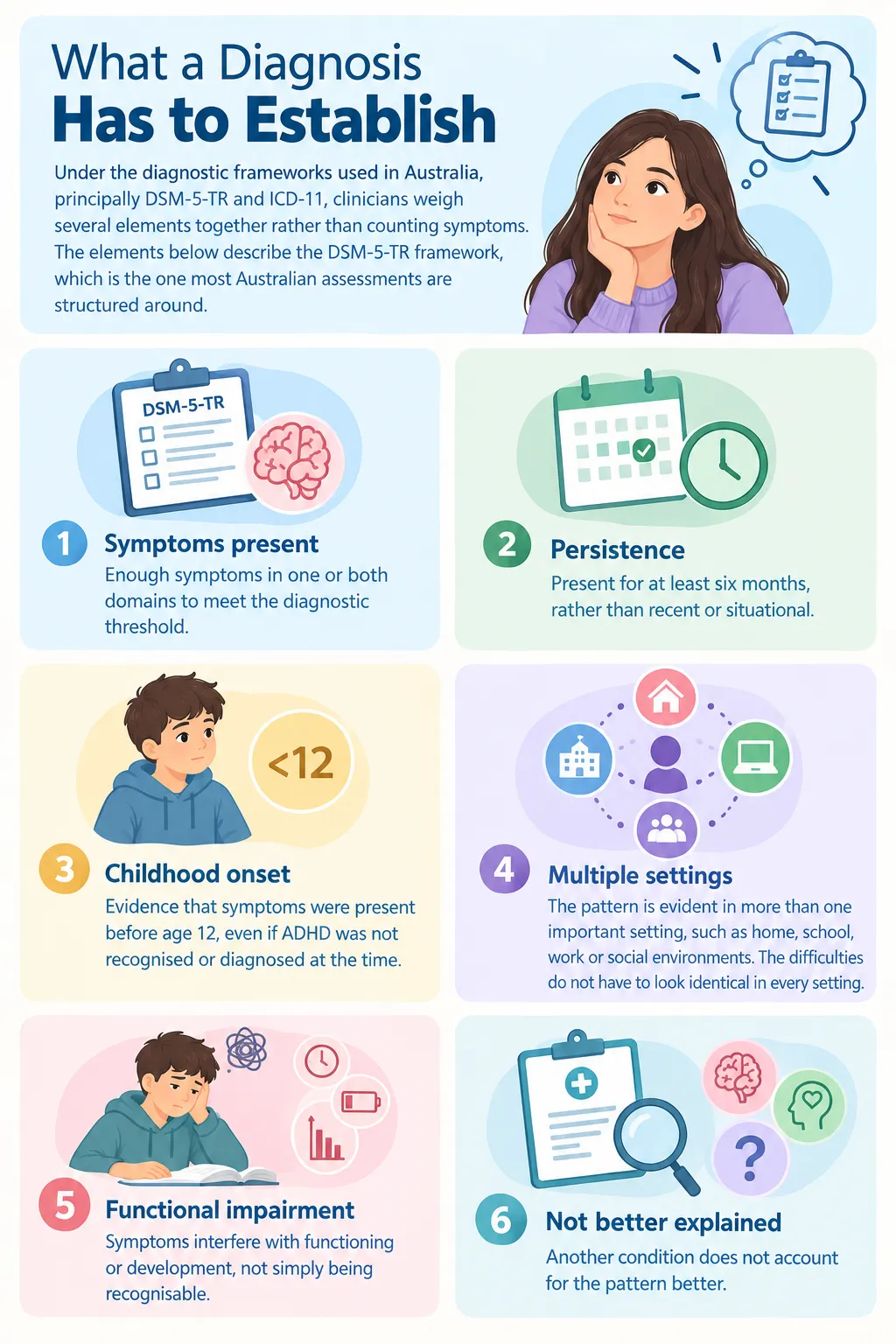
Under the diagnostic frameworks used in Australia, principally DSM-5-TR and ICD-11, clinicians weigh several elements together rather than counting symptoms. The elements below describe the DSM-5-TR framework, which is the one most Australian assessments are structured around.
| Requirement | What it means |
| Symptoms present | Enough symptoms in one or both domains to meet the diagnostic threshold |
| Persistence | Present for at least six months, rather than recent or situational |
| Childhood onset | Evidence that symptoms were present before age 12, even if ADHD was not recognised or diagnosed at the time |
| Multiple settings | The pattern is evident in more than one important setting, such as home, school, work or social environments. The difficulties do not have to look identical in every setting |
| Functional impairment | Symptoms interfere with functioning or development, not simply being recognisable |
| Not better explained | Another condition does not account for the pattern better |
The last two do most of the work. Recognising symptoms is common. Establishing that they cause meaningful difficulty, and that nothing else explains them better, is what assessment is for. The separate guide to the DSM-5 ADHD criteria sets out the symptom lists and thresholds in detail.
Who Can Diagnose ADHD in Australia?
This depends on age, location, the clinician’s qualifications and the purpose of assessment.
Australia’s clinical guideline frames this in terms of the clinician’s registration, training and competence rather than a fixed list of professions. It specifies that the clinician should be appropriately registered, trained in DSM or ICD diagnostic assessment, experienced in clinical interviews, standardised rating scales and functional impairment assessment, and experienced in ADHD assessment or appropriately supervised (Australian ADHD Professionals Association, 2022). Depending on age, circumstances and service, an assessment may therefore involve a psychiatrist, paediatrician, psychologist or another appropriately qualified clinician working within their scope of practice.
Arrangements differ by state
Who can assess and diagnose ADHD, and what prescribing arrangements follow, differ between states and territories and have been changing. Check the current position where you live, and ask a service about its requirements before booking.
The Diagnostic Pathway, Step by Step
Step 1: The GP appointment
For many people a GP is a practical starting point, though some people approach an ADHD assessment service directly. Book a longer appointment and say what you want to discuss when you book, so there is time.
The GP will take a history, ask about how difficulties affect daily life, and consider other explanations. Australia’s clinical guideline notes that medical assessment may consider factors such as hearing impairment, epilepsy, sleep deprivation and nutritional deficiencies, with investigations performed only where clinically indicated (Australian ADHD Professionals Association, 2022). These investigations are not a test for ADHD; they are a way of considering other causes.
Step 2: Referral
If assessment is appropriate, the GP can arrange a referral. You may be able to book some ADHD assessment services directly, but referral requirements vary by clinician, service and Medicare arrangement. A referral can matter when you want to claim a Medicare benefit for an eligible specialist service, and the rules depend on the particular service and MBS item involved. Ask the provider whether you need a referral before booking. The GP-to-referral route is a common pathway rather than the only one.
Choosing where to go involves practical trade-offs: public services may have eligibility criteria and longer waits, while private assessment is usually more directly accessible but fee for service.
Step 3: The assessment
Assessment involves a detailed clinical interview and can take place over one or more appointments. The duration varies with the clinician, service, age, complexity and the information already available; some comprehensive assessments involve interviews lasting two to three hours, sometimes across more than one appointment (Australian ADHD Professionals Association, 2022). AADPA recommends that a diagnostic assessment include clinical and psychosocial assessment, developmental, mental health and medical history, observer information, and medical assessment where clinically indicated.
- Clinical interview covering current difficulties and their effect on daily life
- Developmental history reaching back to early childhood
- Mental health, medical and family history
- Standardised rating scales completed by the person and, where possible, an informant
- Information about functioning across more than one setting
- Assessment of functional impairment
- Consideration of alternative and co-occurring conditions
The separate guide to what happens during an ADHD assessment covers preparation, appointment structure and what to expect on the day.
Step 4: The outcome
Depending on the service, you may receive a written report setting out the findings, whether criteria were met, the symptom profile, functional impacts and recommendations. Some services discuss findings verbally and provide a summary letter instead.
What Evidence Is Used to Support an ADHD Diagnosis?
No single source of information establishes ADHD. A diagnosis is built by putting several sources beside each other and asking whether they describe a consistent pattern. AADPA’s consumer companion describes developmental history, observer information, school reports and standardised rating scales among the sources a clinician draws on (Australian ADHD Professionals Association, 2022).
| Source of evidence | What it can contribute |
| Clinical interview | Current symptoms, history and how the person is functioning now |
| Developmental history | Evidence about whether symptoms were present in childhood |
| School reports | Historical evidence where records still exist |
| Parent or carer information | Childhood observations and, for young people, current ones |
| Partner, relative or friend information | How difficulties show up in adult life and relationships |
| Standardised rating scales | Structured symptom information that can be compared against norms |
| Medical and mental health history | Other conditions and factors that may contribute to the presentation |
| Functional history | Impact across work, study, relationships and daily life |
Not every source is available for every person, and none of them is required in every case. What matters is whether the clinician has enough information to judge the pattern, its onset, its spread across settings and its effect on functioning.
Why There Is No Single Test
This is the question people ask most.
ADHD is defined by a pattern of behaviour and functioning over time and across settings. No single measurement can capture that. A questionnaire captures self-report at one moment. A computer task captures performance in a quiet room. A brain scan captures structure or activity at one point. None of them establish whether difficulties have been present since childhood, appear across settings, cause impairment, or are better explained by something else.
Australia’s clinical guideline states that computerised cognitive assessments, neuroimaging and EEG do not increase diagnostic accuracy beyond appropriate clinical assessment and rating scales (Australian ADHD Professionals Association, 2022).
The Role of Rating Scales
Rating scales are used throughout assessment, and they are adjuncts rather than the assessment itself. Australia’s clinical guideline is explicit that diagnosis should not be based solely on rating scales or observational data.
What they add is structure: the same questions asked every time, comparison against normed populations, and the ability to gather information systematically from more than one person. Our guide to ADHD questionnaires and rating scales covers the individual instruments.
Why Informant Information Matters
Self-report provides important information, and clinicians may also seek information from other people who know the person well, particularly where this helps establish how symptoms have appeared across different settings and over time.
For children, this usually means parent and teacher information. For adults, an informant may be a partner, parent, relative, friend or another person who knows the person’s history well. An informant is not always available, and that does not prevent an adult from being assessed. Where accounts differ, that difference is clinically informative rather than a problem to resolve before assessment.
Conditions That May Mimic, Contribute To or Co-occur With ADHD
Assessment is not simply checking whether someone recognises ADHD symptoms. It is determining whether ADHD best explains the overall pattern. Some conditions can produce overlapping symptoms, while others may coexist with ADHD; the assessment considers both possibilities. This is a simplified summary of why that matters, not a guide to distinguishing conditions yourself.
| Considered | Why it can overlap |
| Anxiety | Concentration difficulty, restlessness, racing thoughts |
| Depression | Reduced concentration, motivation and energy |
| Sleep disorders | Daytime inattention, irritability and executive difficulties |
| Autism | Executive function and attention-shifting difficulties can overlap, and both can be diagnosed together |
| Trauma-related conditions | Concentration, arousal and emotional symptoms can overlap |
| Learning disorders | Task avoidance and apparent inattention can result from underlying learning difficulty |
| Medical conditions | Thyroid disorders, iron deficiency and other conditions can contribute to fatigue and concentration difficulties |
Several of these also occur alongside ADHD rather than instead of it. Identifying one does not rule out the other, and co-occurring conditions are specifically assessed.
How Diagnosis Differs Across the Lifespan
| Children and adolescents | Adults | |
| Information sources | The young person, plus parents or carers and, where available and appropriate, teachers or other relevant observers | The person themselves |
| Informant | Usually available and routinely sought | Often a partner or parent, where available |
| Childhood evidence | Current, and often directly observable | Retrospective, drawing on reports and recollection |
| Setting evidence | Home and school | Work, study, home and relationships |
| Common difficulty | Distinguishing ADHD from developmental stage or learning difficulty | Distinguishing long-standing pattern from recent circumstances |
What Diagnosis Does and Does Not Give You
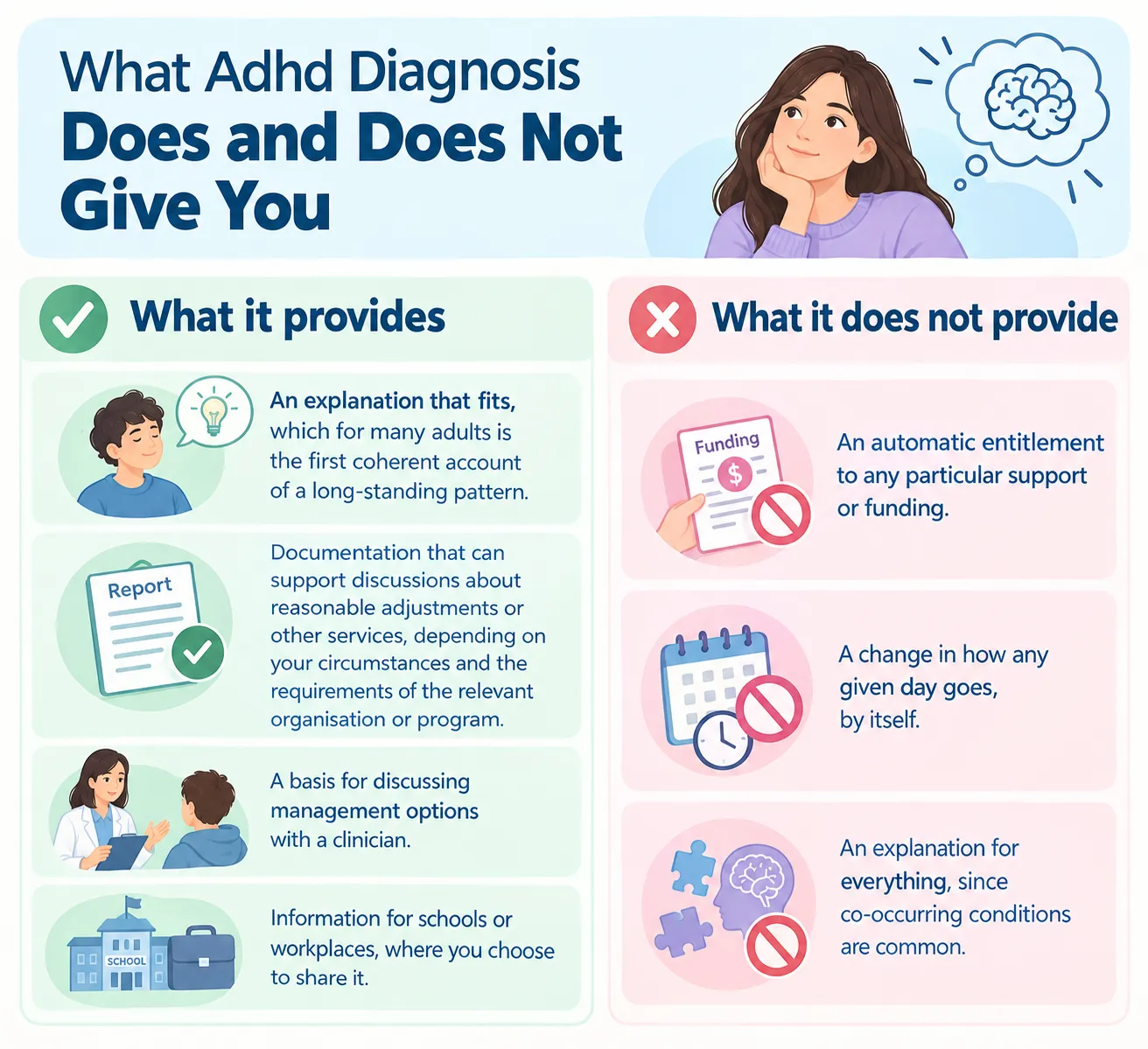
What it provides
- An explanation that fits, which for many adults is the first coherent account of a long-standing pattern
- Documentation that can support discussions about reasonable adjustments or other services, depending on your circumstances and the requirements of the relevant organisation or program
- A basis for discussing management options with a clinician
- Information for schools or workplaces, where you choose to share it
What it does not provide
- An automatic entitlement to any particular support or funding
- A change in how any given day goes, by itself
- An explanation for everything, since co-occurring conditions are common
If the Assessment Does Not Identify ADHD
This is a common and valid outcome. It has not established that the difficulties are imaginary; it has narrowed down what is causing them.
The outcome may lead to assessment or support for another condition, a co-occurring difficulty, or another factor contributing to the person’s difficulties. Sometimes further information or assessment is needed before a clear explanation is established. The guide to undiagnosed and misdiagnosed ADHD covers this in more detail.
References
- Australian ADHD Professionals Association. Australian Evidence-Based Clinical Practice Guideline for Attention Deficit Hyperactivity Disorder (ADHD). Released October 2022. Sections on assessment and diagnosis. adhdguideline.aadpa.com.au
- Healthdirect Australia. Attention deficit hyperactivity disorder (ADHD). healthdirect.gov.au
- American Psychiatric Association. Diagnostic and Statistical Manual of Mental Disorders, Fifth Edition, Text Revision (DSM-5-TR). 2022.
- World Health Organization. International Classification of Diseases, 11th Revision (ICD-11). 6A05 Attention deficit hyperactivity disorder. icd.who.int
- Australian Government Department of Health, Disability and Ageing. Medicare Benefits Schedule, general explanatory notes on referrals for specialist services. health.gov.au