

What Happens in an ADHD Assessment?
A clinical interview covering current difficulties and developmental history, standardised rating scales, information from someone who knows you well where possible, assessment of how difficulties affect daily functioning and what the person’s strengths are, and consideration of other conditions. Duration varies by service, age and complexity, and assessment may run across more than one appointment.
Most people arrive at an ADHD assessment without knowing what it will involve, which makes it harder than it needs to be. Some services still advertise an ADD/ADHD assessment; ADD is an older name for the same condition and the process is identical. Knowing the shape of it changes how you prepare and how much value you get from it.
This guide covers what happens in the room: what you are asked, who conducts the assessment, how long it takes and what the appointment is actually like. The separate guide to how ADHD is diagnosed in Australia covers the diagnostic pathway end to end, including what the criteria require.
Before the Appointment
Most services send paperwork in advance. Completing it properly is the single most useful thing you can do.
- Rating scales for you to complete, and often a version for a partner, parent or someone who knows you well
- A history form covering development, education, medical and family background
- Consent forms, including consent to contact a school or another clinician where relevant
- A request for school reports, previous assessments or referral letters
How to complete the forms
Answer for what happens without the systems you have built, not with them. If you would miss the appointment without three reminders, the honest answer is that you miss appointments. Rating scales measure outcomes; assessment is interested in what those outcomes cost you.
Who Can Conduct an ADHD Assessment in Australia?
The right clinician depends on age, presentation, the service and the clinician’s qualifications. Australia’s clinical guideline does not reduce assessment to a single profession. It specifies that the clinician should be appropriately registered, trained in DSM or ICD diagnostic assessment, experienced in clinical interviews, standardised rating scales and functional impairment assessment, and experienced in ADHD assessment or appropriately supervised (Australian ADHD Professionals Association, 2022).
In practice this can mean a psychiatrist, paediatrician, psychologist or another appropriately qualified clinician working within their scope of practice. A psychological assessment for ADHD conducted by a registered psychologist and a psychiatric assessment cover much of the same ground, though what each clinician can do afterwards differs. Registration can be checked on the AHPRA public register. It is reasonable to ask a service directly what training and ADHD experience the assessing clinician has, and whether the assessment includes a written report.
Arrangements differ between states and territories and have been changing, so check the current position where you live before booking.
What Does an ADHD Assessment Look At?
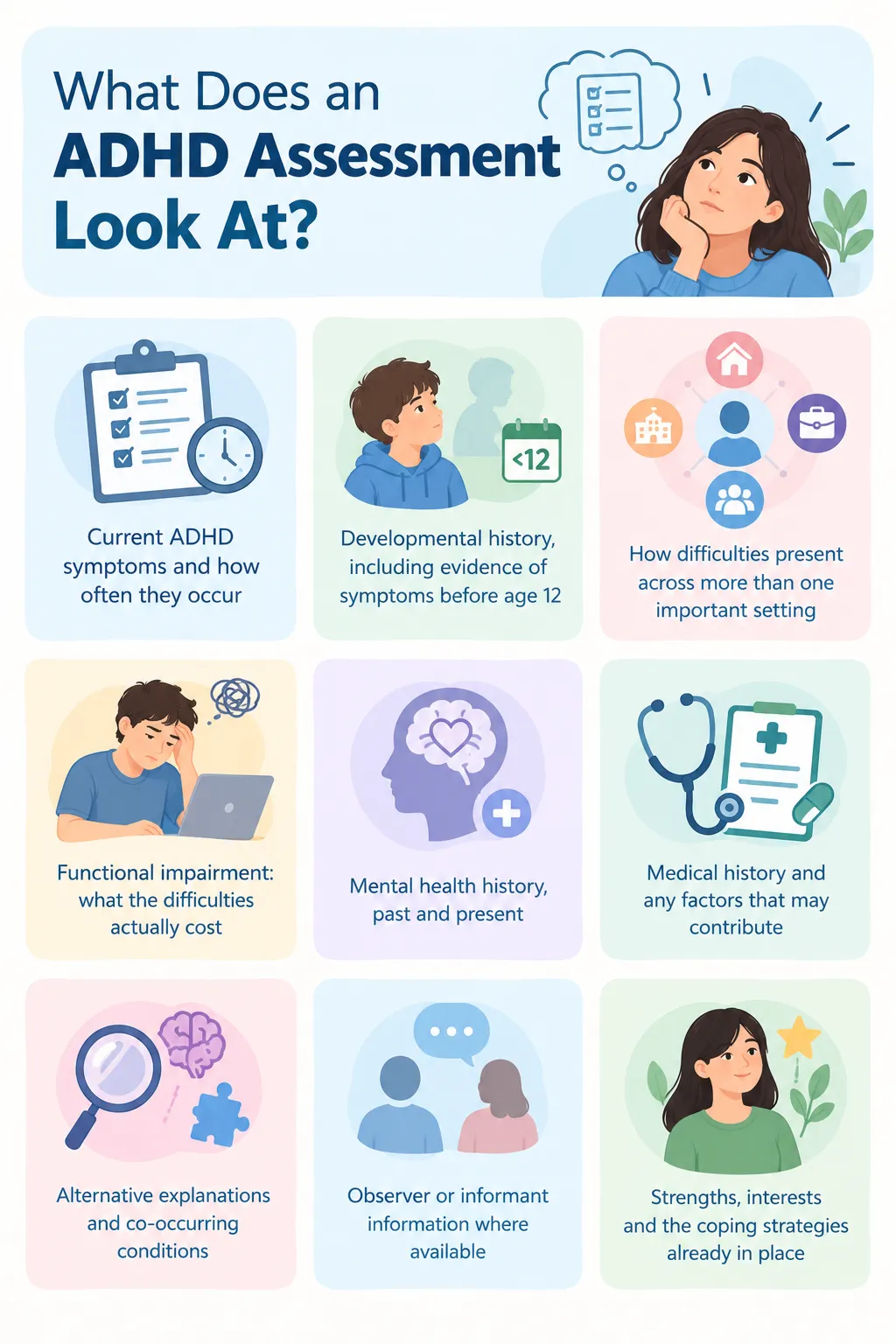
Whatever the format, assessments for ADHD are gathering evidence about the same set of things. Australia’s clinical guideline describes assessment as covering the person’s strengths as well as symptoms, how they present across everyday settings, developmental, mental health and medical history, observer reports, mental state, and medical assessment where clinically indicated (Australian ADHD Professionals Association, 2022).
- Current ADHD symptoms and how often they occur
- Developmental history, including evidence of symptoms before age 12
- How difficulties present across more than one important setting
- Functional impairment: what the difficulties actually cost
- Mental health history, past and present
- Medical history and any factors that may contribute
- Alternative explanations and co-occurring conditions
- Observer or informant information where available
- Strengths, interests and the coping strategies already in place
The last point is often underestimated. An assessment that only catalogues problems produces a thinner picture than one that also records what works, what the person is good at, and what they have already built to compensate. Those details inform what is recommended afterwards.
The Clinical Interview
This is the core of the assessment and usually takes the most time. It is a structured conversation rather than a test. The ADHD assessment questions you are asked fall into a few groups, and knowing which group a question belongs to makes it easier to answer usefully.
Current difficulties
What is happening now, how often, in which situations, and what the consequences are. Specific examples carry far more weight than general descriptions. A clinician can work with missing three appointments this year despite reminders in a way they cannot with being disorganised.
Developmental history
Early childhood, school, when difficulties were first noticed, and how they changed over time. The clinician asks about childhood because current diagnostic frameworks require evidence that ADHD symptoms were present before age 12, even if they were not recognised as ADHD at the time. Australia’s clinical guideline notes that symptoms are present before age 12 while diagnosis can occur much later, including in adulthood (Australian ADHD Professionals Association, 2022). You do not need to have been diagnosed as a child.
Medical, mental health and family history
Previous diagnoses and assessments, current medicines, sleep, and whether anyone in the family has ADHD or related conditions. ADHD has a substantial heritable component, so family history is genuinely informative.
Functioning across settings
How difficulties present at work or school, at home, and in relationships. Symptoms need to be evident in more than one important setting, so this section is doing specific diagnostic work rather than making conversation. The specific difficulties may look different from one setting to another; they do not have to be identical everywhere.
Functional impact
What these difficulties actually cost: missed deadlines, financial consequences, relationship strain, underemployment relative to capability, or the effort required to maintain ordinary functioning. This is the part people most often under-report.
Rating Scales During Assessment
Standardised scales are completed by you and, where possible, by an informant. Australia’s clinical guideline states that diagnosis should not be based solely on rating scales; they are adjuncts to assessment (Australian ADHD Professionals Association, 2022).
Their value is structure: the same questions asked every time, comparison against normed populations, and a systematic way of gathering more than one perspective. Instruments such as the ASRS, Conners and Vanderbilt scales are commonly used, and the separate guide to ADHD questionnaires and rating scales covers what each one measures.
Informant Information
For children this means parents and teachers. For adults it may mean a partner, parent, relative or long-term friend. An adult does not always have someone available who knew them well in childhood, and that does not prevent an assessment from going ahead. The clinician works with the evidence that is available, and where information is incomplete or contradictory, more than one appointment may be needed.
People often worry that an informant will contradict them. Where accounts differ, that difference is informative rather than a problem. Different settings genuinely produce different behaviour, and observers notice different things.
Assessment for Other Conditions
A substantial part of assessment is spent on what else might explain or accompany the difficulties. This is not scepticism; it is what makes the conclusion meaningful. Two different questions are being asked. The first is whether something else better explains the pattern, which is an alternative explanation. The second is whether the person has ADHD and another condition at the same time, which is a co-occurring condition.
Examples include anxiety, depression, sleep disorders, autism, learning disorders, trauma-related conditions and some medical conditions. The list is illustrative rather than exhaustive, and several of these commonly occur alongside ADHD rather than instead of it. Australia’s clinical guideline specifically directs assessment towards co-occurring and alternative medical, mental health and neurodevelopmental conditions (Australian ADHD Professionals Association, 2022).
Will I Need Blood Tests or Other Medical Tests?
ADHD itself is not diagnosed with a blood test, a brain scan or a computerised attention task. No such test establishes the diagnosis.
Medical assessment can still form part of the process. Australia’s clinical guideline notes that medical assessment may help identify other causes of symptoms or associated conditions, giving examples such as hearing impairment, epilepsy, sleep deprivation and nutritional deficiencies, and that investigations should be performed only where clinically indicated (Australian ADHD Professionals Association, 2022). Tests are not automatically required for everyone; whether any are ordered depends on symptoms, history and clinical judgement.
Some clinicians use additional tools, such as computerised attention tasks, where they judge it appropriate. Current guidance treats these as adjuncts to clinical assessment rather than replacements for it, and they do not establish or rule out ADHD on their own.
How Long Does an ADHD Assessment Take?
There is no standard length. Some services use one longer appointment; others spread assessment across several. Time is also needed outside the room for rating scales, informant questionnaires, school records and review. Complex presentations or co-occurring conditions can require additional assessment. As an example of scale, some comprehensive assessments involve interviews lasting two to three hours (Australian ADHD Professionals Association, 2022).
| Stage | What to expect |
| The interview | Varies by clinician, service, age and complexity. Some comprehensive assessments run two to three hours |
| Number of sessions | May be one longer appointment or several shorter ones, depending on the service and the information needed |
| Additional time | Obtaining teacher or informant information, reviewing school reports and scoring rating scales happen outside the appointment |
| Waiting to be seen | A separate question. Waits vary considerably by provider, location and whether the service is public or private |
Assessment for Children and Adolescents
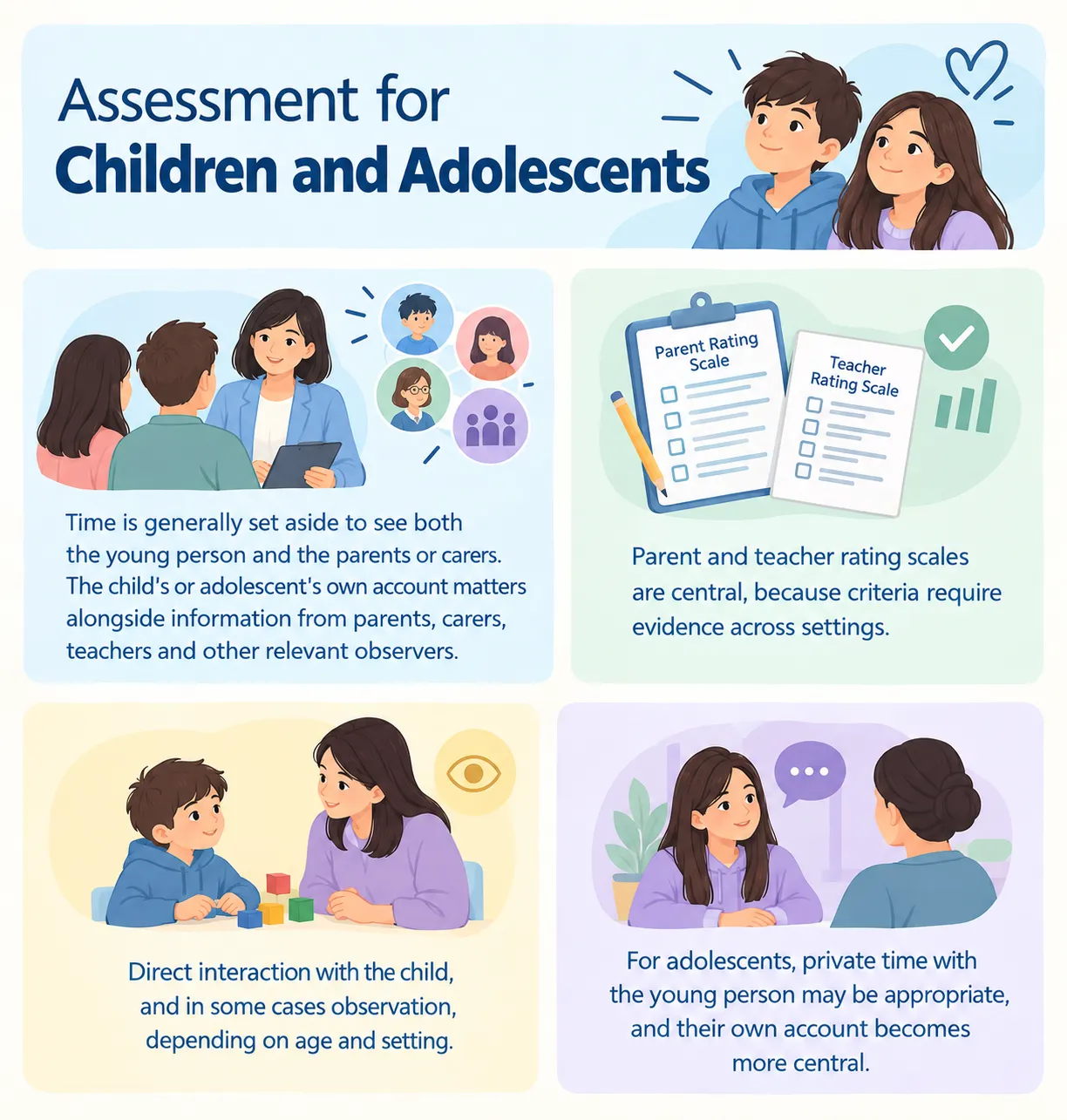
A childhood ADHD assessment follows a similar structure, with the information sources shifted.
- Time is generally set aside to see both the young person and the parents or carers. The child’s or adolescent’s own account matters alongside information from parents, carers, teachers and other relevant observers
- Parent and teacher rating scales are central, because criteria require evidence across settings
- Direct interaction with the child, and in some cases observation, depending on age and setting
- For adolescents, private time with the young person may be appropriate, and their own account becomes more central
Our guide to ADHD testing for children covers the child pathway in more detail, including how to involve the school.
Can an ADHD Assessment Be Done Online?
An ADHD assessment online, sometimes searched as ADHD online assessment, usually means telehealth. A telehealth ADHD assessment can involve the same core components as an in-person one: clinical interview, developmental history, rating scales, informant information and consideration of other conditions. The exact process varies by service, and some situations may require an in-person component.
An online ADHD assessment in this sense is different from an online questionnaire. A questionnaire is a screening tool and cannot diagnose ADHD. The separate guide to online ADHD tests in Australia covers what those tools can and cannot tell you.
Practical considerations differ: telehealth can reduce travel and waiting, while some assessments benefit from in-person observation, particularly with younger children. Ask the service what its process involves.
What Is an ADHD Self-Assessment?
An ADHD self assessment is usually a screening questionnaire completed by the person themselves. A self assessment for ADHD can help you decide whether to seek a clinical assessment, and it is not an assessment in the clinical sense.
A self-completed score does not establish childhood onset, evidence across settings, functional impairment or whether something else explains the pattern better. Those are the parts that determine a diagnosis.
What to Bring
- School reports or other childhood records across several years, if available, particularly the written comments
- Any previous assessments, even for something else
- A list of current medicines and relevant medical history
- Specific examples: what happens, how often, in which settings, what the consequence is
- A record of what you have already tried and whether it helped
- Family history, since ADHD has a substantial heritable component
- Any completed paperwork the service sent in advance
Do I Need a Referral for an ADHD Assessment?
It depends on the service. Requirements vary between providers, between clinician types, and according to whether the service is public or private and what Medicare arrangement applies. Some services can be booked directly; others require a referral. Check with the service before booking.
If you are wondering how to get assessed for ADHD, a GP is a useful starting point either way. A GP can discuss your concerns, consider other explanations, help you decide which kind of clinician suits your situation, and arrange a referral where one is needed. A referral can also matter where you want to claim a Medicare benefit for an eligible specialist service.
What the Appointment Feels Like
Two things surprise people, and both are worth expecting.
The first is how much of it is history rather than current symptoms. People arrive prepared to describe what is happening now and find themselves asked about primary school. That is not the clinician being sidetracked; childhood onset is a diagnostic requirement.
The second is how tiring it is. Recounting years of difficulty in detail, often for the first time, is emotionally demanding. It is reasonable to build in some space afterwards rather than returning straight to work.
Do You Have to “Act ADHD” During the Assessment?
No. A common worry is that presenting calmly in a quiet room for an hour will count against you. Assessment is not based on how someone behaves during a short appointment. The clinician is weighing developmental history, symptoms across settings, functional impact, observer information and other available evidence.
Clinical guidance recognises that brief observation during an appointment may not show obvious ADHD behaviours, and that this on its own does not rule ADHD out. A novel, structured, one-to-one conversation is also close to the conditions under which many people with ADHD function best, which is part of why it is a poor sample of everyday life.
At the End of the Assessment
What happens next varies by service. Some clinicians discuss findings at the end of the appointment; others need time to review informant information or school reports first.
- A written report setting out findings, whether criteria were met, the symptom profile, functional impacts and recommendations, depending on the service
- A discussion of what the findings mean and what options exist
- Sometimes a request for further information before a conclusion is reached
- Sometimes a recommendation for additional assessment, such as for a learning disorder or autism
A conclusion that ADHD criteria are not met is a valid outcome rather than a failed assessment. Depending on the findings, the clinician may identify another condition, a co-occurring difficulty, or recommend further assessment to understand the difficulties better. Sometimes no single alternative explanation emerges straight away.
Related Guides
- How to get an ADHD diagnosis as an adult
- Getting a child assessed for ADHD
- DSM-5 ADHD diagnostic criteria explained
References
- Australian ADHD Professionals Association. Australian Evidence-Based Clinical Practice Guideline for Attention Deficit Hyperactivity Disorder (ADHD). Released October 2022. Sections on assessment and diagnosis. adhdguideline.aadpa.com.au
- Healthdirect Australia. Attention deficit hyperactivity disorder (ADHD). healthdirect.gov.au
- American Psychiatric Association. Diagnostic and Statistical Manual of Mental Disorders, Fifth Edition, Text Revision (DSM-5-TR). 2022.