

What Are the DSM-5 ADHD Criteria?
DSM-5 lists nine inattention symptoms and nine hyperactivity-impulsivity symptoms. Children need at least six in a domain and people aged 17 and over need at least five. Symptoms must have persisted for at least six months, several must have been present before age 12, they must appear in more than one setting, and they must interfere with functioning. Which domains meet threshold determines the presentation recorded.
DSM-5 is the diagnostic manual published by the American Psychiatric Association. It is one of the two diagnostic systems used in Australia, alongside the World Health Organization’s ICD-11 (Australian ADHD Professionals Association, 2022). The criteria themselves are copyrighted, so what follows is a summary in plain language rather than the verbatim text.
The DSM-5 ADHD criteria are more demanding than symptom lists suggest, and understanding why is more useful than memorising the symptoms. They are not simply a checklist. It is also worth separating two things that are often confused: the diagnostic criteria describe what has to be established, while clinical assessment is how a clinician gathers and weighs the evidence for each of them.
The Five Requirements
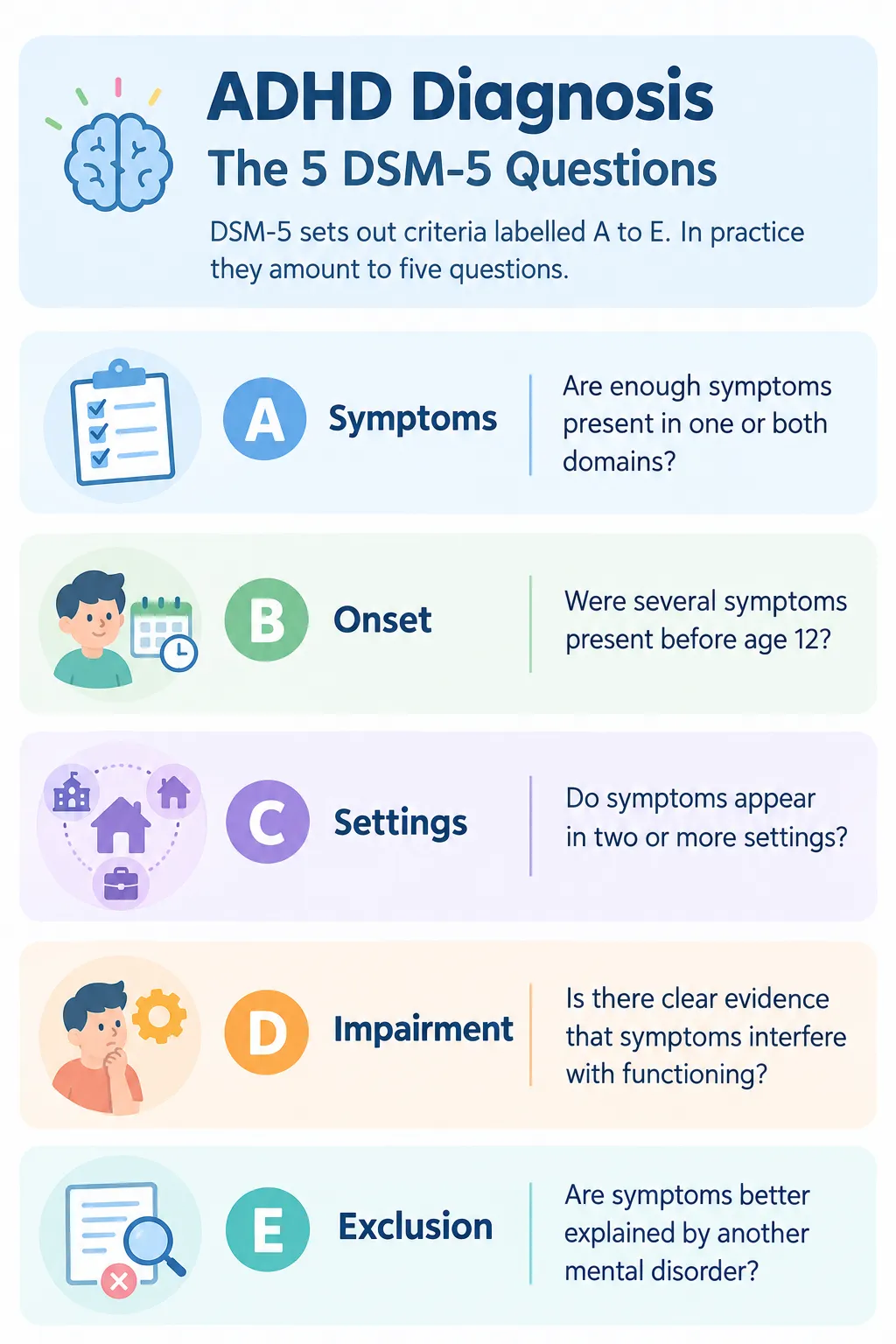
DSM-5 sets out criteria labelled A to E. In practice they amount to five questions.
| Requirement | What it asks |
| A. Symptoms | Are enough symptoms present in one or both domains? |
| B. Onset | Were several symptoms present before age 12? |
| C. Settings | Do symptoms appear in two or more settings? |
| D. Impairment | Is there clear evidence that symptoms interfere with functioning? |
| E. Exclusion | Are symptoms better explained by another mental disorder? |
Meeting Criterion A is only part of a diagnosis. The clinician must also establish the required developmental onset, presence across settings and functional impairment, and that the symptoms are not better explained by another condition. Criterion E is not an extra symptom requirement; it is the differential diagnosis question. Meeting the symptom threshold alone is not sufficient, which is the point most symptom lists omit.
Criterion A: The Symptom Thresholds
| Age group | Inattention | Hyperactivity-impulsivity |
| Children up to 16 | At least 6 of 9 | At least 6 of 9 |
| Aged 17 and over | At least 5 of 9 | At least 5 of 9 |
Symptoms must also have persisted for at least six months and be inconsistent with developmental level. DSM-5 uses a lower symptom threshold from age 17 onward.
Inconsistent with developmental level is doing real work in that sentence. The question is not whether the behaviour exists but whether it exceeds what would be expected for someone of that age and stage. A six-year-old who cannot sit still through a long meeting is unremarkable; a sixteen-year-old with the same difficulty is not. Clinical assessment also takes developmental, cultural and contextual factors into account when interpreting both symptoms and impairment.
The two domains
Inattention covers difficulty sustaining attention, careless errors, not following through, difficulty organising, avoiding sustained mental effort, losing things, distractibility and forgetfulness. In adults, distractibility explicitly includes being drawn away by unrelated thoughts.
Hyperactivity-impulsivity covers fidgeting, leaving a seat, moving when it is not appropriate, difficulty engaging quietly, being on the go, talking excessively, blurting out answers, difficulty waiting and interrupting. In adolescents and adults, the criteria explicitly note that hyperactivity may be limited to feeling restless.
Our symptoms guide covers all eighteen in detail, including how each presents at different ages.
Criterion B: Onset Before Age 12
This is the most misread requirement.
It requires that several symptoms were present before age 12. It does not require that all symptoms were present, that the full diagnostic picture was evident, or that anyone identified them at the time. A diagnosis in childhood is not required.
Why this matters for adults
Many adults conclude they cannot be assessed because nobody noticed when they were young. Quieter presentations were routinely missed, particularly in children who were academically capable or not disruptive. What is needed is evidence of the pattern, not a record of a diagnosis.
The previous edition, DSM-IV, required onset before age 7; DSM-5 raised this to 12 (American Psychiatric Association, 2022).
Criterion C: Two or More Settings
Symptoms must be present in two or more settings, such as home, school, work, with friends or relatives, or in other activities.
This is why assessment gathers information from more than one source. Difficulty confined to a single demanding environment points toward something specific about that environment rather than toward a pervasive pattern, though ADHD symptoms can genuinely vary by context.
Criterion D: Functional Impairment
There must be clear evidence that symptoms interfere with, or reduce the quality of, social, academic or occupational functioning.
This criterion separates a diagnosable condition from recognisable traits. Almost everyone experiences distraction, disorganisation and restlessness. What DSM-5 requires is demonstrable interference with functioning.
In practice that interference tends to look like this:
- At school: assignments left incomplete, deadlines missed, performance inconsistent with apparent ability
- At work: missed deadlines, difficulty organising tasks, trouble sustaining attention on longer work
- Socially: interrupting, forgetting commitments, strain on relationships
- At home: administrative tasks left undone, disorganisation that has consequences rather than being an inconvenience
Criterion E: Not Better Explained
Symptoms must not occur exclusively during schizophrenia or another psychotic disorder, and must not be better explained by another mental disorder.
In practice this is the differential diagnosis work: anxiety, depression, sleep disorders, trauma-related conditions, substance use and other conditions can produce overlapping difficulties. Better explained is not the same as cannot co-occur. DSM-5 removed the earlier prohibition on diagnosing ADHD and autism together, which made the two diagnostically compatible. Separately from that change, Australia’s clinical guideline recognises autism as a common co-occurring neurodevelopmental condition in people with ADHD, and states that ADHD can be diagnosed in the presence of other conditions (Australian ADHD Professionals Association, 2022).
Presentations and Severity
Two specifiers are recorded alongside the diagnosis.
| Specifier | Options |
| Presentation | Predominantly inattentive, predominantly hyperactive-impulsive, or combined, depending on which domains meet threshold |
| Severity | Mild, moderate or severe, based on symptom count beyond threshold and degree of functional impairment |
DSM-5 replaced the DSM-IV term subtype with presentation, because a person’s symptom pattern can change over time. Our guide to types and presentations covers this in detail.
DSM-5 also allows a specifier of in partial remission, where full criteria were previously met, fewer symptoms have been present for the past six months, and symptoms still result in functional impairment.
Where Do ADHD Questionnaires and Rating Scales Fit?
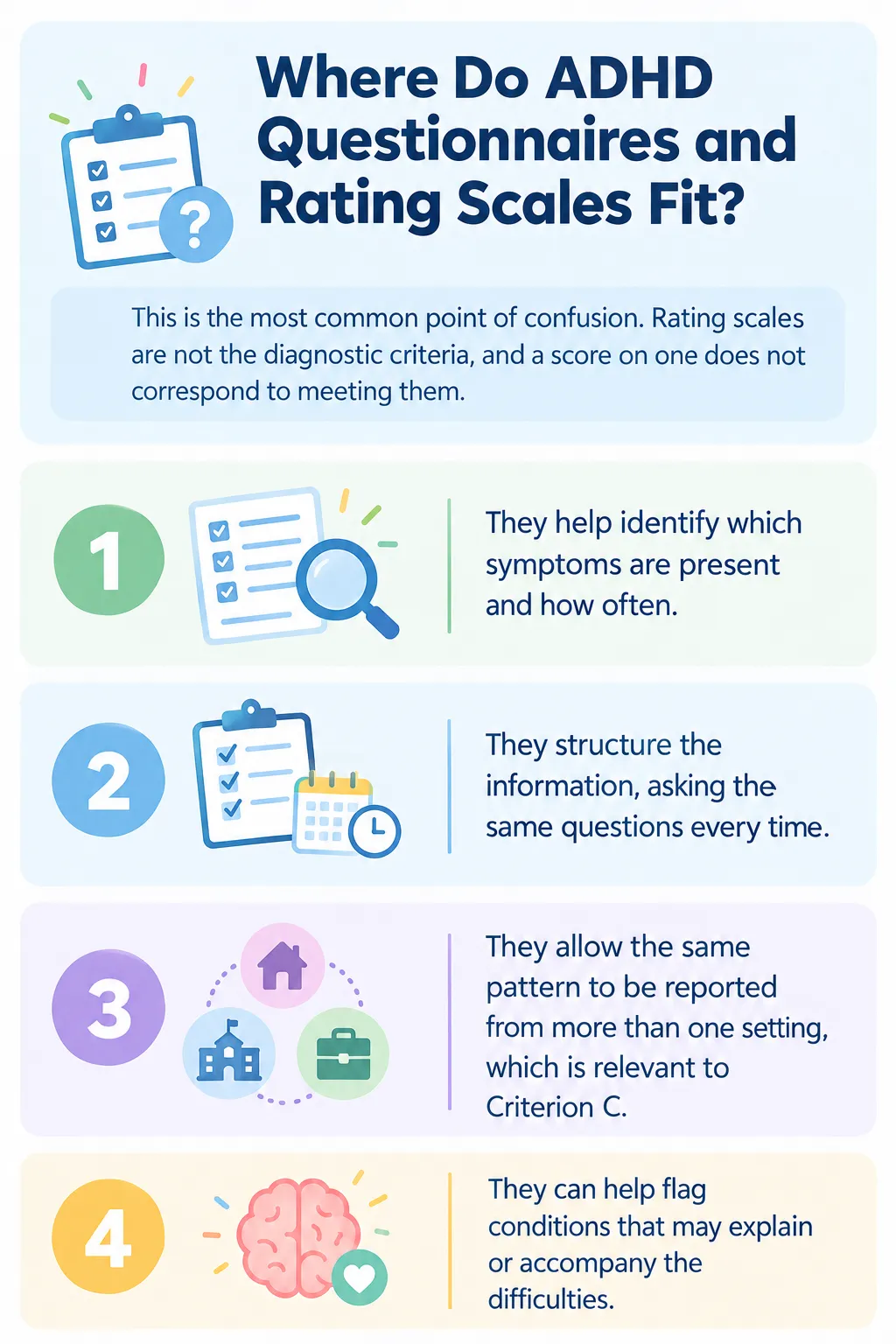
This is the most common point of confusion. Rating scales are not the diagnostic criteria, and a score on one does not correspond to meeting them.
- They help identify which symptoms are present and how often
- They structure the information, asking the same questions every time
- They allow the same pattern to be reported from more than one setting, which is relevant to Criterion C
- They can help flag conditions that may explain or accompany the difficulties
What they do not do is establish the diagnosis. Australia’s clinical guideline is explicit that diagnosis should not rest solely on rating scales or observational data (Australian ADHD Professionals Association, 2022). They feed evidence into criteria that a clinician then applies. The separate guide to ADHD questionnaires and rating scales covers the individual instruments.
DSM-5 and DSM-5-TR
DSM-5-TR was published in 2022 as a text revision. It updated supporting text, prevalence information and wording, and retains the core DSM-5 ADHD diagnostic framework. The American Psychiatric Association continues to publish periodic updates to DSM-5-TR criteria and text, so the current manual and its published updates are what should be used when applying the criteria clinically.
How DSM-5 Differs From ICD-11
Both systems are used internationally and in Australia, and both organise ADHD around inattention and hyperactivity-impulsivity. They are not interchangeable, and the differences are more than cosmetic.
| DSM-5 | ICD-11 | |
| Coding | Used alongside ICD codes for administrative purposes | 6A05, with five categories: 6A05.0, 6A05.1, 6A05.2, 6A05.Y and 6A05.Z |
| Symptom thresholds | Specified counts: six for children up to 16, five from age 17 | Fewer specific requirements regarding symptom thresholds, allowing more clinical judgement |
| Onset | Several symptoms present before age 12 | Framed in terms of the developmental period rather than a single age cut-off |
| Category | Neurodevelopmental disorders | Neurodevelopmental disorders |
ICD-11 codes ADHD as 6A05 and sets out five categories beneath it: 6A05.0 predominantly inattentive presentation, 6A05.1 predominantly hyperactive-impulsive presentation, 6A05.2 combined presentation, 6A05.Y other specified presentation and 6A05.Z presentation unspecified. DSM-5’s three presentations therefore do not map one to one onto ICD-11’s categories.
The onset requirements are also not equivalent. DSM-5 specifies that several symptoms were present before age 12. ICD-11 frames onset in terms of the developmental period rather than a single numeric cut-off, so treating the two as the same requirement stated differently is misleading. In Australia, clinicians may work from DSM-5 or DSM-5-TR or from ICD-11 depending on the clinical setting and purpose; Australia’s clinical guideline identifies both as the main systems in use (Australian ADHD Professionals Association, 2022).
What the Criteria Do Not Include
Several features strongly associated with ADHD are not diagnostic criteria. Their absence does not rule ADHD out, and their presence does not establish it.
- Emotional regulation difficulties, which are commonly reported and recognised as associated
- Hyperfocus, which is widely described but not consistently defined in research
- Time blindness, which is a community term rather than a clinical one
- Rejection sensitivity, which is not a diagnostic category in DSM-5-TR or ICD-11
- Sensory sensitivity, which appears in autism criteria rather than ADHD criteria
The Criteria Are Not a Self-Test
Reading the criteria and recognising yourself in them is a reasonable starting point. It is not a diagnosis, and the gap between the two is larger than it looks. Four of the five requirements call for judgements that cannot be made from the inside: whether symptoms exceed what is expected for your developmental level, whether impairment is clinically meaningful rather than frustrating, whether the pattern genuinely spans settings, and whether something else accounts for it better.
If you are trying to work out whether these criteria apply to you or to someone you care for, a clinician can assess symptoms, developmental history, functioning and alternative explanations together. The guides to how ADHD is diagnosed in Australia.
Related Guides
- How to get an ADHD diagnosis as an adult
- Do I have ADHD? Making sense of your own symptoms
- ADHD, IQ, intelligence and giftedness
References
- American Psychiatric Association. Diagnostic and Statistical Manual of Mental Disorders, Fifth Edition, Text Revision (DSM-5-TR). 2022.
- World Health Organization. International Classification of Diseases, 11th Revision (ICD-11). 6A05 Attention deficit hyperactivity disorder. icd.who.int
- World Health Organization. Clinical descriptions and diagnostic requirements for ICD-11 mental, behavioural and neurodevelopmental disorders (CDDR). 2024. who.int
- Australian ADHD Professionals Association. Australian Evidence-Based Clinical Practice Guideline for Attention Deficit Hyperactivity Disorder (ADHD). Released October 2022. adhdguideline.aadpa.com.au
- American Psychiatric Association. Updates to DSM-5-TR criteria and text. psychiatry.org
Last reviewed: September 2026. Next scheduled review: September 2027. This article is general information and is not a substitute for individual medical advice, assessment or diagnosis.