

How Do You Study With ADHD?
Two things matter more than any technique. Register with your institution’s disability or inclusion service, because reasonable adjustments are part of the obligations education providers have under the Disability Standards for Education 2005, not a discretionary favour. And build study around short, externally-structured sessions with visible progress, because the difficulty is usually starting and sustaining rather than understanding.
Studying with ADHD goes wrong in a specific place, and it is not usually the material. School supplies structure: a timetable, daily contact, someone noticing when work is not handed in. ADHD at university, and at TAFE, runs into the opposite: almost all of that structure is removed and replaced with a deadline twelve weeks away. The people who struggle most are frequently those who did well at school, because the scaffolding that was doing the work was invisible until it disappeared.
ADHD and university are a difficult combination for reasons that are fixable, and knowing how to study ADHD-style starts with the system rather than the technique. This guide covers the Australian adjustments system, which is the part almost no study-tips article mentions, and then the strategies themselves. For the wider adult picture, see the guide to ADHD in adults.
Your Rights as a Student in Australia
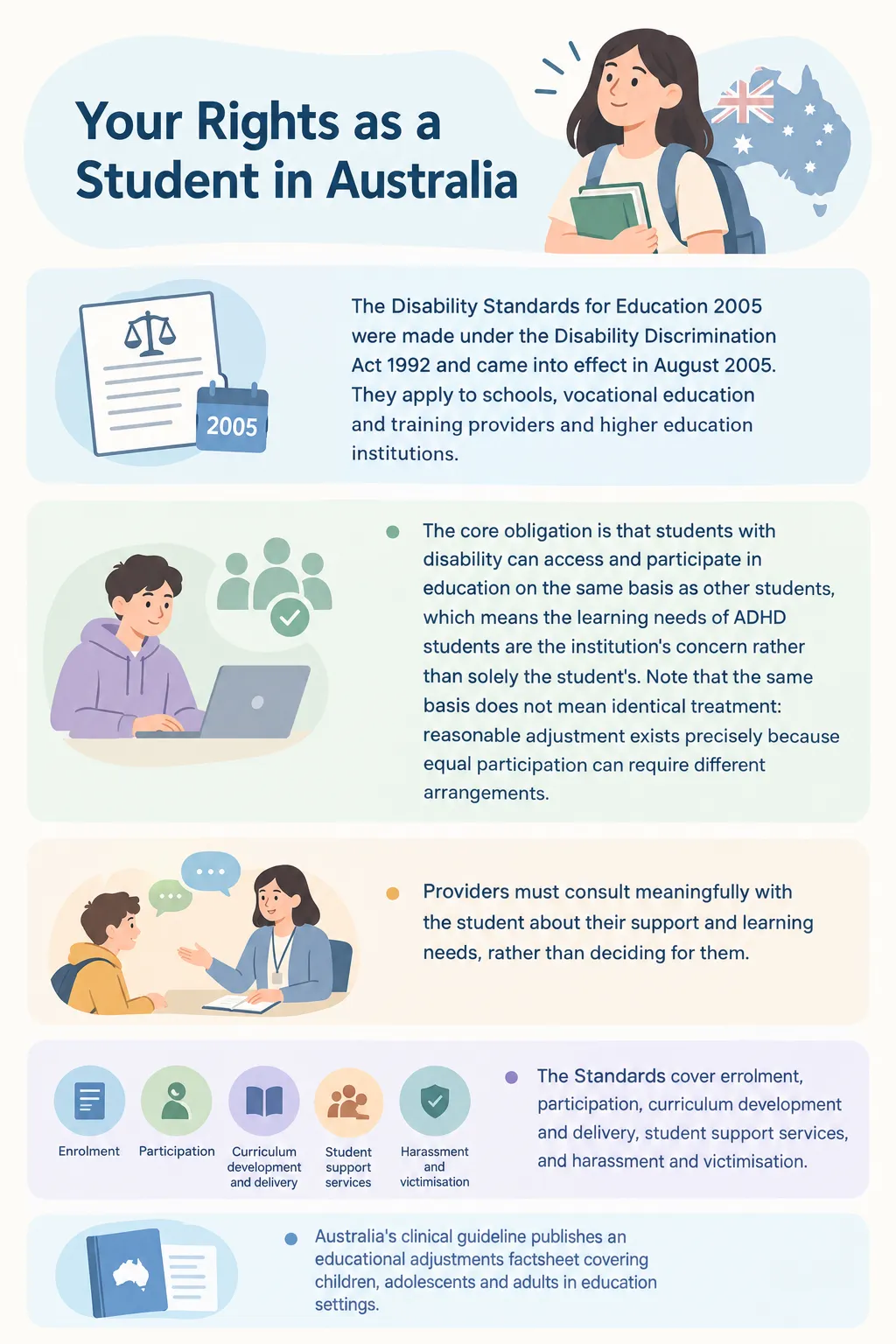
The Disability Standards for Education 2005 were made under the Disability Discrimination Act 1992 and came into effect in August 2005. They apply to schools, vocational education and training providers and higher education institutions.
- The core obligation is that students with disability can access and participate in education on the same basis as other students, which means the learning needs of ADHD students are the institution’s concern rather than solely the student’s. Note that the same basis does not mean identical treatment: reasonable adjustment exists precisely because equal participation can require different arrangements
- Providers must consult meaningfully with the student about their support and learning needs, rather than deciding for them
- The Standards cover enrolment, participation, curriculum development and delivery, student support services, and harassment and victimisation
- Australia’s clinical guideline publishes an educational adjustments factsheet covering children, adolescents and adults in education settings
Whether ADHD meets the definition of disability in a particular case depends on the circumstances, and this is general information rather than legal advice. The guide to whether ADHD is a disability covers that question.
What Makes an Adjustment Reasonable
A reasonable adjustment is one that relates to a student’s disability-related needs and enables participation, decided through consultation with the student. It does not mean every requested change must be made, and it operates within the requirements of the education program. Providers can consider practicality and whether a change would cause unjustifiable hardship. This is general information rather than legal advice.
Registering With Disability Services
Every Australian university and most TAFEs have a disability, inclusion or accessibility service. Registering with it is the single highest-value thing an ADHD student can do, and a large number never do, usually because they assume ADHD does not count or that the process is harder than it is.
A common process looks like this
- Gather supporting documentation from your treating health professional, usually on the institution’s own form
- Apply through the student portal or wellbeing system
- Meet with an inclusion or disability officer, typically for about an hour, to work out what you actually need
- The service develops a personalised academic plan, which formally communicates your approved adjustments to teaching staff for the semester
The academic plan is the part that matters. It means you are not negotiating with each individual lecturer, explaining yourself repeatedly, or relying on goodwill. Processes, terminology and documentation requirements differ between institutions and courses, so check your own rather than assuming the description above applies everywhere.
Adjustments that may be available
- Assessment and exam adjustments, such as extra time or a separate room
- Alternative formatting of materials
- Timetable adjustments
- Access to assistive technology
- Lecture support, including recording or note-taking assistance
- Placement adjustments for courses with practical components
- Library services, including extended loans
Academic adjustments are not special consideration
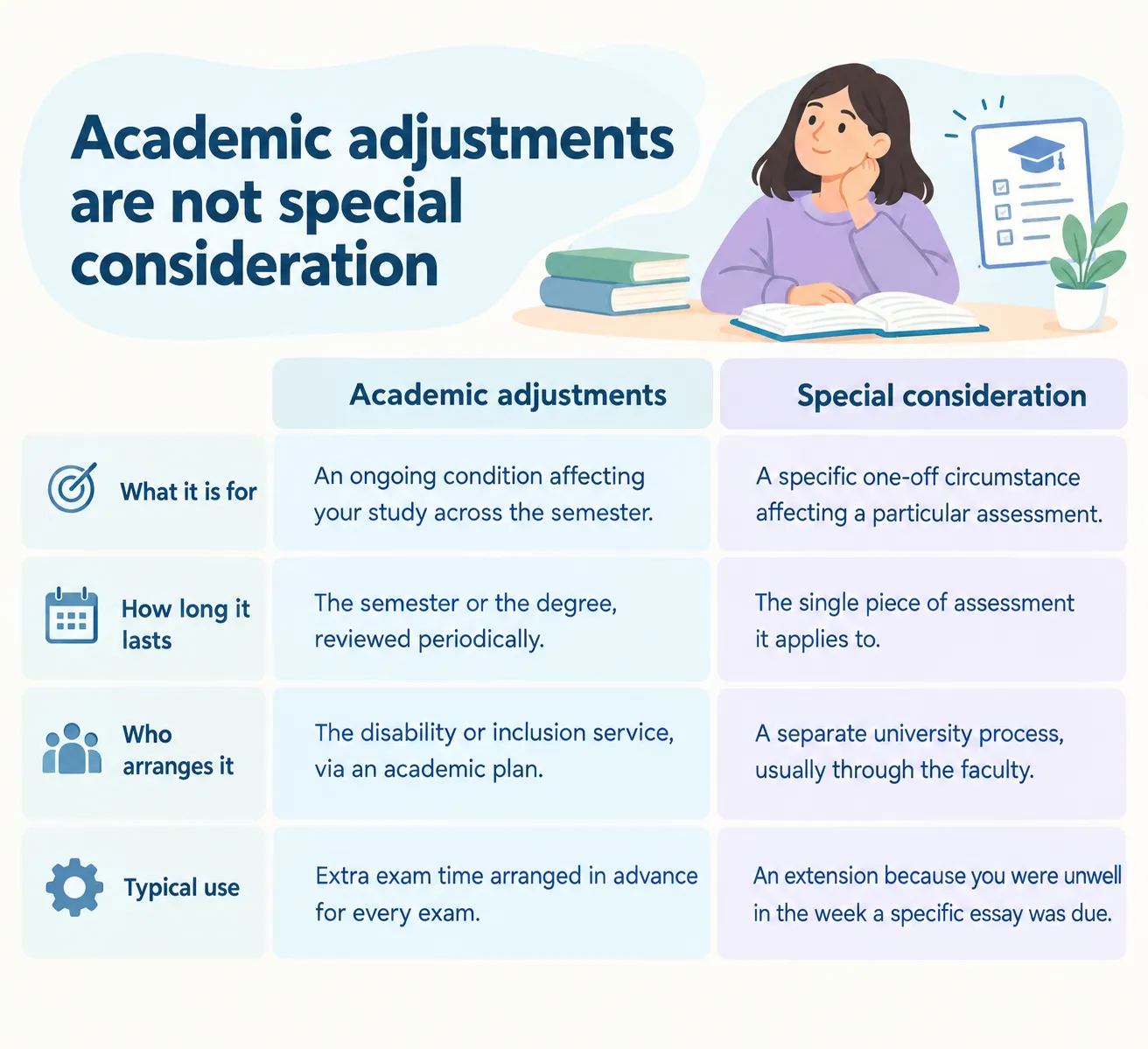
These get confused constantly, and they are different processes with different purposes.
| Academic adjustments | Special consideration | |
| What it is for | An ongoing condition affecting your study across the semester | A specific one-off circumstance affecting a particular assessment |
| How long it lasts | The semester or the degree, reviewed periodically | The single piece of assessment it applies to |
| Who arranges it | The disability or inclusion service, via an academic plan | A separate university process, usually through the faculty |
| Typical use | Extra exam time arranged in advance for every exam | An extension because you were unwell in the week a specific essay was due |
Disability services generally cannot intervene in special consideration decisions, academic appeals or requests for leniency. The exact names, eligibility criteria and application processes vary by institution. If you have an ongoing condition, the adjustment route is the one that prevents the problem rather than responding to it.
ADHD Study Techniques That Account for How ADHD Works
Most study skills advice assumes the problem is not knowing how to study. For ADHD students it is almost always starting and sustaining. Study techniques for ADHD, and study skills for ADHD more broadly, have to target that or they are just a nicer-looking version of trying harder. The ADHD study methods below are grouped by which part of the problem they address, and useful ADHD study habits tend to come from the same principle: reduce what depends on willpower.
Which Study Strategies Have the Strongest Evidence
Not every popular ADHD study technique has the same evidence behind it, and it is worth knowing which is which. Retrieval practice and spaced practice have strong general learning evidence across subjects and age groups. The ADHD-specific evidence base is much smaller: a 2024 systematic review of university students with ADHD found that symptoms, particularly inattention, are associated with poorer academic performance, and that executive functioning and study strategies also influence outcomes.
| Strategy | Evidence status | How to use it |
| Retrieval practice | Strong general learning evidence | Test yourself instead of only rereading |
| Spaced or distributed practice | Strong general learning evidence | Spread review across several sessions rather than one block |
| Practice testing under exam conditions | Strong general learning evidence | Use past papers and time yourself |
| Short structured study blocks | Practical ADHD-friendly strategy | Choose a duration you can actually maintain |
| External structure and accountability | Plausible and widely used; ADHD-specific evidence is limited | Scheduled sessions, study partners, agreed deadlines |
| Body doubling | Practical strategy with limited ADHD-specific evidence | Work alongside someone, in person or on a call |
| Environmental change | Reasonable ADHD-support strategy | Change location, remove the phone, reduce friction |
Starting
- Shrink the first step until it is too small to avoid. Opening the document and writing the title is a legitimate first step
- Decide when and where in advance, specifically. A plan attached to a time and a place gets acted on far more often than an intention
- Use a launch ritual, the same one every time, so starting becomes a habit rather than a decision
- Work with someone else present, in person or on a call. Body doubling is a practical strategy with limited ADHD-specific evidence, and many students find it changes the conditions rather than requiring more willpower
Sustaining
- Short blocks with fixed breaks. Many people find 25 minutes works; some need 15 and some can hold 50. Among tips for studying with ADHD this is the one most often adopted from someone else and least often adjusted, so find your own length
- Make progress visible. A word count, a page count, a physical tick. Invisible progress does not sustain effort
- Change location when attention collapses, rather than pushing through in the same chair
- Put the phone in another room. Notification-off in your pocket is not the same thing
Reading and notes
- Read with a question you are trying to answer, not from the first page to the last. This is one of the more reliable study tips for ADHD, because it converts passive reading into a search
- Read actively: highlight sparingly, then summarise the section in your own words before moving on
- Record lectures where permitted, because divided attention between listening and writing is the specific difficulty
- Some students find handwriting useful because it forces them to process and condense rather than transcribe. Evidence comparing handwriting and typing is mixed and depends on the task and note-taking style
- Rewrite notes into a condensed version within a day or two. For many students, condensing and recalling material soon after a lecture is more useful than repeatedly reviewing the original notes, because it does the encoding that may not have happened live
What does not work well
- Long unbroken study sessions, which look productive and produce diminishing returns quickly
- Re-reading as a main revision method. It can create a sense of familiarity without requiring you to retrieve the information, and active recall generally provides stronger retrieval practice for durable learning
- Studying somewhere comfortable enough to fall asleep
- Waiting to feel motivated. Waiting can make starting harder, so many students find it more useful to make the first step very small
ADHD and Assignments
Assignments fail at predictable points, and each has a specific fix.
| Where it goes wrong | What to do about it |
| The deadline is too far away to feel real | Set your own milestones with someone else attached to them, since self-imposed deadlines can be harder to maintain when external accountability is limited |
| The task is too big to start | Break it down until the first step takes under ten minutes, and write the breakdown down |
| Research expands indefinitely | Set a time limit for research and stop when it ends, even if it feels incomplete |
| The draft is delayed until it can be done properly | Write a deliberately bad first draft. Editing is a different and easier task than creating |
| Everything happens in the final 48 hours | Plan for it rather than pretending otherwise. Front-load the reading and research so the crunch is writing, which is the part urgency actually helps |
| Submission itself is forgotten | Set an alarm for submission separately from the deadline for finishing |
ADHD and Exams
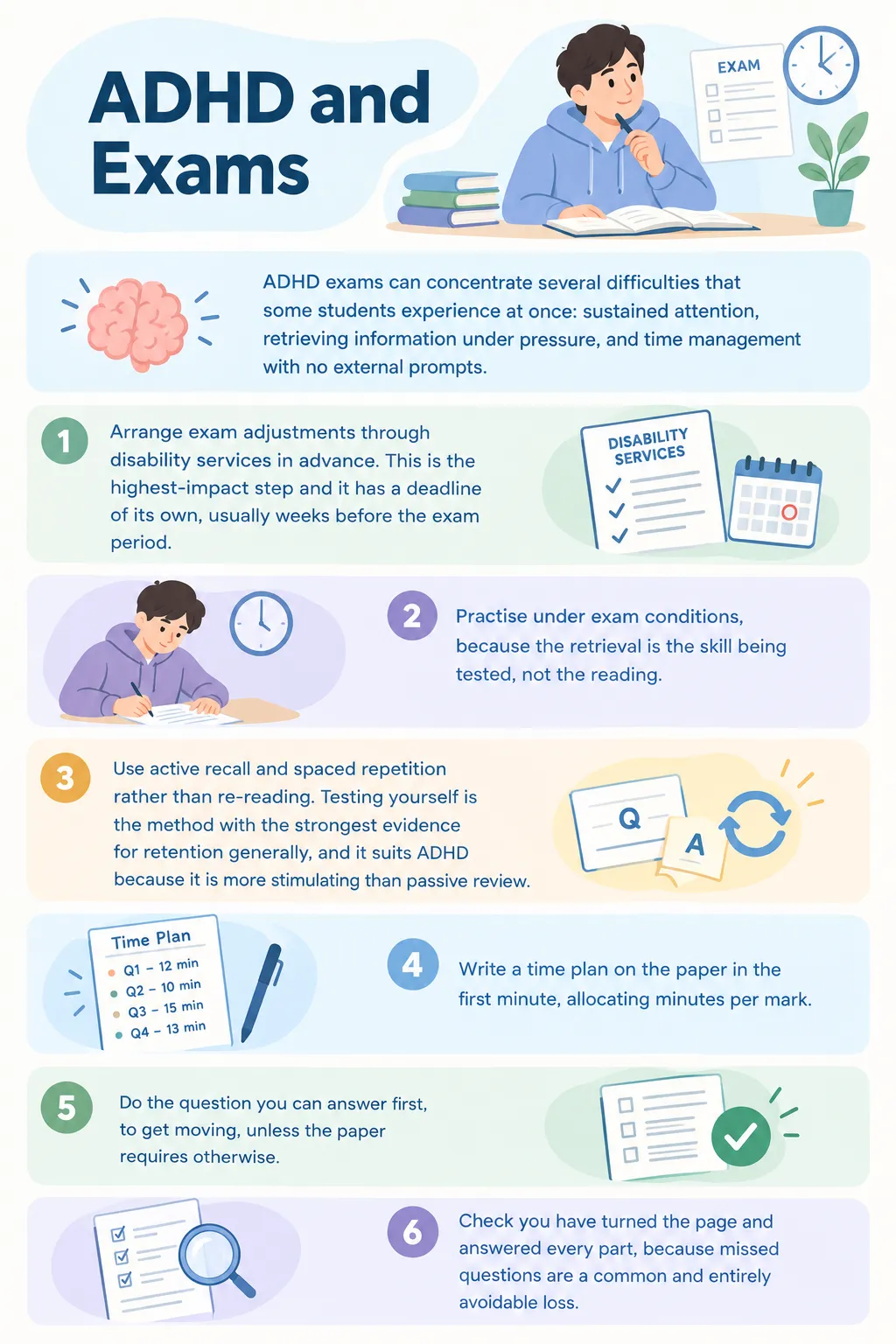
ADHD exams can concentrate several difficulties that some students experience at once: sustained attention, retrieving information under pressure, and time management with no external prompts.
- Arrange exam adjustments through disability services in advance. This is the highest-impact step and it has a deadline of its own, usually weeks before the exam period
- Practise under exam conditions, because the retrieval is the skill being tested, not the reading
- Use active recall and spaced repetition rather than re-reading. Testing yourself is the method with the strongest evidence for retention generally, and it suits ADHD because it is more stimulating than passive review
- Write a time plan on the paper in the first minute, allocating minutes per mark
- Do the question you can answer first, to get moving, unless the paper requires otherwise
- Check you have turned the page and answered every part, because missed questions are a common and entirely avoidable loss
Study Tools and Apps
ADHD study tools work when they reduce friction and fail when they become the project. An ADHD study planner you spend three hours designing is procrastination wearing a productivity costume. The useful categories of study aids for ADHD are timers, distraction blockers, task capture, text to speech and recording, and the ADHD study websites worth using are the ones you will actually open twice. Tools for ADHD students, ADHD apps for students and ADHD tools and gadgets for students are covered in more depth in the guide to apps and tools for ADHD.
Two principles worth applying to any of them. Choose the one you will actually open, not the best-reviewed one. And limit yourself to one tool per job, because tool-switching is itself a form of avoidance.
Tutoring and academic support
Most Australian universities and TAFEs run free academic support: writing centres, learning advisers, peer mentoring and subject-specific drop-ins. A tutor for an ADHD student is often most useful not for explaining content but for providing the external structure and accountability that makes the work happen. That is a legitimate reason to use one.
TAFE, VET and Apprenticeships
The Disability Standards for Education 2005 apply to vocational education and training providers as well as universities, so the right to adjustments is the same. The practical picture differs.
- Some students find practical and hands-on components easier to engage with than lecture-based learning, while others find practical environments more distracting or administratively demanding
- Workplace-based training brings the workplace adjustment question with it, which is a different framework again
- Support services exist but are usually less visible than at university, so ask directly rather than waiting to be offered
When Study Stops Being the Problem
Some difficulties are not study-skills problems and will not respond to study-skills solutions.
- Persistent low mood, anxiety or exhaustion that does not lift between assessment periods
- Sleep that has inverted or collapsed, which degrades attention independently
- Repeated withdrawal from units, or a pattern of starting courses and not finishing
- Feeling that you are working many more hours than peers for worse results, which is a common and exhausting experience among students with undiagnosed ADHD
Most institutions provide free counselling to enrolled students, and a GP is the starting point for anything clinical. If you have not been assessed and this describes you, the guide to getting an ADHD diagnosis as an adult sets out the pathway.
Related Guides
- ADHD at work: rights, adjustments and what helps
- ADHD burnout: what it is and how it differs from tiredness
- ADHD in teenagers
- ADHD, emotional dysregulation and rejection sensitivity
References
- Australian Government Department of Education. Disability Standards for Education 2005, and accompanying guidance notes. education.gov.au
- Disability Discrimination Act 1992 (Cth). legislation.gov.au
- Australian ADHD Professionals Association. Educational adjustments for students with ADHD factsheet, covering children, adolescents and adults in education settings. adhdguideline.aadpa.com.au
- ADHD and academic performance in college students: a systematic review. 2024. PMID 39668738
- Systematic review of distributed practice and retrieval practice in health professions education. 2023. PMID 37615780
- Australian Disability Clearinghouse on Education and Training (ADCET). Tertiary disability support information. adcet.edu.au
- Australian ADHD Professionals Association. Australian Evidence-Based Clinical Practice Guideline for Attention Deficit Hyperactivity Disorder (ADHD). Released October 2022. Educational and occupational outcomes. adhdguideline.aadpa.com.au
- University of Sydney. Inclusion and disability services: registration process and academic plans, used here as a representative example of Australian university practice. sydney.edu.au
Last reviewed: September 2026. Next scheduled review: September 2027. This article is general information and is not a substitute for individual medical advice, assessment or diagnosis.