

What Is ADHD in Adults?
The same neurodevelopmental condition recognised in childhood, presenting differently because adult life makes different demands. Hyperactivity tends to become less visible and more internal, inattention shows up as distractibility and difficulty formulating and finishing things, and impulsivity can appear in spending, eating or conflict. International estimates put adult prevalence at 2 to 6 per cent, and Australia’s clinical guideline notes there are no Australian adult prevalence studies using current DSM-5 criteria (Australian ADHD Professionals Association, 2022).
Many adults who go looking for this are not starting from curiosity. They are trying to work out whether a long-running pattern has a name, often after years of assuming it was a character problem.
This guide covers what adult ADHD actually is, how common it is in Australia, what happens to it across the lifespan, and where it shows up across working life, relationships, money, driving and study. It is the overview page for this topic. The detailed symptom picture is covered separately in the guide to ADHD symptoms in adults.
What ADHD Looks Like in Adulthood
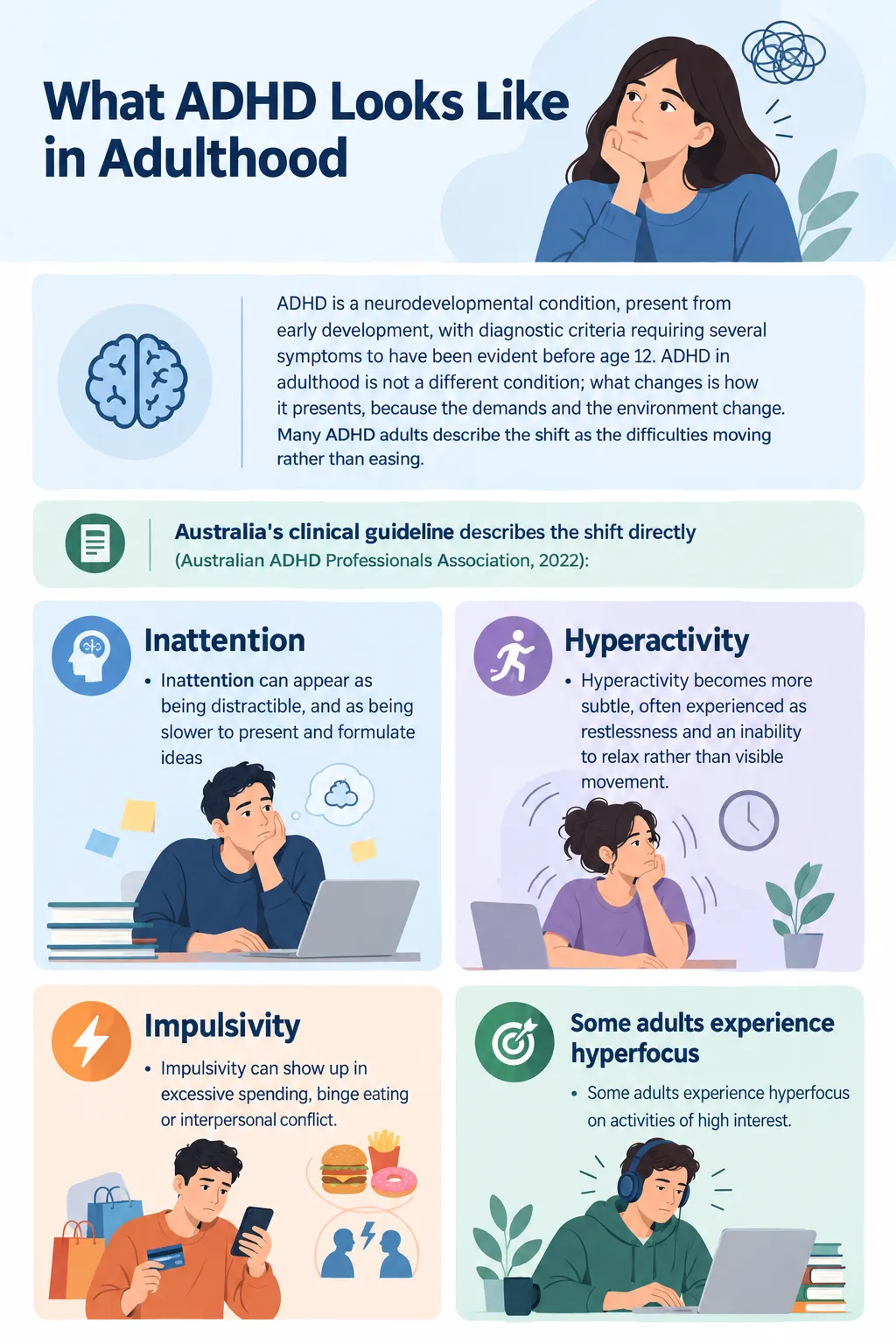
ADHD is a neurodevelopmental condition, present from early development, with diagnostic criteria requiring several symptoms to have been evident before age 12. ADHD in adulthood is not a different condition; what changes is how it presents, because the demands and the environment change. Many ADHD adults describe the shift as the difficulties moving rather than easing.
Australia’s clinical guideline describes the shift directly (Australian ADHD Professionals Association, 2022):
- Inattention can appear as being distractible, and as being slower to present and formulate ideas
- Hyperactivity becomes more subtle, often experienced as restlessness and an inability to relax rather than visible movement
- Impulsivity can show up in excessive spending, binge eating or interpersonal conflict
- Some adults experience hyperfocus on activities of high interest
That last point causes a lot of confusion, including for the person themselves. The ability to lock onto something absorbing for hours sits oddly with a condition named after an attention deficit, and it is one of the reasons adults conclude the label cannot apply to them.
Symptoms, Impairment and Compensation Are Different Things
This distinction matters more in adulthood than at any other age, and it answers the question many adults ask first: how could I have ADHD when I have a career and a mortgage?
Symptoms are the difficulties themselves. Impairment is the effect they have on functioning, which is what diagnosis requires alongside the symptoms. Compensation is everything a person has built to reduce that effect. An adult may have developed strategies that lower the visible impact of symptoms without removing the underlying difficulties, which is why outcomes alone are a poor guide to whether ADHD is present.
- Excessive preparation, so nothing depends on recall in the moment
- Working longer hours to produce the same output
- Relying on deadline pressure to start anything
- Rigid routines that break down when circumstances change
- Extensive reminder systems
- Avoiding roles, tasks or situations that would expose the difficulty
The cost of compensating is real and rarely counted. It is also why some adults only come to assessment when the compensation stops working, typically when demands increase or the structure that was holding it together disappears.
ADHD in Older Adults
Australia’s clinical guideline states that ADHD should be considered across all age groups, including adults over 65 (Australian ADHD Professionals Association, 2022). Recognition in later life is less common, and treatment planning at that stage takes account of other health conditions, other medicines already being taken and a different pattern of daily demands.
Adult ADD and ADHD describe the same condition. ADD is a former name, most often used for what is now called the predominantly inattentive presentation. The guide to ADD versus ADHD covers the terminology.
How Common Is ADHD in Australian Adults?
The honest answer is that nobody knows precisely, and that is worth stating plainly because a lot of content quotes Australian figures with more confidence than the evidence supports.
Australia’s clinical guideline states there are no Australian adult prevalence studies using current DSM-5 diagnostic criteria. Only one Australian adult study was identified, and it had significant limitations including a small sample, non-clinical assessment and outdated criteria. International estimates put adult prevalence in the range of 2 to 6 per cent (Australian ADHD Professionals Association, 2022).
Australian prescription data gives a partial picture of treatment, not of prevalence. Analysis by the Medicines Intelligence Research Program at UNSW of subsidised Pharmaceutical Benefits Scheme and Repatriation PBS dispensing found that 2.36 per cent of Australian adults aged 20 to 64 filled at least one ADHD medication prescription in the 2025 financial year, up from 0.35 per cent in 2016 to 2017 (UNSW, April 2026). The researchers are explicit that this measures medicines dispensed rather than diagnoses, so it describes treatment access, not how many people have ADHD.
Why the rate depends on your postcode
The same analysis found substantial variation between areas. In 2023 to 2024, Fremantle and Cottesloe in Western Australia recorded the highest rates nationally at 4.4 and 4.1 per cent, while Fairfield in south-western Sydney recorded 0.3 per cent. Western Australia accounted for 13 of the 20 highest-dispensing areas.
What this data can and cannot tell you matters. It shows that the proportion of adults receiving ADHD medication varies substantially between areas. It does not establish that ADHD itself is more common in one suburb than another, because dispensing reflects diagnosis, access, clinician availability, affordability, prescribing patterns, awareness and local services as well as underlying need. Some media reporting has described very low-dispensing areas as ADHD deserts; that is a journalistic description rather than an established epidemiological category, and prescription data alone cannot establish how many people in those areas have ADHD or remain undiagnosed. Commentary on the analysis has raised questions in both directions, about people who may be missing out and about whether some diagnoses are being made too readily.
Adult ADHD in Australia: What We Know and What We Do Not
| Question | What the evidence shows | What remains uncertain |
| Adult prevalence | International estimates of 2 to 6 per cent (AADPA, 2022) | No Australian adult prevalence study using current DSM-5 criteria |
| Medication use | 2.36 per cent of adults aged 20 to 64 filled an ADHD prescription in FY2025 (UNSW, 2026) | This measures dispensing, not diagnosis or prevalence |
| Geographic variation | Large differences between areas, from 4.4 per cent to 0.3 per cent in 2023 to 2024 | Causes cannot be determined from dispensing data alone |
| Persistence | Symptoms commonly persist into adulthood | Persistence of full diagnostic criteria varies widely by classification used |
| Diagnosis | Requires clinical assessment, developmental history, impairment and consideration of other explanations | Access to assessment varies considerably |
Whether rising recognition amounts to appropriate identification or over-identification is a genuinely contested question, and it is covered separately in the guide to undiagnosed, misdiagnosed and overdiagnosed ADHD.
Does ADHD Continue Into Adulthood?
For many people, yes, and the figures vary considerably depending on how persistence is defined.
Research following North American cohorts found that between 60 and 86 per cent of people with childhood ADHD experienced persistent symptoms into adulthood. Persistence of the full diagnostic criteria varied much more widely, from around 6 to 77 per cent, depending on which classification system was used (Australian ADHD Professionals Association, 2022).
That spread is not a flaw in the research so much as a reflection of a real question: whether someone still meets a symptom threshold designed largely around children is a different question from whether they still have significant difficulty. Many adults sit in the gap between those two, with symptoms that no longer look like the childhood picture and impairment that has not gone anywhere.
Can ADHD start in adulthood?
Under current diagnostic criteria, no. Several symptoms must have been present before age 12, even if nobody recognised them as ADHD at the time and no assessment was ever done. What can genuinely begin in adulthood is the point at which difficulties become unmanageable, usually when external structure disappears or demands increase.
ADHD in Men
Most of the recent public conversation about missed ADHD has focused on women, for good reason. It has left a gap where adult men are concerned, and ADHD in adult men is not as well covered as the diagnosis figures would suggest it should be.
Australia’s clinical guideline notes that prevalence is higher in boys than girls, with that disparity reducing somewhat in adulthood, and that women may become aware of symptoms in adulthood and self-refer for assessment (Australian ADHD Professionals Association, 2022). Boys are identified more often in childhood. The points below are patterns commonly described clinically rather than findings established for adult men specifically.
- Boys who were quiet and inattentive rather than disruptive were less likely to prompt a referral, and that route into late recognition is less discussed for men than for women
- Adult men often present when a job changes, a relationship is in difficulty, or a child is assessed and the pattern looks familiar
- Help-seeking for mental health is generally lower among men, which can delay assessment further
- Hyperactivity in adult males may be experienced as internal restlessness or channelled into work and physical activity, where it is less likely to be read as a symptom
The detailed symptom picture, including how ADHD presents in adult men specifically
And in women
Women are more likely to become aware of symptoms in adulthood and to self-refer for assessment, and Australia’s clinical guideline identifies girls and women as a group at risk of under-recognition. This has its own guides: ADHD symptoms in women and late ADHD diagnosis in women.
Where Adult ADHD Shows Up
This is the part that distinguishes adult ADHD from the childhood picture. The difficulties are the same mechanisms, but they land on a different set of responsibilities, and the consequences are correspondingly larger. Australia’s clinical guideline documents functional impact across several domains (Australian ADHD Professionals Association, 2022).
| Area of life | What the evidence describes | Where to read more |
| Work and career | Poorer employment quality, reduced income and lower occupational achievement | ADHD at work |
| Education | Adults with ADHD are nearly four times more likely not to have completed school | ADHD for students |
| Relationships | Difficulties in romantic relationships and in family functioning | ADHD and relationships |
| Money | Impulsivity can show up as excessive spending; income effects compound it | ADHD and money |
| Driving and safety | Increased risky driving, and increased mortality risk overall | ADHD and driving |
| Health | Higher rates of obesity and sleep problems, and poorer quality of life across physical, psychosocial and achievement domains | ADHD and sleep |
Two things about that table are worth saying out loud. These are population-level findings, not predictions about any individual, and plenty of adults with ADHD do well across every one of those domains, often with considerable effort behind the scenes. And the effort itself is the part that rarely gets counted: much of the cost of undiagnosed adult ADHD is in what it takes to keep the outcomes looking ordinary.
What Often Comes With It
Co-occurring conditions are common in adults with ADHD. A 2024 umbrella review of systematic reviews and meta-analyses found ADHD is associated with substantial comorbidity across both mental and physical health conditions, while noting that exact prevalence varies considerably by condition, population and study design. Figures as high as 80 per cent are sometimes quoted for at least one additional mental health condition, and that number depends heavily on which population is being described.
That figure matters for two practical reasons. It means an assessment that only looks for ADHD is not doing the whole job. And it explains why many adults have already been treated for something else, often anxiety or depression, sometimes for years, before ADHD is considered. That earlier treatment was not necessarily wrong; it addressed what was visible at the time.
Getting Assessed as an Adult
Adults can be diagnosed with ADHD, and many are. Assessment is a clinical process rather than a test: a clinician looks at current symptoms, developmental history reaching back before age 12, functioning across more than one setting, functional impairment, and other possible explanations. The full pathway, including what to do when childhood records no longer exist, is set out in the guide to getting an ADHD diagnosis as an adult.
If you are at the earlier stage of working out whether to pursue assessment at all, an ADHD checker adults can complete online is a screening questionnaire rather than a diagnostic tool. The guide to free ADHD tests for adults covers what those tools can and cannot tell you.
Adult ADHD Treatment
ADHD treatment for adults is individualised rather than standard. Treating ADHD in adults can involve pharmacological approaches, non-pharmacological approaches or both, decided with a clinician based on severity, impairment, co-occurring conditions, preferences and what is actually available. Cognitive-behavioural intervention carries a strong recommendation for adults in Australia’s clinical guideline. The full picture is in the guide to ADHD treatment in Australia, and this article does not cover medication.
Is there a cure for ADHD in adults?
There is currently no established treatment that cures ADHD. An adult ADHD cure is not something any treatment offers, and current clinical guidance does not support a cure through any intervention. What treatment and support change is how much difficulty the condition causes, which for many adults is a substantial difference.
Living With Adult ADHD
Two practical themes come up repeatedly in discussions of managing adult ADHD, and neither is about willpower.
The first is that they stop relying on remembering. Systems that live outside your head, environments arranged to reduce friction, and structure that does not depend on being in the right frame of mind on the day all do more work than effort does.
The second is that they get the secondary layer treated as well as the primary one. Decades of unexplained difficulty tend to leave beliefs behind, and those beliefs affect what someone attempts. Addressing them is not separate from managing ADHD; for many adults diagnosed late it is most of the work.
Related Guides
- ADHD at work: careers, jobs and workplace adjustments
- ADHD and relationships
- ADHD hyperfocus and hyperfixation
References
- Australian ADHD Professionals Association. Australian Evidence-Based Clinical Practice Guideline for Attention Deficit Hyperactivity Disorder (ADHD). Released October 2022. Background section on ADHD across the lifespan, prevalence, persistence and functional impact. adhdguideline.aadpa.com.au
- Medicines Intelligence Research Program, University of New South Wales. New data shows sharp rise in adult ADHD medication use, April 2026. Analysis of subsidised Pharmaceutical Benefits Scheme and Repatriation PBS dispensing via the Australian Bureau of Statistics Person Level Integrated Data Asset, adults aged 20 to 64. unsw.edu.au
- Comorbid health conditions in people with attention-deficit/hyperactivity disorders: an umbrella review of systematic reviews and meta-analyses. 2024. PMID 39003821
- ABC News. ADHD rates in adults are skyrocketing, but by how much depends where you live. April 2026. Public reporting of the UNSW analysis.
- American Psychiatric Association. Diagnostic and Statistical Manual of Mental Disorders, Fifth Edition, Text Revision (DSM-5-TR). 2022. Neurodevelopmental disorders.
- World Health Organization. International Classification of Diseases, 11th Revision (ICD-11). 6A05 Attention deficit hyperactivity disorder. icd.who.int
- Healthdirect Australia. Attention deficit hyperactivity disorder (ADHD). healthdirect.gov.au
Last reviewed: September 2026. Next scheduled review: September 2027. This article is general information and is not a substitute for individual medical advice, assessment or diagnosis.