

Is Emotional Dysregulation Part of ADHD?
Emotional regulation difficulties are commonly reported in ADHD and are recognised in Australian clinical guidance as associated with the condition, although they are not part of the formal diagnostic criteria (Australian ADHD Professionals Association, 2022). What people describe is usually intensity and speed rather than a different range of emotions.
This is one of the more significant gaps between the diagnostic criteria and how people actually experience ADHD. The 18 criteria say nothing about emotion. A great many people with ADHD would put emotional intensity near the top of a list of what is hardest.
The research supports that gap being real. A major review of the literature concluded that emotion dysregulation is prevalent in ADHD across the lifespan and is a significant contributor to impairment, while also finding that no consensus had been reached on how to conceptualise it (Shaw, Stringaris, Nigg and Leibenluft, American Journal of Psychiatry, 2014).
This guide covers what emotional dysregulation means in this context, what the evidence supports, how anger and rejection sensitivity fit, and where emotional difficulty points somewhere other than ADHD. People search for this in several ways, including ADHD emotional dysregulation, emotional regulation ADHD and ADHD emotions. The underlying question is the same: why can emotions feel harder to regulate with ADHD?
What Emotional Dysregulation Means
Emotional dysregulation describes difficulty modulating emotional responses: how quickly they arrive, how intense they are, and how long they take to settle. ADHD and emotional regulation are linked in this specific sense. It is not about having unusual emotions.
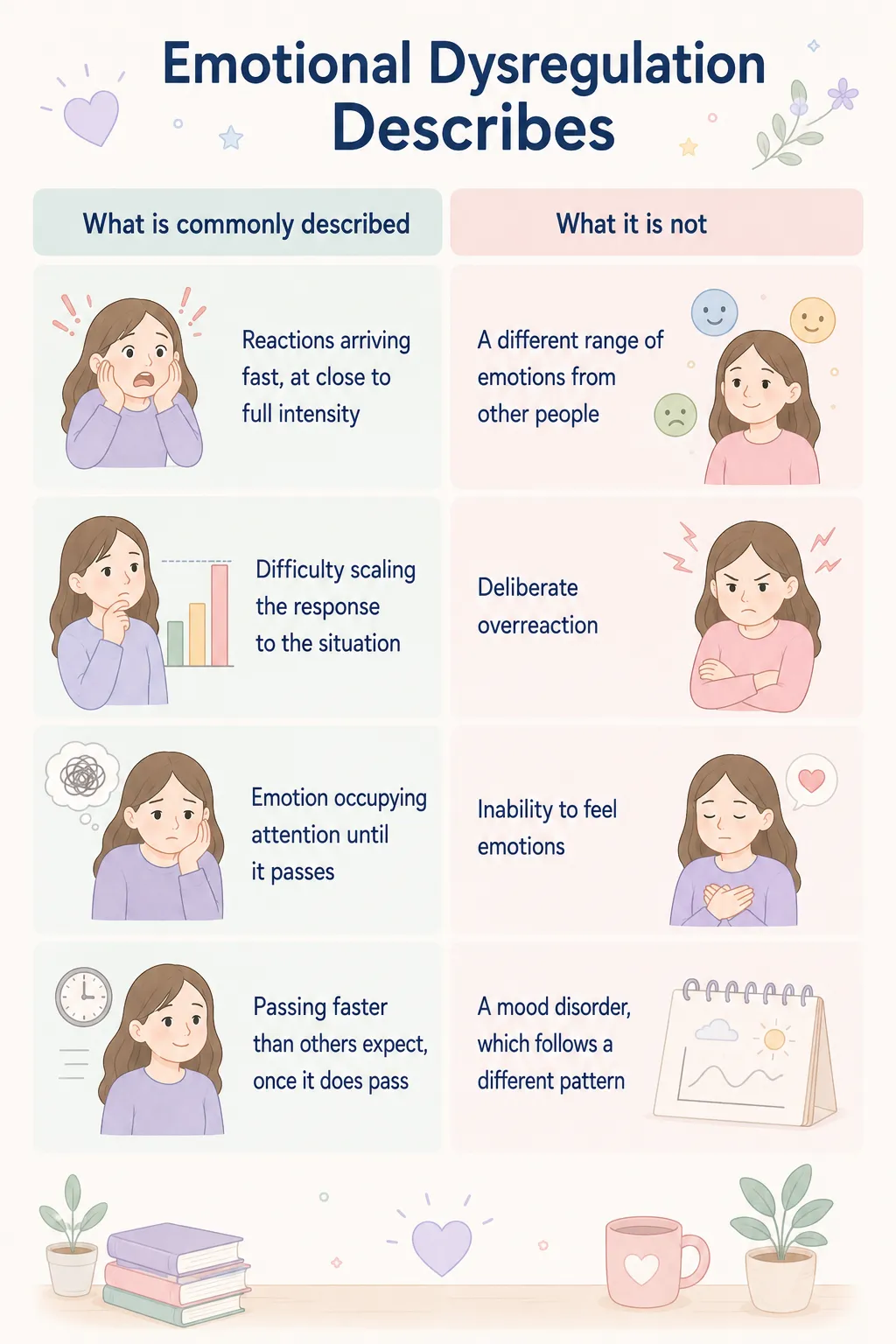
| What is commonly described | What it is not |
| Reactions arriving fast, at close to full intensity | A different range of emotions from other people |
| Difficulty scaling the response to the situation | Deliberate overreaction |
| Emotion occupying attention until it passes | Inability to feel emotions |
| Passing faster than others expect, once it does pass | A mood disorder, which follows a different pattern |
The last row is worth sitting with. People with ADHD may describe emotional responses as rapid, intense and difficult to regulate, with some reporting that they settle relatively quickly. Sustained low mood over weeks is a different pattern and warrants separate assessment.
Why It Is Not a Diagnostic Criterion
This causes confusion, so it is worth being direct. Emotional dysregulation is not one of the 18 diagnostic symptoms. It appears in neither DSM-5-TR nor ICD-11 as an ADHD criterion.
That does not mean clinicians ignore it. Australia’s clinical guideline recognises emotional dysregulation as a feature associated with ADHD (Australian ADHD Professionals Association, 2022), and it is routinely discussed in assessment and support planning. The distinction is that its presence does not establish ADHD, and its absence does not rule it out.
Why the distinction matters practically
Content presenting emotional dysregulation as an ADHD symptom leads people to conclude they have ADHD on that basis alone. Emotional regulation difficulties occur in anxiety, depression, trauma histories, autism, personality disorders and simply in people under sustained stress. It is not specific to ADHD.
ADHD and Anger
Anger is the emotion people most often search about in relation to ADHD, whether as ADHD with anger, ADHD and rage, or ADHD and anger problems. It deserves a straightforward answer.
ADHD anger, sometimes described as ADHD rage, ADHD anger issues or ADHD rage attacks adults, is not a separate phenomenon with its own mechanism. What people are usually describing is the same pattern as other emotions: rapid onset, high intensity, and difficulty interrupting the response once it starts. Impulsivity contributes, because the gap between feeling and acting is narrower.
- Frustration escalating faster than the situation seems to warrant
- Difficulty stepping back once a response has begun
- Regret afterwards that is disproportionate to how the moment felt
- Anger arriving in response to interruption, being rushed, or losing track of something
- Cumulative frustration from a day of small difficulties surfacing at an unrelated trigger
Two things are worth saying about ADHD and anger issues. ADHD does not cause aggression, and it is not an explanation for behaviour that harms other people. And if anger is causing damage to relationships, work or safety, that is worth addressing directly with a clinician regardless of what is underlying it. It is not something to wait out.
ADHD Mood Swings
Emotional shifts sometimes described as ADHD mood swings are typically reported as changes that happen within a day or within hours, often in response to something specific. ADHD mood swings is not a formal clinical construct; what clinicians describe is emotional lability, which can occur with ADHD.
Sustained mood episodes lasting days to weeks, and less tied to immediate triggers, require consideration of other conditions. That distinction matters clinically, because the two are managed differently and can also occur together. If mood changes are sustained rather than reactive, that is worth raising specifically.
Rejection Sensitive Dysphoria: What the Evidence Says
Rejection sensitive dysphoria, usually shortened to RSD, describes intense emotional pain in response to perceived rejection, criticism or failure. The term circulates widely in ADHD content.
It is worth being clear about its status. RSD is not a diagnostic category. It does not appear in DSM-5-TR or ICD-11, it is not a recognised condition, and it is not something a clinician can diagnose. The term has been popularised through clinical writing and ADHD communities, but it does not have the status of a formally recognised diagnostic construct.
| What is true | What is not established |
| Sensitivity to perceived rejection is commonly reported by people with ADHD | That it is a distinct condition with its own diagnostic boundaries |
| The experience described is real and can be significantly distressing | That it occurs only in ADHD, or in all people with ADHD |
| It is discussed by some clinicians as a useful descriptive shorthand | That there is an established mechanism or prevalence figure |
Why this matters: describing an experience is useful, and treating a description as a diagnosis is not. People sometimes seek treatment for RSD specifically, or conclude they have ADHD because they recognise it. Neither follows. What is reasonable is describing the experience to a clinician in ordinary terms and letting them assess what is going on.
Noise and Sensory Sensitivity
ADHD and noise sensitivity is commonly searched, and the honest answer is more nuanced than most content suggests. Noise sensitivity ADHD content often presents it as a symptom, which is not accurate.
Sensory sensitivity is not part of the ADHD diagnostic criteria. Sensory hyperreactivity, or unusual interest in sensory aspects of the environment, is included among the restricted and repetitive behaviour criteria for autism, and ADHD and autism co-occur frequently, which accounts for part of the overlap. Many people with ADHD do report difficulty filtering background noise, which is consistent with distractibility rather than with a sensory processing difference specifically.
Practically, the distinction is less important than the difficulty. If noise is genuinely interfering with work, sleep or daily functioning, that is worth raising with a clinician, who can consider whether it relates to ADHD, autism, anxiety, or something else.
Why Emotions Feel Different With ADHD
Several mechanisms have been proposed, although no single explanation accounts for emotional regulation difficulties in everyone with ADHD. The review cited above noted that emotion dysregulation in ADHD may relate to how attention is oriented toward and allocated to emotional information (Shaw et al., 2014). The factors below are possible contributors rather than established mechanisms. Our guide to the ADHD brain covers the neuroscience in more depth.
- Executive function overlap: the processes involved in inhibiting a response are the same ones affected in ADHD, which plausibly extends to inhibiting emotional responses
- Attention allocation: difficulty shifting attention away from a distressing thought or feeling means it occupies more space for longer
- Cumulative load: a day of small difficulties, corrections and effort leaves less capacity for regulating the next thing
- History: years of unexplained difficulty and criticism can produce heightened sensitivity to further criticism, independent of any ADHD-specific mechanism
That last point is often underweighted. Some of what is attributed to ADHD-specific emotional processing may reflect the accumulated experience of living with undiagnosed difficulty.
When Emotional Difficulty Is Something Else
Emotional regulation difficulties are common across many conditions. This is a simplified summary of why assessment matters, not a guide to distinguishing them yourself.
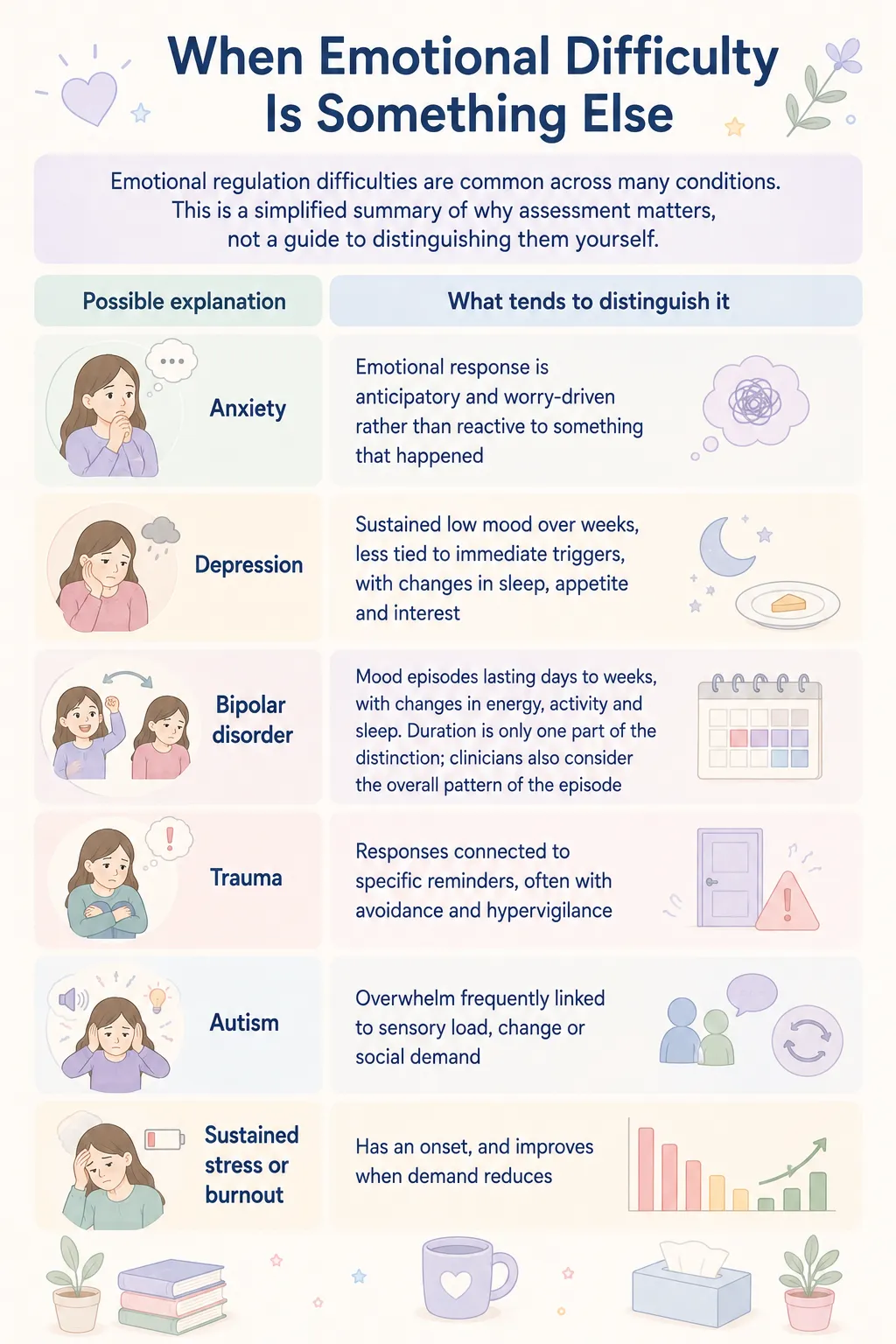
| Possible explanation | What tends to distinguish it |
| Anxiety | Emotional response is anticipatory and worry-driven rather than reactive to something that happened |
| Depression | Sustained low mood over weeks, less tied to immediate triggers, with changes in sleep, appetite and interest |
| Bipolar disorder | Mood episodes lasting days to weeks, with changes in energy, activity and sleep. Duration is only one part of the distinction; clinicians also consider the overall pattern of the episode |
| Trauma | Responses connected to specific reminders, often with avoidance and hypervigilance |
| Autism | Overwhelm frequently linked to sensory load, change or social demand |
| Sustained stress or burnout | Has an onset, and improves when demand reduces |
These patterns can overlap substantially, so they are not reliable ways to distinguish conditions without clinical assessment. Several of them also occur alongside ADHD rather than instead of it. Identifying one does not rule out the other.
What Helps
Management is individualised and may involve psychological, behavioural, environmental or other approaches depending on the person’s symptoms, impairment and co-occurring conditions (Australian ADHD Professionals Association, 2022). Some general points come up consistently.
- Naming the pattern helps. Recognising that a response is arriving fast and will likely pass changes how people respond to it in the moment
- Reducing cumulative load matters more than managing individual reactions, because capacity is finite
- Sleep affects emotional regulation substantially, and sleep difficulties are common in ADHD
- Psychological therapies with an ADHD-informed focus are commonly discussed, particularly where anxiety or long-standing self-criticism have developed alongside
- Where anger is affecting safety or relationships, that warrants direct clinical attention rather than self-management
This article does not cover medicines. Treatment options are a matter for you and your treating clinician.
Related Guides
- ADHD symptoms: the full symptom picture
- What ADHD feels like: living as a person with ADHD
- ADHD symptoms in adults
- ADHD in Australia: the complete guide
References
- Vidal R, Valero S, Nogueira M, et al. Emotional lability: the discriminative value in the diagnosis of attention deficit/hyperactivity disorder in adults. Comprehensive Psychiatry. 2014;55:1712–1719. doi:10.1016/j.comppsych.2014.07.001
- Shaw P, Stringaris A, Nigg J, Leibenluft E. Emotion dysregulation in attention deficit hyperactivity disorder. American Journal of Psychiatry. 2014;171(3):276–293. doi:10.1176/appi.ajp.2013.13070966
- Australian ADHD Professionals Association. Australian Evidence-Based Clinical Practice Guideline for Attention Deficit Hyperactivity Disorder (ADHD). Released October 2022. adhdguideline.aadpa.com.au
- American Psychiatric Association. Diagnostic and Statistical Manual of Mental Disorders, Fifth Edition, Text Revision (DSM-5-TR). 2022.
- World Health Organization. International Classification of Diseases, 11th Revision (ICD-11). 6A05 Attention deficit hyperactivity disorder.
- National Institute for Health and Care Excellence (NICE). Attention deficit hyperactivity disorder: diagnosis and management. NG87.
Last reviewed: September 2026. Next scheduled review: September 2027. This article is general information and is not a substitute for individual medical advice, assessment or diagnosis.