

What Is ADHD Hyperfocus?
Hyperfocus describes periods of intense concentration on something engaging, sometimes lasting far longer than intended, with reduced awareness of time and surroundings. It is commonly described by people with ADHD but is not a diagnostic criterion, does not appear in DSM-5-TR or ICD-11, and is not consistently defined in research.
Hyperfocus is the part of ADHD that confuses people most, including people who have it. A condition named for an attention deficit does not obviously accommodate someone working for six hours without noticing.
It is consistent, though, once you understand the difficulty as regulating where attention goes rather than lacking attention. This guide covers what hyperfocus and hyperfixation describe, the crash people report afterwards, and where the line sits between colloquial obsession and clinical OCD.
Hyperfocus and Hyperfixation: The Terms
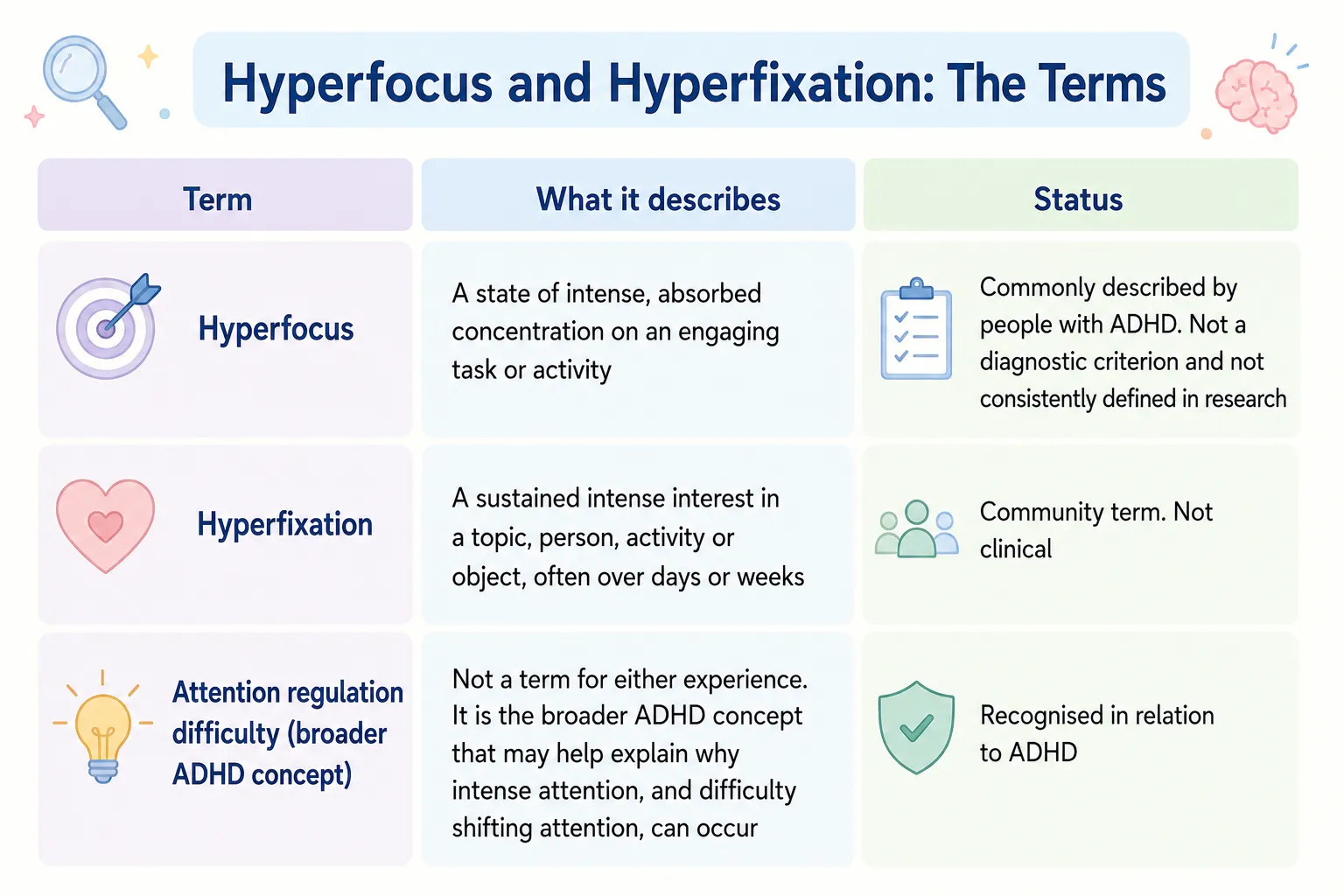
| Term | What it describes | Status |
| Hyperfocus | A state of intense, absorbed concentration on an engaging task or activity | Commonly described by people with ADHD. Not a diagnostic criterion and not consistently defined in research |
| Hyperfixation | A sustained intense interest in a topic, person, activity or object, often over days or weeks | Community term. Not clinical |
| Attention regulation difficulty (broader ADHD concept) | Not a term for either experience. It is the broader ADHD concept that may help explain why intense attention, and difficulty shifting attention, can occur | Recognised in relation to ADHD |
There is no universally accepted clinical distinction between the two terms. In everyday ADHD discussions, hyperfocus usually refers to an intensely absorbed period of attention, while hyperfixation is often used for a sustained interest lasting days or longer. Both are descriptive rather than clinical, and the terms are used loosely and interchangeably online.
Why Hyperfocus Is Not a Contradiction
This is the point worth understanding, because it is the reason many people rule themselves out of assessment.
The difficulty in ADHD is better understood as attention regulation rather than attention capacity. Attention goes somewhere; the difficulty is directing it deliberately and shifting it when needed. On that reading, intense absorption in something engaging is the same difficulty viewed from the other side: attention has locked on, and disengaging it is as hard as engaging it was on the boring task.
Why this matters for assessment
Being able to concentrate intensely on something you find engaging does not rule out ADHD, and clinicians do not treat it as evidence against the diagnosis. Intense periods of concentration can also occur without ADHD, so hyperfocus on its own cannot establish or rule out a diagnosis. If you have discounted yourself on this basis, it is worth reconsidering.
What Hyperfocus Looks Like
- Losing track of time completely, sometimes by hours
- Not registering hunger, thirst, needing the bathroom, or someone speaking to you
- Difficulty stopping even when you intend to, or when something else needs doing
- Producing a great deal of work in one sitting, then nothing for days
- Reading, gaming, music, creative work and research being common triggers
- Difficulty resuming afterwards, because the state cannot be summoned deliberately
That last point is the one people find hardest. Hyperfocus is not a productivity tool, because it cannot be reliably switched on. Attempting to build a working method around it usually fails.
The Hyperfocus Crash
ADHD hyperfocus crash, or the ADHD crash after hyperfocus, describes what people report once the session ends: exhaustion, difficulty transitioning to anything else, and sometimes low mood or irritability. Some also describe ADHD hyperfocus anxiety when they surface and realise how much time has passed or what has been left undone.
Common explanations offered are sustained cognitive effort without breaks, missed food, water and movement during the session, and the abrupt drop in stimulation when an absorbing task ends. These are reasonable explanations rather than established mechanisms.
Where hyperfocus sessions are frequent and followed by significant depletion, people sometimes describe this as ADHD hyperfocus burnout. That is a community description rather than a clinical construct. If exhaustion is persistent, or accompanied by low mood, that warrants discussion with a clinician rather than being attributed to hyperfocus alone.
Hyperfocus in Relationships
ADHD hyperfocus in relationships, sometimes searched as ADHD hyperfocus relationships, is commonly described in two directions, and both are worth naming without overstating them.
Early in a relationship, some people describe intense attention and absorption in a new partner. Later, some describe the opposite: a partner feeling deprioritised when attention is absorbed elsewhere. Both are reported experiences rather than established patterns, and neither is unique to ADHD.
What is worth saying is that inconsistent attention is often experienced by a partner as inconsistent caring. Naming the difference can help, because the two are not the same thing.
Hyperfixation, Obsession and OCD
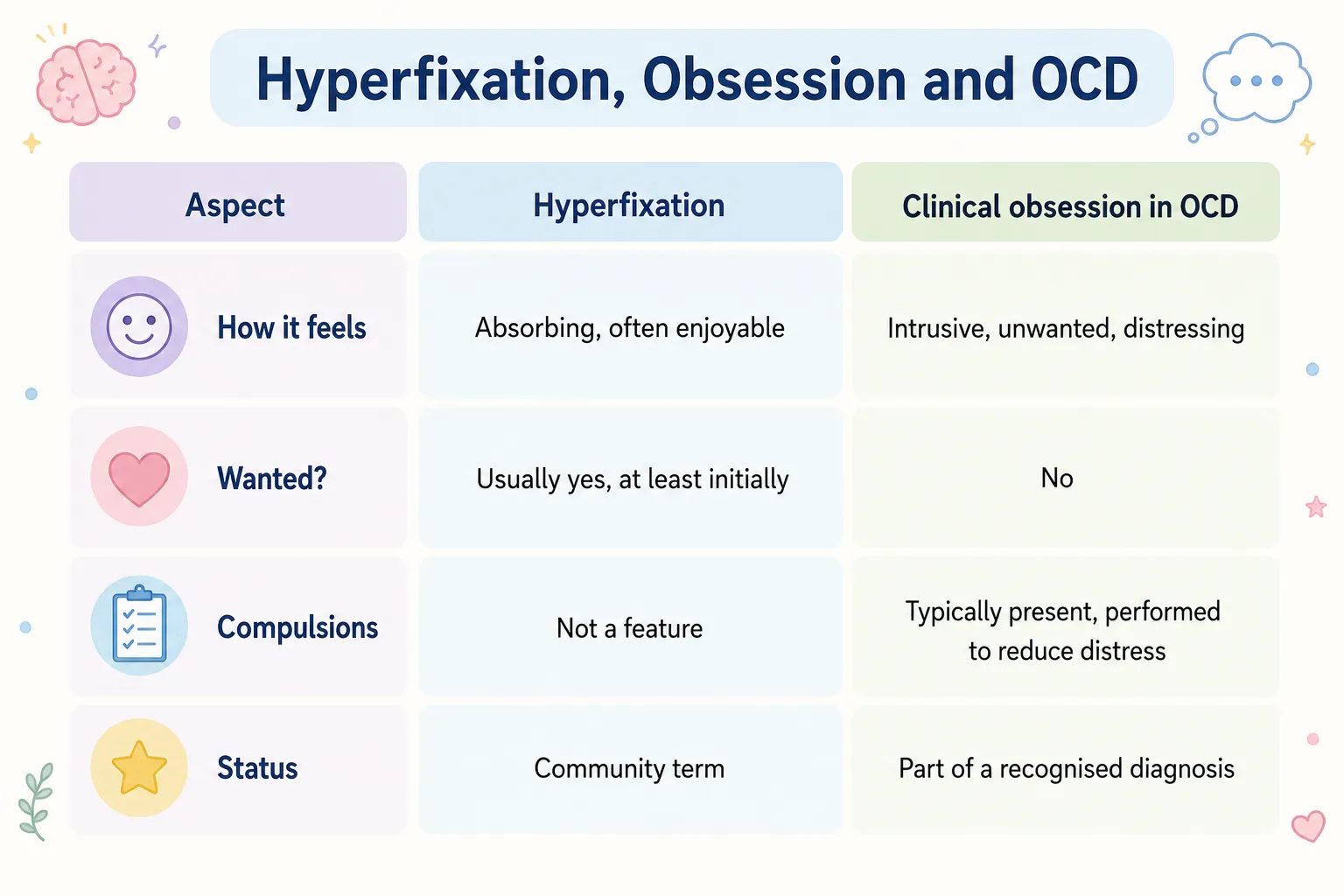
This is where terminology causes real problems, so it is worth separating carefully.
People often use obsession colloquially to describe hyperfixation: an intense interest in a topic, a person, an activity, or a food. ADHD and food fixation, ADHD food obsession, ADHD and obsessing over things, ADHD and obsession with a person, and ADHD romantic obsession are all searched using that everyday sense of the word. What they describe is usually hyperfixation.
Obsessions in the clinical sense are something different. In obsessive-compulsive disorder, obsessions are intrusive, unwanted and distressing, and are typically accompanied by compulsions performed to reduce that distress. Hyperfixation is generally experienced as enjoyable or absorbing rather than distressing.
| Aspect | Hyperfixation | Clinical obsession in OCD |
| How it feels | Absorbing, often enjoyable | Intrusive, unwanted, distressing |
| Wanted? | Usually yes, at least initially | No |
| Compulsions | Not a feature | Typically present, performed to reduce distress |
| Status | Community term | Part of a recognised diagnosis |
ADHD and OCD can also occur together, and distinguishing between them is a clinical question rather than something to settle from a description. Our guide to ADHD and OCD covers that overlap properly.
Is Hyperfocus ADHD or Autism?
Is hyper focus ADHD or autism? It is described in both, and it is not diagnostic of either. Intense sustained interest is also described in autism, where it relates to the restricted and repetitive behaviour criteria. ADHD and autism co-occur frequently, which accounts for part of the overlap.
Practically, the presence of hyperfocus tells a clinician very little on its own. The presence of intense interests or prolonged concentration needs to be considered alongside the broader pattern of attention, behaviour and developmental history.
Working With It Rather Than Around It
Practical strategies vary between people and are commonly described rather than established interventions.
- External interruptions: alarms, calendar blocks, or another person, since internal time awareness is unreliable during a session
- Preparing before starting: water, food and a clear stopping point, on the basis that you will not notice needing them
- Protecting the state where the work matters, rather than fragmenting the day and losing it
- Accepting that it cannot be summoned, and not building a schedule that depends on it
- Treating the crash as predictable rather than as a personal failing, and planning lighter work afterwards
Where hyperfocus is significantly affecting sleep, work, relationships or health, that is worth raising with a clinician. Support options are a matter for you and your treating clinician.
Related Guides
- ADHD symptoms: the full symptom picture
- ADHD paralysis, procrastination and executive dysfunction
- What ADHD feels like: living as a person with ADHD
- ADHD strengths, benefits and positive traits
References
- Australian ADHD Professionals Association. Australian Evidence-Based Clinical Practice Guideline for Attention Deficit Hyperactivity Disorder (ADHD). Released October 2022. adhdguideline.aadpa.com.au
- American Psychiatric Association. Diagnostic and Statistical Manual of Mental Disorders, Fifth Edition, Text Revision (DSM-5-TR). 2022.
- World Health Organization. International Classification of Diseases, 11th Revision (ICD-11). 6A05 Attention deficit hyperactivity disorder.
- National Institute for Health and Care Excellence (NICE). Attention deficit hyperactivity disorder: diagnosis and management. NG87.
Last review: September 2026. Next scheduled review: September 2027. This article is general information and is not a substitute for individual medical advice, assessment or diagnosis.