

Does ADHD Get Worse After Having a Baby?
Many mothers say it does, and there are reasons it would: sleep loss, the collapse of external structure, and a sudden increase in invisible administrative work all hit exactly the functions ADHD already strains. Mental health risk in the postpartum year is also higher in women with ADHD, though large registry data suggests much of that difference travels with co-occurring conditions and circumstances rather than with ADHD alone. ADHD itself does not start after pregnancy; it is a neurodevelopmental condition present from childhood, and what changes is how much difficulty it causes.
ADHD and motherhood is a subject with a great deal written about it and very little of it sourced. Most of it is also American, so you will see ADHD mom rather than ADHD mum and support services that do not exist here. This guide covers what changes across pregnancy and the postpartum year, what the research actually supports, and what helps, with Australian support pathways at the end. For how ADHD presents in women generally, see the guide to ADHD in women and girls.
Did My Child Get It From Me?
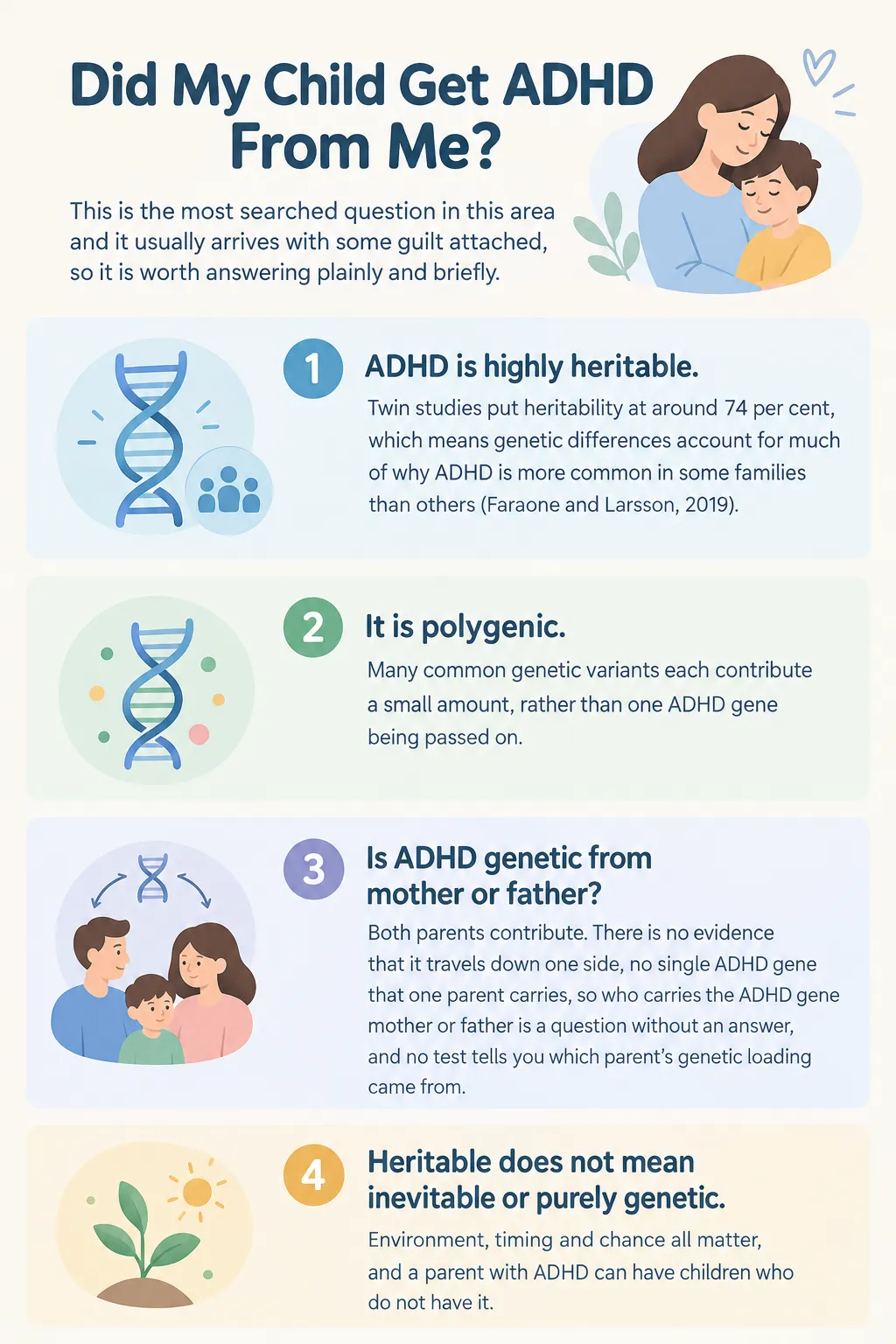
This is the most searched question in this area and it usually arrives with some guilt attached, so it is worth answering plainly and briefly.
- ADHD is highly heritable. Twin studies put heritability at around 74 per cent, which means genetic differences account for much of why ADHD is more common in some families than others (Faraone and Larsson, 2019)
- It is polygenic. Many common genetic variants each contribute a small amount, rather than one ADHD gene being passed on
- Is ADHD genetic from mother or father? Both parents contribute. There is no evidence that it travels down one side, no single ADHD gene that one parent carries, so who carries the ADHD gene mother or father is a question without an answer, and no test tells you which parent a child’s genetic loading came from
- Heritable does not mean inevitable or purely genetic. Environment, timing and chance all matter, and a parent with ADHD can have children who do not have it
The practical version: a child’s diagnosis often prompts a parent to recognise themselves, which is one of the most common routes to adult diagnosis in women. That is worth acting on rather than feeling responsible for. The mechanism is covered properly in the guide to what causes ADHD, and the adult pathway in late ADHD diagnosis in women.
Pregnancy
Self-reported experience during pregnancy runs in every direction. In survey data, roughly a fifth of women with ADHD describe improved focus and organisation during pregnancy, close to half notice no real difference, and around a third find symptoms worse. Being in any of those groups is unremarkable, and none of them predicts how the postpartum year will go.
Decisions about ADHD medicines during pregnancy or while breastfeeding sit with your treating clinician and your maternity team, and this guide deliberately does not cover them. What is worth knowing is that it is a conversation to start early rather than at the point of deciding, and that your GP, psychiatrist and obstetric team should be talking to each other rather than each holding a piece of it.
The part nobody warns you about
Pregnancy is administratively heavy: appointments at intervals that shorten as you go, forms, referrals, tests with timing windows, hospital registration, and a set of decisions with deadlines. That load falls on exactly the functions ADHD makes less reliable. Practical things that help:
- Put every appointment in one calendar at the moment it is made, with a travel-time alarm, not on a card in your wallet
- Keep one folder, physical or digital, for everything pregnancy-related, so nothing depends on remembering where it went
- Ask at each appointment what the next thing is and when it needs to happen by, and write the answer down before leaving the room
- Tell your midwife or obstetrician that you have ADHD and what specifically helps, which is usually written instructions rather than verbal ones
The Postpartum Year: What the Evidence Shows
ADHD after pregnancy is not a new condition appearing, and ADHD worse after pregnancy is one of the most common descriptions women give of this year. The ADHD postpartum picture has two halves: mental health risk, which has been studied, and daily functioning, which has barely been studied at all.
This is where the numbers matter, and where most writing on the subject quotes only the largest one.
A Swedish population register study of 773,047 women, of whom 3,515 had a diagnosis of ADHD, found postpartum depression diagnosed in 16.8 per cent of the ADHD group compared with 3.3 per cent of the rest, and postpartum anxiety in 24.9 per cent compared with 4.6 per cent. Those are prevalence ratios of about 5.1 and 5.4 (Andersson and colleagues, 2023).
The same study then adjusted for sociodemographic factors and for psychiatric conditions occurring alongside ADHD. After that adjustment, ADHD still independently increased risk, but the adjusted prevalence ratio fell to 1.13. In other words, mothers with ADHD are at substantially higher risk in absolute terms, and most of that gap is carried by co-occurring conditions and life circumstances rather than by ADHD on its own.
A separate matched cohort of 15,488 pregnancies with maternal ADHD and 61,952 without, restricted to women with no prior history of depression, found postpartum depression in 6.4 per cent versus 5.2 per cent, an increase of about 24 per cent. Restricting to women without a depression history removes much of the same overlap, and the result is again a real but modest independent effect.
| What you will read | What the research supports |
| Mothers with ADHD are around five times more likely to experience postpartum depression | Accurate as an unadjusted figure from Swedish register data, and it describes the whole picture including co-occurring conditions |
| ADHD itself causes postpartum depression | Not supported as stated. After adjustment the independent effect is small, around 1.13 in the same study |
| The risk is not worth worrying about because the adjusted figure is small | Not a safe reading either. The absolute rates in mothers with ADHD are high, whatever is driving them |
| ADHD can start after pregnancy | Not supported. ADHD is present from childhood; what can change after a birth is how much difficulty it causes and whether it finally gets recognised |
The practical conclusion is not reassurance or alarm. It is that postpartum mental health screening deserves to be taken seriously if you have ADHD, particularly if you also have a history of anxiety or depression, and that it is worth flagging before the birth rather than after.
If you are struggling in pregnancy or the first year after birth:
PANDA’s National Perinatal Mental Health Helpline is on 1300 726 306, Monday to Friday 9am to 7:30pm and weekends and public holidays 9am to 4pm, Australian Eastern Time. Your GP and your maternal and child health nurse are both appropriate starting points. If you are in crisis, call Lifeline on 13 11 14, or 000 in an emergency.
Why the Newborn Period Is Specifically Hard With ADHD
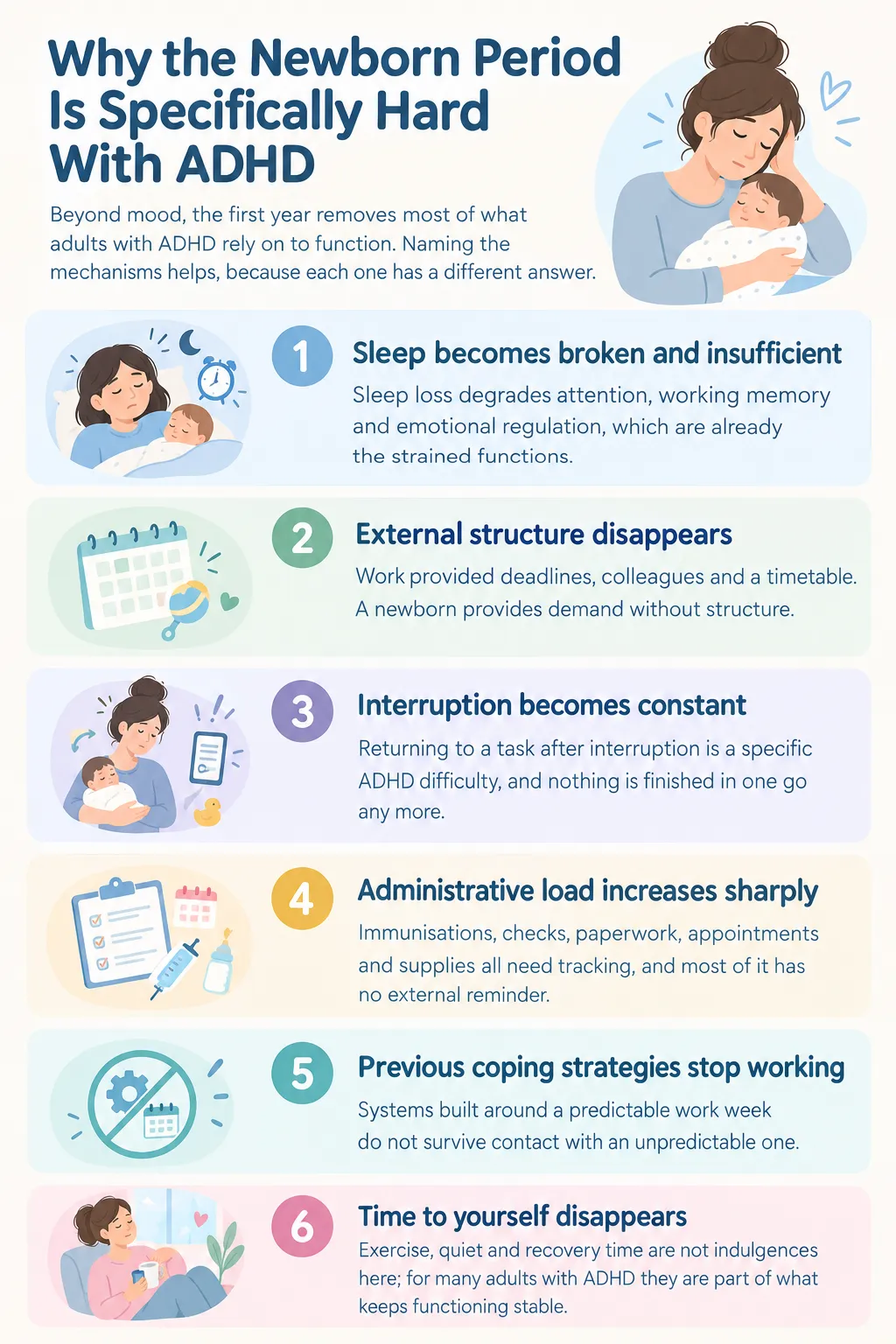
Beyond mood, the first year removes most of what adults with ADHD rely on to function. Naming the mechanisms helps, because each one has a different answer.
| What changes | Why it lands hard |
| Sleep becomes broken and insufficient | Sleep loss degrades attention, working memory and emotional regulation, which are already the strained functions |
| External structure disappears | Work provided deadlines, colleagues and a timetable. A newborn provides demand without structure |
| Interruption becomes constant | Returning to a task after interruption is a specific ADHD difficulty, and nothing is finished in one go any more |
| Administrative load increases sharply | Immunisations, checks, paperwork, appointments and supplies all need tracking, and most of it has no external reminder |
| Previous coping strategies stop working | Systems built around a predictable work week do not survive contact with an unpredictable one |
| Time to yourself disappears | Exercise, quiet and recovery time are not indulgences here; for many adults with ADHD they are part of what keeps functioning stable |
The mental load
The invisible job of knowing what the household needs, when, and who has to act on it is a tracking task running continuously in the background. It is work that lands badly on working memory, and it is often invisible to everyone else precisely because it never appears on a list. The answer is to get it out of your head and into something shared:
- One shared calendar that both parents actually use, with alarms rather than entries alone
- A single running list in one place, not several started in different apps
- Recurring items set up once as repeats: nappies, formula if used, immunisation dates, appointments
- Explicit ownership of whole domains rather than tasks, so nobody has to be reminded to do their half
- A weekly ten-minute check with your partner or support person, which is far easier than reconstructing everything under pressure
Mothering With ADHD
Do women with ADHD make good mothers? The question comes up often enough in search that it deserves a direct answer: there is no evidence that ADHD makes someone a worse parent, and the question is usually being asked by someone already doing the work and worrying about it. What ADHD affects is the administrative and consistency side of parenting, which is a systems problem rather than a character one.
ADHD in motherhood is not only a list of difficulties. Mums with ADHD frequently describe strengths that are real and rarely counted: tolerance for chaos, willingness to play, quick responses in genuine emergencies, and an unusual capacity to take a child’s interests seriously. Those are not compensation for the hard parts, but they are not nothing either.
What tends to help
- Build routines into the environment rather than into willpower: the bag by the door, the clothes laid out, the checklist on the fridge
- Reduce the number of decisions rather than trying to make them faster
- Batch school and childcare admin into one fixed slot a week rather than handling each item as it arrives
- Accept help in specific forms. Naming a task is easier for everyone than being asked to delegate on the spot
- Keep one place where things live, because searching for keys, forms and shoes is a large hidden tax on the morning
- Treat your own sleep, treatment and appointments as part of the household’s infrastructure rather than as something to get to later
When your child also has ADHD
Parenting a child with ADHD while having it yourself is harder in a specific way: the structures a child needs are the structures you find hardest to maintain. It is also an advantage in understanding what is happening. The practical side belongs in its own guide, the assessment pathway in getting a child assessed for ADHD.
Breastfeeding
ADHD and breastfeeding questions are almost always really medication questions, and those belong with your prescriber, your GP and your maternity team rather than with an article. What is general enough to say here is that the decision is individual, that it should be made with current advice rather than what someone read in a forum, and that feeding decisions of any kind are not a measure of how good a parent you are.
Single parenting with ADHD
Whether you search it as ADHD single mum or ADHD single mom, the answer is structural rather than motivational. Without a second adult to absorb the load, externalising becomes more important rather than less. The things that make the difference are usually structural: automating what can be automated, including bills and repeat orders, building a small named support network rather than a vague sense that people would help, and being specific when asking. Financial administration in particular is worth systematising early.
Recognising ADHD in Your Own Mother
Does my mum have ADHD is a question a significant number of people arrive at this topic carrying, from the other direction, and having a mother with ADHD who was never identified is common enough to be worth naming. It is a reasonable question given how consistently women of earlier generations were missed, and the ADHD mother and daughter pattern often becomes visible only once one of them is diagnosed. An older woman recognising herself in a daughter’s diagnosis is common, and assessment is available at any age. What is not useful is diagnosing a parent at a distance; what is useful is describing what you have noticed and leaving the decision with her.
Getting Support in Australia
- Your GP, who can assess mood, arrange a mental health treatment plan, and coordinate between your prescriber and your maternity team
- Your maternal and child health nurse, who sees you regularly in the first year and is a low-barrier place to raise that you are not coping
- PANDA’s National Perinatal Mental Health Helpline on 1300 726 306 for perinatal mental health support, including for partners
- COPE, the Centre of Perinatal Excellence, for information on perinatal mental health and screening
- Gidget Foundation Australia, which provides perinatal mental health counselling
- Your psychiatrist or prescriber, early rather than late, for anything involving treatment across pregnancy and feeding
Worth saying to any of them: that you have ADHD, what specifically is hard, and that you want written rather than verbal instructions. It changes the quality of the help you get.
Related Guides
- ADHD, hormones and the menstrual cycle
- ADHD burnout: what it is and how it differs from tiredness
- ADHD Testing for Women: How Assessment Works
References
- Andersson A and colleagues. Depression and anxiety disorders during the postpartum period in women diagnosed with attention deficit hyperactivity disorder. Journal of Affective Disorders, 2023. Swedish population register study, 773,047 women including 3,515 with ADHD; unadjusted prevalence ratios 5.09 for depression and 5.41 for anxiety, adjusted prevalence ratio 1.13.
- Faraone SV, Larsson H. Genetics of attention deficit hyperactivity disorder. Molecular Psychiatry, 2019;24:562-575. Twin-study heritability of 74 per cent; ADHD described as polygenic, with many common variants of small effect.
- Matched cohort analysis of 15,488 pregnancies with maternal ADHD and 61,952 without, restricted to women with no prior depression diagnosis: postpartum depression 6.4 per cent versus 5.2 per cent.
- PANDA, Perinatal Anxiety and Depression Australia. National Perinatal Mental Health Helpline, 1300 726 306. panda.org.au
- Australian ADHD Professionals Association. Australian Evidence-Based Clinical Practice Guideline for Attention Deficit Hyperactivity Disorder (ADHD). Released October 2022. adhdguideline.aadpa.com.au
- Centre of Perinatal Excellence (COPE). Perinatal mental health information and screening. cope.org.au
Last reviewed: September 2026. Next scheduled review: September 2027. This article is general information and is not a substitute for individual medical advice, assessment or diagnosis.