

How Is ADHD Diagnosed in Teenagers?
Through a comprehensive clinical assessment, adapted to the young person’s age and developmental level. Australia’s clinical guideline specifies that symptom criteria should be considered according to age and developmental level, and that assessment should draw on information from more than one setting and more than one reporter where relevant (Australian ADHD Professionals Association, 2022). In adolescence the young person’s own account becomes central rather than supplementary, time is generally set aside to see both the teenager and their parents, and private time with the adolescent may be appropriate. Symptoms must have been present before age 12, even if ADHD was not recognised at the time.
Diagnosing ADHD in teenagers is harder than diagnosing ADHD in children generally, and for reasons specific to adolescence rather than to ADHD. The signs that trigger a childhood referral are often the ones that have faded by fourteen, while the demands that expose the underlying difficulty have grown.
This guide covers what changes in adolescence, what happens during a teen ADHD assessment, how to involve a teenager who does not want to be assessed, and what to do when childhood records are unavailable. For a younger child, the general pathway for ADHD diagnosis in children, including a children’s ADHD diagnosis through the school and what a child ADHD assessment costs, is covered in the guide to ADHD testing for children.
Why Adolescence Complicates Assessment
| What changes | Why it matters for assessment |
| Hyperactive or impulsive behaviour may become less overt | The most recognisable signs can be less visible, and difficulties may present more as problems with organisation and independent work |
| School structure loosens | Multiple teachers rather than one, so no single person observes the whole picture |
| Independence increases | Difficulties appear in self-management rather than in supervised settings |
| Adolescence itself | Moodiness, disorganisation and conflict are common at this age regardless of ADHD |
| Co-occurring difficulties emerge | Anxiety and low mood may occur alongside ADHD, or may themselves contribute to attention and functioning difficulties, so clinicians consider both possibilities |
| Self-report becomes central | The young person can describe internal experience, but may under-report or minimise |
The distinguishing questions are whether the pattern predates adolescence, whether it appears across settings, and whether it is disproportionate to circumstances.
Who Can Assess and Diagnose a Teenager in Australia?
Australia’s clinical guideline frames this around the clinician rather than the profession: the person conducting a diagnostic assessment should be appropriately registered, trained in DSM or ICD diagnostic assessment, and experienced in ADHD assessment or appropriately supervised (Australian ADHD Professionals Association, 2022).
In practice a GP is usually where the process starts. The Royal Children’s Hospital Melbourne notes that some GPs can diagnose children while many refer on to a specialist such as a paediatrician, child psychologist or child psychiatrist. What a given clinician can do depends on their scope of practice and on arrangements in your state or territory, which have been changing. Registration can be checked on the AHPRA public register, and it is reasonable to ask a service what ADHD training and experience the assessing clinician has.
What Happens During a Teen ADHD Assessment?
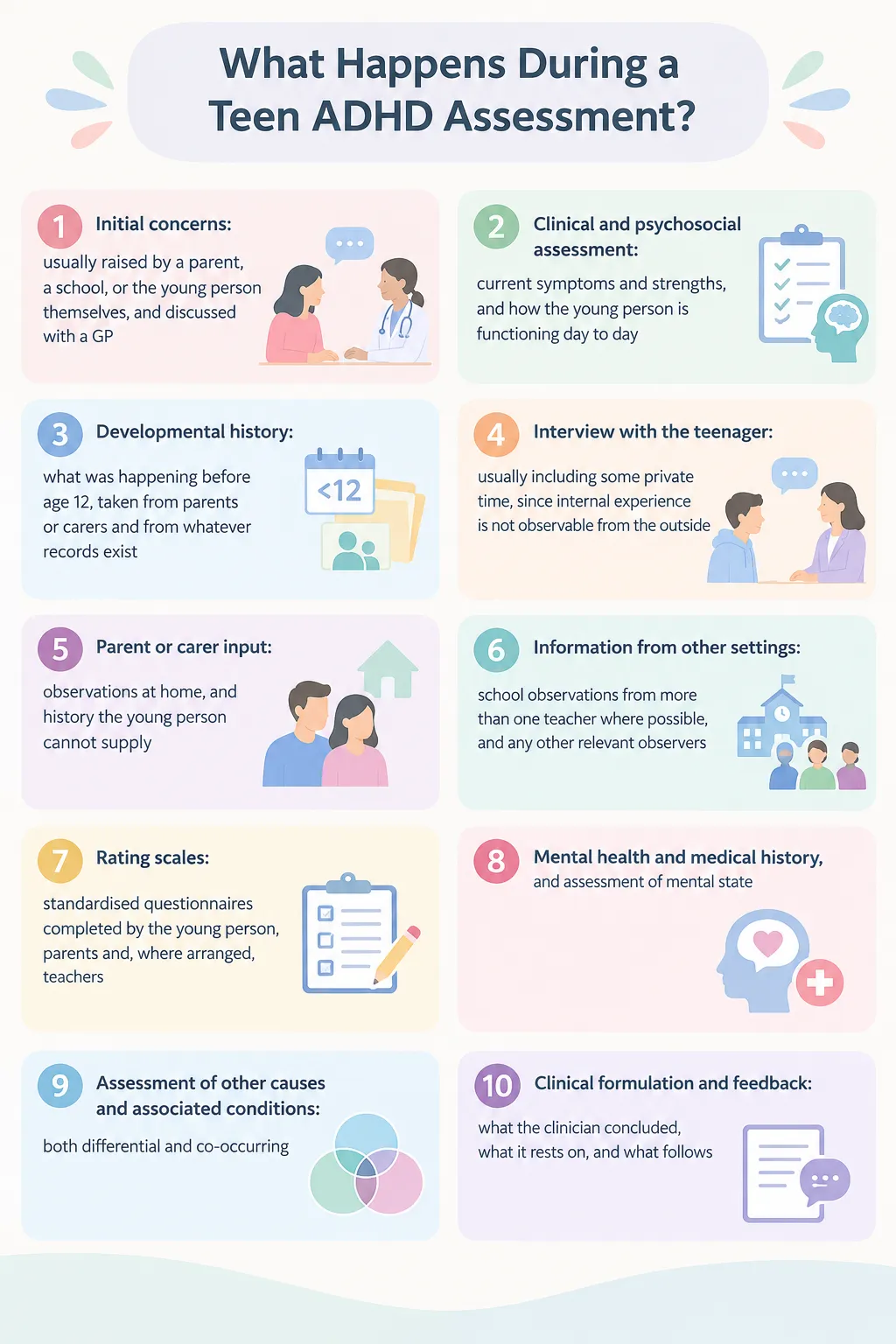
How to diagnose ADHD in teenagers is not a separate framework. An ADHD diagnosis for teenagers follows the same components Australia’s clinical guideline sets out for any ADHD assessment, with the emphasis shifted towards the adolescent’s own account (Australian ADHD Professionals Association, 2022).
- Initial concerns: usually raised by a parent, a school, or the young person themselves, and discussed with a GP
- Clinical and psychosocial assessment: current symptoms and strengths, and how the young person is functioning day to day
- Developmental history: what was happening before age 12, taken from parents or carers and from whatever records exist
- Interview with the teenager: usually including some private time, since internal experience is not observable from the outside
- Parent or carer input: observations at home, and history the young person cannot supply
- Information from other settings: school observations from more than one teacher where possible, and any other relevant observers
- Rating scales: standardised questionnaires completed by the young person, parents and, where arranged, teachers
- Mental health and medical history, and assessment of mental state
- Assessment of other causes and associated conditions: both differential and co-occurring
- Clinical formulation and feedback: what the clinician concluded, what it rests on, and what follows
Rating scales are adjuncts rather than the assessment itself. Australia’s clinical guideline states that ADHD should not be diagnosed solely from rating scales or observational data. The separate guide to ADHD questionnaires and rating scales covers what the individual instruments measure.
What Functional Impairment Looks Like in a Teenager
Symptoms alone are not enough. The guideline describes diagnosis in relation to symptoms that negatively affect functioning across areas such as psychological, social and academic life (Australian ADHD Professionals Association, 2022). For an adolescent, that is usually concrete:
- Assignments started late or handed in unfinished, across several subjects at once
- Difficulty holding a timetable, or repeatedly arriving without the right equipment
- Multi-step tasks such as exam preparation that do not get broken down or begun
- Chronic lateness, and time that is consistently misjudged
- Homework that takes far longer than it should for the work produced
- Friction in friendships or at home that follows from the above rather than from conflict itself
- Difficulty managing the independence that comes with the senior years
The question is not whether a teenager does any of these occasionally. It is whether the pattern is persistent, disproportionate to circumstances, and costing them something.
The Teenager’s Own Account
This is the main structural difference from assessing a younger child.
Younger children are assessed largely through parent and teacher report. Adolescents can describe what is happening internally: losing the thread mid-task, rereading pages without retaining them, knowing what needs doing and being unable to start. Assessment that relies only on parent report misses that entirely, which matters most for inattentive presentations that produce no visible behaviour.
Time is generally set aside to see both the young person and their parents or carers, and private time with the adolescent may be appropriate. Parent and teen accounts can differ, and that difference is informative rather than a problem to resolve first.
If Your Teenager Does Not Want to Be Assessed
Resistance is common and worth taking seriously rather than overriding.
Adolescents often read assessment as being labelled, or as parents looking for something wrong with them. Australia’s clinical guideline emphasises person-centred care, meaningful informed consent and supported decision-making (Australian ADHD Professionals Association, 2022). Meaningful involvement supports engagement and communication, and the account a teenager gives is a central source of information in adolescent assessment.
- Involve them in the decision rather than presenting it as settled
- Be clear the outcome is information rather than a verdict, and that not ADHD is a possible result
- Ask what specifically they object to. Sometimes it is the appointment, sometimes the label, sometimes being discussed
- Acknowledge that they can decline to answer particular questions
- Where they are old enough, be clear that some of the appointment will be theirs alone
- Avoid framing it as something that will fix them
Consent and confidentiality
Consent for people under 18 in Australia depends on capacity and circumstances rather than on age alone. Healthdirect describes informed consent as requiring sufficient understanding and capacity, and notes that some young people under 16 can give informed consent in certain circumstances. This is often described as the mature minor framework, and the RACGP notes that consent and confidentiality for people under 18 can be complex in practice. What that means for a particular assessment, including what is shared with parents, is a question for the service. Ask how it handles consent and confidentiality before the appointment, so everyone knows where they stand. This is general information rather than legal advice.
Getting School Information for a Teenager
This is harder than for a primary school child, and it is worth planning around.
A primary student has one teacher who sees them all day. A secondary student has six or more, each seeing them for a few hours a week in a single subject. No one of them has the whole picture.
- Ask the year adviser, head of year or wellbeing coordinator rather than a single subject teacher
- Request past reports as well as current ones, since primary school comments are often more informative
- Ask whether the school will circulate a rating scale to several teachers rather than one
- Note which subjects are affected and which are not, since the pattern itself is informative
What to Bring to the Assessment
- School reports across several years, particularly the written comments rather than the grades
- Anything current the school has raised, including emails or wellbeing notes
- Your own observations, with specific examples rather than general descriptions
- What you can recall of early development and primary school
- Any previous assessments, including for learning, speech or anything unrelated
- Relevant medical history and current health information
- Any questions the teenager wants answered, written down by them
ADHD Diagnosis Without Childhood Evidence
Diagnostic criteria require several symptoms to have been present before age 12. For teenagers this is recent enough to often still be documented, but records are not always available. The distinction that matters is between symptom onset and when the person was recognised or diagnosed: Australia’s clinical guideline notes that some people do not come to clinical attention until well after symptoms began (Australian ADHD Professionals Association, 2022).
Families move schools and countries. Reports get lost. A child may have changed schools repeatedly, or been educated overseas, or had no formal reports at all.
What clinicians can use instead
- Parent recollection of early childhood, which is more recent for a teenager than for an adult
- Any school reports that do exist, particularly written comments rather than grades
- Records from other services, such as speech pathology or paediatric appointments
- Sibling or extended family observations
- The young person’s own memories of primary school
Missing paperwork does not prevent an assessment, but it is not the same as the childhood evidence not being needed. The clinician still has to establish sufficient developmental history to judge whether symptoms were present before age 12; the records are one route to that, not the only one. Tell the clinician what is available and what is not, so they can work with the developmental history that can be constructed.
What Often Emerges Alongside
Assessment in adolescence frequently identifies more than one thing, and that is not a complication so much as the point. Two different questions are being asked. A co-occurring condition means ADHD and another condition are both present. A differential diagnosis means another condition may explain some or all of the symptoms being investigated. Australia’s clinical guideline directs assessment at both (Australian ADHD Professionals Association, 2022).
| Commonly considered | Why it comes up in adolescence |
| Anxiety | Can occur alongside ADHD and can also produce concentration difficulty in its own right. Academic pressure in the senior years often brings it to attention |
| Low mood | Can occur alongside ADHD and may be relevant where longstanding difficulty has affected functioning or self-esteem |
| Learning difficulties | Become more visible as reading and writing demands increase |
| Sleep difficulties | Delayed sleep is common in adolescence and affects daytime attention independently |
| Autism | Recognised in Australia’s clinical guideline as a common co-occurring neurodevelopmental condition. Autism-related characteristics may also overlap with some of the presenting concerns, so both possibilities are considered |
Where anxiety or low mood is identified, that does not settle the ADHD question. Both can be present, and which came first is often less useful than addressing what is currently causing difficulty.
After a Teenage Diagnosis
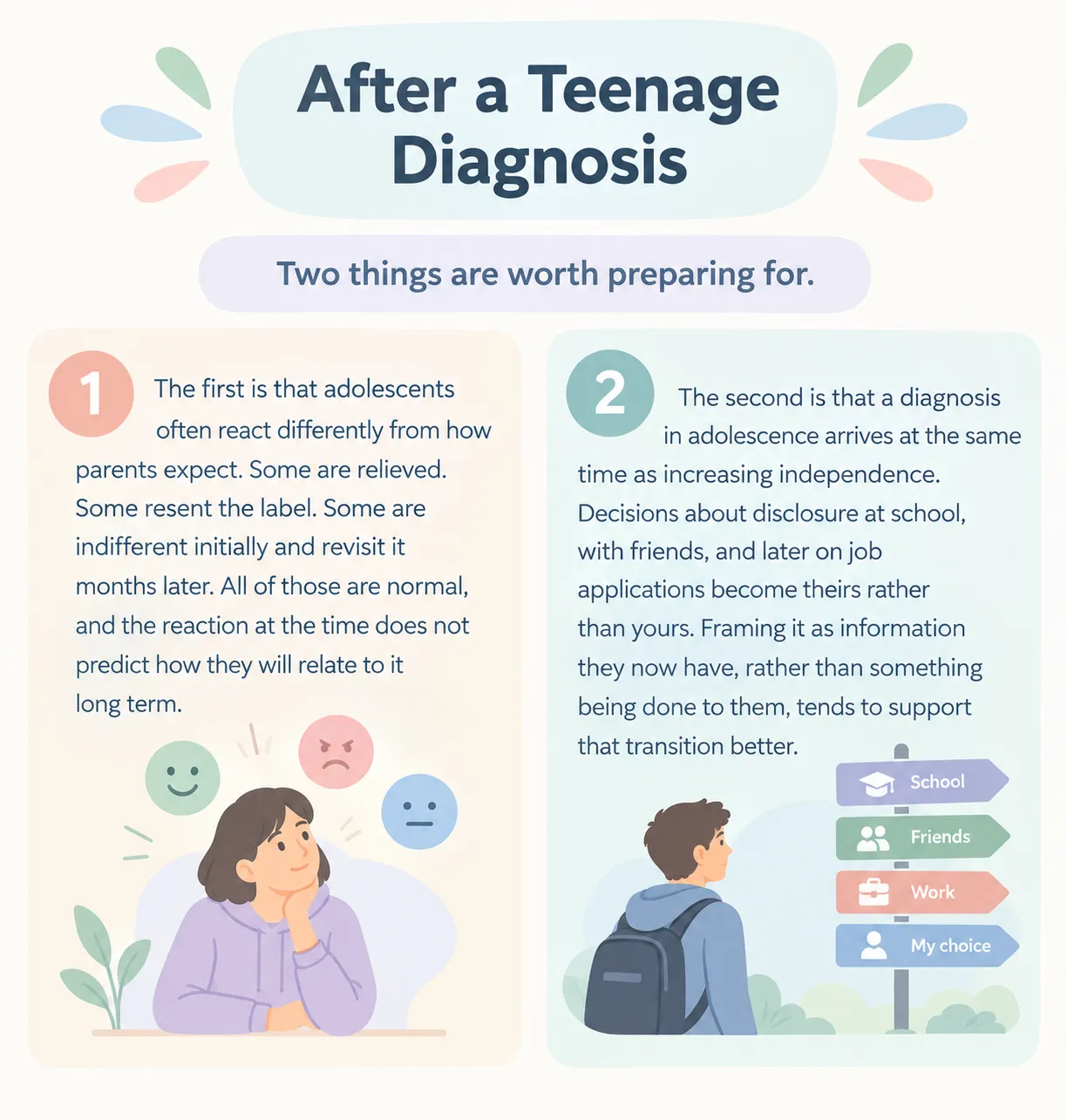
Two things are worth preparing for.
The first is that adolescents often react differently from how parents expect. Some are relieved. Some resent the label. Some are indifferent initially and revisit it months later. All of those are normal, and the reaction at the time does not predict how they will relate to it long term.
The second is that a diagnosis in adolescence arrives at the same time as increasing independence. Decisions about disclosure at school, with friends, and later on job applications become theirs rather than yours. Framing it as information they now have, rather than something being done to them, tends to support that transition better.
Related Guides
- ADHD symptoms in children and toddlers
- How ADHD is diagnosed in Australia: the full process
- What actually happens in an ADHD assessment
- ADHD questionnaires and rating scales
References
- Australian ADHD Professionals Association. Australian Evidence-Based Clinical Practice Guideline for Attention Deficit Hyperactivity Disorder (ADHD). Released October 2022. Sections on assessment and diagnosis. adhdguideline.aadpa.com.au
- Healthdirect Australia. Attention deficit hyperactivity disorder (ADHD). healthdirect.gov.au
- Royal Children’s Hospital Melbourne. Attention deficit hyperactivity disorder (ADHD). Kids Health Info. rch.org.au
- American Psychiatric Association. Diagnostic and Statistical Manual of Mental Disorders, Fifth Edition, Text Revision (DSM-5-TR). 2022.
- Healthdirect Australia. Informed consent. healthdirect.gov.au
- Royal Australian College of General Practitioners. Consent to medical treatment: the mature minor. racgp.org.au