

How Does ADHD Affect Relationships?
Research consistently associates ADHD symptoms with lower relationship satisfaction, more hostile conflict behaviour and more negative conflict resolution, with inattentive symptoms showing the most consistent association. The friction usually comes from mechanisms rather than motives: forgotten commitments, unfinished tasks, interrupted listening and emotional responses that arrive faster than intended. Naming the mechanism is what stops it being read as not caring.
Almost everything difficult about ADHD in a relationship comes down to one misreading: behaviour driven by attention regulation gets interpreted as evidence about how much someone cares. This guide covers what the research shows, where the friction actually comes from, and what helps on both sides. For the wider picture, see the guide to ADHD in adults.
What the Research Shows
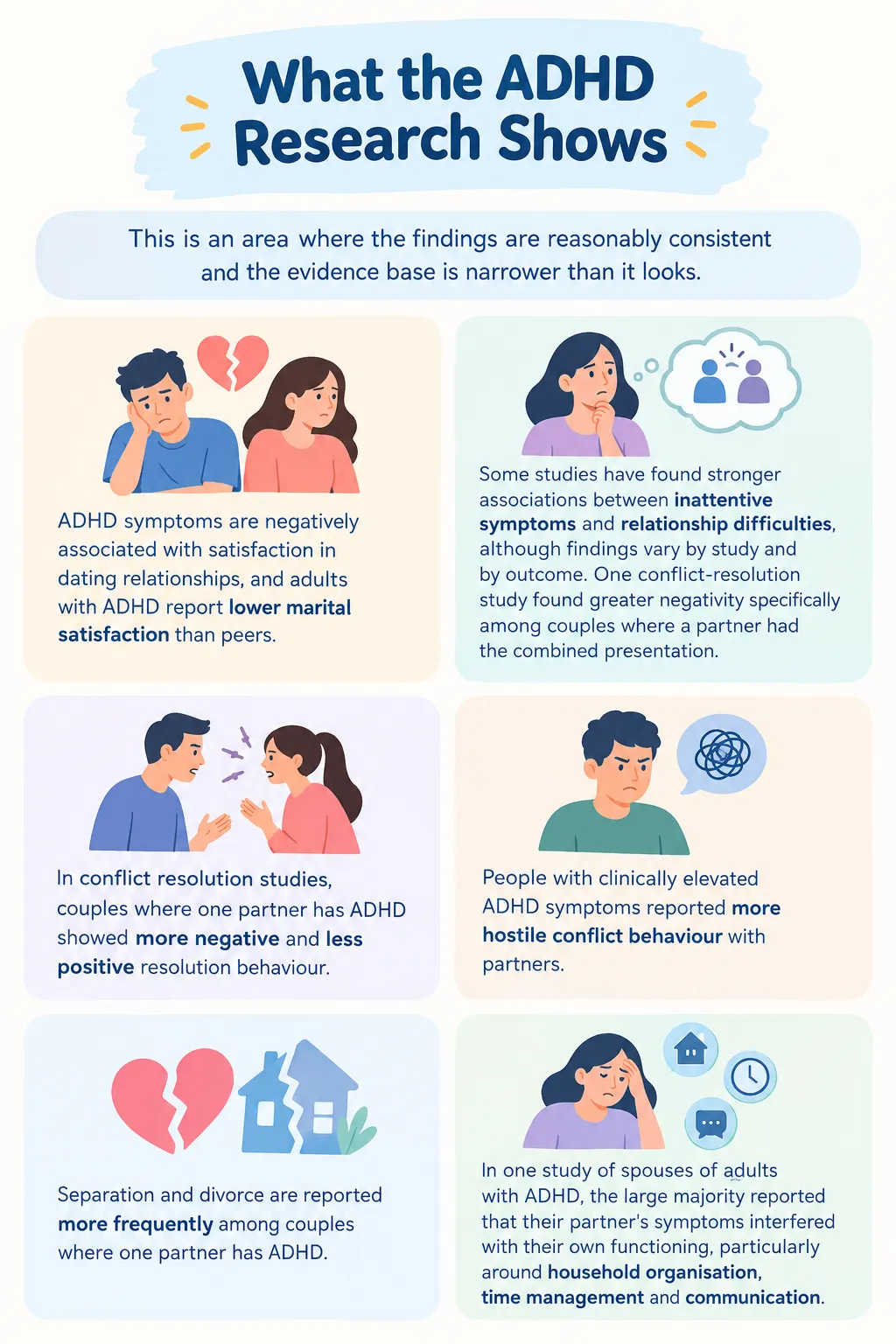
This is an area where the findings are reasonably consistent and the evidence base is narrower than it looks.
- ADHD symptoms are negatively associated with satisfaction in dating relationships, and adults with ADHD report lower marital satisfaction than peers
- Some studies have found stronger associations between inattentive symptoms and relationship difficulties, although findings vary by study and by outcome. One conflict-resolution study found greater negativity specifically among couples where a partner had the combined presentation
- In conflict resolution studies, couples where one partner has ADHD showed more negative and less positive resolution behaviour
- People with clinically elevated ADHD symptoms reported more hostile conflict behaviour with partners
- Separation and divorce are reported more frequently among couples where one partner has ADHD
- In one study of spouses of adults with ADHD, the large majority reported that their partner’s symptoms interfered with their own functioning, particularly around household organisation, time management and communication
The limitations matter as much as the findings. Researchers in this area note that there are few longitudinal studies, that samples have been drawn overwhelmingly from heterosexual couples, that little is known about at-risk subgroups, and that most of the work relies on self-report. Findings should not be assumed to describe every relationship structure. Read these as patterns that show up across groups, not as a forecast for any particular relationship.
One framing point before going further. This guide often refers to a partner with ADHD and another partner, because that is how the research is usually structured. In practice either or both partners may have ADHD, and relationship patterns depend on the people, the context and other factors involved. Nothing here positions one person as the problem and the other as a neutral observer.
Where the Friction Actually Comes From
Nearly every recurring argument in an ADHD relationship traces back to one of a small number of mechanisms. ADHD in relationships is rarely about the thing the argument appears to be about, and a relationship with ADHD in it runs into the same handful of patterns again and again.
| What happens | How it gets read | What is actually going on |
| A commitment is forgotten | You do not care enough to remember | Caring about a commitment does not necessarily prevent ADHD-related memory or attention difficulties, which is why external reminders can be more reliable than intention |
| Attention drifts mid-conversation | You are not listening to me | Sustained attention on low-stimulation input can be the specific difficulty, and it is not selective by importance |
| A task is started and left unfinished | You start things and lose interest in them, including us | Task completion depends on the same mechanism whether it is a shelf or a conversation |
| Plans are agreed and then run late | My time does not matter to you | Time estimation is unreliable in both directions, and the optimism is genuine rather than strategic |
| A small criticism produces a large response | You are overreacting on purpose | Emotional responses can arrive faster and larger than intended, and the regulation lag is the difficulty |
| Intense early attention fades | You have stopped loving me | Early relationships can provide unusually high novelty and stimulation. A later change in attention does not by itself tell you whether feelings have changed |
None of this is an excuse, and framing it as one is the fastest way to lose a partner’s goodwill. An explanation tells you where to aim a solution. It does not remove the obligation to build one.
The Core Principle
One idea carries most of what follows: do not make the relationship carry the executive function. Shared calendars, automatic payments, written plans, recurring routines and an explicit division of responsibilities all move the load out of memory and negotiation. Externalising it is usually more effective than either partner trying harder.
The Parent and Child Dynamic
One recurring pattern described in ADHD relationships is a shift from partnership towards a parent-and-child dynamic, and it can affect both people.
It develops gradually. One partner starts absorbing the tasks that keep falling through: the appointments, the bills, the remembering. Absorbing them works, so they absorb more. Over time one person becomes the manager and the other becomes the managed, and the relationship reorganises around competence rather than partnership.
- The non-ADHD partner accumulates an invisible workload and, eventually, resentment about carrying it
- The ADHD partner is reminded constantly of what they cannot do, which reinforces a belief system already built over decades
- Nagging and avoidance escalate together, each making the other worse
- Attraction and intimacy can be affected, because supervision changes how partners experience one another
The way out tends to be structural rather than emotional. Systems that neither person has to remember, an explicit division that reflects actual strengths, and outsourcing where it is affordable generally do more than promising to try harder. Instead of asking whether someone remembered to pay the bill, the bill goes out of a shared account automatically on the first of the month. Some partners describe the shift from supervision back to partnership as the change that mattered most, and rebuilding an ADHD partnership on that basis takes longer than one conversation.
ADHD and Lying: What Is Actually Happening
ADHD and lying is one of the most searched and least well-handled topics in this area, and it needs saying clearly: lying is not an ADHD diagnostic symptom, and there is not good evidence that ADHD itself makes people more dishonest. CHADD has stated directly that there is no hard data supporting a link between ADHD and lying more often. ADHD lying, lying and ADHD, and the related phrases people search all describe something real being misread.
What some clinicians and ADHD organisations describe is that forgetting, impulsivity, avoidance and shame can produce behaviour that looks deceptive from the outside. CHADD frames apparent dishonesty in ADHD as a possible coping mechanism rather than a moral failing, while being explicit that the link is not established by evidence. The patterns below are explanations offered clinically, not findings.
- Genuine forgetting reported as fact: saying something was done because you believe it was, or having no memory of agreeing to it
- Time optimism: promising a timeframe you sincerely expect to meet and repeatedly missing it
- Avoidance under pressure: a reflexive answer given to end an uncomfortable conversation, regretted immediately
- Shame-driven cover-up: concealing a task that did not get done, not to deceive but because the accumulated history of disappointing people makes admitting it feel unbearable
The distinction that matters to a partner is between deception intended to mislead for gain and behaviour that arises from the mechanisms above. That distinction can be real. It is also not infinitely elastic: the effect on the person being lied to is the same regardless of what drove it, and repeated small dishonesties erode trust whatever the explanation.
What actually helps
- Do not ask a question when you already know the answer. CHADD makes this point directly, and it removes the moment where a reflexive answer gets given
- Reduce the cost of admitting something. If the response to an unfinished task is consistently large, concealment becomes the rational choice
- Separate the missed task from the concealment, and address them as two different problems
- Build systems that remove the need for recall, so there is less to be wrong about
- Where the pattern is entrenched, this is worth raising with a therapist rather than litigating at home
Arguing With Someone Who Has ADHD
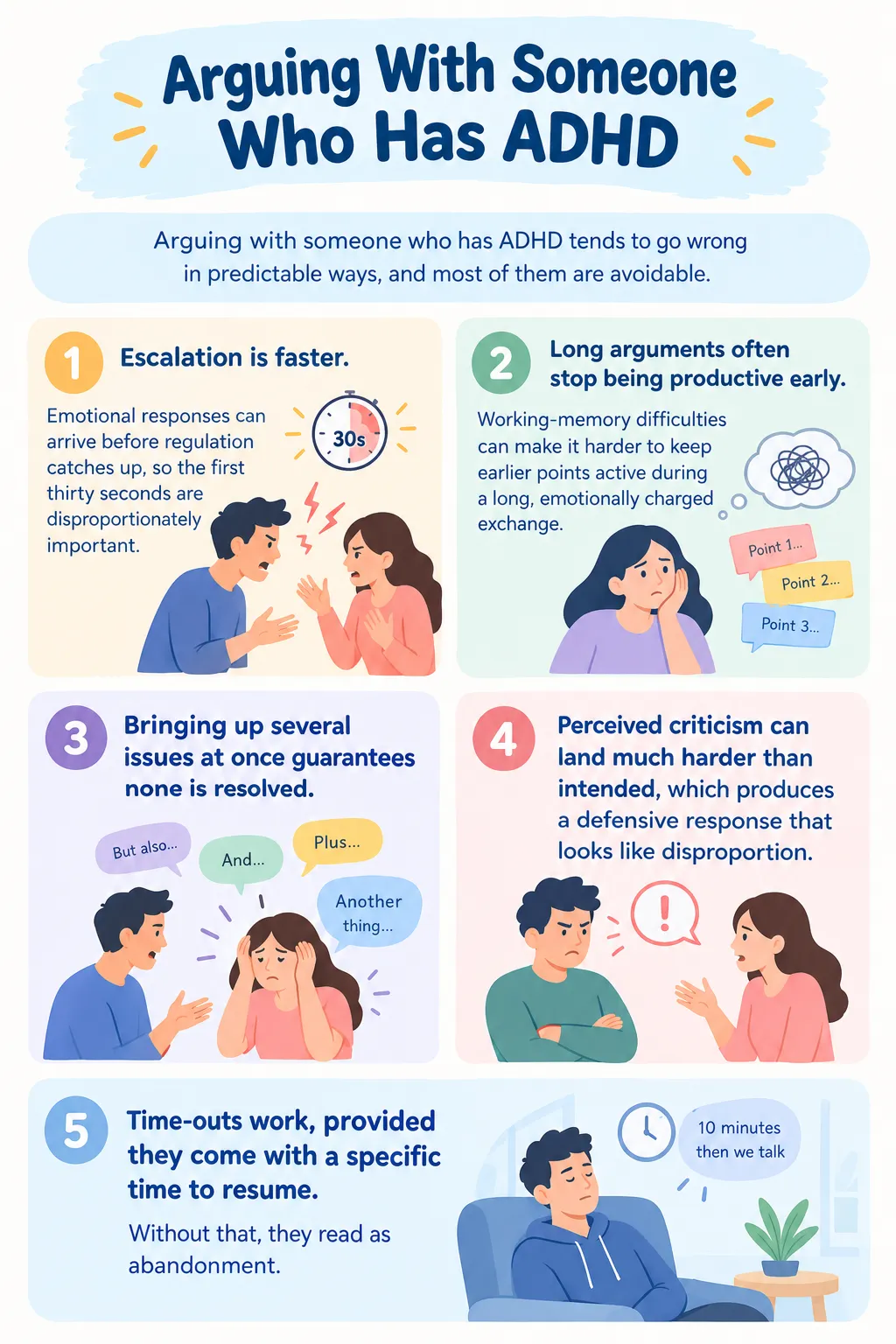
Arguing with someone who has ADHD tends to go wrong in predictable ways, and most of them are avoidable.
- Escalation is faster. Emotional responses can arrive before regulation catches up, so the first thirty seconds are disproportionately important
- Long arguments often stop being productive early. Working-memory difficulties can make it harder to keep earlier points active during a long, emotionally charged exchange
- Bringing up several issues at once guarantees none is resolved
- Perceived criticism can land much harder than intended, which produces a defensive response that looks like disproportion
- Time-outs work, provided they come with a specific time to resume. Without that, they read as abandonment
For the partner with ADHD, the most useful single move is to say plainly that you need a pause and will come back at a stated time, rather than shutting down or escalating. For the other partner, one issue at a time, in writing where it is complicated, resolves more than a long conversation does.
Repairing After an Argument
Repair matters more than the argument itself, and it tends to work better in a sequence than as a single apology.
- Regulate first. Nothing useful happens while either person is still escalated
- Name the specific behaviour rather than the general pattern
- Acknowledge the impact before explaining anything
- Explain the mechanism if it helps, without using it as an excuse. Both the explanation and the accountability have to be present
- Agree one behavioural change, not several
- Build the system that supports it, so it does not depend on remembering
- Revisit in a week or two to check whether it actually worked
ADHD, Love and Dating
ADHD and dating have a specific dynamic in the early phase that is worth understanding before it is misread later. ADHD dating experiences are frequently described in the same two stages.
Love and ADHD interact in a particular way early on. Early relationships can provide unusually high novelty and stimulation, and some people with ADHD report very intense attention, effort and interest in early dating: fully present, elaborately planned, intensely focused. This is real rather than performance. What follows, when novelty reduces, is frequently experienced by the other person as a withdrawal of feeling.
Being ADHD in love does not necessarily mean feeling less than it looked like from outside. A reduction in novelty-driven attention does not by itself establish that feelings have changed, and it also does not rule out that something has genuinely shifted. Saying this early, before it happens, prevents a great deal of unnecessary damage.
Dating someone with ADHD
- Ask for what you need explicitly. Hinting relies on interpretation that may not happen
- Written follow-up on plans is not bureaucratic; it is the difference between a plan happening and not
- Distinguish between forgotten and unimportant, because they look identical and are not
- Notice the effort that goes into things you cannot see, particularly if your partner is compensating hard
- If you are the person with ADHD, disclosing early is usually easier than explaining retrospectively after a pattern has been misread
ADHD and Marriage
The ADHD effect on marriage is a well-known framing, and the value in it is that it describes a cycle rather than blaming a person. The cycle usually runs: symptoms produce a shortfall, the shortfall produces a response from the other partner, the response produces shame or defensiveness, and that makes the original difficulty worse.
Long-term ADHD marriage difficulties tend to accumulate in the domains where the research points: household organisation, time management, communication and, where children are involved, the division of parenting load. What makes the difference is rarely a single conversation. It is whether the couple ends up treating ADHD as a shared problem to be managed or as one person’s defect.
ADHD relationship counselling
Couples counselling may be worth considering where relationship distress is significant, particularly with a clinician familiar with ADHD. A therapist who is unfamiliar with ADHD may interpret executive-function difficulties primarily as motivation or relationship problems, so ADHD-specific experience can be useful. Australia’s clinical guideline recommends cognitive-behavioural intervention for adults and identifies communication, problem-solving, self-advocacy and interpersonal difficulties among relevant targets, which is not the same as establishing couples therapy itself as an evidence-based ADHD treatment.
ADHD and Friendships
ADHD and friendships get far less attention than romantic relationships and are often where the loss is quietest. ADHD friendships have no formal structure, no shared household and nothing that forces contact, which makes them unusually vulnerable to the same mechanisms.
- Contact lapses without intent. Months pass, and the gap itself then becomes a barrier to getting in touch
- Replies are composed mentally and never sent, which is experienced by the other person as being ignored
- Plans are agreed enthusiastically and cancelled, sometimes repeatedly
- Conversation is interrupted or dominated, particularly when interested, and reads as self-absorption
- Rejection sensitivity makes a small ambiguity feel like evidence, so people withdraw pre-emptively
Friends with ADHD are often deeply loyal and entirely inconsistent in contact, and those two things are not in conflict. ADHD friends are rarely absent because they stopped caring. The practical fixes are unglamorous: recurring scheduled contact rather than spontaneous, naming the pattern explicitly so silence is not misread, and low-friction formats such as a voice note rather than a composed reply.
ADHD and Intimacy
ADHD intimacy difficulties are commonly described and rarely discussed. Distraction during sex, difficulty staying present, differences in desire driven by stimulation rather than affection, and the corrosive effect of the parent and child dynamic on attraction all come up. Where a relationship has drifted into supervision, intimacy is usually the first casualty and the last thing addressed.
What Helps
For the partner with ADHD
- Externalise rather than promise. A shared calendar with alerts is worth more than an assurance
- Own the impact even where the intent was absent. Both things are true at once
- Address the shame layer, because defensiveness usually sits on top of it
- Treat your partner’s reminders as a system that is currently necessary rather than an insult, while working towards it not being necessary
For the other partner
- Separate the person from the mechanism. This is harder than it sounds and it is most of the work
- Ask for behaviour change, not for more caring. Caring is not the variable
- Say what you need in plain terms, at a time that is not the middle of an argument
- Protect yourself from the invisible-workload trap by making the division explicit rather than absorbing it
- Your frustration is legitimate. Understanding the mechanism does not oblige you to accept any impact indefinitely
If conflict in your relationship ever becomes frightening or unsafe, that is a different situation and it needs specialist support rather than relationship strategies. In Australia, 1800RESPECT is available on 1800 737 732.
Related Guides
- Emotional dysregulation and rejection sensitivity in ADHD
- ADHD at work: rights, adjustments and what helps
- Therapy for ADHD: CBT and other approaches
- ADHD symptoms in adults
- Late ADHD diagnosis in women: what happens after
References
- Wymbs BT and colleagues. Adult ADHD and romantic relationships: what we know and what we can do to help. 2021. Review of relationship satisfaction, conflict and separation research, including stated evidence gaps. PMID 33421168
- Canu WH and colleagues. Young adult romantic couples’ conflict resolution and satisfaction varies with partner’s ADHD type. Journal of Marital and Family Therapy, 2014.
- Huynh-Hohnbaum AL, Benowitz E. Effects of adult ADHD on intimate partnerships. Journal of Family Social Work, 2022. Systematic literature review.
- “I felt like a burden”: an exploration into the experience of romantic relationships for people with ADHD. 2025. Qualitative study of 355 adults; themes included emotional intensity, passion and distraction, partner and caregiver dynamics and self-understanding. Qualitative findings, not prevalence. PMC12662942
- Do people with ADHD lie more often? States there is no hard evidence supporting the link. chadd.org
- The truth about ADHD and lying. Apparent dishonesty as a coping mechanism arising from memory, impulsivity, avoidance and shame. chadd.org
- Australian ADHD Professionals Association. Australian Evidence-Based Clinical Practice Guideline for Attention Deficit Hyperactivity Disorder (ADHD). Released October 2022. Functional impact on relationships and family functioning, and cognitive-behavioural interventions for adults. adhdguideline.aadpa.com.au
- Healthdirect Australia. Attention deficit hyperactivity disorder (ADHD). healthdirect.gov.au
Last reviewed: September 2026. Next scheduled review: September 2027. This article is general information and is not a substitute for individual medical advice, assessment or diagnosis.