

What Are My Rights With ADHD at Work in Australia?
The Disability Discrimination Act 1992 uses a broad definition of disability that includes neurological and learning disabilities, and covers disability that is not visible or not constant. Where it applies, an employer is required to make reasonable adjustments, and can only decline on the basis of unjustifiable hardship, which they must be able to demonstrate rather than simply assert. Funding for adjustments may be available through the Employment Assistance Fund. This is general information, not legal advice.
Work is where adult ADHD tends to become expensive. School provides structure, deadlines someone else enforces and a timetable that repeats. Many workplaces provide less external structure than that, which can make planning, prioritisation and deadlines harder for some adults with ADHD. Australia’s clinical guideline describes poorer employment quality, reduced income and lower occupational achievement among adults with ADHD, and identifies occupational functioning as an important part of adult assessment (Australian ADHD Professionals Association, 2022). ADHD employment statistics reflect that pattern at a population level rather than predicting any individual career.
This guide covers where ADHD shows up at work, what the law in Australia actually requires, which adjustments are worth asking for, how the disclosure decision works and what funding exists. For the wider picture of adult ADHD, see the guide to ADHD in adults.
Where ADHD Shows Up at Work
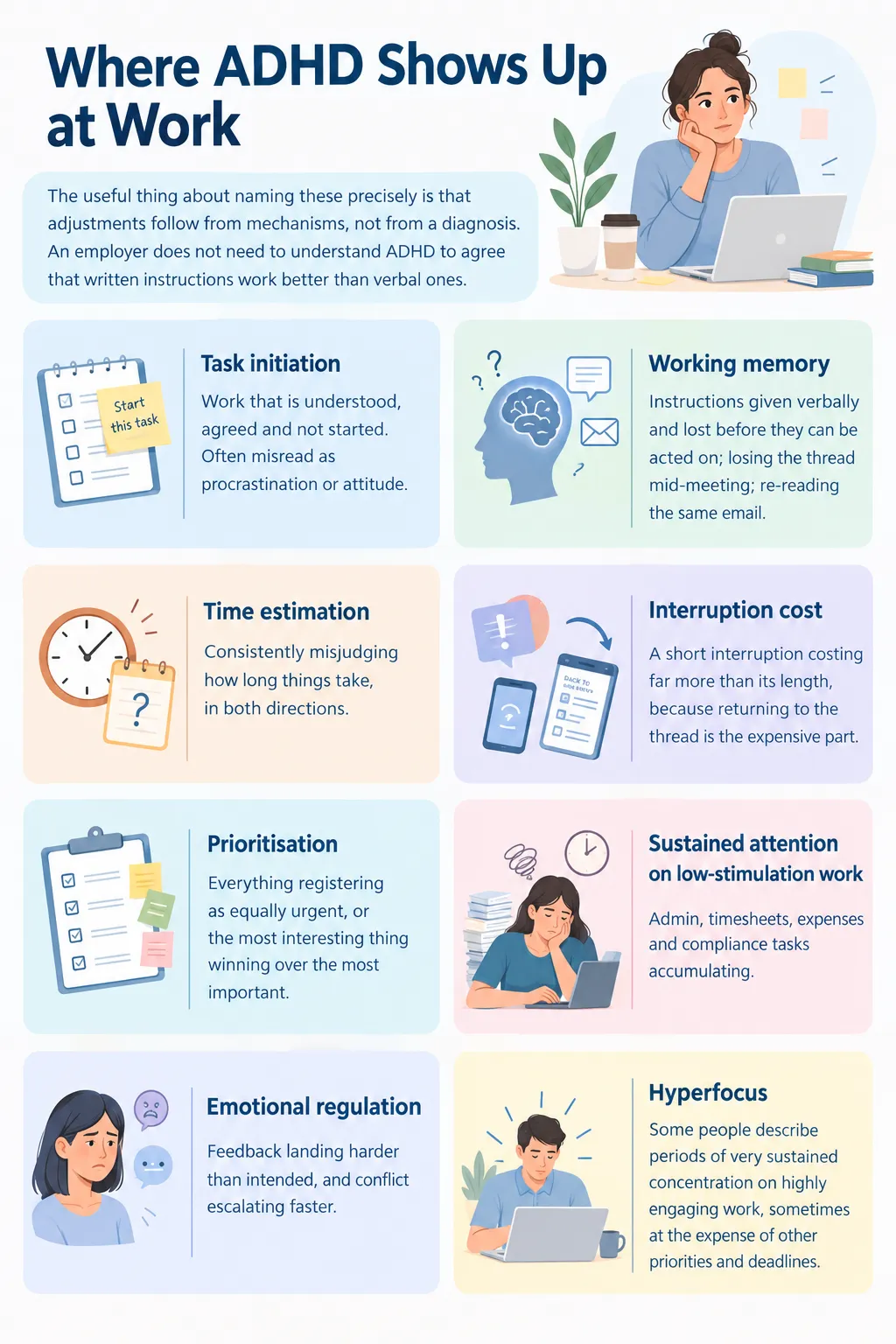
The useful thing about naming these precisely is that adjustments follow from mechanisms, not from a diagnosis. An employer does not need to understand ADHD to agree that written instructions work better than verbal ones.
| What is actually happening | How it looks at work |
| Task initiation | Work that is understood, agreed and not started. Often misread as procrastination or attitude |
| Working memory | Instructions given verbally and lost before they can be acted on; losing the thread mid-meeting; re-reading the same email |
| Time estimation | Consistently misjudging how long things take, in both directions |
| Interruption cost | A short interruption costing far more than its length, because returning to the thread is the expensive part |
| Prioritisation | Everything registering as equally urgent, or the most interesting thing winning over the most important |
| Sustained attention on low-stimulation work | Admin, timesheets, expenses and compliance tasks accumulating |
| Emotional regulation | Feedback landing harder than intended, and conflict escalating faster |
| Hyperfocus | Some people describe periods of very sustained concentration on highly engaging work, sometimes at the expense of other priorities and deadlines |
ADHD and working memory is behind a large share of workplace difficulty, because so much of office life is transmitted verbally and expected to survive until it can be acted on. ADHD working memory difficulties are not the same thing as not listening or not caring, and the practical fixes tend to be structural rather than effortful. Working memory ADHD searches usually land on the general cognitive picture, which is covered in the guide to ADHD, memory and brain fog; this page stays with how those difficulties show up at work and what adjustment addresses them.
Falling asleep at work and the after-work crash
ADHD falling asleep in meetings is a common and rarely discussed experience, and ADHD falling asleep at work more broadly comes up often enough to be worth addressing directly. Falling asleep at work should not be attributed to ADHD automatically. Low-stimulation environments can be genuinely hard to stay alert in when attention regulation depends on stimulation, and a long meeting with no participation required is a demanding version of that. Sleep problems are also common alongside ADHD. Persistent daytime sleepiness has a number of possible causes, including insufficient sleep, circadian timing, medicines and undiagnosed sleep disorders, and it warrants assessment rather than a workaround.
What some people call an ADHD crash after work is an informal description rather than a clinical term. A day spent sustaining effort and compensating in an environment that does not suit you has a cost, and fatigue, sleep and the effort of compensating are all plausible contributors. It is worth recognising as a workload signal rather than a personal failing.
Is ADHD Covered by Disability Discrimination Law?
The Disability Discrimination Act 1992 uses a broad definition of disability that includes physical, intellectual, psychiatric, sensory, neurological and learning disabilities. It covers disability that is not visible and not constant, past disability, future disability, and cases where someone is treated as having a disability whether or not they do (Australian Human Rights Commission).
- A person with a disability has a right to the same employment opportunities as a person without one
- Where the Act applies, employers generally have obligations to make reasonable adjustments for an employee with disability, unless doing so would cause unjustifiable hardship or another relevant legal exception applies (Australian Human Rights Commission)
- Unjustifiable hardship is a legal exception that turns on the circumstances rather than on an employer simply labelling an adjustment unreasonable. JobAccess states that an employer may not have to make an adjustment where they can demonstrate unjustifiable hardship, which can involve severe financial hardship, technical issues or heritage reasons, and that a small cost or inconvenience is not unjustifiable hardship (JobAccess)
- The Act contains provisions concerning the inherent requirements of a job, reasonable adjustments and unjustifiable hardship. Whether any particular employment decision is lawful depends on the circumstances of the case
Whether ADHD meets the definition in a particular case depends on the individual circumstances, and this is general information rather than legal advice. The guide to whether ADHD is a disability covers the broader question, including NDIS and other frameworks.
What makes an adjustment reasonable?
JobAccess describes reasonable adjustments as changes that give people with disability equal access to employment, and groups them into physical changes to the work area, equipment or services, and changes to work methods and tasks (JobAccess guidelines on reasonable adjustment). In practice an adjustment is easier to justify when it connects to a disability-related need, enables the person to do the job, and is workable for the employer. What counts as reasonable in a particular workplace is a legal question that depends on the circumstances.
Adjustment or preference?
This distinction decides how most of these conversations go. A preference sounds like: I work better from home. A functional request sounds like: a quieter environment reduces interruptions and lets me hold concentration on sustained tasks, so two days a week at home would let me do the deep work reliably. The second explains the mechanism and the outcome, which is what an employer can assess, approve and review.
ADHD Workplace Adjustments Worth Asking For
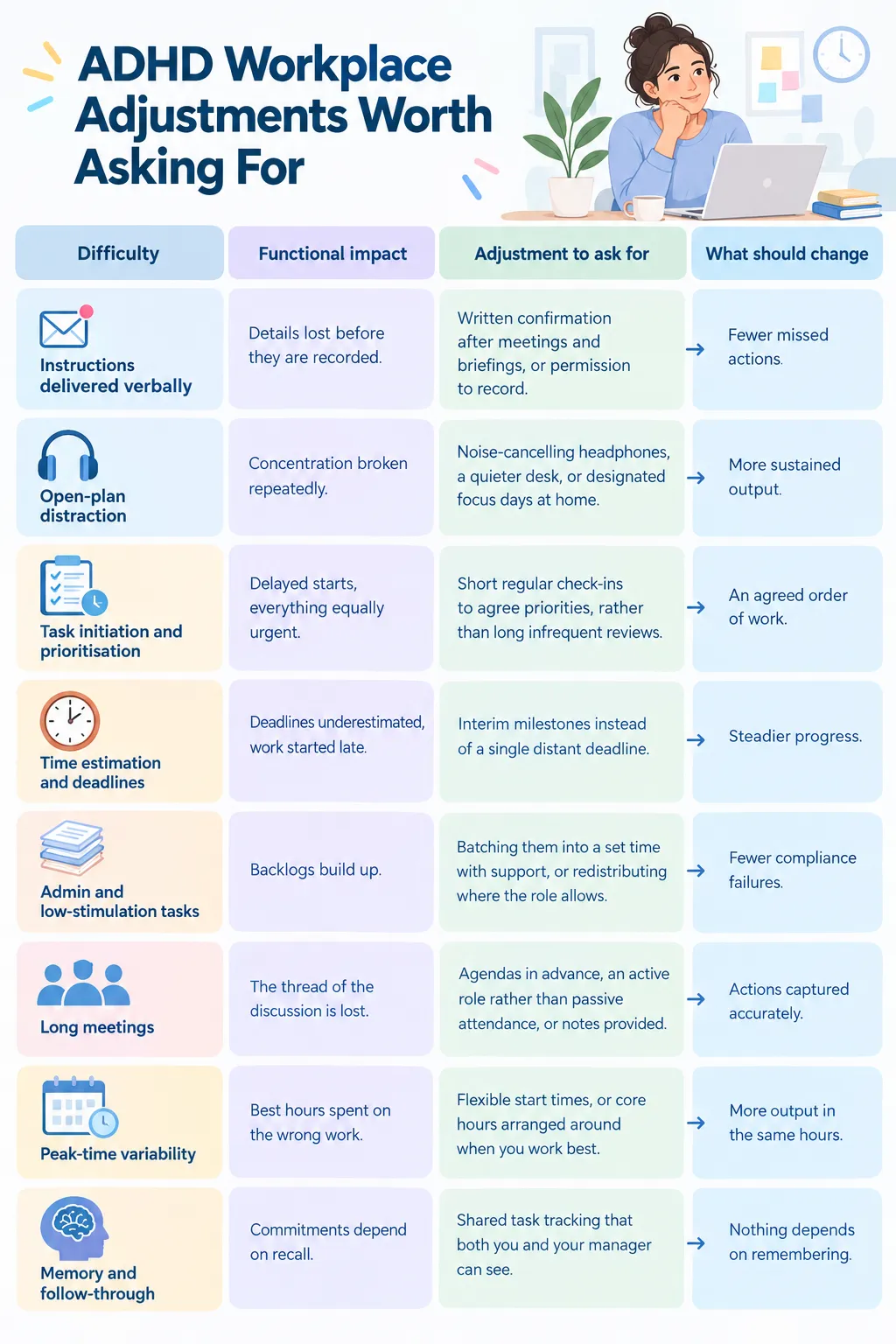
Adjustments work best when they are specific and tied to a mechanism. Asking for flexibility is vague; asking for written follow-up after verbal briefings is something an employer can actually action.
One way to structure a request is difficulty, functional impact, adjustment, expected outcome. Setting it out that way makes the adjustment measurable, which also makes it reviewable. The adjustments below are the ones that come up most often for ADHD at work.
| Difficulty | Functional impact | Adjustment to ask for | What should change |
| Instructions delivered verbally | Details lost before they are recorded | Written confirmation after meetings and briefings, or permission to record | Fewer missed actions |
| Open-plan distraction | Concentration broken repeatedly | Noise-cancelling headphones, a quieter desk, or designated focus days at home | More sustained output |
| Task initiation and prioritisation | Delayed starts, everything equally urgent | Short regular check-ins to agree priorities, rather than long infrequent reviews | An agreed order of work |
| Time estimation and deadlines | Deadlines underestimated, work started late | Interim milestones instead of a single distant deadline | Steadier progress |
| Admin and low-stimulation tasks | Backlogs build up | Batching them into a set time with support, or redistributing where the role allows | Fewer compliance failures |
| Long meetings | The thread of the discussion is lost | Agendas in advance, an active role rather than passive attendance, or notes provided | Actions captured accurately |
| Peak-time variability | Best hours spent on the wrong work | Flexible start times, or core hours arranged around when you work best | More output in the same hours |
| Memory and follow-through | Commitments depend on recall | Shared task tracking that both you and your manager can see | Nothing depends on remembering |
ADHD office tools and ADHD productivity tools are worth treating as part of the same conversation. ADHD office supplies, task software, timers and noise-cancelling equipment are often exactly the kind of practical change that both an employer and a funding scheme will support, because the cost is small and the outcome is measurable.
Funding: JobAccess and the Employment Assistance Fund
The Employment Assistance Fund, administered through JobAccess, can fund workplace changes, equipment and services. It is a federal scheme and it is not widely known about.
Eligibility
- You are an Australian resident, which includes citizens, permanent visa holders, protected Special Category visa holders, and holders of Temporary Protection or Safe Haven Enterprise Visas
- You have a job, or have been offered a job, where the work will run for at least 13 weeks. JobAccess notes there may be exceptions for shorter periods or for seasonal work
- You work at least 8 hours a week. Self-employed applicants need 8 or more hours a week for 13 weeks at or above the national minimum wage
- You have an ongoing disability that has lasted or will last at least 2 years, and that limits, restricts or affects your ability to work
What it can cover
- Workplace modifications and equipment
- Services that enable you to do your job
- Workplace assessments to identify what adjustments are needed
- Assistive technology for job searching, and support at interviews, which can be available before you have a job
These are the standard criteria rather than an unconditional rule: JobAccess assesses each application case by case and provides exceptions in some circumstances. The emphasis is on the functional effect on your ability to work rather than on the diagnostic label alone. Criteria and coverage change, so check the current eligibility criteria on JobAccess before relying on any of this.
Should You Disclose ADHD at Work?
Whether you disclose ADHD can depend on why you are disclosing, the adjustment you need and the circumstances of your employment. There is no general need to disclose a diagnosis simply because you have ADHD, though particular legal or workplace circumstances can affect what information is relevant, including some safety-critical roles. The practical trade-off is straightforward: formal adjustments generally require some disclosure, and disclosure cannot be undone.
What tends to favour disclosing
- You want formal adjustments, or you want to apply for funding that requires them
- Performance is already being discussed, and an explanation plus a plan is better than an explanation alone
- Your workplace has a visible track record with other employees, not just a policy document
- You need something that cannot be arranged informally
What tends to favour waiting
- The adjustments you need can be arranged as ordinary preferences without a label
- You are new and have no read on how it would land
- You are in a probation period or a restructure
- You do not yet know what you would actually ask for, which is the most common reason to wait
Disclosure is not all or nothing. You can describe the functional difficulty and the adjustment without naming a diagnosis: saying you process written instructions better than verbal ones asks for the same change as disclosing ADHD, without disclosing anything. You can also disclose to HR without disclosing to your team, or to a manager without it going further, and it is reasonable to ask who else will be told before you say anything.
How to Ask for Adjustments
- Work out the mechanism first, not the label. What specifically goes wrong, and when?
- Pair each difficulty with a concrete adjustment, so the conversation is about a solution rather than a problem
- Put it in writing, even after a verbal conversation, so there is a record of what was agreed
- Frame it around output. Adjustments that produce more reliable work are easier to approve than adjustments framed as accommodations
- Ask what evidence they need before arranging anything. Documentation requirements vary with the employer, the adjustment and the circumstances: some want a clinician’s letter describing functional effects, some accept a conversation, and assuming the most onerous version is a common reason people never ask
- Agree a review point and what you will look at. The cycle that works is problem, adjustment, something you can measure, review, then modify: missed actions after meetings, for example, reviewed six weeks after written follow-ups start. That turns a change that is not working into a scheduled adjustment rather than a difficult conversation
What if your employer says no?
A refusal is not necessarily the end of it, and it is not necessarily unlawful either. Ask for the reason in writing, because a specific objection to cost, practicality or operational effect can often be answered with a smaller version, a trial period or funding that removes the cost. If the objection is to the adjustment rather than to you, a trial with an agreed measure is usually the easiest thing to approve. If you think the refusal is discriminatory, that is the point to get advice from a union, a community legal centre or an employment lawyer rather than to argue the law yourself.
Careers, Job Hunting and Fit
There is no ADHD career list, and content that presents one tends to be built on stereotypes rather than evidence. What does seem to matter is the shape of the role rather than the field.
- Variety and genuine deadlines usually work better than open-ended, self-directed work with distant milestones
- Roles where the interesting part is the main part, rather than surrounded by heavy admin
- Environments where you can get feedback early rather than at the end
- Managers who communicate in writing, which is a bigger factor than the industry
A common version of this question is: is teaching a good job for ADHD? It illustrates the point well. Teaching can offer external structure, variety and frequent interaction, and it also involves administration, fixed schedules and substantial emotional labour. Whether it suits an individual depends on which of those demands dominate in the particular role and which are most compatible with how that person functions, rather than on the profession itself.
Interviews
- You can request interview adjustments, such as questions in advance or extra time, and the Employment Assistance Fund may cover support at interview stage
- There is no obligation to disclose at interview
- Prepare concrete examples in advance, since recalling them under pressure is exactly the condition that makes working memory difficulties worse
ADHD Strengths in the Workplace
This deserves care, because the advantages of ADHD in the workplace are frequently overstated in a way that is unhelpful to people who are struggling. ADHD is diagnosed on the basis of impairment, and a strengths framing should not obscure that.
What can be said more defensibly is that the same traits behave differently depending on the environment. Australia’s clinical guideline lists novel idea generation, problem-solving and hyperfocus among strengths described in ADHD, while also describing impairment in work and daily functioning (Australian ADHD Professionals Association, 2022). Comfort with urgency and deep absorption in genuinely engaging work are commonly described too. These are not a compensation package for the difficulties, and they show up most where the role fits.
Workaholism and the overwork pattern
ADHD and workaholism come up together often, and the relationship is worth stating carefully. Some people respond to ADHD-related difficulties by working longer hours to compensate for delayed starts, lost time or inconsistent output. That is a pattern some people describe rather than an established causal pathway. Where long hours become persistent and hard to control, it can be useful to consider whether overwork is functioning as a compensation strategy, because it is frequently invisible to everyone including the person doing it. The guide to ADHD burnout covers what that pattern looks like and how it differs from ordinary tiredness.
If Things Go Wrong
If you believe you have been discriminated against, you can raise it directly with the people involved or with a supervisor, and you can lodge a complaint with the Australian Human Rights Commission. Complaints are free. The process involves investigation and conciliation, and can be escalated to the Federal Court if it is not resolved.
Workplace matters can also involve the Fair Work system depending on the circumstances. If your situation is serious, get advice from a union, a community legal centre or an employment lawyer rather than relying on a general article, including this one.
Related Guides
- ADHD and relationships
- ADHD for students: university, TAFE and study strategies
- ADHD symptoms in adults
References
- Australian Human Rights Commission. Your rights as an employee under the Disability Discrimination Act 1992 (Cth). Definition of disability, reasonable adjustments, unjustifiable hardship and inherent requirements. humanrights.gov.au
- Disability Discrimination Act 1992 (Cth). legislation.gov.au
- Employment Assistance Fund: who is eligible and what it can cover. jobaccess.gov.au
- Guidelines on reasonable adjustment: definition, categories of adjustment, and unjustifiable hardship. jobaccess.gov.au
- Australian ADHD Professionals Association. Australian Evidence-Based Clinical Practice Guideline for Attention Deficit Hyperactivity Disorder (ADHD). Released October 2022. Functional impact in adulthood. adhdguideline.aadpa.com.au
- Healthdirect Australia. Attention deficit hyperactivity disorder (ADHD). healthdirect.gov.au
Last reviewed: September 2026. Next scheduled review: September 2027. This article is general information and is not a substitute for individual medical advice, assessment or diagnosis.