

Can ADHD Be Managed Without Medication?
Non-medication approaches have a real evidence base, but it is uneven, and the strength of the evidence varies considerably from one approach to the next. Australia’s clinical guideline makes a strong recommendation for cognitive-behavioural interventions in adults and for parent and family training in young children, and treats ADHD coaching as clinical consensus rather than proven. Most natural remedies and supplements sold for ADHD are not recommended by the guideline at all, because the evidence does not support them (Australian ADHD Professionals Association, 2022).
Searching for ADHD treatment without medication turns up two very different kinds of content. One is a list of tips with no indication of which are supported and which are guesswork. The other is a natural ADHD treatment page selling something. Neither tells you what Australian clinical guidance actually recommends, or where it deliberately stops short.
There is no single answer to how to treat ADHD without medication, because what carries the strongest support differs by age. This guide covers what the evidence supports, what it does not, and where the honest answer is that nobody knows yet. It does not cover medication, and it is not an argument for or against it: that conversation belongs with your treating clinician. For how the condition is identified in the first place, see the guide to how ADHD is diagnosed in Australia.
What “Without Medication” Actually Means
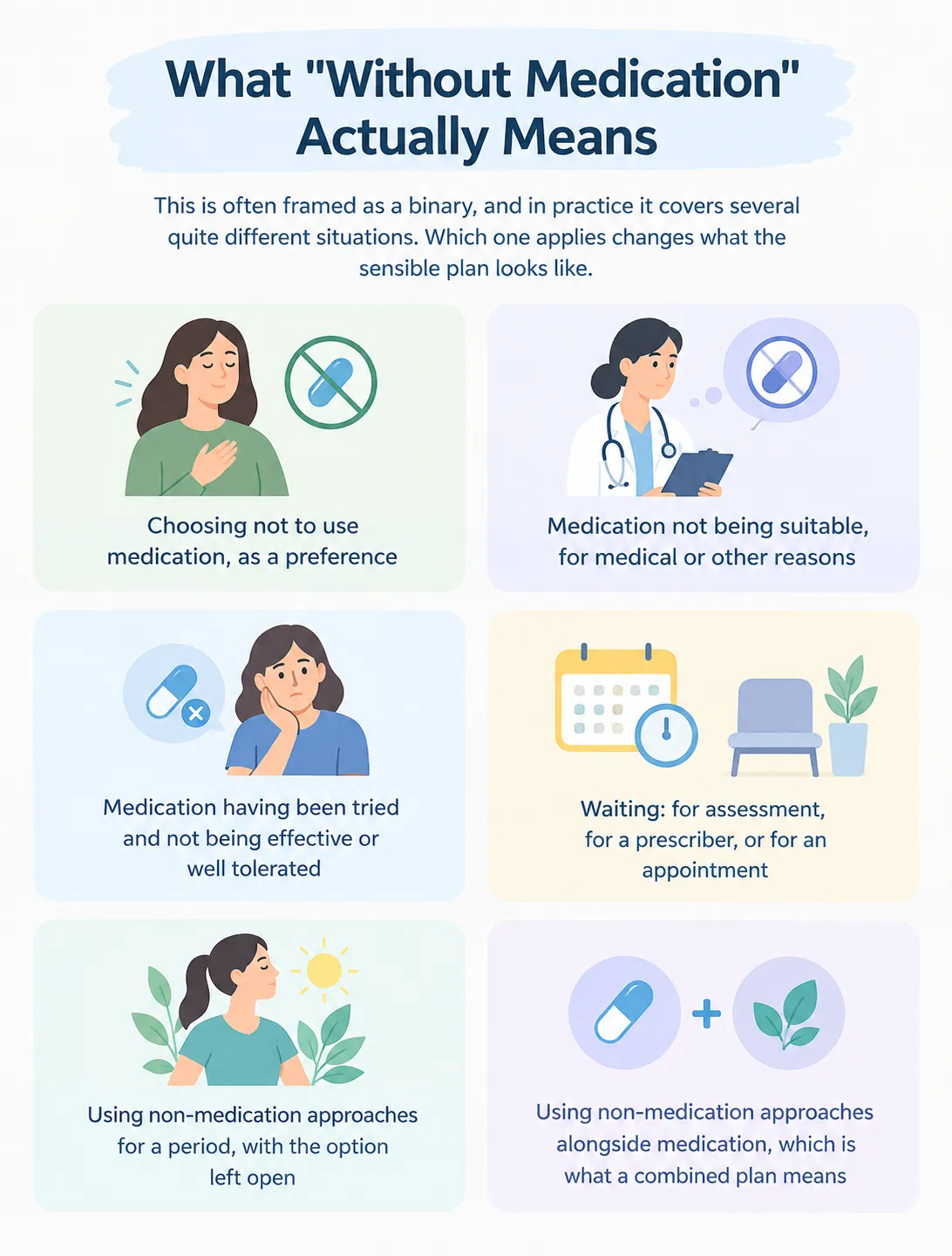
This is often framed as a binary, and in practice it covers several quite different situations. Which one applies changes what the sensible plan looks like.
- Choosing not to use medication, as a preference
- Medication not being suitable, for medical or other reasons
- Medication having been tried and not being effective or well tolerated
- Waiting: for assessment, for a prescriber, or for an appointment
- Using non-medication approaches for a period, with the option left open
- Using non-medication approaches alongside medication, which is what a combined plan means
Australia’s clinical guideline presents treatment as individualised, involving pharmacological approaches, non-pharmacological approaches or both. This article covers the non-pharmacological side; it is not an argument that one route is better than another, and choosing non-medication treatment does not have to be a permanent decision.
What Australia’s Clinical Guideline Recommends
This is the part most coverage leaves out. Australia’s evidence-based clinical practice guideline grades each recommendation, so you can see not just what is suggested but how confident the evidence allows anyone to be. The recommendations below come from that Australian guideline; recommendations and access arrangements differ in other countries (Australian ADHD Professionals Association, 2022).
| Approach | Who for | Strength of recommendation |
| Parent and family training | Young children under 5 | Strong recommendation, low to moderate certainty evidence |
| Parent and family training | Children 5 to 17 | Conditional recommendation, low certainty evidence |
| More intensive parent and family training | Children with co-occurring oppositional defiant disorder or conduct disorder | Strong recommendation, moderate certainty evidence |
| Cognitive-behavioural interventions | Children 5 to 17 | Conditional recommendation, low certainty evidence |
| Cognitive-behavioural interventions | Adolescents 13 to 17 | Conditional recommendation, low certainty evidence |
| Cognitive-behavioural interventions | Adults 18 and over | Strong recommendation, low certainty evidence |
| ADHD coaching | Adolescents and adults | Clinical consensus recommendation, insufficient evidence to grade |
| Lifestyle guidance on sleep, diet and physical activity | All ages | Clinical practice point, no formal evidence rating |
Two things are worth reading carefully in that table. The strongest recommendation for treating ADHD without medication in adults is cognitive-behavioural intervention, not a supplement or a device. And coaching, which is widely sold, sits at clinical consensus: the guideline states it could be considered as part of a treatment plan for adolescents and adults, and classifies that as a clinical consensus recommendation because the available evidence was insufficient to grade.
Just as informative is what the guideline does not make recommendations about. It does not recommend omega-3 or other supplements, elimination diets, neurofeedback or cognitive training as treatments for ADHD. That absence is not an oversight; it reflects that the evidence reviewed did not support making a recommendation. What the pattern does support is a holistic treatment for ADHD in the ordinary sense of the word: skills, sleep, environment and support addressed together, rather than one intervention expected to carry everything.
What the Recommendation Labels Actually Mean
These terms are used consistently throughout this article, and they are easy to misread.
- Strong recommendation: the panel judged the likely benefit worth acting on. It does not mean the evidence is high certainty, and in ADHD it often is not
- Conditional recommendation: the balance of benefits and burdens is closer, so the decision depends more on the individual
- Clinical practice point: practical guidance offered without a formal evidence rating
- Clinical consensus: experts agreed it could be considered, where evidence was insufficient to grade formally
- No recommendation or insufficient evidence: the evidence reviewed did not support making a recommendation. That is not the same as being proven ineffective, and it is not the same as being unsafe
One further distinction matters: evidence strength is a statement about populations, not about you. An approach with insufficient evidence to grade may still be useful to a particular person, and an approach with a strong recommendation may not suit them. That is why the guideline asks for individualised, shared decision-making rather than applying a ranking.
Non-Medication Treatment by Age
- Young children under 5: parent and family training, strong recommendation
- Children 5 to 17: parent and family training conditionally recommended, more intensive programs strongly recommended where oppositional defiant or conduct disorder co-occurs; cognitive-behavioural interventions could be offered
- Adolescents 13 to 17: cognitive-behavioural interventions should be offered, conditionally; coaching could be considered
- Adults 18 and over: cognitive-behavioural interventions, strong recommendation; coaching could be considered
- All ages: lifestyle guidance on sleep, diet and physical activity, offered as a clinical practice point
Cognitive-Behavioural Approaches
For adults this is the most strongly supported non-medication approach in the Australian guideline. It is not talking therapy about feelings in general. ADHD-adapted cognitive-behavioural work targets the specific mechanics that go wrong: starting tasks, holding a plan in mind, estimating how long something will take, managing the emotional pile-up that follows repeated failure at ordinary things. The separate guide to therapy for ADHD, including CBT covers what the sessions involve and how to find a practitioner in Australia.
One caveat the guideline itself flags: the recommendation for adults is strong, but the certainty of the underlying evidence is rated low. A strong recommendation with low certainty evidence means the expert panel judged the likely benefit worth acting on, not that the trials are conclusive.
Parent and family training
For children, the most strongly supported approach is not delivered to the child at all. Parent and family training programs teach structured responses to behaviour, and for children under five, and for children with co-occurring oppositional defiant disorder or conduct disorder, the guideline’s recommendation is strong. For school-age children generally it is conditional, meaning the balance of benefits and burdens is closer.
Sleep, Exercise and Diet
The guideline’s practice point is that clinicians should ask about sleep, diet and physical activity and offer strategies or referral where there are difficulties. That is a modest-sounding recommendation that matters more than it reads, because sleep problems in particular are common alongside ADHD and independently degrade attention, mood and self-regulation.
- Sleep: delayed sleep timing is common in ADHD, and the daytime cost of short sleep looks very similar to inattention. This is worth raising with a GP rather than self-managing indefinitely
- Physical activity: the evidence reviewed by the US National Center for Complementary and Integrative Health describes small to moderate benefits from short-term aerobic exercise, including yoga, on core symptoms. Physical activity is generally beneficial for overall health, though what is appropriate depends on the individual and on any other health conditions. It is an addition to treatment rather than a replacement for it
- Diet: the guideline asks clinicians to enquire about diet and offer help with any challenges. That is different from recommending a particular ADHD diet, which it does not do
None of these three is a treatment for ADHD on its own. Australia’s clinical guideline states that lifestyle changes have the potential to improve day-to-day functioning and asks clinicians to offer guidance on them, while noting that its evidence review found few studies and did not support graded recommendations for lifestyle interventions (Australian ADHD Professionals Association, 2022).
Natural Remedies and Supplements: What the Evidence Shows
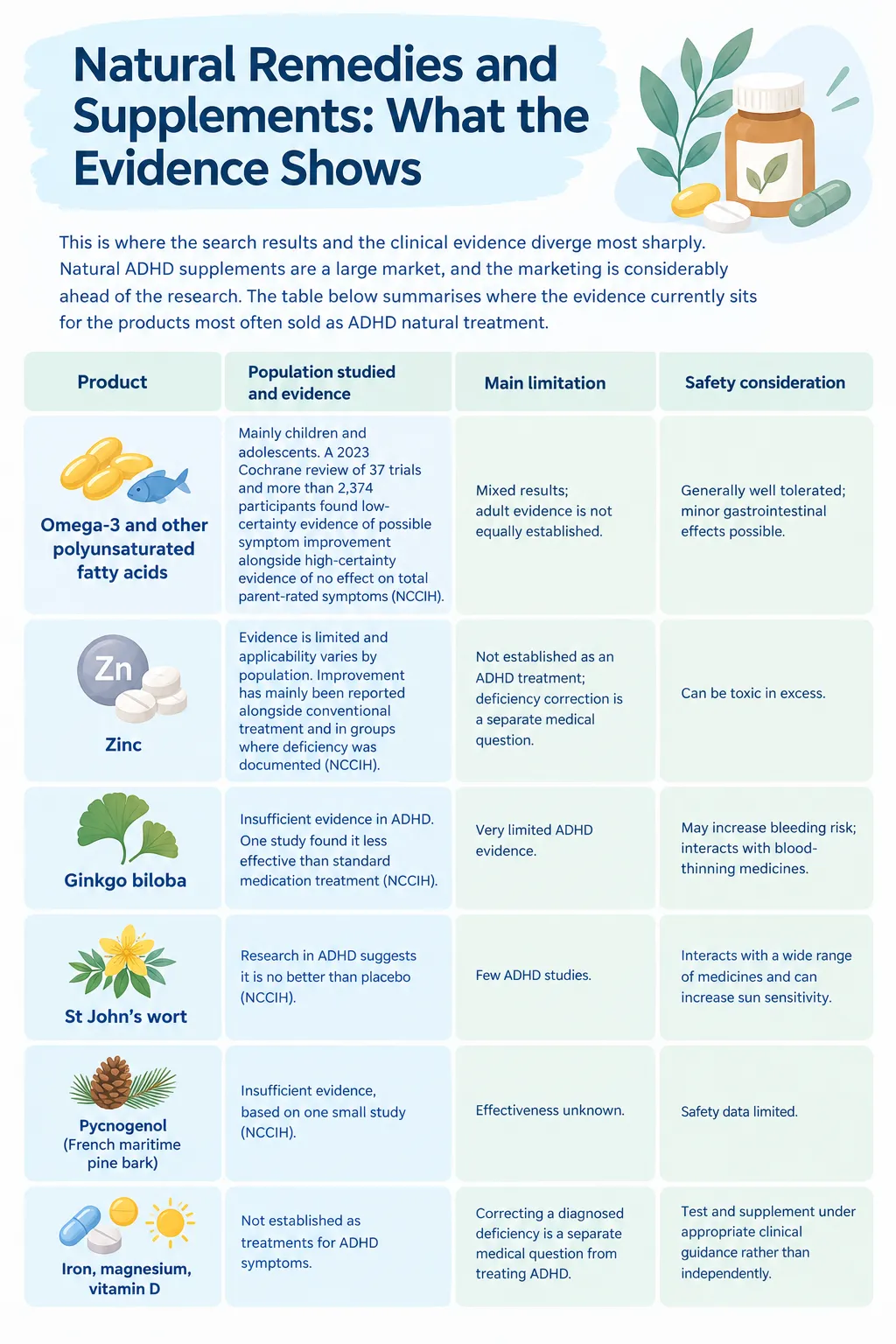
This is where the search results and the clinical evidence diverge most sharply. Natural ADHD supplements are a large market, and the marketing is considerably ahead of the research. The table below summarises where the evidence currently sits for the products most often sold as ADHD natural treatment.
| Product | Population studied and evidence | Main limitation | Safety consideration |
| Omega-3 and other polyunsaturated fatty acids | Mainly children and adolescents. A 2023 Cochrane review of 37 trials and more than 2,374 participants found low-certainty evidence of possible symptom improvement alongside high-certainty evidence of no effect on total parent-rated symptoms (NCCIH) | Mixed results; adult evidence is not equally established | Generally well tolerated; minor gastrointestinal effects possible |
| Zinc | Evidence is limited and applicability varies by population. Improvement has mainly been reported alongside conventional treatment and in groups where deficiency was documented (NCCIH) | Not established as an ADHD treatment; deficiency correction is a separate medical question | Can be toxic in excess |
| Ginkgo biloba | Insufficient evidence in ADHD. One study found it less effective than standard medication treatment (NCCIH) | Very limited ADHD evidence | May increase bleeding risk; interacts with blood-thinning medicines |
| St John’s wort | Research in ADHD suggests it is no better than placebo (NCCIH) | Few ADHD studies | Interacts with a wide range of medicines and can increase sun sensitivity |
| Pycnogenol (French maritime pine bark) | Insufficient evidence, based on one small study (NCCIH) | Effectiveness unknown | Safety data limited |
| Iron, magnesium, vitamin D | Not established as treatments for ADHD symptoms | Correcting a diagnosed deficiency is a separate medical question from treating ADHD | Test and supplement under appropriate clinical guidance rather than independently |
The pattern is consistent. Where an effect is reported it is small, often confined to people who were deficient in something to begin with, and rarely replicated. Australia’s clinical guideline does not recommend any of these as ADHD treatments. That does not mean nothing helps: treating ADHD naturally, in the sense of natural ways to treat ADHD through sleep, exercise, skills and environment, has better support than any product does. It is the ADHD remedies sold in bottles that the evidence does not back.
Two practical points. Natural does not mean inert: several of the products above have real interactions with prescribed medicines, which is a conversation to have with a GP or pharmacist before starting anything, particularly if you or your child are already being treated. And in Australia, complementary medicines including ADHD over the counter supplements are regulated by the Therapeutic Goods Administration under a different framework from prescription medicines. That does not mean they are unregulated, but it does mean you should not assume a product carries the same evidence base or the same pre-market requirements as a prescription treatment.
Elimination diets and food additives
Elimination diets, additive-free diets and sugar restriction come up constantly in searches for ADHD home remedies and herbal remedies for ADHD. Australia’s clinical guideline does not recommend elimination diets as a treatment for ADHD. Restrictive diets in children carry their own risks around nutrition and around the child’s relationship with food, and are not something to start without professional guidance.
Natural ways to increase dopamine
This phrase appears often in searches and rarely in clinical literature, and the gap between the two is worth explaining. ADHD involves differences in dopamine signalling, but that does not mean symptoms can be managed by raising dopamine through food, supplements or activity in any measurable, targeted way. Exercise, sleep and engaging work genuinely help how people with ADHD function. Describing that as increasing dopamine adds a mechanism the evidence does not support.
Neurofeedback and Cognitive Training
Both are marketed as drug-free ADHD treatments, and neither is recommended in Australia’s clinical guideline, which found insufficient or inconsistent evidence for both (Australian ADHD Professionals Association, 2022).
- Neurofeedback: Australia’s clinical guideline found the evidence inconsistent and made no recommendation. The NCCIH evidence review describes moderate effects on parent-rated symptoms and considerably weaker effects on teacher ratings, and notes research suggesting the benefit may reflect non-specific psychological and behavioural effects rather than brain-wave training specifically
- Cognitive training: Australia’s clinical guideline found insufficient evidence to make a recommendation, reporting no clear benefit in adults and no improvement across several broader functioning outcomes. Programs that drill working memory or attention tend to improve performance on the trained task, and the guideline’s review did not find that this transfers to everyday functioning
Both are typically expensive and time-intensive. That is worth weighing against an evidence base that does not yet justify either as a core treatment.
Mindfulness, Meditation and Yoga
The NCCIH evidence review describes insufficient evidence for meditation-based therapies in ADHD, noting a 2023 review which found the research lacked rigorous, unbiased evidence while reporting a small to moderate effect in the available data. The same source reports that short-term aerobic exercise, including yoga, showed small to moderate benefits, and that yoga research has reported positive effects on attention, hyperactivity and impulsive behaviour from a modest evidence base.
A reasonable reading is that these are worth trying as part of a broader approach, particularly for the emotional regulation side of ADHD, and are not a substitute for the interventions with stronger support. They are also low-risk and inexpensive, which changes the calculation compared with a costly device or a long supplement regimen.
Changing the Environment Rather Than the Person
Much of what makes ADHD disabling is a mismatch between how someone’s attention works and how a particular environment is arranged. Changing the environment is not usually counted as treatment, and for many adults it produces more day-to-day improvement than anything else on this page.
- Externalising memory: everything that matters lives somewhere visible rather than in your head
- Reducing the number of decisions a task requires before it can be started
- Making deadlines real and proximate rather than distant and abstract
- Body doubling and working alongside others, which changes the conditions rather than the capacity
- Workplace or study adjustments, which are a formal option in Australia rather than a favour
- Removing the specific friction points that reliably derail you, which are individual and worth identifying deliberately
Structured support for building these systems is what ADHD coaching sets out to provide. The guideline treats it as clinical consensus rather than proven, which is worth knowing before paying for it. The guide to ADHD coaching and support in Australia covers what is available, including free and peer-led options.
Can ADHD Be Cured Without Medication?
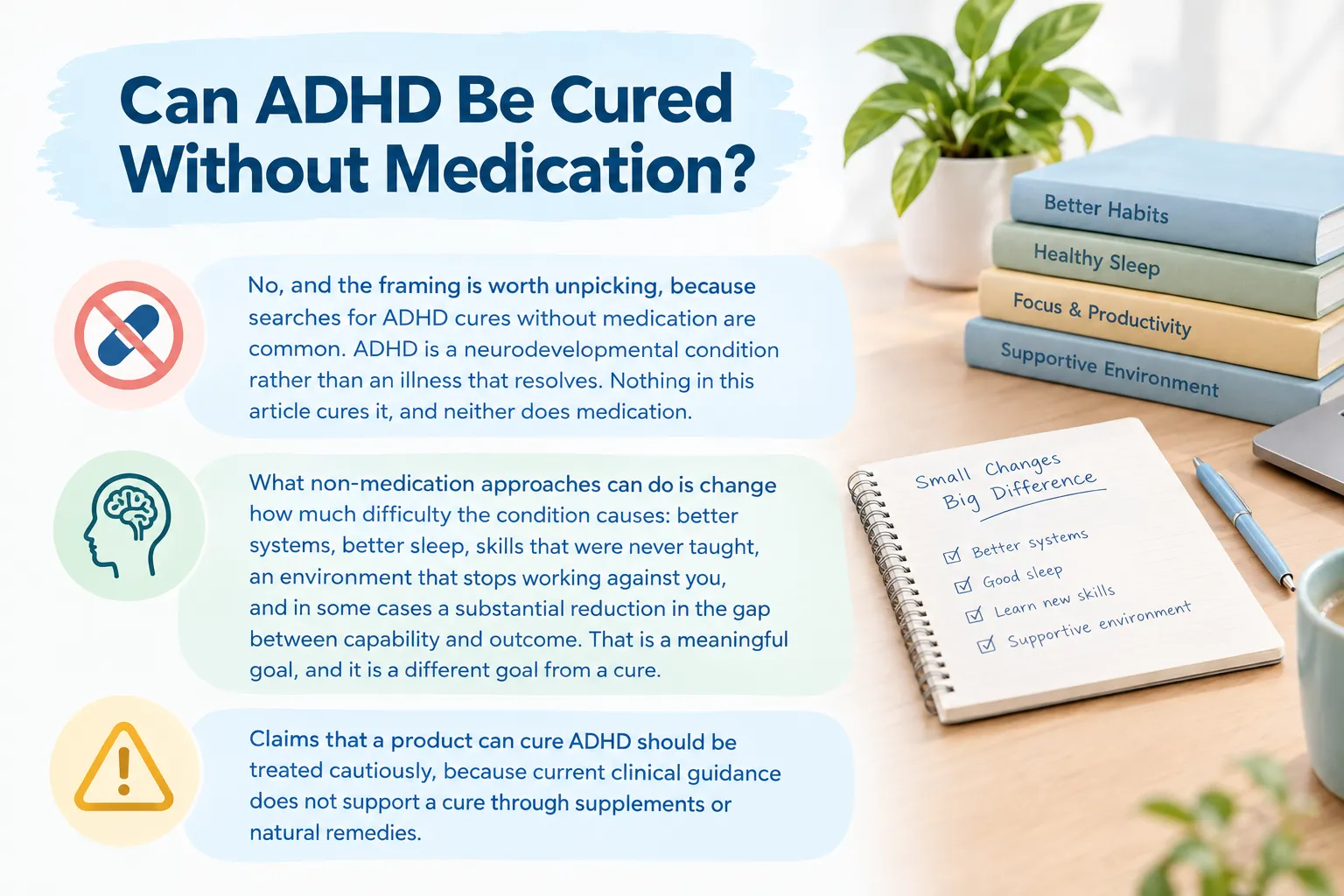
No, and the framing is worth unpicking, because searches for ADHD cures without medication are common. ADHD is a neurodevelopmental condition rather than an illness that resolves. Nothing in this article cures it, and neither does medication.
What non-medication approaches can do is change how much difficulty the condition causes: better systems, better sleep, skills that were never taught, an environment that stops working against you, and in some cases a substantial reduction in the gap between capability and outcome. That is a meaningful goal, and it is a different goal from a cure. Claims that a product can cure ADHD should be treated cautiously, because current clinical guidance does not support a cure through supplements or natural remedies.
When Non-Medication Approaches Are Not Enough
Choosing to manage ADHD without medication is a legitimate decision, and it is one to make with a clinician rather than alone, partly because it is a decision you can revisit.
- If functioning is still significantly affected after a genuine attempt at the approaches with the strongest support, that is information worth bringing back to your clinician
- If co-occurring anxiety, low mood or sleep problems are present, those may need attention in their own right rather than being treated as ADHD symptoms
- If the effort of compensating is itself the problem, which is common in adults diagnosed late, the cost of that effort is worth naming explicitly in the conversation
- Discuss the full range of options with your treating clinician, including any you have ruled out, so the decision is made with complete information
Related Guides
- ADHD treatment in Australia: the full picture
- Is ADHD a disability, a disorder or a difference?
- ADHD strengths, benefits and positive traits
References
- Australian ADHD Professionals Association. Australian Evidence-Based Clinical Practice Guideline for Attention Deficit Hyperactivity Disorder (ADHD). Released October 2022. Chapter 4, non-pharmacological interventions. adhdguideline.aadpa.com.au
- National Center for Complementary and Integrative Health. ADHD and complementary health approaches: what the science says. Clinical Digest. nccih.nih.gov
- Cochrane review of polyunsaturated fatty acids for ADHD, 2023. 37 trials, more than 2,374 participants. Low-certainty evidence of possible benefit alongside high-certainty evidence of no effect on total parent-rated symptoms, as summarised by NCCIH.
- Therapeutic Goods Administration. Complementary medicines regulation in Australia. tga.gov.au
- Healthdirect Australia. Attention deficit hyperactivity disorder (ADHD). healthdirect.gov.au
- Better Health Channel, Victoria. Attention deficit hyperactivity disorder (ADHD): therapies. betterhealth.vic.gov.au