

Where Can I Get ADHD Support in Australia?
ADHD support in Australia includes national helplines, peer support groups, community organisations and professional services such as coaching or therapy. Australia’s clinical guideline states that ADHD coaching could be considered as part of a treatment plan for adolescents and adults, and classifies that as a clinical consensus recommendation because the available evidence was insufficient to grade (Australian ADHD Professionals Association, 2022). ADHD Foundation Australia runs a national helpline on 1300 39 39 19 and ADDults with ADHD runs an ADHD National Support Line on 02 9889 5977; both are volunteer-staffed, free, and not crisis services.
Support and coaching are often mentioned together and are not the same thing. One is largely free, peer-run and about not being alone with it. The other is a paid professional service with a specific method and its own market. This guide covers both, and is clear about what the evidence does and does not show.
What Counts as ADHD Support?
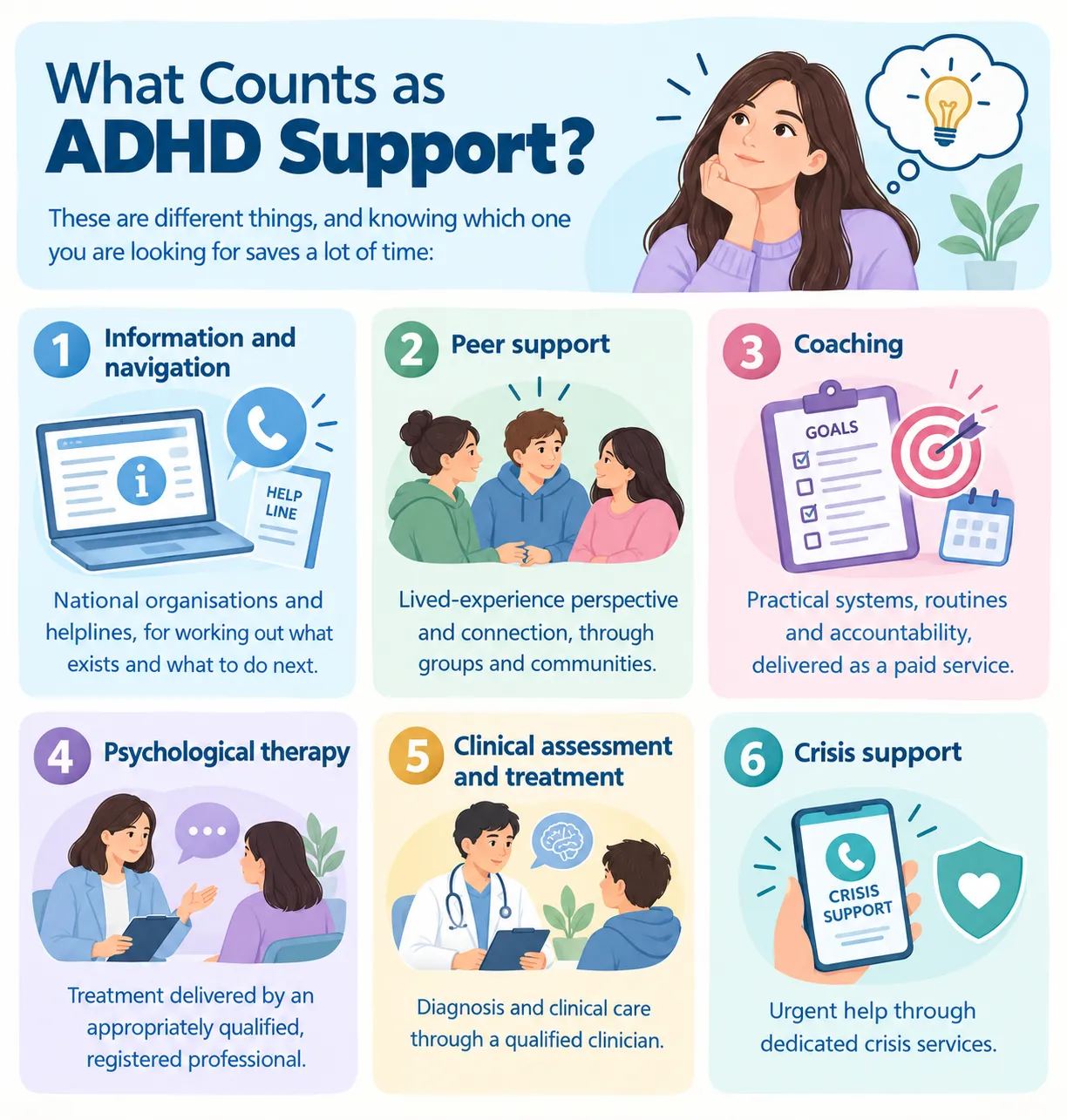
These are different things, and knowing which one you are looking for saves a lot of time:
- Information and navigation: national organisations and helplines, for working out what exists and what to do next
- Peer support: lived-experience perspective and connection, through groups and communities
- Coaching: practical systems, routines and accountability, delivered as a paid service
- Psychological therapy: treatment delivered by an appropriately qualified, registered professional
- Clinical assessment and treatment: diagnosis and clinical care through a qualified clinician
- Crisis support: urgent help through dedicated crisis services
Peer support, coaching, therapy and crisis support are not interchangeable, and most people end up using more than one of them.
What Type of ADHD Support Do You Need?
| If you need | Consider |
| Information about ADHD, or help working out what to do next | A national organisation or helpline |
| Connection with people who have lived experience | A peer support group |
| Practical systems, routines and accountability | ADHD coaching |
| Psychological treatment | A registered psychologist or other qualified therapist |
| Assessment or diagnosis | A qualified clinician, usually starting with a GP |
| Urgent help | A crisis service. Lifeline 13 11 14, or 000 in an emergency |
Details last verified: September 2026. Contact details, opening hours and support group availability change, and ADHD Australia notes that its own support group directory is being updated. Check the current details with the organisation before relying on them.
ADHD Support Organisations in Australia
| Organisation | Coverage | What it offers | Contact |
| ADHD Foundation Australia | National | National ADHD helpline, screening and counselling, group and individual therapy programs, psychology services, NDIS support coordination. A community-funded charity, run by volunteers and not government funded | Helpline 1300 39 39 19, adhdfoundation.org.au |
| ADDults with ADHD | Based in NSW, national support line | ADHD National Support Line offering information about ADHD at any age, staffed by volunteers | 02 9889 5977, Tuesday to Thursday 10:30am to 4:30pm, adultadhd.org.au |
| ADHD Australia | National | National advocacy and awareness, and a directory of support groups and services. The directory is currently being updated | adhdaustralia.org.au |
| ADHD WA | Western Australia | Regular support group meetings for parents and adults, at various locations and online. Also provides assessment, therapy and coaching | Information line 08 6255 8880, Monday to Friday 9am to 4pm |
| ADHD Support Australia | National, online | Online community and live expert speaker events, plus resources | adhdsupportaustralia.com.au |
| Parents for ADHD Advocacy Australia | National, online | National online group working to increase public awareness and reduce stigma | Online |
Most of these are charities or volunteer-run. Any ADHD helpline Australia offers is staffed by volunteers rather than clinicians, is not a crisis service, and is not available around the clock. If you need help urgently in Australia, contact Lifeline on 13 11 14, or call 000 in an emergency.
Which ADHD Foundation do you mean?
The name ADHD Foundation can refer to different organisations, including organisations in Australia and the UK, and they are unrelated. ADHD Foundation Australia is the Australian charity described above. The ADHD Foundation UK is a separate organisation, and an ADHD helpline UK services provide will not be able to help with Australian referrals, services or rebates.
The DIVA Foundation ADHD searches often surface is a different thing again, and worth separating out. It is a Dutch non-profit responsible for the DIVA diagnostic interview, a structured interview used by clinicians in adult ADHD assessment. It is not a support organisation and does not provide services to the public.
ADHD Support Groups
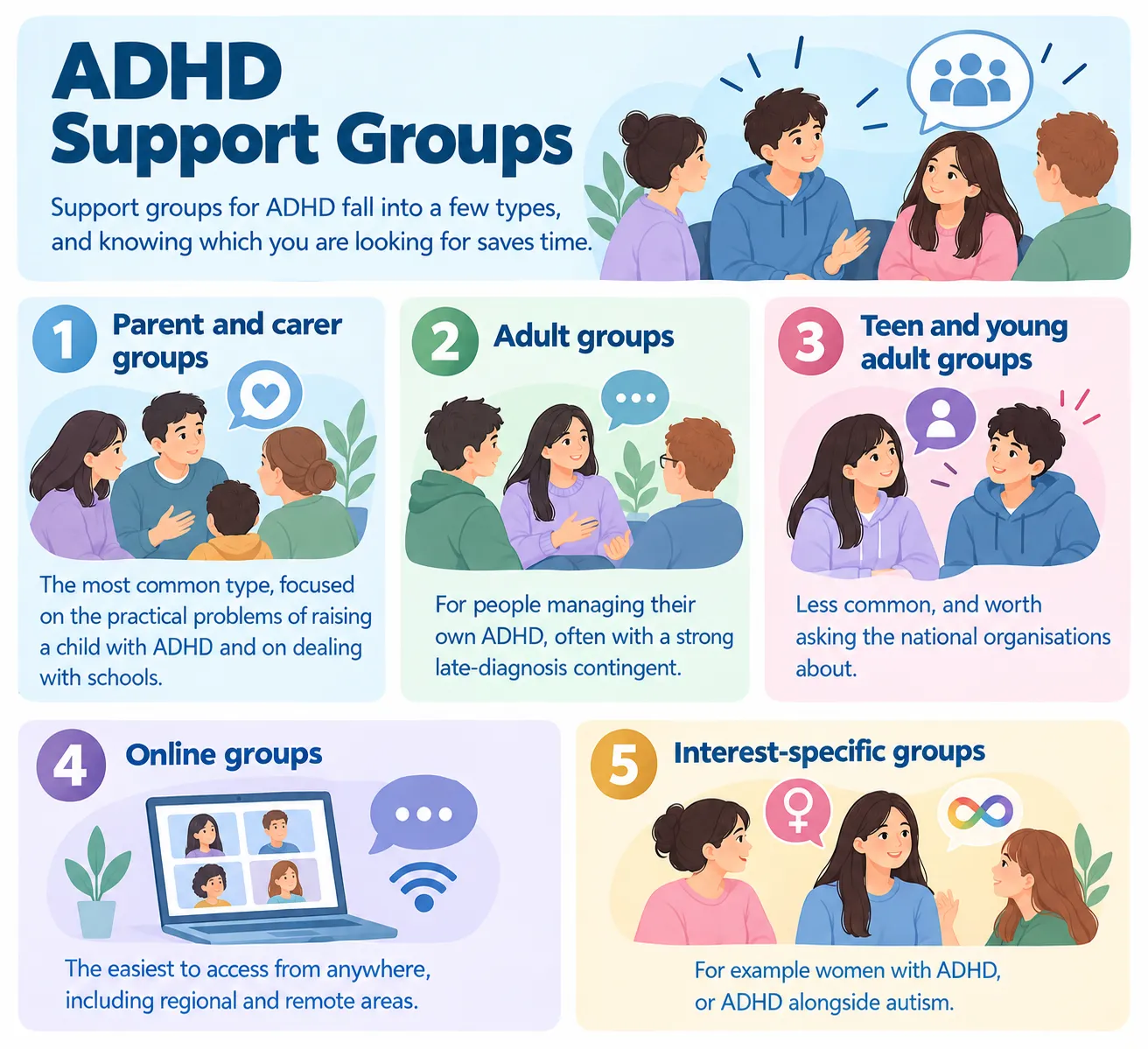
Support groups for ADHD fall into a few types, and knowing which you are looking for saves time.
- Parent and carer groups: the most common type, focused on the practical problems of raising a child with ADHD and on dealing with schools
- Adult groups: for people managing their own ADHD, often with a strong late-diagnosis contingent
- Teen and young adult groups: less common, and worth asking the national organisations about
- Online groups: the easiest to access from anywhere, including regional and remote areas
- Interest-specific groups: for example women with ADHD, or ADHD alongside autism
Many peer support groups are free, although availability and cost vary by organisation and location. ADHD Foundation Australia lists independent groups nationally, including national online and face-to-face parent groups and regional groups in areas such as Newcastle, Wollongong, Canberra, Nepean-Penrith and Blacktown. ADHD WA runs regular meetings for parents and adults at various locations and online. In Victoria, peer-run meetups for adults with ADHD operate around Melbourne, and ADHD support groups Victoria listings are best checked through the national directories, since local groups start and stop.
ADHD online support groups also run on social platforms, including community groups covering Australia nationally and city-based groups in Brisbane and Melbourne. These are peer spaces rather than clinical ones, which is both the advantage and the limitation.
What ADHD peer support does and does not do
An ADHD peer support group is people with lived experience, not clinicians. What it can provide is lived-experience perspective, practical ideas, and the specific relief of describing something and having people know exactly what you mean. What it does not provide is assessment, diagnosis, treatment advice or clinical judgement. Treat suggestions about treatment from a peer group as information to raise with your clinician rather than as advice to act on.
What ADHD Coaching Is
Coaching is forward-looking and practical. A coach works with you on systems, routines and accountability rather than on the history and belief patterns a therapist would address. The two overlap at the edges, and the distinction matters when you are deciding what you actually need.
| ADHD coaching | Therapy | |
| Focus | Systems, routines, follow-through, accountability | Thoughts, beliefs, emotional patterns, history |
| Regulation in Australia | Not a registered profession under AHPRA | Psychologists and psychiatrists are AHPRA-registered |
| Medicare rebate | Generally none | Possible under Better Access for eligible services |
| Guideline status | Clinical consensus, evidence insufficient to grade | Cognitive-behavioural intervention carries a strong recommendation for adults |
Australia’s clinical guideline states that ADHD coaching could be considered as part of a treatment plan for adolescents aged 13 to 17 and for adults aged 18 and over, and classifies both as clinical consensus recommendations because the available evidence was insufficient to grade. The guideline also notes that appropriately credentialled ADHD coaches and allied health professionals can provide elements of coaching (Australian ADHD Professionals Association, 2022). That is worth knowing before committing to a long paid program. The guide to ADHD therapy and CBT covers the approaches that do carry graded recommendations.
ADHD coaching strategies
What a coach actually works on is usually concrete:
- Externalising memory and planning, so that nothing important depends on remembering it
- Breaking work into units small enough to start, which is the step most often skipped
- Time estimation, logged against reality until the estimates improve
- Designing routines that survive a bad week rather than only working on a good one
- Accountability structures, including regular check-ins and body doubling
- Identifying the specific friction points that reliably derail you, which are individual
- Deciding what to stop doing, which is often more useful than adding another system
Choosing a coach in Australia
ADHD coaching is not one of the registered health professions regulated through AHPRA, so the title is not protected in the way that psychologist or occupational therapist is, and there is no single register to check. Some coaches are also registered health practitioners; many are not. The quality range is wide and the responsibility for checking sits with you.
- Ask what ADHD-specific training they have completed, not just general coaching training
- Ask whether they hold a credential from a recognised body such as the International Coaching Federation or a professional association for ADHD coaches
- Ask how they work, how long a typical engagement runs, and what happens between sessions
- Ask for the total cost rather than the session rate, and check whether there is a minimum commitment
- Be cautious of anyone promising to cure ADHD, or offering treatment advice they are not qualified to give
- If a coach is also an AHPRA-registered practitioner, check which role they are acting in, because rebates and professional obligations differ
Can You Get ADHD Support Without a Diagnosis?
Often, yes. Peer support groups and community organisations generally do not require a formal diagnosis, and some coaching services state explicitly that one is not needed: ADHD WA, for example, currently says its coaching does not require a formal diagnosis.
Clinical treatment is different. Assessment, diagnosis and treatment through the health system require a clinician, and Medicare-subsidised psychological services require a referral and an assessment of eligibility. If you are waiting for assessment, peer support and information services are available in the meantime.
An ADHD coach app or ADHD coaching app generally means a task, habit or focus tool rather than a coach. Some are useful as the external structure a coach would help you build, and they are inexpensive compared with a person. What an app is less able to do is notice that the system you chose does not fit how you actually work, and adapt it. Body-doubling apps and services sit somewhere between the two, providing the accountability element without the individual design work.
Free and Low-Cost Support
- The national helplines listed above, which are free to call
- Peer support groups, which are usually free
- Employee assistance programs, where your workplace offers one
- University and TAFE counselling services, commonly free to enrolled students
- Better Access services, which are subsidised rather than free and depend on eligibility, the service type and an eligible provider. Since 1 November 2025 the plan or referral is undertaken at your MyMedicare registered practice or by your usual medical practitioner
- Public mental health services, which have eligibility criteria and waiting times
- Community health centres, which vary by state and local area
Related Guides
- ADHD treatment in Australia: the full picture
- Managing ADHD without medication
- Is ADHD a disability, a disorder or a difference?
- How ADHD is diagnosed in Australia: the full process
- Late ADHD diagnosis in women: what happens after
References
- Australian ADHD Professionals Association. Australian Evidence-Based Clinical Practice Guideline for Attention Deficit Hyperactivity Disorder (ADHD). Released October 2022. Recommendations 4.3.1 and 4.3.2 on ADHD coaching. adhdguideline.aadpa.com.au
- ADHD Foundation Australia. Helpline and services. adhdfoundation.org.au
- ADDults with ADHD. ADHD National Support Line. adultadhd.org.au
- ADHD Australia. Support groups directory. adhdaustralia.org.au
- Healthdirect Australia. ADHD Foundation Australia partner listing. healthdirect.gov.au
- DIVA Foundation. Diagnostic Interview for ADHD in Adults. divacenter.eu
- Services Australia. Allied health referrals for mental health treatment services. servicesaustralia.gov.au
- Australian Government Department of Health, Disability and Ageing. Better Access initiative and the redesign from 1 November 2025. health.gov.au
- Australian Health Practitioner Regulation Agency. Registered health professions and protected titles. ahpra.gov.au
- ADHD WA. Coaching services. adhdwa.org