

Are There Benefits to ADHD?
Many people with ADHD describe genuine strengths, including intense focus on engaging work, creative and divergent thinking, and performing well under pressure. Some of these have research support and some are commonly reported without being formally established. ADHD is diagnosed on the basis of impairment, and strengths do not offset that.
Content about ADHD positives tends to sit at one of two extremes. Either ADHD is presented purely as deficit, which does not match how many people experience it, or it is presented as a superpower, which does not match the diagnostic criteria or the reason people seek help. Neither framing helps someone trying to work out what the genuine advantages to ADHD might be.
This page tries to sit where the evidence actually is. That means being specific about which claims have research behind them, which are commonly reported without formal study, and where the framing causes problems.
Which ADHD Strengths Have Research Behind Them
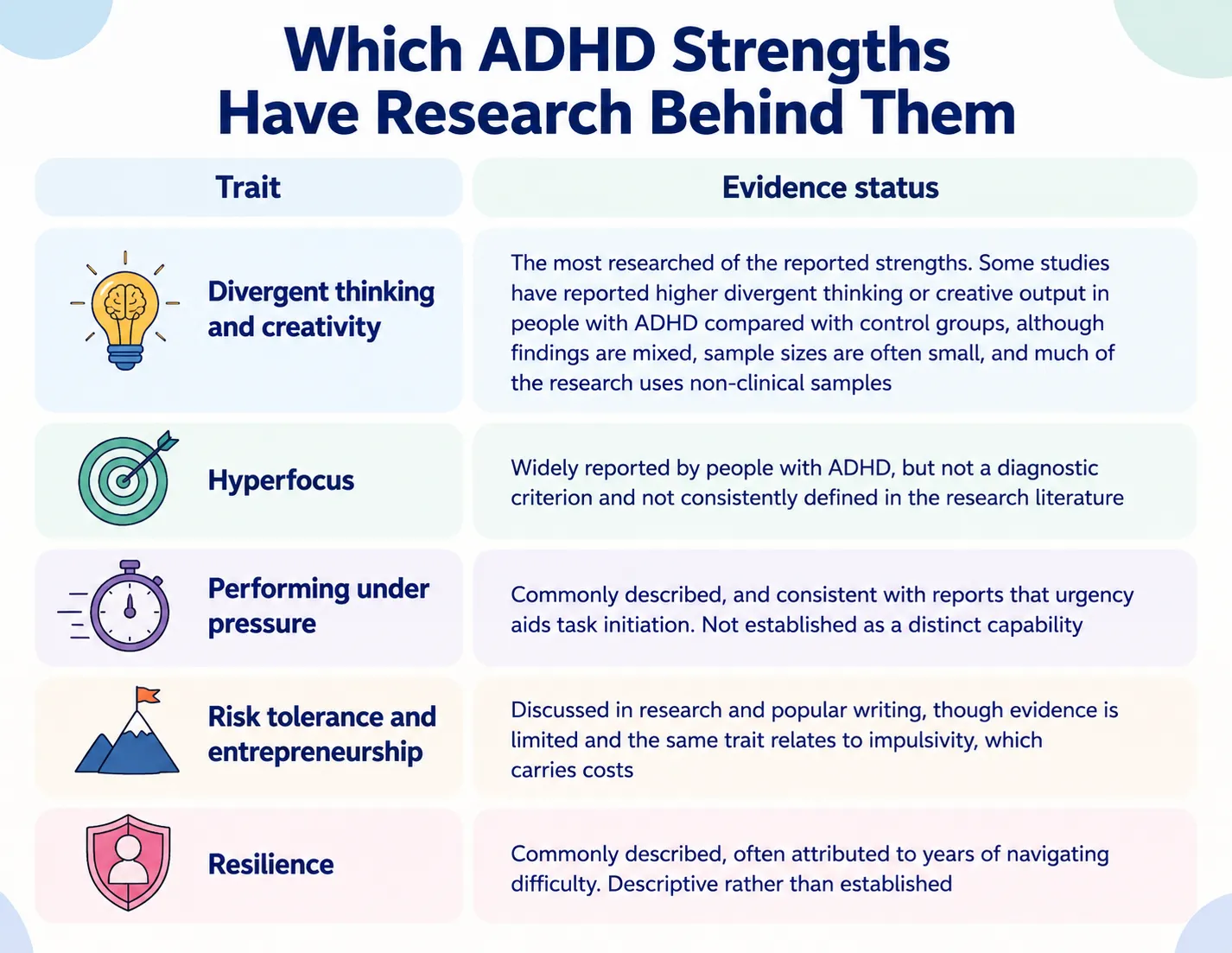
Not all reported strengths adhd communities discuss have the same evidence base. The strongest evidence relates to creativity and divergent thinking, and even there the findings are mixed rather than settled.
| Trait | Evidence status |
| Divergent thinking and creativity | The most researched of the reported strengths. Some studies have reported higher divergent thinking or creative output in people with ADHD compared with control groups, although findings are mixed, sample sizes are often small, and much of the research uses non-clinical samples |
| Hyperfocus | Widely reported by people with ADHD, but not a diagnostic criterion and not consistently defined in the research literature |
| Performing under pressure | Commonly described, and consistent with reports that urgency aids task initiation. Not established as a distinct capability |
| Risk tolerance and entrepreneurship | Discussed in research and popular writing, though evidence is limited and the same trait relates to impulsivity, which carries costs |
| Resilience | Commonly described, often attributed to years of navigating difficulty. Descriptive rather than established |
Being honest about the evidence status matters here. Several widely repeated ADHD positive aspects are reported experiences rather than research findings, and presenting them as established does the topic no favours.
The Positive Traits People Most Commonly Describe
- Intense focus on work that genuinely engages them, sometimes for long periods
- Making connections between ideas that are not obviously related
- Comfort in situations others find chaotic, including fast-moving or high-pressure environments
- A willingness to question how things are usually done rather than defaulting to it
- Rapid problem-solving when a situation demands an immediate response
- Directness and enthusiasm that others describe as energising
- Empathy, which some people attribute to having spent years feeling out of step
These ADHD positive attributes are accounts people give of their own experience. They are not diagnostic features, they are not universal, and someone with ADHD who does not recognise themselves in this list is not doing ADHD wrong.
Why the Superpower Framing Is Contested
You will see ADHD described as a superpower frequently, particularly in social media content. It is worth understanding why that framing divides people.
| The case for it | The case against it |
| It counters decades of purely deficit-based framing | ADHD is diagnosed on the basis of impairment. A condition that only conferred advantages would not meet diagnostic criteria |
| It supports self-esteem after a difficult diagnostic journey | It can make people feel they are failing if they do not experience the advantages |
| It reflects genuine experiences that deficit framing ignores | It can be used to dismiss requests for support or adjustments |
| It reduces stigma | It obscures the experience of people whose ADHD is significantly impairing |
A reasonable position is that both things are true at once. Strengths are real for many people, and they do not cancel out the difficulties that led to a diagnosis. The two do not need to be reconciled into a single story.
ADHD Advantages and Disadvantages
Several ADHD traits are the same trait viewed from different angles, which is why lists of advantages and disadvantages often contain the same items twice.
| The same trait | As an advantage | As a difficulty |
| Intense focus | Sustained deep work on engaging problems | Difficulty disengaging, missed obligations, lost time |
| Rapid idea generation | Creative output, unexpected connections | Difficulty finishing, too many open projects |
| Urgency-driven action | Strong performance under pressure | Difficulty starting without pressure, chronic lateness |
| Risk tolerance | Willingness to try things others avoid | Impulsive decisions with financial or personal cost |
| Emotional intensity | Enthusiasm, warmth, strong engagement | Difficulty regulating reactions, rapid frustration |
This is the more useful way to think about it than a strengths list. The question is rarely whether a trait is good or bad, but whether the environment lets it work in your favour.
Where Strengths Actually Show Up
Environment does most of the work. The same person can look capable in one role and struggle badly in another without their ADHD changing at all.
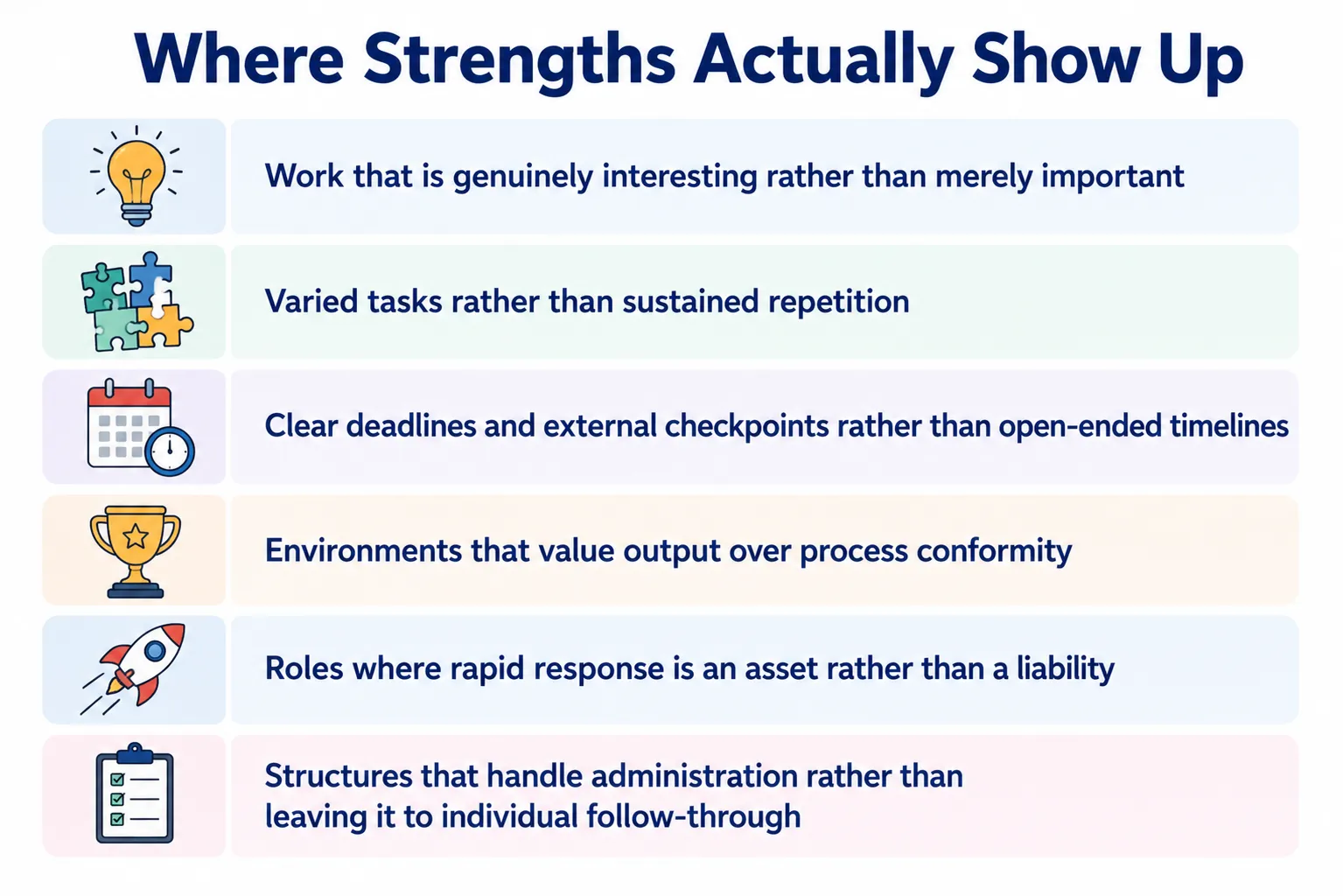
- Work that is genuinely interesting rather than merely important
- Varied tasks rather than sustained repetition
- Clear deadlines and external checkpoints rather than open-ended timelines
- Environments that value output over process conformity
- Roles where rapid response is an asset rather than a liability
- Structures that handle administration rather than leaving it to individual follow-through
None of this is a substitute for assessment or support where difficulties are significant. Environment changes how much a difficulty costs; it does not remove the difficulty.
How to Identify Your Own Strengths
Generic strengths lists are a starting point, not an answer. What is more useful is working out which conditions reliably produce your best work, because that is actionable in a way a list is not.
- Look at what you have finished rather than what you started. Completion patterns say more than intentions do.
- Notice which tasks you lose time in, and what those tasks have in common.
- Ask people who work with you what they come to you for. It is often different from what you assume.
- Track when work felt easy rather than when it felt important. The gap between those two is informative.
- Consider what other people find difficult that you do not notice being difficult.
This is a self-reflection exercise rather than an assessment tool, and it is not a substitute for clinical or psychological assessment where difficulties are significant.
Strengths-Based Framing at Work and School
Strengths-based language has become common in workplace and education settings, and it can be genuinely useful. It can also be used to avoid providing support.
A reasonable test: does the strengths framing come alongside adjustments, or instead of them? Being told your ADHD makes you creative is not a substitute for being given written instructions, clear deadlines or a quieter workspace. Both can happen together, and the framing works when it does.
A Caution About Strengths-Only Content
Strengths-based framing has genuine value, particularly for people who have spent years being told what is wrong with them. Listing ADHD good things, and the benefits for ADHD self-understanding that come with it, is not the problem. The failure mode is worth naming separately.
When ADHD is presented only as a set of advantages, people whose ADHD is significantly impairing can feel excluded from their own diagnosis. It can also make it harder to justify support, both to others and to yourself. If you are struggling, that is not a sign you are experiencing ADHD incorrectly.
Related Guides
- What ADHD feels like: living as a person with ADHD
- What Is ADHD? Meaning, definition and full form
- ADHD, IQ, intelligence and giftedness
- Is ADHD a disability, a disorder or a difference?
- ADHD symptoms in adults: the complete Australian guide
- ADHD in Australia: the complete guide
References
- Australian ADHD Professionals Association. Australian Evidence-Based Clinical Practice Guideline for Attention Deficit Hyperactivity Disorder (ADHD). Released October 2022. adhdguideline.aadpa.com.au
- American Psychiatric Association. Diagnostic and Statistical Manual of Mental Disorders, Fifth Edition, Text Revision (DSM-5-TR). 2022.
- World Health Organization. International Classification of Diseases, 11th Revision (ICD-11). 6A05 Attention deficit hyperactivity disorder.
Last review: September 2026. Next scheduled review: September 2027. This article is general information and is not a substitute for individual medical advice, assessment or diagnosis.