

What Happens After a Late ADHD Diagnosis?
Some women describe relief, grief, or both. Relief because a long-standing pattern finally has an explanation. Grief about the years spent without one. Neither reaction means the diagnosis is wrong. What changes most immediately is how you interpret your own history. A 2023 systematic review of ADHD in adult women identified themes of self-acceptance, social and emotional wellbeing and difficult relationships around adult diagnosis (Attoe and Climie, 2023).
Getting diagnosed as an adult woman is not the end of a process. It is the start of a different one, and almost nothing written about ADHD prepares people for that part. A late ADHD diagnosis in women, sometimes described as an ADHD late diagnosis female pattern or an ADHD adult female diagnosis, usually arrives with decades of history already attached to it.
This guide is about what comes after: what can happen emotionally, what changes and what does not, and what an ADHD diagnosis later in life tends to raise. How to get diagnosed with ADHD as a woman is covered separately, and the guide to ADHD testing for women sets out the assessment pathway, including how to prepare and what to do if you are not taken seriously.
Why Late Diagnosis Is Common in Women
Australia’s clinical guideline identifies girls and women as a group at risk of under-recognition (Australian ADHD Professionals Association, 2022). The short version is that quieter presentations produce fewer childhood referrals, and compensation hides difficulty in effort rather than in outcomes. That is why the ADHD diagnosis women receive so often comes late.
The presentation itself is covered in the guides to ADHD symptoms in women. What matters here is the consequence: many women reach diagnosis with decades of accumulated interpretation already in place.
The Two Reactions
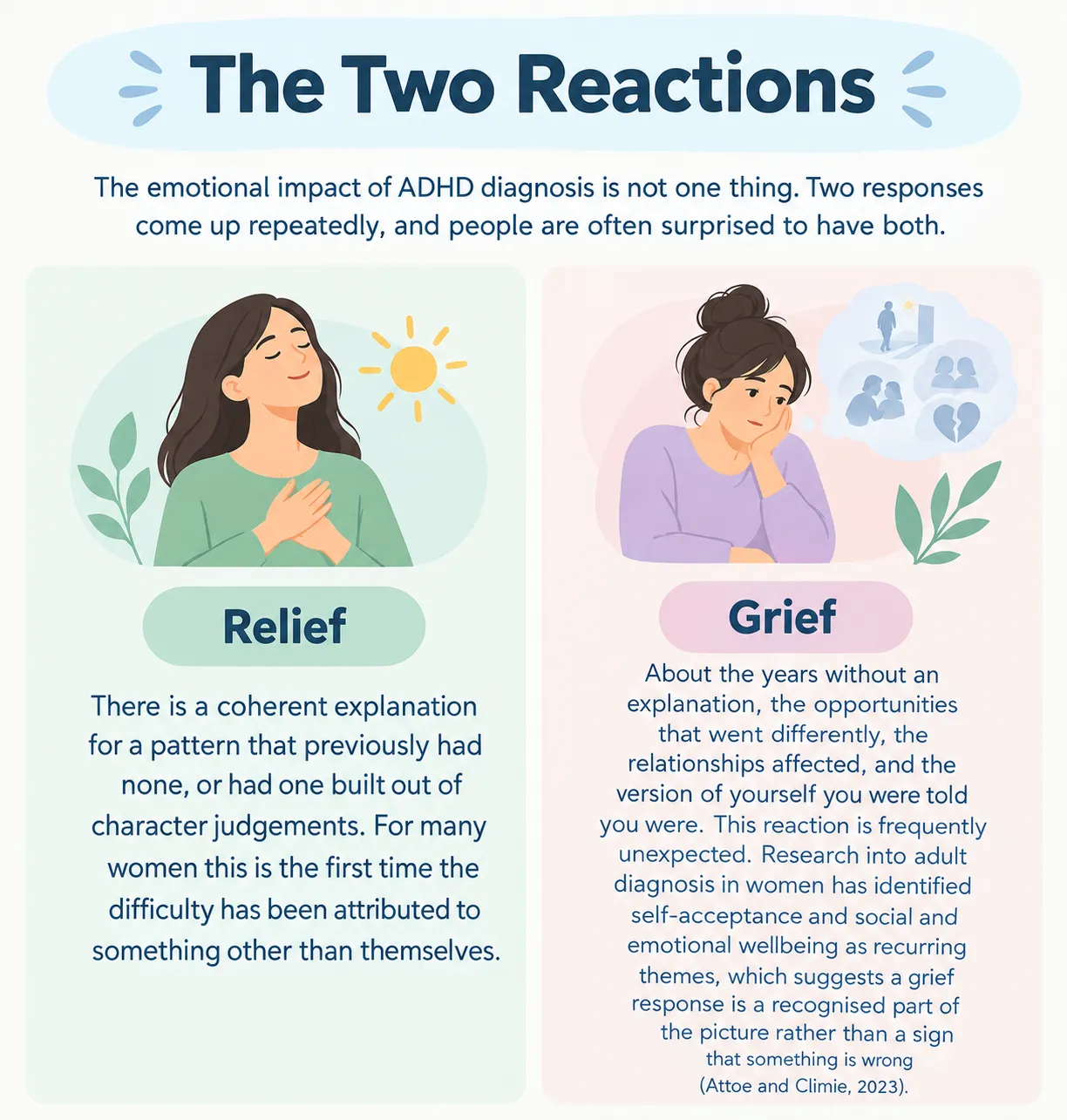
The emotional impact of ADHD diagnosis is not one thing. Two responses come up repeatedly, and people are often surprised to have both.
Relief
There is a coherent explanation for a pattern that previously had none, or had one built out of character judgements. For many women this is the first time the difficulty has been attributed to something other than themselves.
Grief
About the years without an explanation, the opportunities that went differently, the relationships affected, and the version of yourself you were told you were. This reaction is frequently unexpected. Research into adult diagnosis in women has identified self-acceptance and social and emotional wellbeing as recurring themes, which suggests a grief response is a recognised part of the picture rather than a sign that something is wrong (Attoe and Climie, 2023).
Both at once is normal
People often expect one or the other and are unsettled by having both, sometimes within the same hour. The two are not in conflict. They are responses to different parts of the same information.
Reinterpreting Your History
This is the most immediate practical effect, and it takes longer than people expect.
Years of missed deadlines, abandoned projects, unexplained underperformance and difficulty with things other people found ordinary get reread. So do the explanations you accepted at the time: lazy, careless, scattered, not applying yourself, too sensitive.
That rereading is genuinely useful. It is also work, and it can bring up anger at people who dismissed concerns, at systems that missed it, or at yourself for not pushing harder. None of that is a sign the diagnosis is unhelpful.
What Changes and What Does Not
| What changes | What does not automatically change |
| How you interpret your own history | How any given day goes, by itself |
| Your ability to describe and discuss support needs | An automatic entitlement to any particular support or adjustment |
| The framing you use with yourself when something goes wrong | The underlying difficulties, without doing something about them |
| What you can ask for at work or study | A guarantee that workplace adjustments will be approved |
| The conversations available with a clinician | Every difficulty, since co-occurring conditions are common and are assessed separately |
| The starting point for treatment and support discussions | One universal treatment or support plan, which depends on individual needs |
Diagnosis explains the clinical formulation. Treatment and support decisions are separate conversations, based on individual needs and discussed with your treating clinician.
Telling People
Disclosure is a separate decision from diagnosis, and it is reasonable to decide differently in different settings.
Partners and family
Often the most useful conversation, because it reframes years of friction. Some family members respond with recognition. Others respond with scepticism, particularly if they were part of the earlier explanations.
Work
Adjustments generally require some disclosure, though not necessarily full clinical detail. You choose how much to share. Our guide to ADHD as a disability covers the framework for workplace adjustments.
Your children
Some women first consider their own ADHD when a child is being assessed. Sharing your own diagnosis can help a child understand that difficulty is not a character flaw, and it is a personal decision about timing and detail.
The Family Pattern
ADHD has a substantial genetic component and often occurs in families, so a late diagnosis in a woman frequently surfaces the question of who else in the family might have it.
Common patterns include recognising a parent in your own report, recognising yourself in a child’s assessment, or a sibling seeking assessment afterwards. Recognising the pattern in a relative is not a diagnosis of them, and whether they pursue assessment is their decision.
What Often Comes Up Alongside
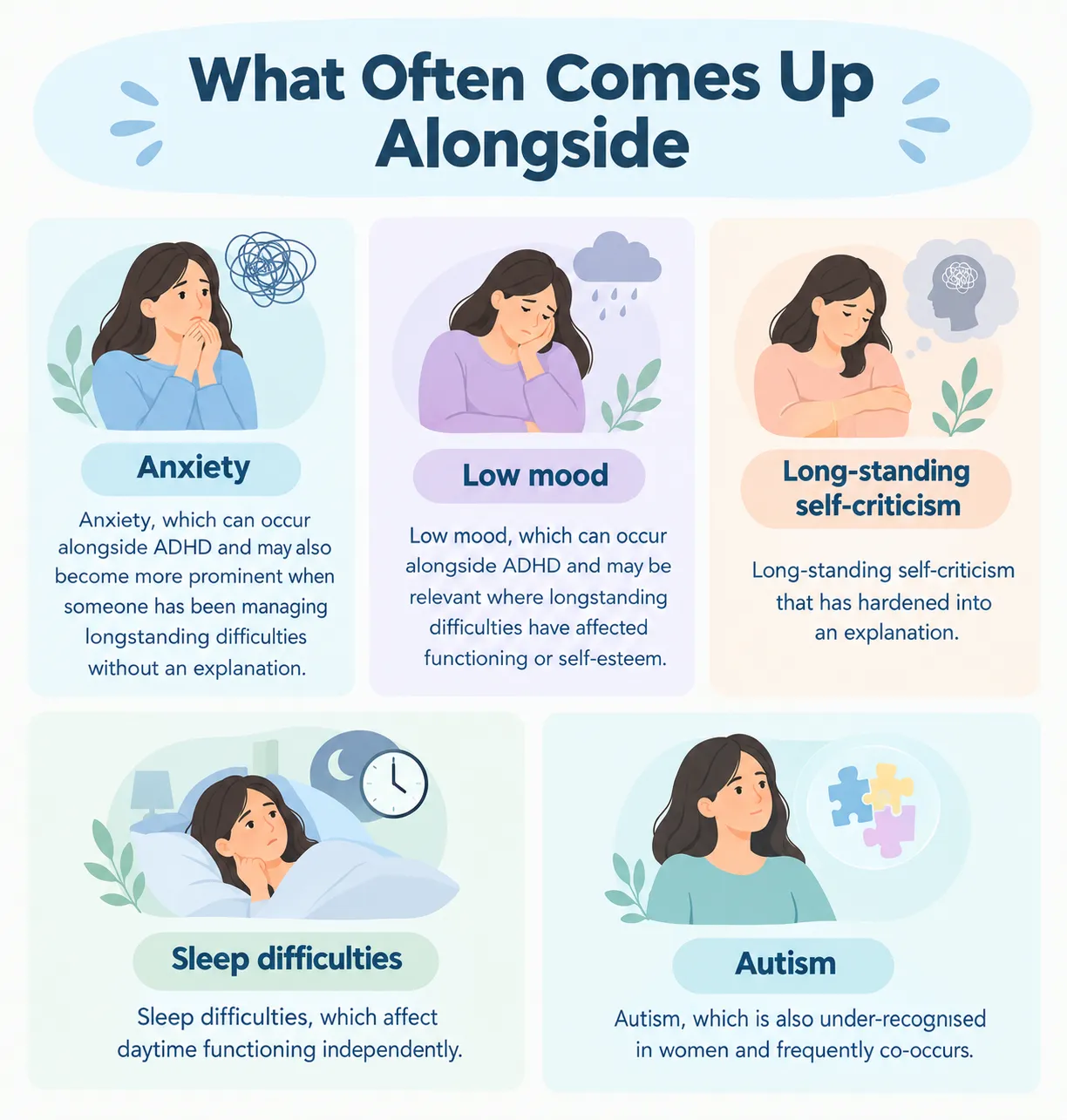
Co-occurring conditions are common and are specifically assessed. Australia’s clinical guideline recognises anxiety and depression among the conditions that may occur alongside ADHD, and notes that women and girls may receive those diagnoses (Australian ADHD Professionals Association, 2022). The items below are ones that often come up for women diagnosed late; they describe associations rather than causes.
- Anxiety, which can occur alongside ADHD and may also become more prominent when someone has been managing longstanding difficulties without an explanation
- Low mood, which can occur alongside ADHD and may be relevant where longstanding difficulties have affected functioning or self-esteem
- Long-standing self-criticism that has hardened into an explanation
- Sleep difficulties, which affect daytime functioning independently
- Autism, which is also under-recognised in women and frequently co-occurs
If anxiety or low mood were treated before ADHD was identified, that treatment was not necessarily wrong. It addressed what was visible.
Diagnosis Later in Life
ADHD is increasingly being recognised in women later in life, including around major life transitions such as children leaving home, career changes, caring responsibilities or perimenopause. Recent literature reflects growing clinical and research attention to late diagnosis in women rather than an established population trend in any one country (Camara and colleagues, 2025).
Two things are worth saying. A diagnosis at fifty or sixty is not too late to be useful, because understanding the pattern changes how you respond to it. And symptoms that changed noticeably around perimenopause are worth describing to a clinician. Australia’s clinical guideline notes possible symptom variation across the menstrual cycle, pregnancy and menopause while stating that the evidence is limited (Australian ADHD Professionals Association, 2022). A 2025 systematic review of ADHD and sex hormones in females reached a similar position, finding suggestive associations but emphasising small study numbers and substantial variation in method (Ramtekkar and colleagues, 2025).
If the Diagnosis Feels Complicated
Some people experience a difficult adjustment period after diagnosis rather than an immediate improvement. Research into adult diagnosis in women describes complex psychosocial responses in this period, and it is worth naming (Attoe and Climie, 2023).
Reasons people give include the grief described above, the effort of rereading a whole history at once, the gap between having an explanation and having things be easier, and sometimes the reaction of people who do not take it seriously.
If low mood, distress or hopelessness persists, that is worth raising with a GP or mental health professional on its own terms rather than treating it as part of adjusting to the diagnosis.
What If You Are Unsure About Your Diagnosis?
Uncertainty after a diagnosis is not the same as the diagnosis being wrong, and it is a reasonable thing to raise. The assessment that led to the conclusion is something you are entitled to understand.
- Ask the diagnosing clinician to go through what the assessment covered and what evidence supported the conclusion
- Ask how alternative explanations and co-occurring conditions were considered
- Ask about any part of the formulation you do not follow, including anything in a written report
- Raise any information that was not available at the time, such as school records or an informant who has since become contactable
- Seek another qualified clinical opinion if uncertainty remains after that conversation
This is separate from the emotional adjustment described above. Both can be happening at once.
What Happens Next?
There is no single sequence to life after ADHD diagnosis, and the order depends on what is causing the most difficulty. In broad terms, the areas that usually come up are:
- Self-understanding: rereading your own history, which takes longer than most people expect
- Healthcare: discussing management and support options with your treating clinician, which is a separate conversation from the diagnosis itself
- Work or study: deciding whether to disclose, and what adjustments would actually help
- Relationships: deciding who to tell, and what you want from telling them
- Routines and systems: reviewing what you had already built to compensate, and what to keep
- Co-occurring conditions: following up anything the assessment flagged for further attention
In Australia, disclosure and workplace adjustments are separate questions from receiving an ADHD diagnosis. A diagnosis can support a conversation about reasonable adjustments, but it does not by itself guarantee that any particular adjustment will be provided.
Related Guides
- How to get an ADHD diagnosis as an adult
- How ADHD is diagnosed in Australia: the full process
- ADHD strengths, benefits and positive traits
- ADHD Symptoms The Full Symptom Picture
References
- Australian ADHD Professionals Association. Australian Evidence-Based Clinical Practice Guideline for Attention Deficit Hyperactivity Disorder (ADHD). Released October 2022. adhdguideline.aadpa.com.au
- Young S, Adamo N, Asgeirsdottir BB, et al. Females with ADHD: an expert consensus statement taking a lifespan approach providing guidance for the identification and treatment of attention-deficit/hyperactivity disorder in girls and women. BMC Psychiatry. 2020;20:404. PMC7422602
- Healthdirect Australia. Attention deficit hyperactivity disorder (ADHD). healthdirect.gov.au
- Attoe DE, Climie EA. Miss. Diagnosis: a systematic review of ADHD in adult women. Journal of Attention Disorders. 2023;27(7):645-657. PMID 36995125
- Systematic review of ADHD and sex hormones in females, 2025. Evidence on associations between reproductive stages and ADHD symptoms remains limited and heterogeneous. PMID 40251875
- Integrative literature review on the impact of ADHD across women’s lifespan, 2025. PMID 41361438