

What Is ADHD Impulsivity?
ADHD impulsivity is a persistent difficulty pausing before responding or acting, particularly when an immediate urge conflicts with longer-term goals. It can involve interrupting, acting quickly, spending impulsively, taking risks, making rapid decisions or struggling to wait. In adults, impulsivity may be less visibly disruptive than in childhood but can still affect relationships, work, finances and daily decisions.
Hyperactivity and impulsivity are the parts of ADHD that people think they understand, which is part of the problem. The mental image is a child who cannot sit still, and that image accounts for a fraction of what these symptoms actually involve.
ADHD impulsivity is not simply being impulsive, and ADHD hyperactivity is not simply being unable to sit still. Our symptoms guide covers the diagnostic criteria themselves, and our guide to combined and hyperactive-impulsive ADHD covers how the presentations are classified.
What Does ADHD Impulsivity Look Like?
The Australian ADHD guideline describes impulsivity as a reduced or inconsistent capacity to pause and reflect before acting, particularly when considering longer-term consequences (Australian ADHD Professionals Association, 2022). In clinical and research contexts this is often discussed in relation to inhibitory control, the ability to pause or suppress an immediate response when doing so better serves a longer-term goal.
- Interrupting, or finishing other people’s sentences, despite intending not to
- Answering before a question is finished
- Buying something before the decision has been thought through
- Saying something and registering how it landed a moment too late
- Committing to things without checking whether the time exists
- Changing plans, jobs or arrangements quickly when something new becomes appealing
- Difficulty waiting: in queues, in conversations, and with slow processes generally
The Australian guideline also describes adult impulsivity as including excessive spending, binge eating, interpersonal conflict, risk-taking, addictions, talking excessively and interrupting (Australian ADHD Professionals Association, 2022).
ADHD and impulsivity can also interact with emotion. Some people notice that an ADHD impulse becomes harder to manage during strong feelings: responding immediately when frustrated, sending a message before reconsidering it, or making a decision during a strong reaction. Emotional dysregulation is not one of the core DSM-5-TR ADHD symptom criteria, though it is commonly reported alongside ADHD.
How ADHD Impulsivity Can Change With Age
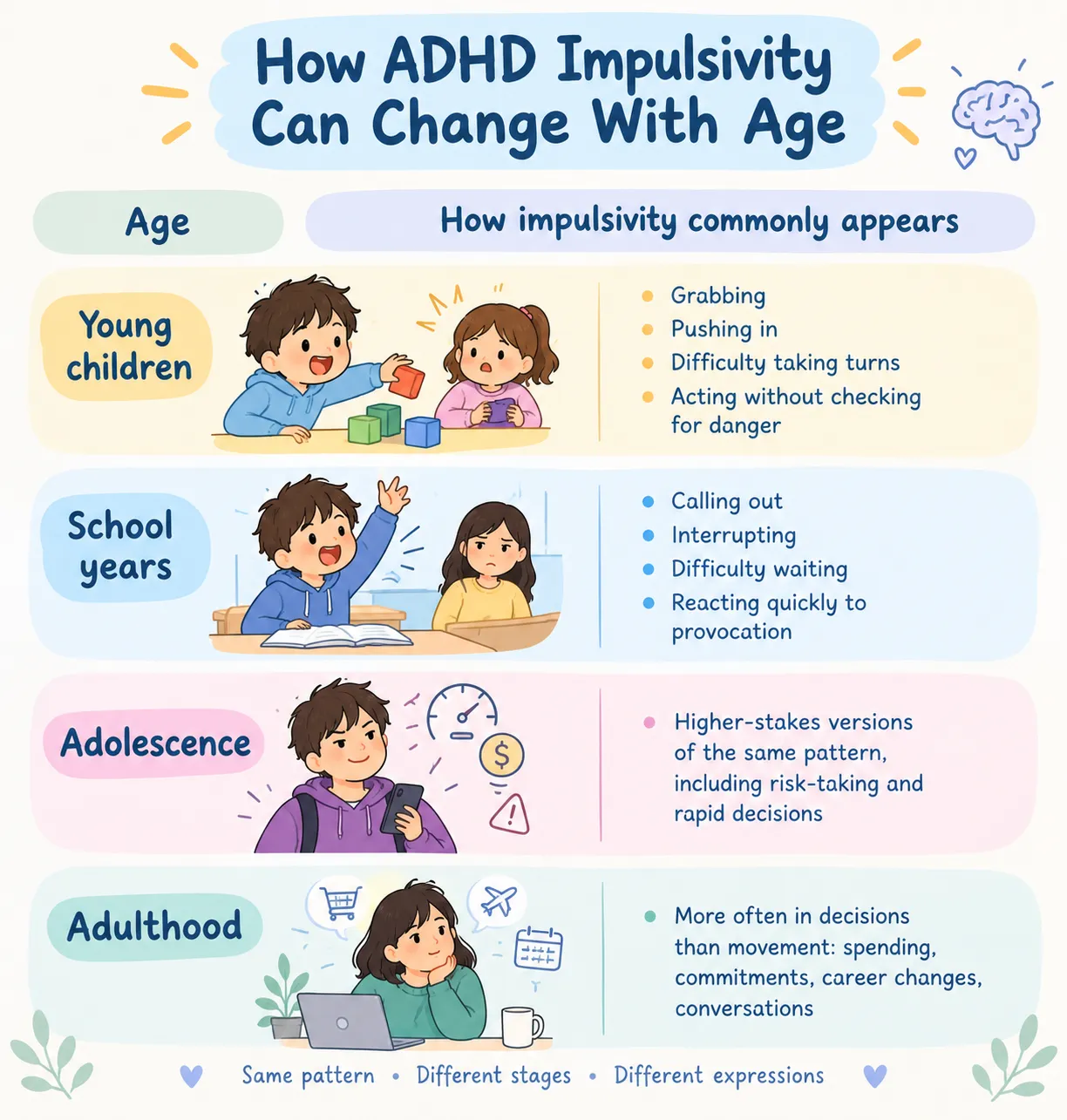
| Age | How impulsivity commonly appears |
| Young children | Grabbing, pushing in, difficulty taking turns, acting without checking for danger |
| School years | Calling out, interrupting, difficulty waiting, reacting quickly to provocation |
| Adolescence | Higher-stakes versions of the same pattern, including risk-taking and rapid decisions |
| Adulthood | More often in decisions than movement: spending, commitments, career changes, conversations |
In adults, impulsivity may become less visibly disruptive but can still affect decisions, spending, relationships, conversations and risk-taking. Impulsive hyperactive ADHD in childhood does not always look the same later. The underlying difficulty may persist while the way it appears, and the consequences it creates, changes with age, environment and demands. Estimates of how ADHD symptoms persist into adulthood vary substantially depending on the diagnostic method used.
What Is ADHD Hyperactivity?
In children it is often visible: movement, difficulty remaining seated, running or climbing when it is not appropriate. Hyperactive ADHD presentations are more likely to be noticed and referred for exactly this reason.
In adolescents and adults, the diagnostic criteria explicitly note that hyperactivity may be limited to feeling restless rather than physical movement. Australia’s clinical guideline recognises internal restlessness and describes adult hyperactivity as often less overt than in childhood (Australian ADHD Professionals Association, 2022). That wording matters, because the absence of visible hyperactivity is a common reason adults rule themselves out.
ADHD Restlessness in Adults
- An internal sense of being driven, or of not being able to settle
- Difficulty relaxing, or discomfort with unstructured time
- Restless hands and feet, tapping, shifting position
- Difficulty sitting through long meetings, films or meals
- Talking a great deal, particularly on topics of interest
- A tendency to fill quiet time with activity rather than rest
ADHD restlessness vs anxiety
ADHD-related restlessness and anxiety-related restlessness can feel similar and often occur together. Anxiety is often accompanied by worry, fear or anticipation of threat, whereas ADHD internal restlessness may occur primarily as difficulty settling, sitting still or tolerating low stimulation. These patterns can overlap, so the distinction is not something a person can reliably make from one symptom alone.
ADHD Fidgeting and Concentration
A pattern people commonly report is concentrating better while moving: walking, fidgeting, or having something in their hands during a meeting.
Research is beginning to examine this directly. A 2024 study of 70 adults with ADHD found increased fidgeting during correct trials on a demanding attention task, with findings consistent with fidgeting supporting arousal and sustained attention, although the authors note that alternative explanations exist (Son et al., Frontiers in Psychiatry, 2024). The findings do not establish that fidgeting improves concentration for everyone with ADHD.
Practically, it matters for how environments are set up. Requiring stillness in order to demonstrate attention may make attention harder, which is relevant in classrooms and meetings.
Movement does not prove ADHD
Fidgeting or needing to move is not, by itself, evidence of ADHD. Diagnosis considers a broader persistent pattern of symptoms, impairment and developmental history.
What Is ADHD Stimming?
Stimming, short for self-stimulatory behaviour, describes repetitive movements, sounds or actions that some people use to regulate attention, energy or emotional state. Common examples include leg bouncing, tapping, doodling, hair twirling, rocking, humming, or manipulating objects.
The term stimming is widely used in discussions of autism and other neurodevelopmental conditions to describe repetitive sensory or self-regulatory behaviours. It is not one of the diagnostic criteria for ADHD. Fidgeting, tapping, squirming, leaving a seat, difficulty engaging quietly and being on the go are directly represented in the ADHD criteria; stimming as a broader concept is not.
People describe these behaviours as serving a purpose in self-regulation: managing understimulation, discharging restlessness, or settling attention. Some people find that repeatedly suppressing a regulating behaviour is tiring or difficult to sustain. Whether suppression is helpful or unhelpful depends on the behaviour and the individual.
Repetitive behaviours that cause injury
Repetitive behaviours that cause injury, such as recurrent skin picking, deserve separate clinical attention because they may have causes other than ordinary fidgeting.
ADHD Stimming vs Fidgeting vs Tics
| Feature | Repetitive self-regulatory behaviour | Tic |
| Experience | May be soothing, regulating or stimulating | Often experienced as difficult to control |
| Urge | May or may not involve a noticeable urge | Often preceded by a premonitory urge |
| Control | May sometimes be delayed or suppressed | Usually difficult to suppress for long |
| Pattern | Can be repetitive and regulating | Often sudden, recurrent movements or sounds |
| Clinical relevance | Not an ADHD diagnostic criterion | May indicate a tic disorder requiring assessment |
If a movement or sound is sudden, repetitive, difficult to control or associated with a strong premonitory urge, a clinician can assess whether it may be a tic.
Should stimming be stopped?
A repetitive behaviour does not automatically need to be stopped simply because it looks unusual. If it is harmless and helps someone regulate attention or activity, there may be no reason to suppress it. If it causes injury, significant distress or functional problems, assessment can help identify what is driving it and what support may be appropriate.
Is Everyone Impulsive Sometimes?
Yes. Occasional impulsive decisions or interruptions are part of ordinary behaviour. ADHD is different when symptoms are persistent, occur across relevant situations, are inconsistent with developmental expectations and cause meaningful impairment in daily life.
What Else Can Cause Impulsive Behaviour?
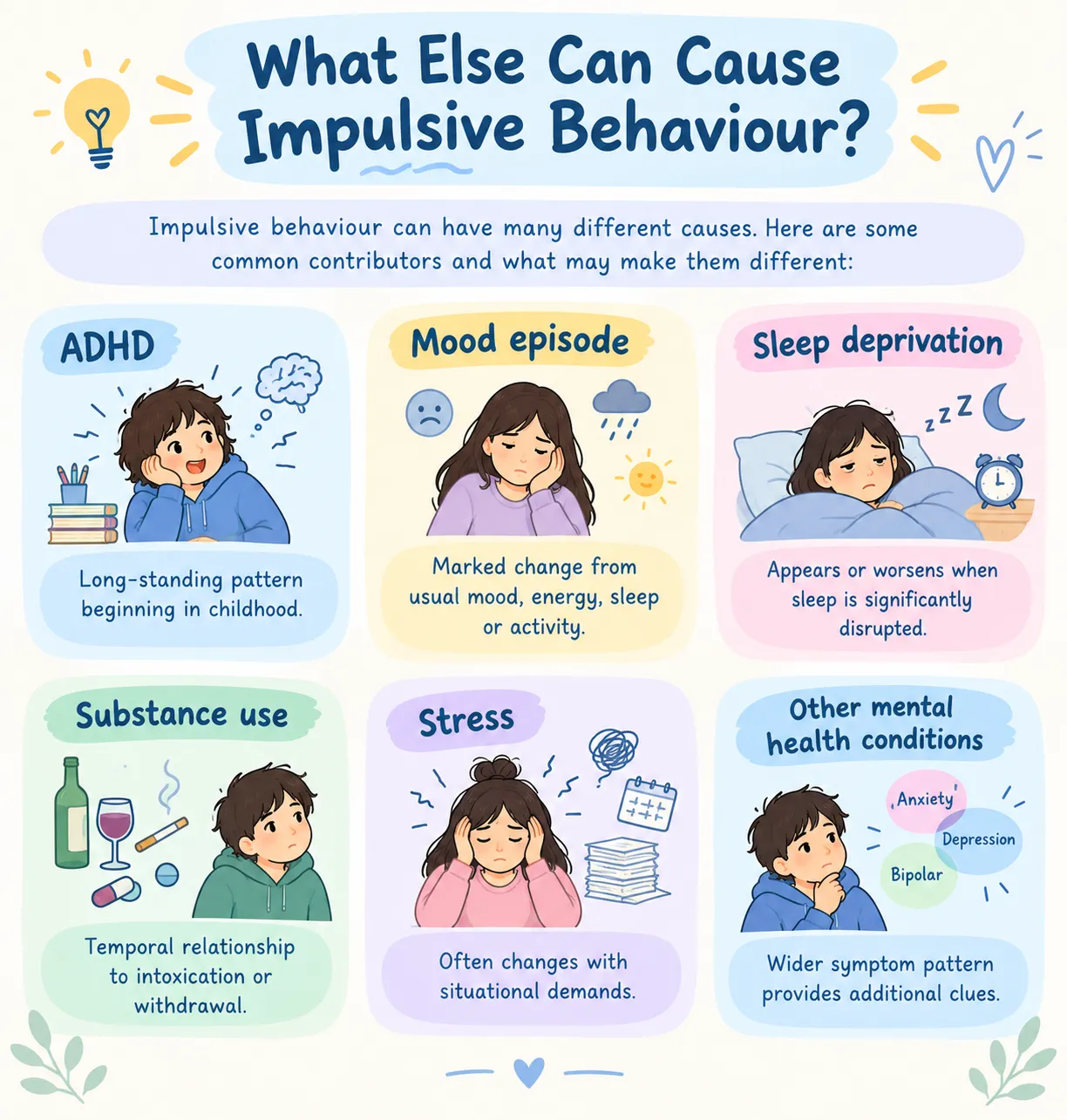
| Possible contributor | What may make it different |
| ADHD | Long-standing pattern beginning in childhood |
| Mood episode | Marked change from usual mood, energy, sleep or activity |
| Sleep deprivation | Appears or worsens when sleep is significantly disrupted |
| Substance use | Temporal relationship to intoxication or withdrawal |
| Stress | Often changes with situational demands |
| Other mental health conditions | Wider symptom pattern provides additional clues |
These patterns can overlap. They are not diagnostic rules, and more than one can apply at the same time.
When Impulsivity or Restlessness Needs Assessment
Impulsivity exists on a spectrum and most of it is manageable. Seek assessment when:
- Impulsivity is new or markedly worse than your usual pattern
- Behaviour is creating repeated harm to yourself or others
- Financial consequences are accumulating rather than occasional
- Risk-taking has increased, particularly with physical safety implications
- Substance use is involved
- Impulsivity occurs alongside major mood or sleep changes
That last point matters. Impulsivity together with a marked change in mood, energy or a reduced need for sleep warrants prompt medical assessment rather than watchful waiting.
Can Impulsivity or Hyperactivity Alone Mean You Have ADHD?
No. Impulsivity, restlessness or fidgeting alone cannot diagnose ADHD. Assessment considers the overall pattern of symptoms, their developmental history, persistence, functional impact and whether another condition provides a better explanation. Australia’s clinical guideline is built around accurate assessment and diagnosis (Australian ADHD Professionals Association, 2022).
When to Speak With a GP
Consider speaking with a GP if impulsivity, hyperactivity or restlessness is repeatedly affecting your work, study, relationships, finances, safety or ability to relax. A GP can discuss whether an ADHD assessment or assessment for another possible cause would be appropriate, and can help identify relevant referral options.
Key Takeaways
ADHD impulsivity involves difficulty pausing before acting, not simply poor judgement. Hyperactivity can become less visible with age and may appear as internal restlessness. Fidgeting is included in the ADHD diagnostic criteria; stimming is a broader term and is not an ADHD diagnostic criterion. Fidgeting or restlessness alone does not establish ADHD. Anxiety, sleep problems, mood episodes, substances and other conditions can also cause restlessness or impulsive behaviour. Persistent impairment or risky behaviour warrants professional assessment.
Related Guides
- ADHD symptoms in adults
- ADHD, emotional dysregulation and rejection sensitivity
- How ADHD is diagnosed in Australia
- ADHD presentation and severity
- What Is ADHD? Meaning, definition and full form
References
- Australian ADHD Professionals Association. Australian Evidence-Based Clinical Practice Guideline for Attention Deficit Hyperactivity Disorder (ADHD). Released October 2022. adhdguideline.aadpa.com.au
- Son HM, Calub CA, Fan B, Dixon JF, Rezaei S, Borden J, Schweitzer JB, Liu X. A quantitative analysis of fidgeting in ADHD and its relation to performance and sustained attention on a cognitive task. Frontiers in Psychiatry. 2024;15:1394096. doi:10.3389/fpsyt.2024.1394096
- Sibley MH, et al. Method of adult diagnosis influences estimated persistence of childhood ADHD: a systematic review of longitudinal studies. The Lancet Psychiatry. 2016. PMID 27745869
- American Psychiatric Association. Diagnostic and Statistical Manual of Mental Disorders, Fifth Edition, Text Revision (DSM-5-TR). 2022.
- World Health Organization. International Classification of Diseases, 11th Revision (ICD-11). 6A05 Attention deficit hyperactivity disorder. icd.who.int
Last reviewed: September 2026. Next scheduled review: September 2027. This article is general information and is not a substitute for individual medical advice, assessment or diagnosis.