

What Is Combined ADHD?
Combined ADHD means a person meets the diagnostic threshold for both symptom domains: inattention and hyperactivity-impulsivity. Under DSM-5 criteria, that means at least six symptoms from each list for children, or at least five from each for people aged 17 and older, present for six months or more, across more than one setting, and interfering with functioning (Australian ADHD Professionals Association, 2022).
What is ADHD combined type, and what is ADHD combined presentation in practice? This is the presentation most people picture when they think of ADHD. It is also the presentation where two quite different sets of difficulties sit alongside each other, which is what makes it distinct from either domain on its own.
This guide covers what the combined presentation involves, how the hyperactive-impulsive presentation differs, the diagnostic codes used in health records, and how the picture changes with age. Our guide to types and presentations covers all three presentations side by side, including severity levels.
What Combined ADHD Means
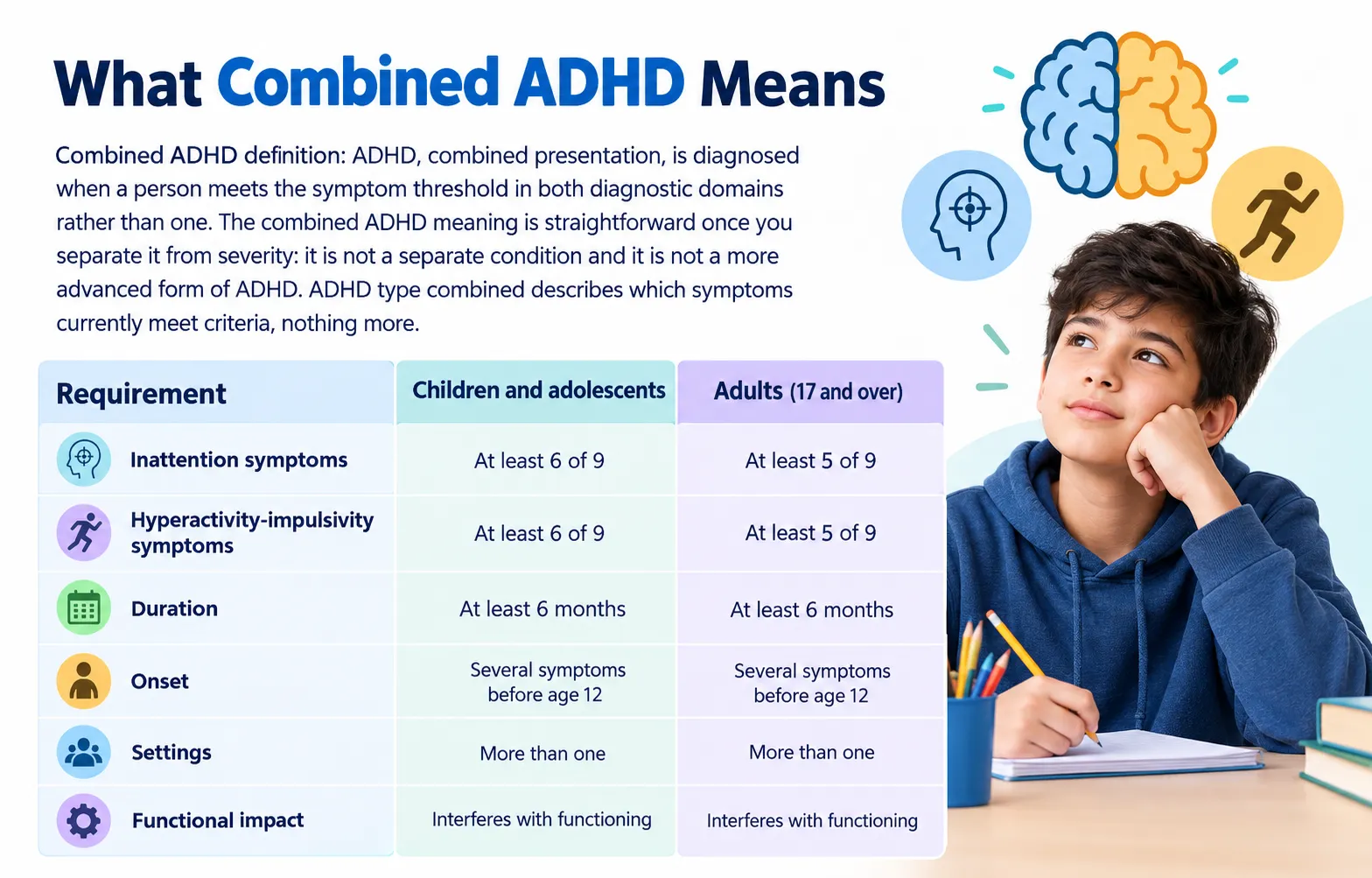
Combined ADHD definition: ADHD, combined presentation, is diagnosed when a person meets the symptom threshold in both diagnostic domains rather than one. The combined ADHD meaning is straightforward once you separate it from severity: it is not a separate condition and it is not a more advanced form of ADHD. ADHD type combined describes which symptoms currently meet criteria, nothing more.
| Requirement | Children and adolescents | Adults (17 and over) |
| Inattention symptoms | At least 6 of 9 | At least 5 of 9 |
| Hyperactivity-impulsivity symptoms | At least 6 of 9 | At least 5 of 9 |
| Duration | At least 6 months | At least 6 months |
| Onset | Several symptoms before age 12 | Several symptoms before age 12 |
| Settings | More than one | More than one |
| Functional impact | Interferes with functioning | Interferes with functioning |
The thresholds apply to each list separately. Meeting eight inattention symptoms and three hyperactivity-impulsivity symptoms does not produce a combined diagnosis for a child, because the second domain has not reached the required count.
What Combined ADHD Looks Like Day to Day
The combined ADHD type is not simply the two domains added together. The interaction between them produces patterns that neither domain creates on its own.
- Starting many things and finishing few, because impulsivity generates new projects faster than attention sustains the existing ones
- Difficulty with tasks that are both boring and require sitting still, which is a considerably narrower set of tolerable activities than either difficulty alone would produce
- Conversations where attention drifts and interruption happens, sometimes in the same exchange
- Decisions made quickly and then not followed through, which can look like unreliability from the outside
- Emotional responses that arrive fast and are harder to regulate when attention is already stretched
In practice, hyperactive-impulsive symptoms tend to be more externally visible than inattentive ones, which can influence how early difficulties are noticed by others. It can also generate more feedback from teachers, employers and family, which shapes how a person comes to understand themselves before anyone mentions ADHD.
The Hyperactive-Impulsive Presentation
This is the third presentation, where hyperactivity-impulsivity meets the threshold but inattention does not. It is worth covering here because it is closely related and frequently confused with the combined presentation.
| Age group | How it commonly appears |
| Young children | Constant movement, difficulty remaining seated, climbing or running when it is not appropriate |
| Older children and adolescents | Fidgeting, difficulty with quiet activities, talking a great deal |
| Adults | Internal restlessness rather than visible movement, a strong need to stay occupied, difficulty relaxing |
Impulsivity is the component that persists most consistently into adult life. It often shows up in decisions rather than in movement: purchases, career changes, conversations, or commitments made faster than they were considered. These are examples of how impulsivity may affect adult life rather than additional diagnostic criteria.
ADHD Combined Type Codes in Health Records
People sometimes encounter a code on a report or referral and want to know what it means. These are administrative classification codes used in health records and reporting, not something a person needs to know or quote. Australian hospital and health service coding uses ICD-10-AM, the Australian Modification, and classification practice differs between settings and jurisdictions.
| Presentation | ICD-10 code | ICD-11 code |
| Predominantly inattentive | F90.06 | 6A05.0 |
| Predominantly hyperactive-impulsive | F90.16 | 6A05.1 |
| Combined | F90.26 | 6A05.2 |
| Unspecified | F90.96 | 6A05.Z |
ICD-11 restructured how the condition is classified, moving away from the earlier ICD-10 hyperkinetic disorders category and aligning more closely with the DSM-5 presentation model, including recognising ADHD across the lifespan. The ICD-10 and ICD-11 categories are broadly analogous rather than exact equivalents, and coding practice depends on the system in use in a particular setting. Codes should be interpreted by the clinician or service that recorded them.
A note on codes
A code recorded in your file describes the presentation identified at that assessment. Because presentation can change over time, a code from an assessment years ago may not describe your current picture. It is a records entry, not a permanent label.
How Combined ADHD Is Diagnosed
The combined presentation is not assessed separately. It falls out of the same clinical process used to diagnose ADHD at all, with the presentation recorded based on which domains meet threshold.
- A developmental and personal history reaching back to childhood, since several symptoms must have been present before age 12.
- Symptom assessment across both domains, usually with standardised rating scales completed by the person and by an informant. Rating scales support assessment but are not, on their own, sufficient to establish a diagnosis.
- Evidence that difficulties appear in more than one setting.
- Assessment of functional impairment across social, academic, occupational and daily-life functioning.
- Consideration of alternative and co-occurring explanations, including anxiety, depression, sleep disorders, trauma, autism and specific learning disorders.
The exact process varies by age, clinician and setting. Our symptoms guide covers what is assessed in each domain.
Combined ADHD in Adults
Adults can be diagnosed with the combined presentation, and the condition still has to have begun in childhood. What differs is how the hyperactive-impulsive domain presents.
Visible hyperactivity is frequently replaced by internal restlessness, difficulty relaxing, or a strong need to stay occupied. Impulsivity more often appears in decisions than in movement. Because these are less obvious to observers than childhood hyperactivity, some adults who meet criteria for the combined presentation assume the inattentive presentation applies to them.
Assessment considers the childhood picture as well as the current one, which is why clinicians ask about early history and often seek information from someone who knew the person as a child. Our guide to ADHD symptoms in adults Australia covers this in more detail.
How Combined ADHD Changes With Age
Presentation is not fixed. A person diagnosed with the combined presentation in childhood may meet criteria for a different presentation later, and this is expected rather than unusual.
The most common pattern is that hyperactivity-impulsivity becomes less externally visible with age while attention difficulties persist. Someone assessed as combined at nine may meet criteria for the predominantly inattentive presentation as an adult. The diagnosis remains ADHD; the recorded presentation reflects the symptom pattern at that point in time.
Not everyone follows this course. Some adults continue to have significant hyperactive-impulsive symptoms, and impulsivity in particular can remain prominent well into adult life.
Combined vs Inattentive: What Actually Differs
Both are ADHD, diagnosed through the same clinical process, and neither is more legitimate than the other.
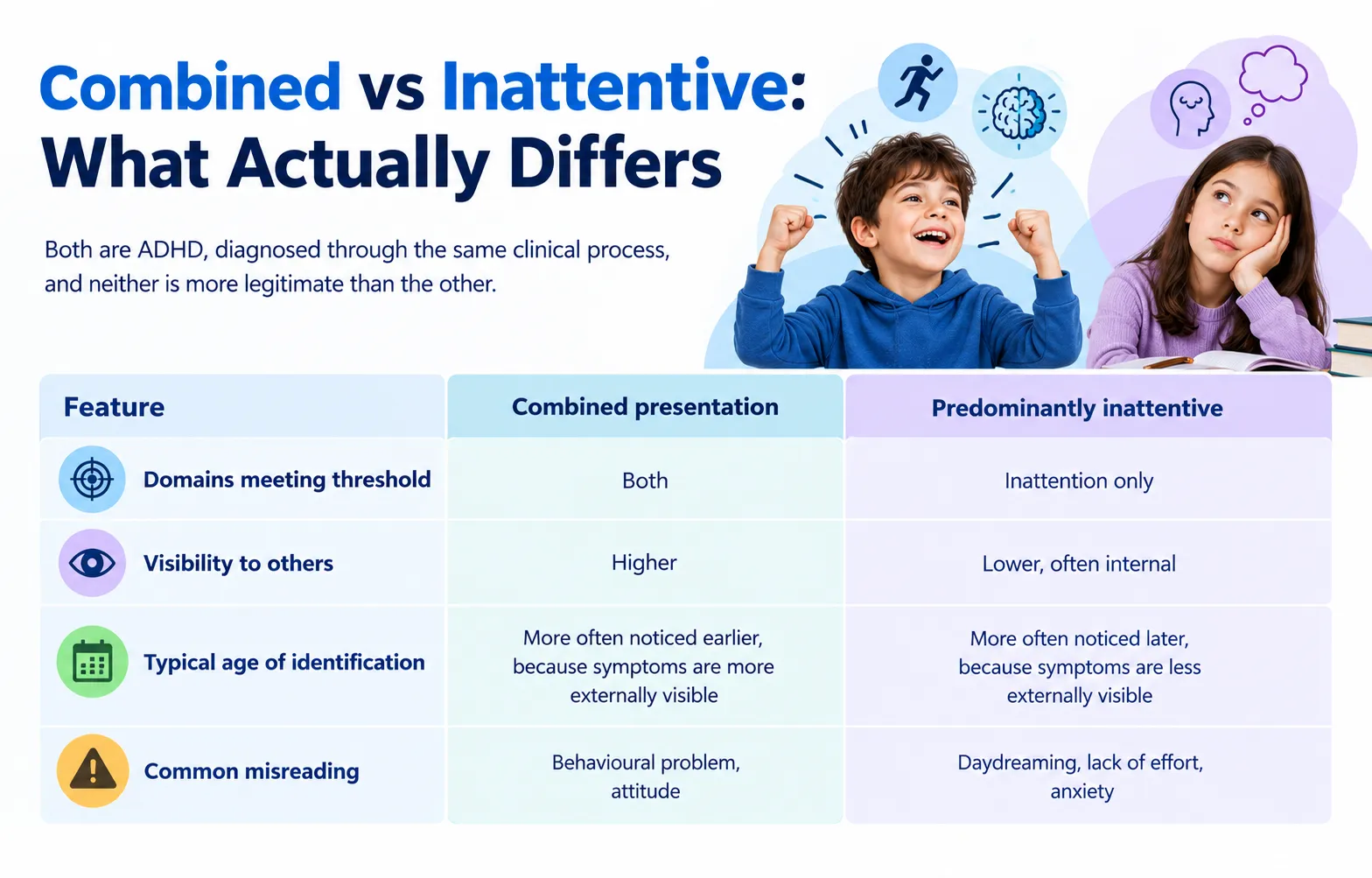
| Feature | Combined presentation | Predominantly inattentive |
| Domains meeting threshold | Both | Inattention only |
| Visibility to others | Higher | Lower, often internal |
| Typical age of identification | More often noticed earlier, because symptoms are more externally visible | More often noticed later, because symptoms are less externally visible |
| Common misreading | Behavioural problem, attitude | Daydreaming, lack of effort, anxiety |
Severity is recorded separately from presentation. Someone with the combined presentation and mild severity may function better than someone with the inattentive presentation and marked impairment. Our guide to inattentive ADHD covers that presentation in depth.
Living With the Combined Presentation
Approaches that help tend to address both domains rather than picking one, because the difficulties interact.
- Externalising memory and structure, so completion does not depend on sustained attention
- Building in a pause between deciding and acting on decisions with financial or commitment consequences
- Physical movement built into the day rather than suppressed, which many people find reduces restlessness
- Reducing the number of open projects, since the combined presentation generates new ones faster than it finishes them
- Addressing co-occurring anxiety, low mood or sleep difficulties, which affect both domains
These are self-management approaches rather than clinical treatment, and the two are not interchangeable. Support options are a matter for you and your treating clinician.
References
- Australian ADHD Professionals Association. Australian Evidence-Based Clinical Practice Guideline for Attention Deficit Hyperactivity Disorder (ADHD). Released October 2022. adhdguideline.aadpa.com.au
- American Psychiatric Association. Diagnostic and Statistical Manual of Mental Disorders, Fifth Edition, Text Revision (DSM-5-TR). 2022.
- World Health Organization. International Classification of Diseases, 11th Revision (ICD-11). 6A05 Attention deficit hyperactivity disorder. icd.who.int
- World Health Organization. International Classification of Diseases, 10th Revision (ICD-10). F90 Hyperkinetic disorders.
- National Institute for Health and Care Excellence (NICE). Attention deficit hyperactivity disorder: diagnosis and management. NG87.
Last review: September 2026. Next scheduled review: September 2027. This article is general information and is not a substitute for individual medical advice, assessment or diagnosis.