

What Are the Symptoms of ADHD?
ADHD symptoms fall into two domains: inattention and hyperactivity-impulsivity, with nine symptoms listed in each. ADHD is a neurodevelopmental condition rather than a disease, so ADHD disease symptoms is a common but inaccurate phrasing. Diagnosis requires enough symptoms in one or both domains, present for at least six months, with several evident before age 12, appearing in more than one setting, and interfering with functioning (Australian ADHD Professionals Association, 2022).
What is ADHD symptoms in full, and what are ADHD symptoms actually required to show? Symptom lists are everywhere and most of them are incomplete. They tend to list the recognisable behaviours and leave out the thresholds, the age requirements and the functional impact criteria that actually determine whether a pattern meets diagnosis.
This guide covers all 18 diagnostic symptoms, how each one presents differently in children and adults, what is required beyond the symptoms themselves, and which commonly discussed features are associated with ADHD without being part of the criteria.
The Two Symptom Domains
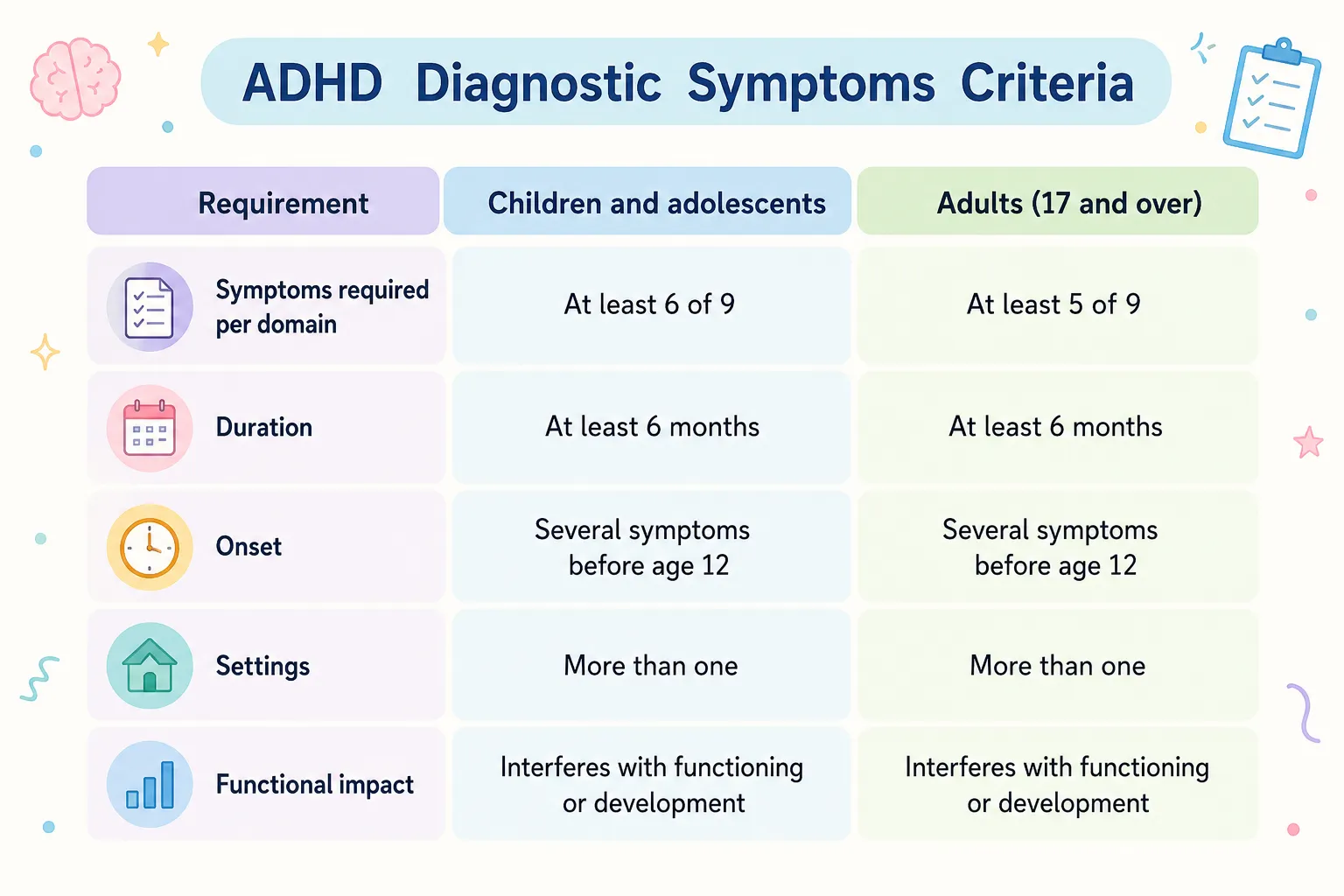
Diagnostic criteria group ADHD symptoms into inattention and hyperactivity-impulsivity, with nine listed in each domain. Which domains meet the threshold determines the presentation recorded: predominantly inattentive, predominantly hyperactive-impulsive, or combined. The thresholds below are the DSM-5 criteria as applied in Australian clinical practice (Australian ADHD Professionals Association, 2022).
| Requirement | Children and adolescents | Adults (17 and over) |
| Symptoms required per domain | At least 6 of 9 | At least 5 of 9 |
| Duration | At least 6 months | At least 6 months |
| Onset | Several symptoms before age 12 | Several symptoms before age 12 |
| Settings | More than one | More than one |
| Functional impact | Interferes with functioning or development | Interferes with functioning or development |
Two points about that table are easy to miss. The onset requirement is that several symptoms were present before age 12, not that the full diagnostic picture was evident then, and not that a diagnosis was made. And the functional impact row does more work than most symptom lists suggest: recognising traits is common, while meeting the diagnostic bar requires those traits to be causing difficulty across settings, at a level inconsistent with developmental stage.
Inattention Symptoms: All Nine
The nine inattention symptoms are summarised below in plain language, with how each commonly presents at different ages. These are paraphrased descriptions for general information, not the verbatim diagnostic criteria, which are set out in DSM-5-TR. People search for these as ADHD inattentive symptoms, symptoms of inattentive ADHD, or ADHD predominantly inattentive symptoms; they all refer to the same list.
1. Fails to give close attention to detail or makes careless mistakes
In children: errors in schoolwork that are not explained by not knowing the material. In adults: mistakes in forms, emails and reports that get missed on rereading, often in work well within capability.
2. Difficulty sustaining attention in tasks or play
In children: difficulty staying with lessons, reading or extended activities. In adults: difficulty with long documents, meetings, lectures or conversations, particularly when the content is not intrinsically engaging.
3. Does not seem to listen when spoken to directly
Present at all ages. The person hears, but the content does not register. Often described by others as being somewhere else, and by the person as having realised mid-conversation that they have lost the thread.
4. Does not follow through on instructions and fails to finish
In children: starting tasks and drifting, homework begun and abandoned. In adults: projects that stall at 80 percent, side-tracking during a task and not returning, and a pattern of unfinished work that is not explained by ability or intent.
5. Difficulty organising tasks and activities
In children: disorganised work, poor time management, messy belongings. In adults: sequencing multi-step work, keeping materials in order, meeting deadlines, and managing the administrative load of ordinary life.
6. Avoids or dislikes tasks requiring sustained mental effort
In children: reluctance around homework and extended written work. In adults: avoidance of reports, forms, tax, and lengthy reading. The avoidance is often experienced as inability to start rather than unwillingness.
7. Loses things necessary for tasks and activities
In children: school materials, books, equipment. In adults: keys, wallets, phones, glasses, documents and paperwork, at a frequency that stands out among peers.
8. Easily distracted by extraneous stimuli
In adults and older adolescents, this explicitly includes distraction by unrelated thoughts, not only external noise or movement. Internal distraction is often the more significant form.
9. Forgetful in daily activities
In children: chores, routines, taking things to school. In adults: appointments, returning calls, paying bills, running errands, and commitments made in passing.
Hyperactivity and Impulsivity Symptoms: All Nine
The nine hyperactivity-impulsivity symptoms are summarised below in the same way: paraphrased for general information rather than reproduced verbatim from DSM-5-TR.
1. Fidgets, taps hands or feet, or squirms in seat
Present at all ages, though it often becomes smaller and less visible with age. In adults it may appear as restless hands, tapping, or shifting position rather than obvious movement.
2. Leaves seat when remaining seated is expected
In children: getting up during lessons or meals. In adults: standing during meetings, finding reasons to leave the room, difficulty remaining seated through long sessions.
3. Runs about or climbs where it is inappropriate
In adolescents and adults, this criterion is explicitly noted as potentially limited to feeling restless rather than physical movement.
4. Unable to play or engage in activities quietly
In children: noisy play, difficulty with quiet activities. In adults: difficulty with sustained quiet or stillness, including relaxing without an activity.
5. On the go, acting as if driven by a motor
In children: constant movement. In adults: an internal sense of being driven, difficulty settling, discomfort with unstructured time, and often being described by others as hard to keep up with.
6. Talks excessively
Present at all ages. Often described by the person as difficulty stopping once started, particularly on topics of interest.
7. Blurts out answers before questions are completed
In children: calling out in class. In adults: finishing other people’s sentences, answering before the question lands, and speaking before the thought is fully formed.
8. Difficulty waiting turn
In children: queues, games, classroom turns. In adults: waiting in lines, waiting for others to finish speaking, and difficulty with delayed processes generally.
9. Interrupts or intrudes on others
Across ages: interrupting conversations, joining activities uninvited, and in adults, taking over tasks or using others’ things without asking.
What Symptom Lists Usually Leave Out
Several features are strongly associated with ADHD and commonly reported, but are not part of the formal diagnostic criteria. Knowing which is which matters, because their absence does not rule ADHD out and their presence does not establish it.
| Feature | Status |
| Emotional regulation difficulties | Commonly reported and recognised in Australian clinical guidance as associated with ADHD, but not a diagnostic criterion |
| Hyperfocus | Widely reported and consistent with attention regulation difficulty, but not a criterion and not consistently defined in research |
| Time blindness | Commonly described within ADHD communities. Difficulties with time management appear in the organisation criterion, but the term itself is not clinical |
| Rejection sensitivity | Frequently described online, often as rejection sensitive dysphoria. Not a diagnostic category and not recognised in DSM-5-TR or ICD-11 |
| Executive dysfunction | A broader concept describing the processes affected. Not a separate diagnosis |
| Sensory sensitivity | Reported by many people with ADHD. Not part of ADHD criteria; it appears in autism criteria |
None of this means these experiences are not real. It means a clinician assesses against the criteria, and content presenting associated features as diagnostic symptoms causes confusion in both directions.
What Interferes With Functioning Actually Means
This criterion does more work than any other, and it is the one most symptom lists omit entirely. Symptoms have to be causing difficulty, not simply be recognisable.
Australian clinical guidance frames this in terms of impact on psychological, social, academic, occupational or daily-life functioning. In practice, assessment looks at consequences rather than at whether a behaviour occurs.
| Domain | What impact can look like |
| Academic | Underperformance relative to ability, incomplete work, difficulty with independent study |
| Occupational | Missed deadlines, difficulty with administrative requirements, job changes, underemployment relative to capability |
| Social | Conversational difficulties, friendships affected by forgetfulness or interruption, conflict from impulsive responses |
| Daily life | Bills, appointments, household administration, and the accumulation of small unfinished tasks |
| Psychological | Anxiety, low mood or self-criticism developing from years of unexplained difficulty |
Two people can report identical symptoms and reach different conclusions at assessment, because one has built an environment that absorbs the difficulty and the other has not. That is not inconsistency in the criteria. Functional impact is genuinely part of what is being assessed.
How Symptoms Are Assessed
Symptoms are not assessed by asking whether someone recognises a list. Clinical assessment builds a picture from several sources.
- A developmental and personal history reaching back to childhood, since several symptoms must have been present before age 12
- Standardised rating scales completed by the person, and often by a parent, partner or someone who has known them a long time. Rating scales support assessment but are not, on their own, sufficient to establish a diagnosis
- Evidence that difficulties appear across more than one setting rather than in a single demanding environment
- Assessment of functional impact across the domains above
- Consideration of alternative and co-occurring explanations
The informant element matters more than people expect. Self-report alone is limited, partly because ADHD affects self-monitoring, and partly because people normalise difficulties they have had their whole life. Someone who knew you as a child often notices things you do not think to mention.
Symptoms That Overlap With Other Conditions
Several conditions produce difficulties that look like ADHD symptoms. This overlap is the main reason self-diagnosis from a symptom list is unreliable. The table below is a simplified summary to illustrate why assessment matters, not a guide to distinguishing conditions yourself.
| Condition | Overlapping features | What differs |
| Anxiety | Difficulty concentrating, restlessness, difficulty starting tasks | Often has a clearer onset, and concentration difficulty tracks with worry rather than being long-standing |
| Depression | Reduced motivation, poor concentration, forgetfulness | Usually episodic, with mood change central rather than lifelong attention difficulty |
| Sleep disorders | Inattention, irritability, poor memory, restlessness | Symptoms track sleep quality and may resolve when sleep improves |
| Autism | Difficulty with attention shifting, sensory sensitivity, executive difficulty | Social communication differences and restricted or repetitive patterns are central. Both can be diagnosed together |
| Trauma | Concentration difficulty, hypervigilance mistaken for distractibility, emotional dysregulation | Onset and pattern relate to the experience rather than to early development |
| Thyroid conditions | Fatigue, concentration difficulty, restlessness | Physical signs and blood test results identify these |
These conditions can also occur alongside ADHD rather than instead of it, which is common. Identifying one does not rule out the other, and assessment considers both possibilities.
How ADHD Symptoms Differ by Age
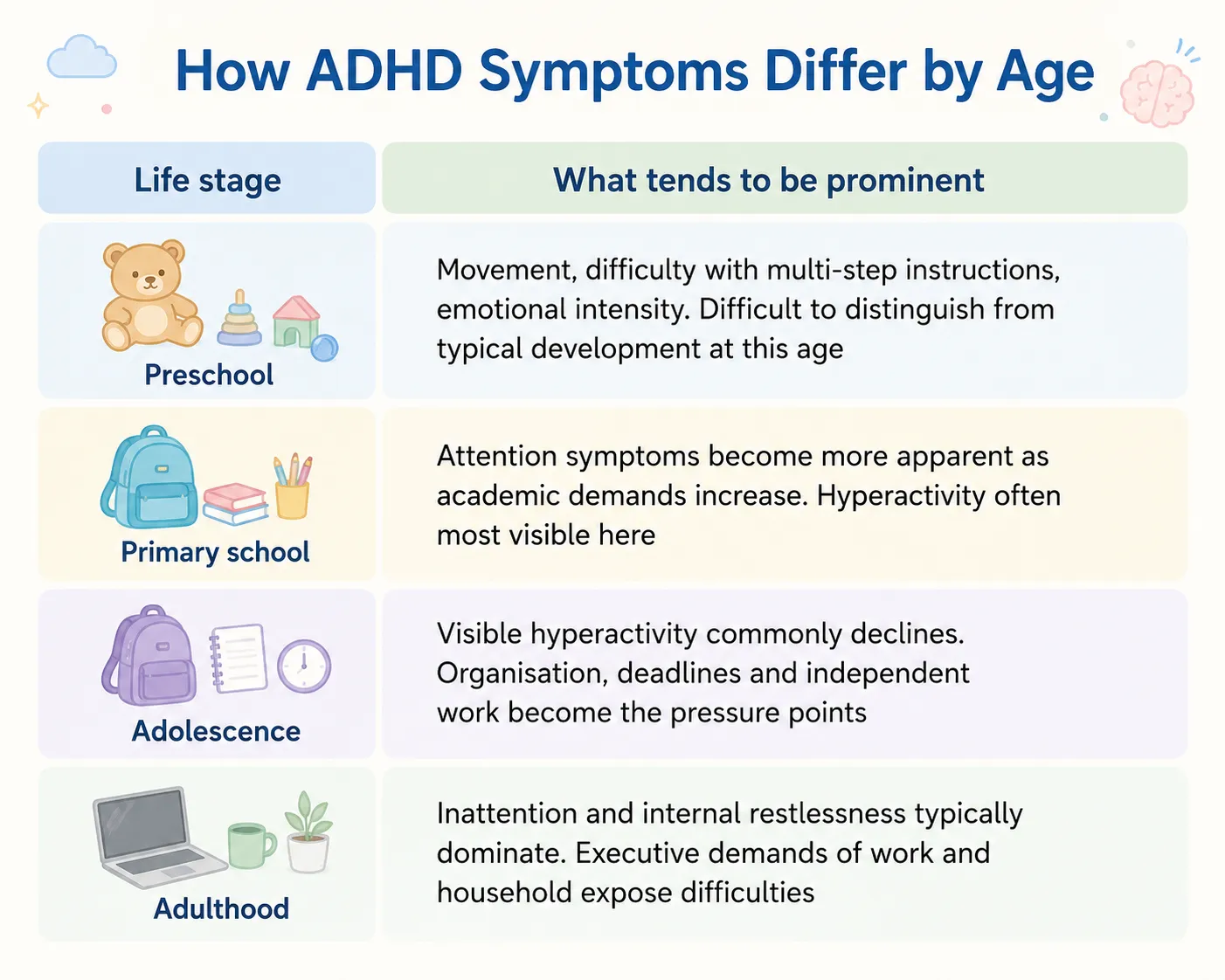
| Life stage | What tends to be prominent |
| Preschool | Movement, difficulty with multi-step instructions, emotional intensity. Difficult to distinguish from typical development at this age |
| Primary school | Attention symptoms become more apparent as academic demands increase. Hyperactivity often most visible here |
| Adolescence | Visible hyperactivity commonly declines. Organisation, deadlines and independent work become the pressure points |
| Adulthood | Inattention and internal restlessness typically dominate. Executive demands of work and household expose difficulties |
The symptoms do not change; the way they present and what they collide with does. The age-related descriptions throughout this page are illustrative examples of how symptoms are commonly described, not diagnostic indicators in themselves. Our guides to ADHD symptoms in adults, in women and in children cover each in depth.
Symptoms by Presentation
Which symptoms meet threshold determines the presentation recorded.
| Presentation | Which domains meet criteria |
| Predominantly inattentive | Inattention only. Often called inattentive ADHD symptoms, and historically described as ADD |
| Predominantly hyperactive-impulsive | Hyperactivity-impulsivity only |
| Combined | Both domains |
Presentation can change over time as symptoms and demands change, and that is not a misdiagnosis. Our guide to types and presentations covers this along with severity levels.
Can ADHD Symptoms Be Mild?
Yes. Alongside presentation, ADHD is recorded with a severity specifier: mild, moderate or severe. Mild means few symptoms beyond the diagnostic threshold and only minor impairment in functioning.
Mild does not mean the difficulties are trivial or that support is unnecessary. It also is not fixed: severity reflects current symptoms and current functional impact, both of which change with circumstances, demands and co-occurring conditions. Someone assessed as mild at one point can be assessed differently later without anything having gone wrong with the earlier assessment.
Severity is a separate judgement from presentation. Someone with the combined presentation and mild severity may function better than someone with the inattentive presentation and marked impairment.
What Is Not an ADHD Symptom
Not everything that looks like it belongs on a list of symptoms for ADHD actually does. Being clear about the boundaries is as useful as the list itself.
- Occasional distractibility, disorganisation or restlessness. Almost everyone experiences these, particularly when tired, stressed or under load.
- Difficulty concentrating that began recently in adulthood without a childhood history. That warrants assessment for other causes.
- Poor performance in a single setting only. Criteria require difficulties in more than one.
- Low intelligence or low ability. ADHD is unrelated to intellectual capacity.
When Symptoms Warrant Assessment
The practical threshold is not how many items on a list you recognise, but whether a long-standing pattern is causing difficulty.
- The pattern has been present since childhood rather than starting recently
- It appears in more than one area of life, such as work and relationships, or school and home
- It is causing difficulty rather than simply being noticeable
- There is a persistent gap between capability and outcomes despite genuine effort
- Other explanations, including anxiety, depression, sleep difficulties and thyroid conditions, have been considered
Online symptom checkers are screening tools rather than diagnostic ones. A high score is a reasonable prompt to seek assessment, not a result in itself. For ADHD symptoms and treatment options together, assessment is the starting point: support decisions follow diagnosis rather than preceding it.
Related Guides
- ADHD symptoms in women
- ADHD symptoms in children and toddlers
- Signs and traits of ADHD: what to look for
- Inattentive ADHD (formerly known as ADD)
- What Is ADHD? Meaning, definition and full form
References
- Australian ADHD Professionals Association. Australian Evidence-Based Clinical Practice Guideline for Attention Deficit Hyperactivity Disorder (ADHD). Released October 2022. adhdguideline.aadpa.com.au
- American Psychiatric Association. Diagnostic and Statistical Manual of Mental Disorders, Fifth Edition, Text Revision (DSM-5-TR). 2022.
- World Health Organization. International Classification of Diseases, 11th Revision (ICD-11). 6A05 Attention deficit hyperactivity disorder.
- National Institute for Health and Care Excellence (NICE). Attention deficit hyperactivity disorder: diagnosis and management. NG87.
Last review: August 2026. Next scheduled review: August 2027. This article is general information and is not a substitute for individual medical advice, assessment or diagnosis.