

What Is Inattentive ADHD?
“Inattentive ADHD” is the common term for ADHD in which the predominantly inattentive presentation is identified. ADHD remains the diagnosis; the presentation describes the current symptom picture. Attention regulation difficulties dominate and obvious hyperactivity is absent or minimal (Australian ADHD Professionals Association, 2022). It can be particularly easy to miss in childhood, because it produces less disruptive behaviour than hyperactive-impulsive symptoms.
This is the presentation people describe when they say they have always been forgetful, always three steps behind on admin, always the one who reread the same paragraph four times. It is also the presentation least likely to be picked up at school, because it produces no disruption. A child who is quietly not finishing work is far easier to overlook than a child who cannot stay in their seat.
This guide covers what inattentive ADHD actually involves, why it is missed so often, how it differs from the other presentations, and what assessment looks like in Australia.
Inattentive ADHD and ADD: The Same Thing?
Short answer: essentially yes. ADD, attention deficit disorder, is an older term no longer used as a separate formal diagnosis. What was historically called ADD is now generally captured as the predominantly inattentive presentation of ADHD.
You will still see ADD used informally, and by people diagnosed decades ago under the older terminology. The abbreviation ADHD-PI also appears in clinical writing. All three refer to broadly the same clinical picture. Our comparison guide covers the terminology history in more detail.
People also search for “ADHD inattentive type” and “ADHD-PI”. Current diagnostic terminology generally uses predominantly inattentive presentation. Here is how the terms line up.
| Term | What it means |
| ADHD | The overall neurodevelopmental disorder |
| Inattentive ADHD | Common consumer term for the predominantly inattentive presentation |
| Predominantly inattentive presentation | Current clinical terminology |
| ADHD-PI / ADHD inattentive type | Abbreviations used in some clinical and research contexts |
| ADD | Older term, no longer a separate ADHD diagnosis |
Symptoms of Inattentive ADHD
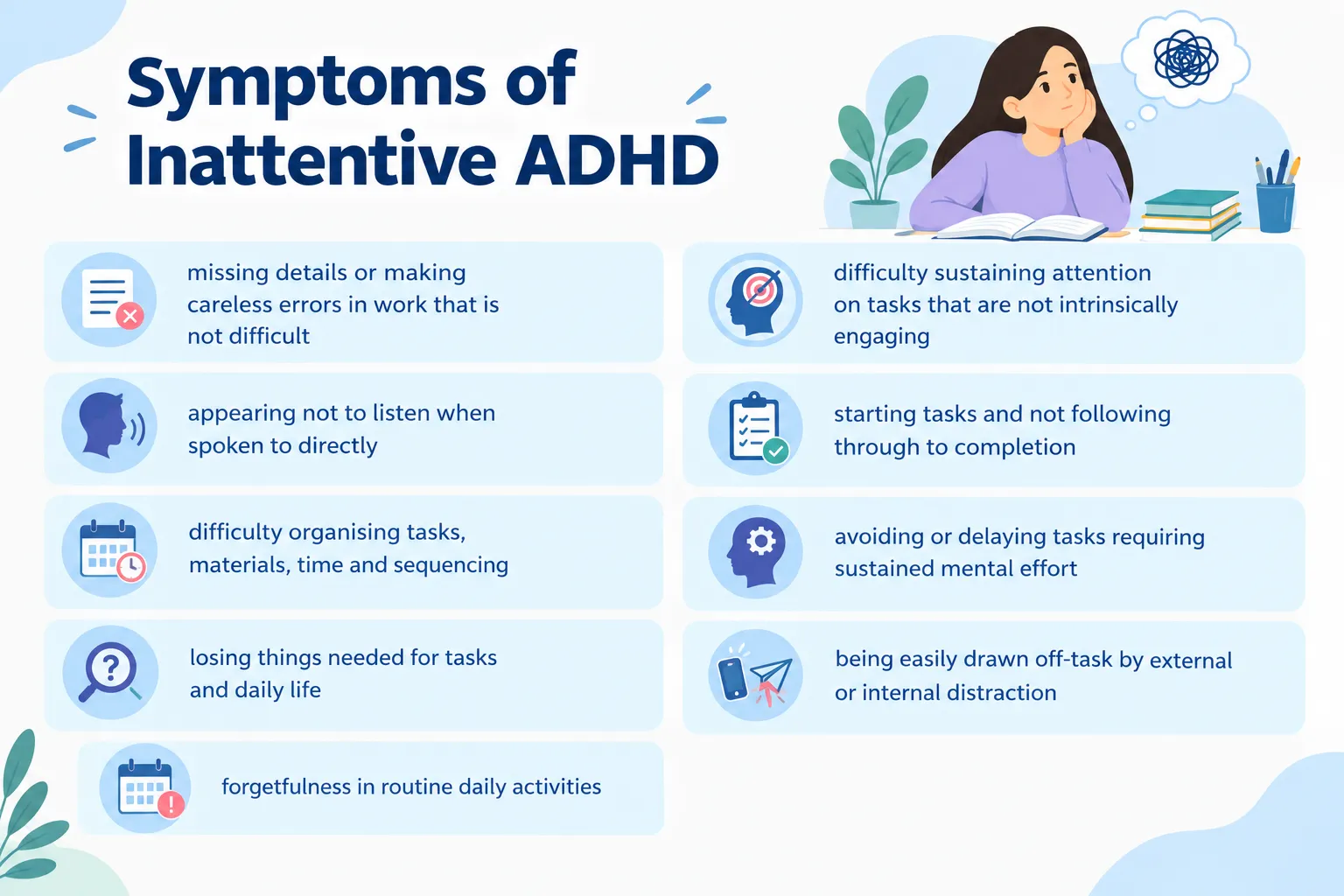
DSM-5 lists nine inattention symptoms and nine hyperactivity-impulsivity symptoms. For the predominantly inattentive presentation, children require at least six inattention symptoms and people aged 17 and older require at least five, without also meeting the threshold for hyperactivity-impulsivity. Symptoms must have persisted for at least six months, been evident before age 12, and appear in more than one setting (Australian ADHD Professionals Association, 2022).
- missing details or making careless errors in work that is not difficult
- difficulty sustaining attention on tasks that are not intrinsically engaging
- appearing not to listen when spoken to directly
- starting tasks and not following through to completion
- difficulty organising tasks, materials, time and sequencing
- avoiding or delaying tasks requiring sustained mental effort
- losing things needed for tasks and daily life
- being easily drawn off-task by external or internal distraction
- forgetfulness in routine daily activities
Symptoms also need to be inconsistent with developmental level and associated with impairment in functioning. Australia’s clinical guideline links diagnosis to symptoms that negatively affect psychological, social, academic, occupational or daily-life functioning (Australian ADHD Professionals Association, 2022). Identifying with several inattentive traits does not establish ADHD.
What this looks like day to day
Reading a page and retaining nothing. Opening an email, intending to answer it, and closing it. Arriving at a room with no memory of why. Losing the thread mid-conversation and reconstructing it from context. None of these in isolation means anything. The pattern, sustained since childhood and across settings, is what matters.
Why Inattentive ADHD Gets Missed
Several factors combine, and they reinforce each other.
| Factor | Effect |
| No disruption | Referrals in childhood are often triggered by behaviour that affects a classroom. Quiet inattention does not trigger them. |
| Compensatory ability | Capable students frequently keep up on ability alone until workload increases, which delays recognition to secondary school, university or work. |
| Historical diagnostic focus | Australia’s clinical guideline notes girls and women are at risk of under-recognition, particularly where symptoms are predominantly inattentive (AADPA, 2022). |
| Misattribution | Difficulties get read as daydreaming, laziness, anxiety or lack of effort, which are explanations that do not prompt assessment. |
| Internalised distress | Struggling quietly tends to produce self-criticism and anxiety rather than visible behaviour, so the anxiety is treated and the underlying pattern is not identified. |
The practical consequence is that some people reach assessment for the first time in adulthood. Women and girls can be at particular risk of under-recognition, especially when symptoms are predominantly inattentive (Australian ADHD Professionals Association, 2022).
How It Differs From the Other Presentations
| Predominantly inattentive | Hyperactive-impulsive | Combined | |
| Core difficulty | Attention regulation, working memory, organisation | Restlessness, impulsivity, difficulty waiting | Both domains meet threshold |
| Visibility | Low. Often internal | High. Often noticed early | Usually noticed |
| Typical age of recognition | Later, sometimes adulthood | Earlier, often primary school | Varies |
| Common misreading | Daydreaming, lack of effort, anxiety | Behavioural problem, defiance | Personality or attitude |
Presentation describes the current picture rather than a fixed category. A person’s presentation can change over time as symptoms and demands change. Our types and presentations guide covers severity levels and how this shifts with age.
Inattentive ADHD in Adults
Adult life removes the external structure that school and early jobs supply. Deadlines become self-imposed, supervision reduces, and administrative load increases. That combination is where inattentive ADHD becomes hardest to compensate for.
- Administrative tasks accumulate: forms, renewals, appointments, correspondence
- Work with distant deadlines and no interim checkpoints stalls
- Conversations require visible effort to track, particularly in meetings or groups
- Time estimation is unreliable, which affects planning more than it affects any single task
- sustaining attention can feel effortful, particularly during prolonged or low-interest tasks
Anxiety and low mood commonly develop alongside, often after years of unexplained underperformance. This matters for assessment, because anxiety and depression can both produce attention difficulties and can also occur with ADHD. Distinguishing between them is a core part of clinical assessment rather than something a questionnaire can settle.
Inattentive ADHD in Children
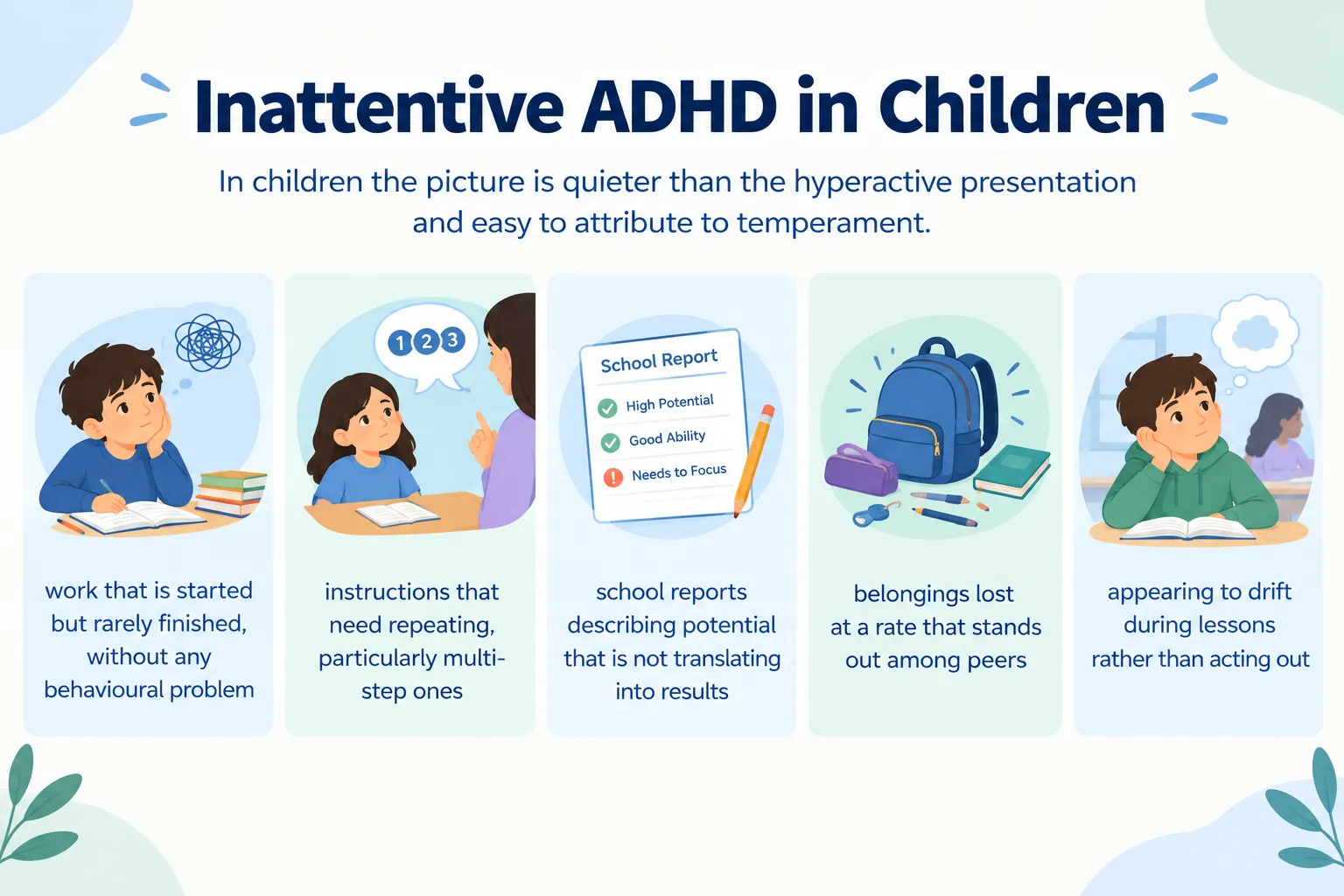
In children the picture is quieter than the hyperactive presentation and easy to attribute to temperament.
- work that is started but rarely finished, without any behavioural problem
- instructions that need repeating, particularly multi-step ones
- school reports describing potential that is not translating into results
- belongings lost at a rate that stands out among peers
- appearing to drift during lessons rather than acting out
A useful question for parents and teachers is whether the pattern is consistent across settings and over time, rather than tied to one subject, one teacher or one period. Our parent’s guide to ADHD symptoms in children covers what to raise and with whom.
Two Things That Confuse People About This Presentation
Both come up constantly and both are worth addressing directly, because each one causes people to rule themselves out incorrectly.
The first is intense focus. Many people with inattentive ADHD can become absorbed in an engaging task for hours and conclude that their attention is fine. Hyperfocus is widely reported by people with ADHD, although it is not itself a diagnostic criterion. It is consistent with a difficulty regulating where attention goes, rather than evidence against it.
The second is capability. Doing well academically or professionally does not rule out inattentive ADHD. Compensation through ability, interest or sheer hours is common, and it usually holds until demands rise beyond what compensation can absorb. What tends to give it away is the effort cost: the same output as peers, produced through a considerably harder process.
The Cost People Rarely Mention
Something worth naming, because it is frequently the reason people finally seek assessment. Years of quietly underperforming relative to your own capability tends to produce an explanation, and in the absence of a clinical one, most people supply a character-based explanation instead. Lazy. Careless. Not trying.
For some people, years of interpreting these difficulties as personal failure can contribute to low self-esteem, frustration or anxiety. That interpretation often shifts after assessment, which is one reason identifying anxiety or low mood alongside ADHD matters rather than treating either in isolation.
Can you have inattentive ADHD and still be successful?
Yes. Academic or professional achievement does not by itself rule out ADHD. Assessment considers the broader developmental history, symptoms and functional impact, including the effort and strategies required to maintain that performance. The relevant question is not what you produced, but what it cost to produce it.
Why can inattentive ADHD be missed in girls and women?
Australia’s clinical guideline notes that girls and women are at risk of under-recognition, particularly where symptoms are predominantly inattentive rather than hyperactive (Australian ADHD Professionals Association, 2022). Quiet difficulty attracts fewer referrals than disruptive behaviour.
How Inattentive ADHD Is Assessed
Assessment follows the same process as for any ADHD presentation. There is no single blood test, brain scan or questionnaire that establishes an ADHD diagnosis.
- A developmental and personal history reaching back to childhood, since onset before age 12 is part of the criteria.
- Standardised rating scales completed by the person, and often by a parent, partner or long-term colleague.
- Evidence that difficulties appear across more than one setting rather than in a single demanding environment.
- Consideration of alternative and co-occurring explanations, including anxiety, depression, sleep disorders, trauma, autism and specific learning disorders.
- Assessment of functional impact, since noticeable traits and impairing traits are not the same thing.
A note on self-recognition
Inattentive ADHD content is widely shared online, and much of it describes experiences common to most people under load. Recognising yourself in a list of ADHD symptoms is a reasonable reason to seek assessment. It is not a diagnosis, and the value of assessment lies partly in ruling other explanations in or out.
Who assesses ADHD in Australia?
Psychiatrists and paediatricians diagnose ADHD, and psychologists contribute assessment in many settings. Some states have expanded roles for specifically trained general practitioners. Arrangements differ by state and territory and have been changing, so check the current position where you live and start with a conversation with your GP about referral pathways.
What Support Looks Like
Support is multimodal, and Australia’s clinical guideline sets out recommendations across psychological, behavioural and educational approaches for children, adolescents and adults (Australian ADHD Professionals Association, 2022). For the inattentive presentation, practical strategies commonly focus on externalising memory, task initiation, organisation and structure. These are self-management approaches rather than clinical treatment, and the two are not interchangeable.
- externalising memory, so nothing important depends on recall
- breaking open-ended work into visible checkpoints with external accountability
- reducing decision load, since decisions are where a lot of the difficulty accumulates
- reasonable workplace or educational adjustments, depending on your circumstances and the relevant policies or legal framework
- addressing co-occurring anxiety, low mood or sleep difficulties, which affect daytime attention in their own right
Medical treatment options exist and are a matter for a person and their treating clinician. This guide does not cover medicines.
References
- Australian ADHD Professionals Association. Australian Evidence-Based Clinical Practice Guideline for ADHD. NHMRC-approved, 2022. adhdguideline.aadpa.com.au
- American Psychiatric Association. Diagnostic and Statistical Manual of Mental Disorders, Fifth Edition, Text Revision (DSM-5-TR). 2022.
- May T, et al. The Australian evidence-based clinical practice guideline for attention deficit hyperactivity disorder. Australian and New Zealand Journal of Psychiatry. 2023. doi:10.1177/00048674231166329
- National Institute for Health and Care Excellence (NICE). Attention deficit hyperactivity disorder: diagnosis and management. NG87.
Last review: September 2026. Next scheduled review: September 2027. This article is general information and is not a substitute for individual medical advice, assessment or diagnosis.