
When Is ADHD Awareness Month?
ADHD Awareness Month is observed every October. The most widely used symbol is an orange ribbon, and a rainbow butterfly is also commonly used within neurodiversity communities. October is recognised as ADHD Awareness Month in Australia, as it is internationally, with campaigns coordinated independently by organisations in different countries
Public awareness of ADHD content tends to be either purely promotional or purely clinical. This page is neither. It covers what the observance is, what the symbols mean and where they came from, and how ADHD came to be recognised as a condition in the first place.
When Is ADHD Awareness Month?
October, every year. The observance runs internationally, with campaigns coordinated independently by organisations in different countries rather than by a single global body.
ADHD Awareness Day, sometimes shortened to ADHD Day, is referenced separately by some organisations. The observance originated as a single awareness day before expanding into a full month, and some organisations still mark a specific date within October. Because there is no single international coordinating body, the exact date varies by country and organisation.
The ADHD Awareness Ribbon and Colours
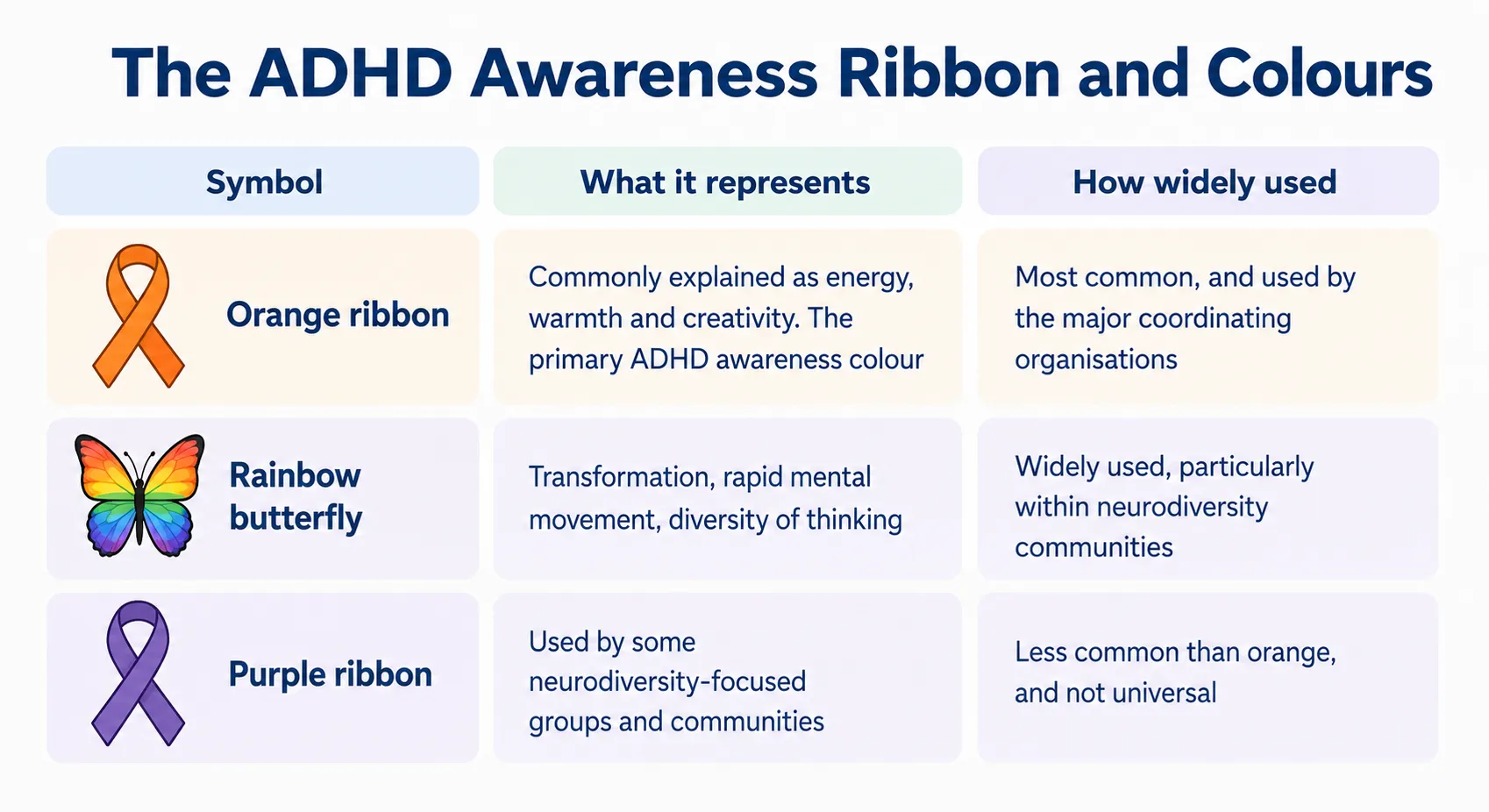
The orange ribbon is the most widely recognised ADHD awareness symbol, and ADHD ribbon awareness campaigns typically centre on it. The choice of orange is commonly explained as reflecting energy, warmth and creativity, although awareness campaign colours are generally chosen for visibility and recognisability rather than through any formal process.
| Symbol | What it represents | How widely used |
| Orange ribbon | Commonly explained as energy, warmth and creativity. The primary ADHD awareness colour | Most common, and used by the major coordinating organisations |
| Rainbow butterfly | Transformation, rapid mental movement, diversity of thinking | Widely used, particularly within neurodiversity communities |
| Purple ribbon | Used by some neurodiversity-focused groups and communities | Less common than orange, and not universal |
Worth knowing: there is no single organisation that owns ADHD symbolism internationally. Orange is the dominant colour and the one used by the largest coordinating bodies, but you will encounter purple and other variations, particularly in community-led and neurodiversity-focused settings. Both are in genuine use, and neither is incorrect.
The Butterfly Symbol
The rainbow butterfly has become one of the more common ADHD symbols, particularly online. The butterfly imagery is generally described as representing rapid mental movement and the capacity to adapt, while the rainbow colours signal diversity of thinking.
It sits alongside the broader rainbow infinity symbol used across the neurodiversity movement. Unlike the orange ribbon, it emerged from community use rather than from an organisational campaign, which is part of why several versions circulate.
ADHD Awareness Month in Australia
Australian ADHD organisations recognise October as ADHD Awareness Month, in line with the international observance. Check the current campaign details with an Australian ADHD organisation, as activities and dates are set by each organisation and change year to year. Australian activity tends to focus on issues specific to the local context: cost and waiting times for assessment, uneven access between metropolitan and regional areas, and recognition of presentations that have historically been missed, particularly in girls and women.
A Senate Inquiry into ADHD assessment and support services reported in 2023 after receiving more than 700 submissions (Senate Community Affairs References Committee, 2023), which gives some indication of how much unmet need exists locally. Our guide to ADHD statistics in Australia covers the numbers in more detail.
When Was ADHD Discovered?
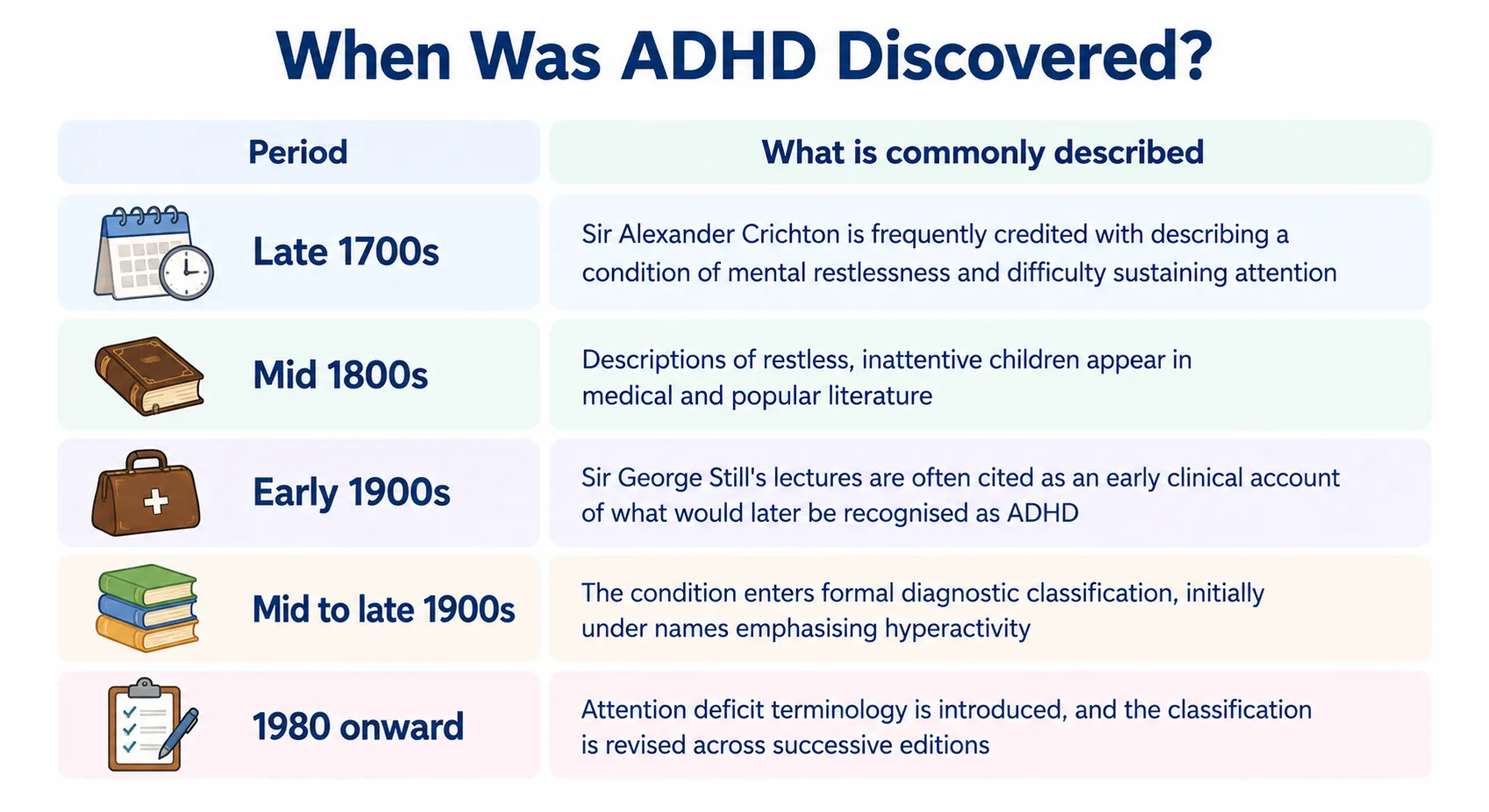
There is no single discovery date. When ADHD was discovered is not a question with one answer, because what histories of ADHD generally describe is a series of clinical descriptions across more than two centuries, under a succession of different names. The attributions below are those commonly made in published histories of the condition rather than settled facts, and historical accounts differ on who described what first.
| Period | What is commonly described |
| Late 1700s | Sir Alexander Crichton is frequently credited with describing a condition of mental restlessness and difficulty sustaining attention |
| Mid 1800s | Descriptions of restless, inattentive children appear in medical and popular literature |
| Early 1900s | Sir George Still’s lectures are often cited as an early clinical account of what would later be recognised as ADHD |
| Mid to late 1900s | The condition enters formal diagnostic classification, initially under names emphasising hyperactivity |
| 1980 onward | Attention deficit terminology is introduced, and the classification is revised across successive editions |
Two things are worth taking from that. ADHD is not a recent invention: clinical descriptions consistent with it long predate the current name and the modern debate. And the name has changed repeatedly while the clinical picture has remained broadly recognisable, which is why terminology confuses people. Our guide to ADD versus ADHD covers how the diagnostic terminology changed across successive editions of the DSM.
Famous People With ADHD
Lists of famous people with ADHD circulate widely, and they are worth approaching with some care.
Some public figures have spoken openly about their own diagnosis, and those accounts are theirs to share. Many lists go further, attributing ADHD to historical figures who died long before the diagnosis existed, or to living people who have never disclosed anything of the sort. Retrospective diagnosis of historical figures is speculation rather than history, and attributing a condition to a living person who has not disclosed it is not appropriate regardless of intent.
Where public disclosure has genuinely occurred, it does useful work: it reduces stigma and makes the condition visible in contexts where people assume it does not exist. That value comes from the disclosure being real.
Talking About ADHD Respectfully
Awareness campaigns are partly about language, and a few conventions are worth knowing.
- Person-first language, such as a person with ADHD, is standard in Australian clinical and health settings.
- Identity-first language, such as an ADHD person or ADHDer, is preferred by many people within neurodivergent communities. Both are in genuine use, and the reasonable approach is to follow the preference of the person you are speaking with.
- Terms such as handicap are outdated and are no longer used in Australian clinical or legal contexts.
- Describing ADHD as a superpower is common in awareness content and is contested. Many people find it dismissive of genuine impairment, while others find it a useful reframe.
What Workplaces and Schools Can Do
Awareness months are most useful when they produce something concrete rather than a social media post.
- Check what adjustments are actually available and whether staff or students know how to request them.
- Review whether requesting an adjustment requires more disclosure than is genuinely necessary.
- Make information about support pathways easy to find rather than something people have to ask for.
- Avoid framing awareness activity in a way that implies people should disclose. Disclosure remains a personal decision.
How People Mark ADHD Awareness Month
- Wearing an orange ribbon, pin or wristband during October
- Sharing accurate information and correcting misconceptions where they come up
- Supporting organisations working on access, assessment and advocacy
- For workplaces and schools, reviewing what adjustments are actually available and whether people know how to request them
- For people with a diagnosis, deciding what, if anything, they want to disclose. Disclosure is a personal choice and awareness campaigns do not change that
Related Guides
- ADHD in Australia: the complete guide
- What Is ADHD? Meaning, definition and full form
- ADHD strengths, benefits and positive traits
- Is ADHD a disability, a disorder or a difference?
- ADHD, IQ, intelligence and giftedness
- ADHD symptoms in adults: the complete Australian guide
References
- ADHD Australia. adhdaustralia.org.au, Released October 2025
- Parliament of Australia, Senate Community Affairs References Committee. Assessment and support services for people with ADHD. 2023. aph.gov.au
- Australian ADHD Professionals Association. Australian Evidence-Based Clinical Practice Guideline for Attention Deficit Hyperactivity Disorder (ADHD). Released October 2022. adhdguideline.aadpa.com.au
- American Psychiatric Association. Diagnostic and Statistical Manual of Mental Disorders, Fifth Edition, Text Revision (DSM-5-TR). 2022.
Last review: September 2026. Next scheduled review: September 2027. This article is general information and is not a substitute for individual medical advice, assessment or diagnosis.