

What Is ADHD Paralysis?
ADHD paralysis is a community term describing being unable to start or continue a task despite understanding what needs doing and wanting to do it. It is not a clinical or diagnostic term, and it does not appear in DSM-5-TR or ICD-11. What it describes overlaps with difficulties in task initiation and executive function that are widely recognised in ADHD.
This is one of the most searched ADHD experiences and one of the least well explained. People describe sitting in front of a task they understand, that matters, that they want to complete, and being unable to begin. Then the not-starting becomes its own problem, and ADHD overwhelmed is how many describe what follows.
This guide covers what the term describes, how it relates to executive function, why it is not laziness, and what people commonly find helps. ADHD paralysis explained honestly means being clear about which parts are established and which are description.
What the Term Describes
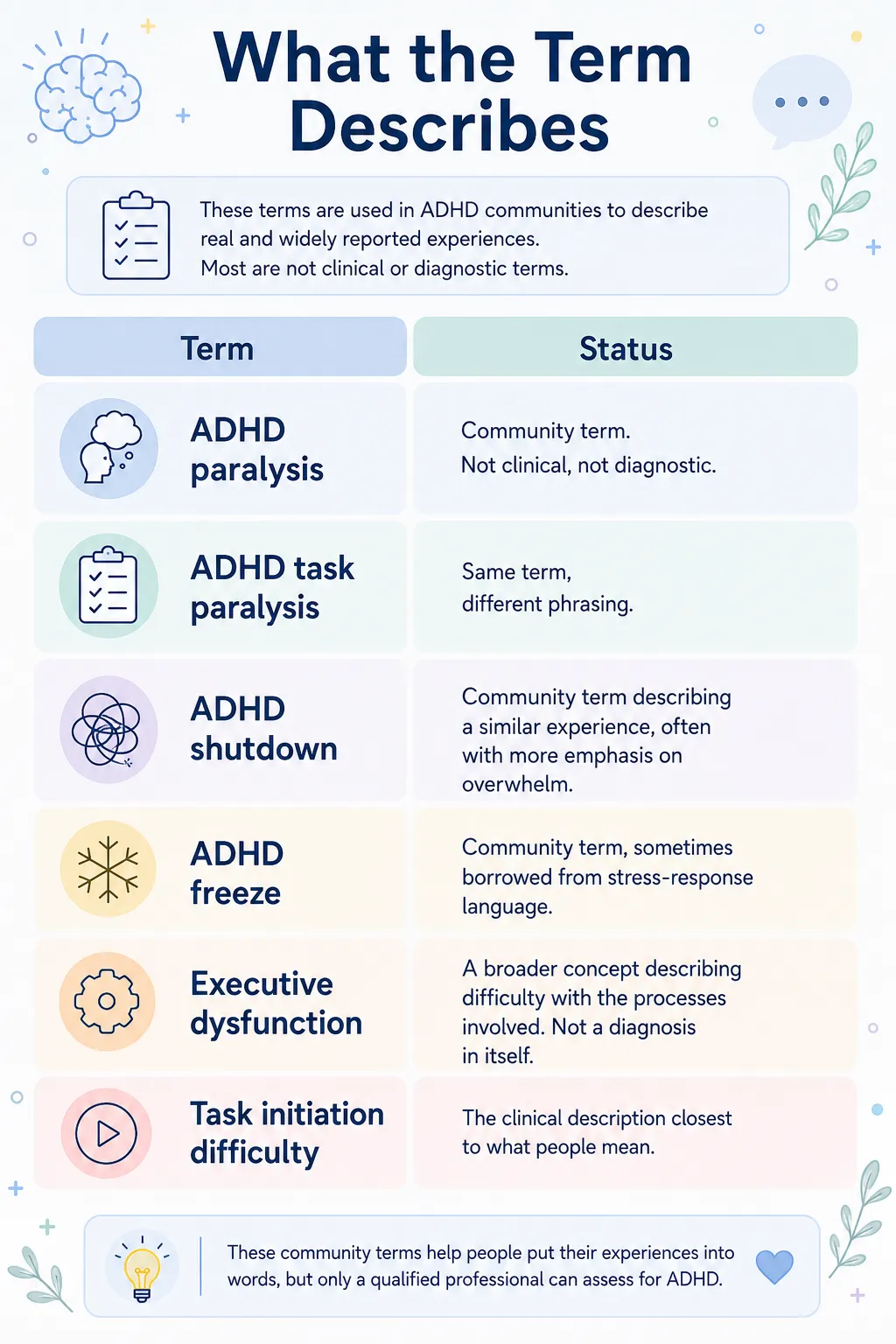
ADHD paralysis is a descriptive term that emerged from ADHD communities rather than from clinical literature. It does not appear in DSM-5-TR or ICD-11 (American Psychiatric Association, 2022; World Health Organization, ICD-11). Dysregulated ADHD and dysregulation ADHD are used loosely in the same way. It is worth saying that plainly, because content presenting these as symptoms or diagnosable states causes confusion.
What it describes is real and widely reported. The underlying difficulty is usually task initiation: the gap between deciding to do something and being able to begin it. Task initiation is commonly considered an executive-function process, and difficulties with executive functioning are frequently discussed in relation to ADHD (Australian ADHD Professionals Association, 2022). Task initiation is not itself a diagnostic criterion.
| Term | Status |
| ADHD paralysis | Community term. Not clinical, not diagnostic |
| ADHD task paralysis | Same term, different phrasing |
| ADHD shutdown | Community term describing a similar experience, often with more emphasis on overwhelm |
| ADHD freeze | Community term, sometimes borrowed from stress-response language |
| Executive dysfunction | A broader concept describing difficulty with the processes involved. Not a diagnosis in itself |
| Task initiation difficulty | The clinical description closest to what people mean |
ADHD Paralysis vs Executive Dysfunction
People search for the difference, and it is worth answering directly.
Executive dysfunction is the broader concept. It describes difficulty with the mental processes that manage goal-directed behaviour: planning, prioritising, initiating, sustaining attention, holding information in mind, and inhibiting responses. Executive functioning difficulties are widely discussed in relation to ADHD (Australian ADHD Professionals Association, 2022). ADHD paralysis describes one experience within that: the specific failure to start.
Put simply, executive dysfunction is the category and ADHD paralysis is one way people experience it. Neither is a diagnosis. Executive function difficulties are also not unique to ADHD.
Why It Happens
Researchers and clinicians have proposed several overlapping processes that may contribute to difficulty starting tasks in ADHD. These should be understood as explanatory models rather than a single proven mechanism, and no one explanation fits everyone.
- Task initiation difficulty: the process of moving from intention to action appears to be a specific point of difficulty rather than a general lack of drive
- Decision load: ADHD decision paralysis is commonly described when a task has several possible starting points and none is obviously correct
- Working memory: holding the shape of a multi-step task in mind while beginning it is effortful
- Time perception: a task that has no immediate deadline can feel equally distant whether it is due tomorrow or next month
- Emotional weight: tasks associated with previous failure, criticism or shame become harder to approach, which compounds over time
- Cumulative load: a day of small difficulties leaves less capacity for the next thing, which is often described as ADHD overwhelm
ADHD and Laziness
This deserves a direct answer, because it is the interpretation most people arrive with.
ADHD laziness is not a clinical concept, and calling someone with ADHD lazy is not an accurate description of what is happening. Calling someone lazy assumes that they are unwilling to act, whereas task-initiation difficulty can occur even when a person wants to complete the task.
Why the distinction matters
The lazy interpretation is not just inaccurate. It is actively unhelpful, because it points toward solutions that do not work. If the difficulty were motivation, trying harder would help. Where the difficulty is initiation, effort applied at the wrong point produces frustration rather than progress.
That said, difficulty starting tasks occurs for many reasons other than ADHD. Depression, burnout, anxiety, sleep deprivation and sustained stress all affect initiation. Concluding ADHD from this experience alone is not reliable.
ADHD, Motivation and Interest
Some people with ADHD find that interest, novelty, urgency or immediate consequences strongly influence their ability to engage with a task. Knowing something matters does not always translate into being able to start it. ADHD and motivation are often discussed in these terms, though how much this applies varies between individuals.
You will see this described online as an interest-based nervous system. That is a popular framing rather than a clinical term, and it does not appear in DSM-5-TR or ICD-11 diagnostic criteria (American Psychiatric Association, 2022). Many people find it a useful description of their experience, which is why it circulates.
What people commonly report as ADHD motivators: genuine interest in the task itself, a deadline close enough to generate pressure, novelty including a new approach to an old task, another person present or expecting an update, and breaking a task down until the first step is obvious. These are reported experiences rather than evidence-based strategies.
ADHD and Perfectionism
ADHD and perfectionism are often treated as opposites. In practice some people with ADHD describe both, and ADHD perfectionism contributes directly to difficulty starting.
Some people with ADHD describe developing very high standards after repeated experiences of inconsistency, criticism or difficulty meeting expectations. For some, those standards can then make starting a task more difficult, because an imperfect start feels worse than no start. This is commonly described rather than well established in research.
Practically, it means the advice to just start is particularly unhelpful for this group, because starting badly is the specific thing being avoided. Some people describe this as emotional avoidance rather than a motivation problem, and low frustration tolerance can make the first attempt harder to sit with. ADHD can present differently across people and across stages of life.
ADHD Shutdown and Overwhelm
ADHD shutting down, sometimes called ADHD shutdown, describes a state people report when demands exceed capacity: disengagement, difficulty responding, and sometimes an inability to do anything at all rather than a specific task.
In community descriptions, shutdown is often used for a broader or more global experience of overwhelm, whereas paralysis is more often used for difficulty with a particular task. Neither is a clinical term, and the distinction reflects how the words are used rather than an established clinical difference.
If shutdown episodes are frequent, prolonged, or accompanied by low mood, hopelessness or an inability to function, that warrants discussion with a clinician. Those features point beyond ADHD alone.
What People Find Helps
Practical strategies can sometimes reduce the demands placed on task initiation. Which approaches help varies between people, and the suggestions below are commonly described by people with ADHD rather than established interventions.
- Reducing the decision, not the task. Deciding in advance what the first action is removes the point where people commonly stall
- Making the first step smaller than feels reasonable. Opening the document rather than writing the report
- External accountability: another person present, or expecting an update at a specific time
- Removing the requirement to do it well on the first attempt, which particularly helps where perfectionism is contributing
- Externalising the task so it does not depend on remembering: written, visible, and set up so the default outcome is the right one
- Reducing cumulative load across the day, since capacity for initiation is finite
When initiation difficulties are significantly affecting work, study or daily functioning, professional assessment can help identify whether ADHD, another condition, sleep problems, stress or several factors are contributing. Functional impairment is central here: the clinical significance of task-initiation difficulties depends partly on how persistent they are and how much they interfere with work, study, relationships or daily functioning. Support options are a matter for you and your treating clinician.
When It Is Not ADHD
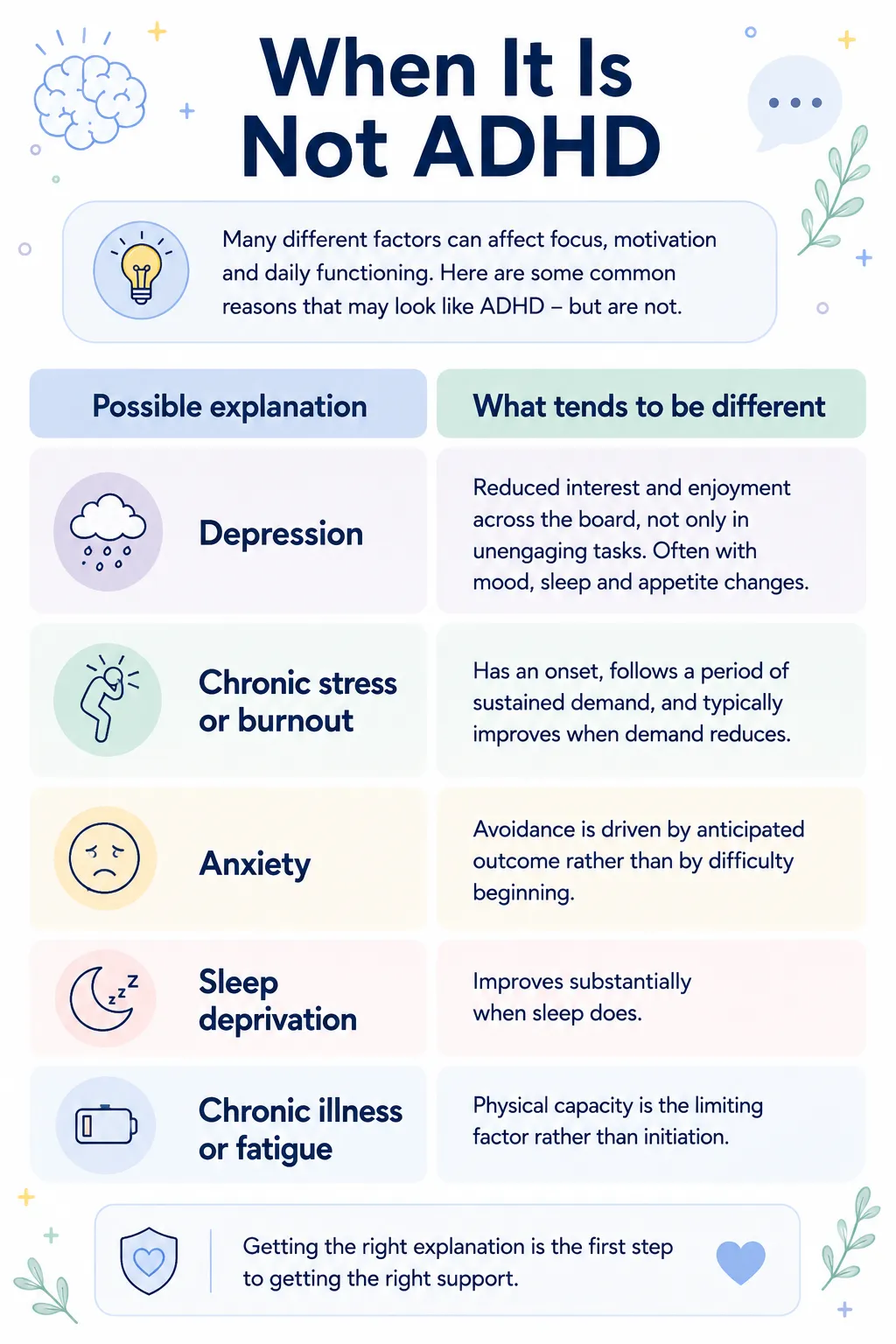
Difficulty initiating tasks is common across several conditions. These patterns can overlap considerably and are not diagnostic rules. A clinician considers the full history, duration, severity, functional impact and co-occurring symptoms when determining what may be contributing to difficulty starting tasks.
| Possible explanation | What tends to be different |
| Depression | Reduced interest and enjoyment across the board, not only in unengaging tasks. Often with mood, sleep and appetite changes |
| Chronic stress or burnout | Has an onset, follows a period of sustained demand, and typically improves when demand reduces |
| Anxiety | Avoidance is driven by anticipated outcome rather than by difficulty beginning |
| Sleep deprivation | Improves substantially when sleep does |
| Chronic illness or fatigue | Physical capacity is the limiting factor rather than initiation |
These patterns overlap substantially and several can occur alongside ADHD. They are not reliable ways to distinguish conditions without clinical assessment.
Related Guides
- ADHD symptoms: the full symptom picture
- What ADHD feels like: living as a person with ADHD
- ADHD, emotional dysregulation and rejection sensitivity
- ADHD symptoms in adults
- The ADHD brain: dopamine, neuroscience and how it differs
References
- Australian ADHD Professionals Association. Australian Evidence-Based Clinical Practice Guideline for Attention Deficit Hyperactivity Disorder (ADHD). Released October 2022. adhdguideline.aadpa.com.au
- American Psychiatric Association. Diagnostic and Statistical Manual of Mental Disorders, Fifth Edition, Text Revision (DSM-5-TR). 2022.
- World Health Organization. International Classification of Diseases, 11th Revision (ICD-11). 6A05 Attention deficit hyperactivity disorder.
- National Institute for Health and Care Excellence (NICE). Attention deficit hyperactivity disorder: diagnosis and management. NG87.
Last reviewed: September 2026. Next scheduled review: September 2027. This article is general information and is not a substitute for individual medical advice, assessment or diagnosis.