

Is ADHD Caused by Low Dopamine?
No, or at least not in the way the popular version suggests. Dopamine signalling is involved in ADHD, but a 2024 critical review of more than forty years of human and animal research concluded that while there is evidence for dopamine involvement, there is limited evidence for a low-dopamine state itself being a key component of ADHD (MacDonald et al., Frontiers in Psychiatry, 2024). This is the authors’ assessment of the accumulated evidence rather than a settled consensus. ADHD is not diagnosed by measuring dopamine.
The low dopamine explanation is the most widely repeated claim about ADHD and the brain, and it is the one most at odds with what the research actually shows. It is not that dopamine is irrelevant. The ADHD dopamine story is considerably more complicated than a shortage of one chemical.
This guide covers what brain research has found, what it has not, why scans cannot diagnose ADHD, and how to read the claims you will encounter online.
What Dopamine Actually Does
What is dopamine?
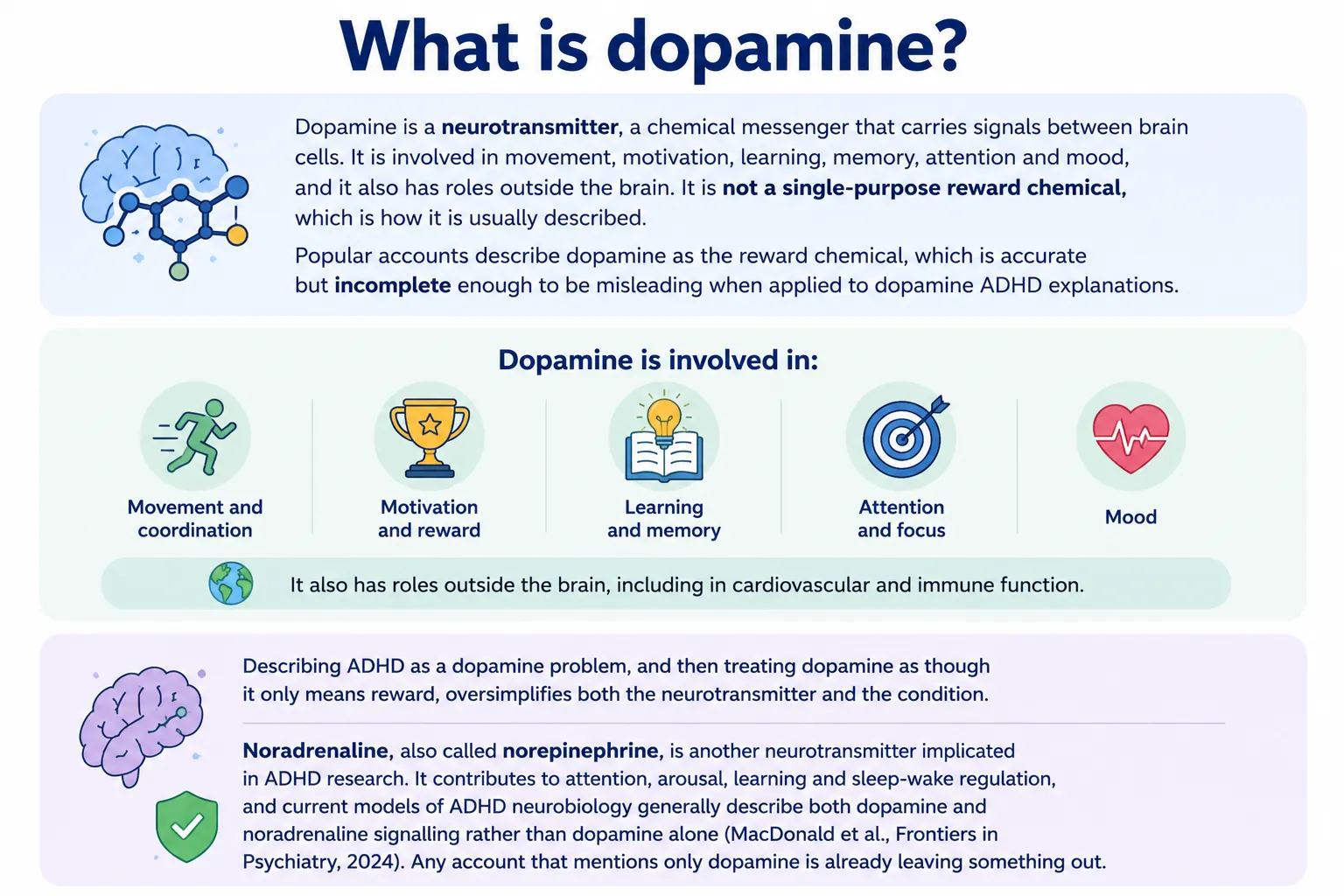
Dopamine is a neurotransmitter, a chemical messenger that carries signals between brain cells. It is involved in movement, motivation, learning, memory, attention and mood, and it also has roles outside the brain. It is not a single-purpose reward chemical, which is how it is usually described.
Popular accounts describe dopamine as the reward chemical, which is accurate but incomplete enough to be misleading when applied to dopamine ADHD explanations.
Dopamine is involved in movement and coordination, motivation and reward, learning and memory, attention and focus, and mood. It also has roles outside the brain, including in cardiovascular and immune function. Describing ADHD as a dopamine problem, and then treating dopamine as though it only means reward, oversimplifies both the neurotransmitter and the condition.
Noradrenaline, also called norepinephrine, is another neurotransmitter implicated in ADHD research. It contributes to attention, arousal, learning and sleep-wake regulation, and current models of ADHD neurobiology generally describe both dopamine and noradrenaline signalling rather than dopamine alone (MacDonald et al., Frontiers in Psychiatry, 2024). Any account that mentions only dopamine is already leaving something out.
What the Dopamine Research Shows
The dopamine hypothesis for ADHD has been investigated for over four decades using brain imaging, genetics and animal models. A 2024 critical review of that literature concluded that there is evidence for the involvement of dopamine in ADHD, but limited evidence for a hypo-dopaminergic state, meaning a low-dopamine state, as a key component of the condition (MacDonald et al., Frontiers in Psychiatry, 2024).
The dopamine transporter research illustrates why. Imaging studies of dopamine transporter levels in people with ADHD have produced inconsistent findings, including reported elevations in some studies, no difference in others, and reductions in particular brain regions. The variation between studies has been wide enough that a single clear conclusion has not emerged (MacDonald et al., Frontiers in Psychiatry, 2024).
Why this matters practically
If ADHD were simply a dopamine deficiency, it would be measurable and correctable. It is neither. Products and programmes marketed as dopamine detoxes or dopamine resets are based on a version of the science that the evidence does not support. Dopamine is not a substance you can detox from.
Can a Brain Scan Diagnose ADHD?
No. Routine brain imaging is not used to diagnose ADHD in Australian clinical practice, and no scan can confirm or exclude the diagnosis in an individual.
This is the single most important thing to understand about ADHD brain imaging research. Studies that report differences are comparing group averages across populations. They are not describing something visible in any one person’s scan. The distributions overlap substantially, which means a scan from someone with ADHD and a scan from someone without it frequently look the same.
Diagnosis remains clinical: developmental history, symptom assessment across settings, functional impact, and consideration of alternative explanations. If a service offers to diagnose ADHD through a brain scan, that is not standard practice in Australia.
ADHD Brain vs Neurotypical Brain: What Research Has Found
People commonly search for normal brain vs ADHD brain comparisons. The clinical framing is neurotypical rather than normal, and the honest answer is that the differences are averages across groups, not a template that applies to any individual.
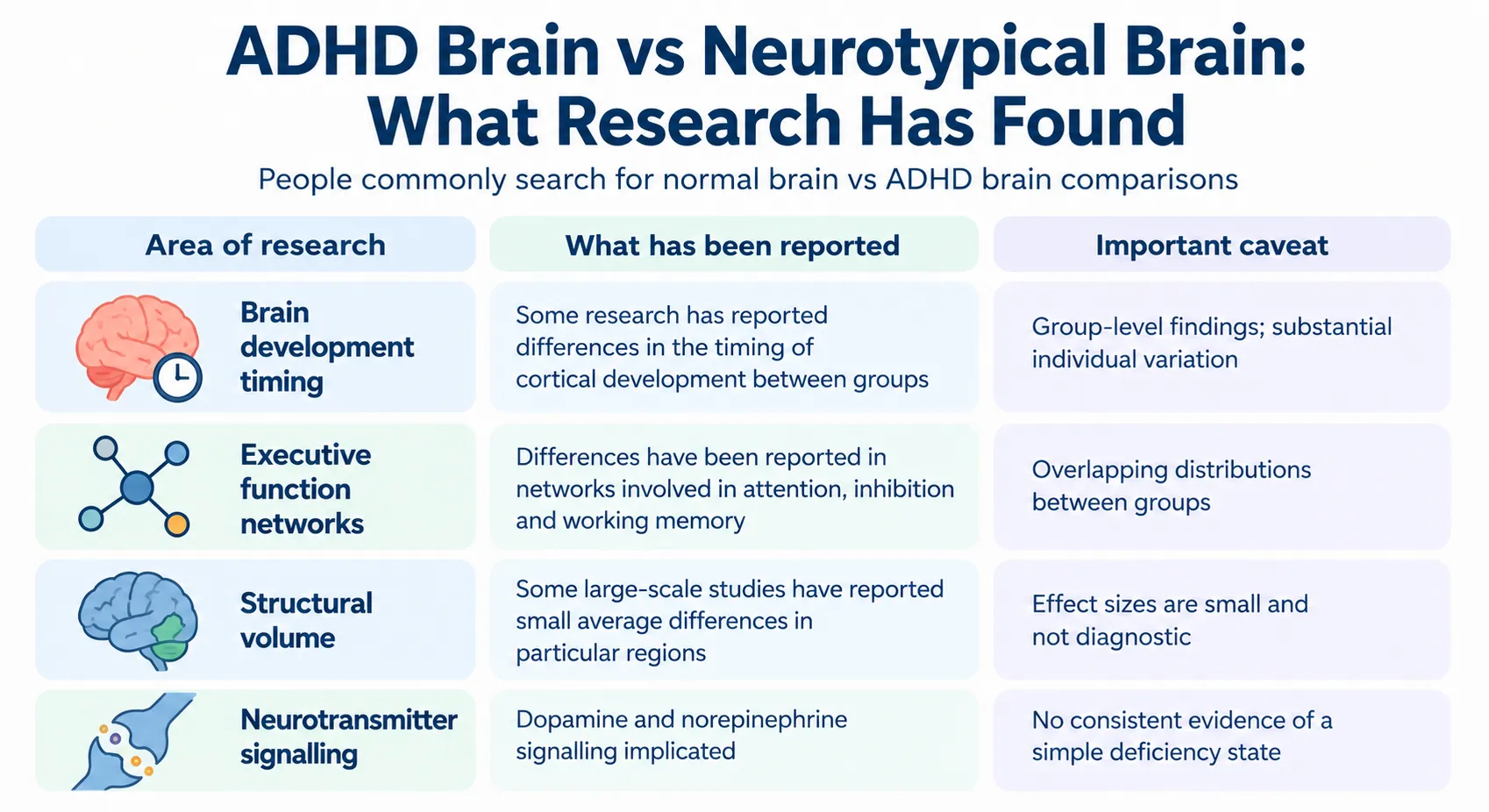
| Area of research | What has been reported | Important caveat |
| Brain development timing | Some research has reported differences in the timing of cortical development between groups | Group-level findings; substantial individual variation |
| Executive function networks | Differences have been reported in networks involved in attention, inhibition and working memory | Overlapping distributions between groups |
| Structural volume | Some large-scale studies have reported small average differences in particular regions | Effect sizes are small and not diagnostic |
| Neurotransmitter signalling | Dopamine and norepinephrine signalling implicated | No consistent evidence of a simple deficiency state |
Two things follow. The differences are real as research findings, which is why the neurobiological account of ADHD is taken seriously. And they are not large or consistent enough to serve as a diagnostic test, which is why nobody uses them as one.
Is ADHD a Neurological Disorder?
Is ADHD a neurological condition? ADHD is formally classified as a neurodevelopmental disorder in DSM-5-TR and ICD-11. That is the precise answer, and it sits between the two framings people usually have in mind when they ask whether ADHD is neurological.
- It is not a neurological disease in the sense of a progressive or structural condition such as epilepsy or multiple sclerosis, and it is not managed by neurologists as standard practice.
- It is not a mental illness in the sense of a condition with an onset and a course, such as depression.
- Neurodevelopmental means it relates to how the brain develops from early life, with differences present before the demands that make them apparent.
People sometimes use neurological loosely to mean brain-based rather than psychological, and in that sense the description is understandable. The formal classification is neurodevelopmental.
What the Brain Research Does Not Show
Being clear about the limits is more useful than overselling the findings.
| Claim you will encounter | Status |
| ADHD is caused by low dopamine | Not supported as a simple explanation. Evidence supports dopamine involvement, not a straightforward deficiency state |
| A brain scan can diagnose ADHD | No. Imaging is not diagnostic and is not used for this purpose in Australian practice |
| Neurotransmitter levels can be measured to confirm ADHD | No. There is no validated clinical test that measures brain neurotransmitter levels for this purpose |
| A dopamine detox will help ADHD | Not supported. Dopamine is not a substance that can be detoxed from |
| The ADHD brain is structurally obvious | No. Reported differences are group averages with substantially overlapping distributions |
Why the Dopamine Story Became So Popular
It is worth understanding why an oversimplified account of ADHD and the brain spread so widely, because the reasons are not purely about misinformation.
A single-chemical explanation is easy to understand and easy to communicate. It also provides something many people are looking for after diagnosis: a concrete, physical reason for difficulties that were previously attributed to character. That is a genuine need, and it is not unreasonable to want an answer that simple.
The problem is that the simple version leads somewhere unhelpful. It supports a market in supplements, detoxes and programmes promising to correct a deficiency that has not been demonstrated. And it sets up disappointment when those approaches do not work.
What This Means for You
- You do not need a brain scan to be assessed for ADHD, and being offered one should prompt questions.
- There is no validated clinical test that measures brain neurotransmitter levels to confirm or rule out ADHD.
- Supplements and programmes marketed as correcting ADHD-related dopamine deficiency are addressing a mechanism that is not established.
- The neurobiological account of ADHD is real and taken seriously. It is just less tidy than the popular version, and it does not translate into a test or a quick correction.
Support for ADHD is based on symptoms, functional impact and evidence for what helps, not on measuring neurotransmitters.
Why Neuroscience Does Not Change What Happens Next
Understanding the brain research is useful for making sense of ADHD, and it is worth being clear about what it does not do.
Neuroimaging and neurotransmitter findings do not currently guide diagnosis or the selection of supports for any individual. Diagnosis remains clinical, and support decisions are based on symptoms, functional impact, age, co-occurring conditions and the person’s own priorities. Nothing in the imaging literature tells a clinician which approach will suit a particular person.
This is not a limitation of ADHD specifically. It is true across most of psychiatry and much of neurology, where group-level research findings have not yet translated into individual-level tests.
Related Guides
- What causes ADHD: genetics, brain development and environment
- What Is ADHD? Meaning, definition and full form
- Types, presentations and severity levels of ADHD
- Is ADHD a disability, a disorder or a difference?
- ADHD in Australia: the complete guide
References
- MacDonald HJ, Kleppe R, Szigetvari PD, Haavik J. The dopamine hypothesis for ADHD: An evaluation of evidence accumulated from human studies and animal models. Frontiers in Psychiatry. 2024. doi:10.3389/fpsyt.2024.1492126
- Australian ADHD Professionals Association. Australian Evidence-Based Clinical Practice Guideline for Attention Deficit Hyperactivity Disorder (ADHD). Released October 2022. adhdguideline.aadpa.com.au
- American Psychiatric Association. Diagnostic and Statistical Manual of Mental Disorders, Fifth Edition, Text Revision (DSM-5-TR). 2022.
- World Health Organization. International Classification of Diseases, 11th Revision (ICD-11). 6A05 Attention deficit hyperactivity disorder.
- National Institute for Health and Care Excellence (NICE). Attention deficit hyperactivity disorder: diagnosis and management. NG87.
Last review: September 2026. Next scheduled review: September 2027. This article is general information and is not a substitute for individual medical advice, assessment or diagnosis.