

How Do I Get My Child Tested for ADHD?
Start with your GP, who can discuss your concerns, consider other explanations and arrange a referral where appropriate. There is no single ADHD test. Assessment draws on a clinical interview, developmental history, parent and teacher information, rating scales and consideration of other conditions. Australia’s clinical guideline states that diagnosis should not be based solely on rating scales (Australian ADHD Professionals Association, 2022).
Most parents looking into ADHD testing for children arrive here after a teacher raised something, or after a pattern at home stopped feeling like a phase. Both are reasonable starting points.
This guide covers what an ADHD assessment for children actually involves, who can do it in Australia, how long it takes, what it costs, and how to prepare your child. Our guide to ADHD symptoms in children covers what the signs look like at different ages.
What Is an ADHD Test for Children?
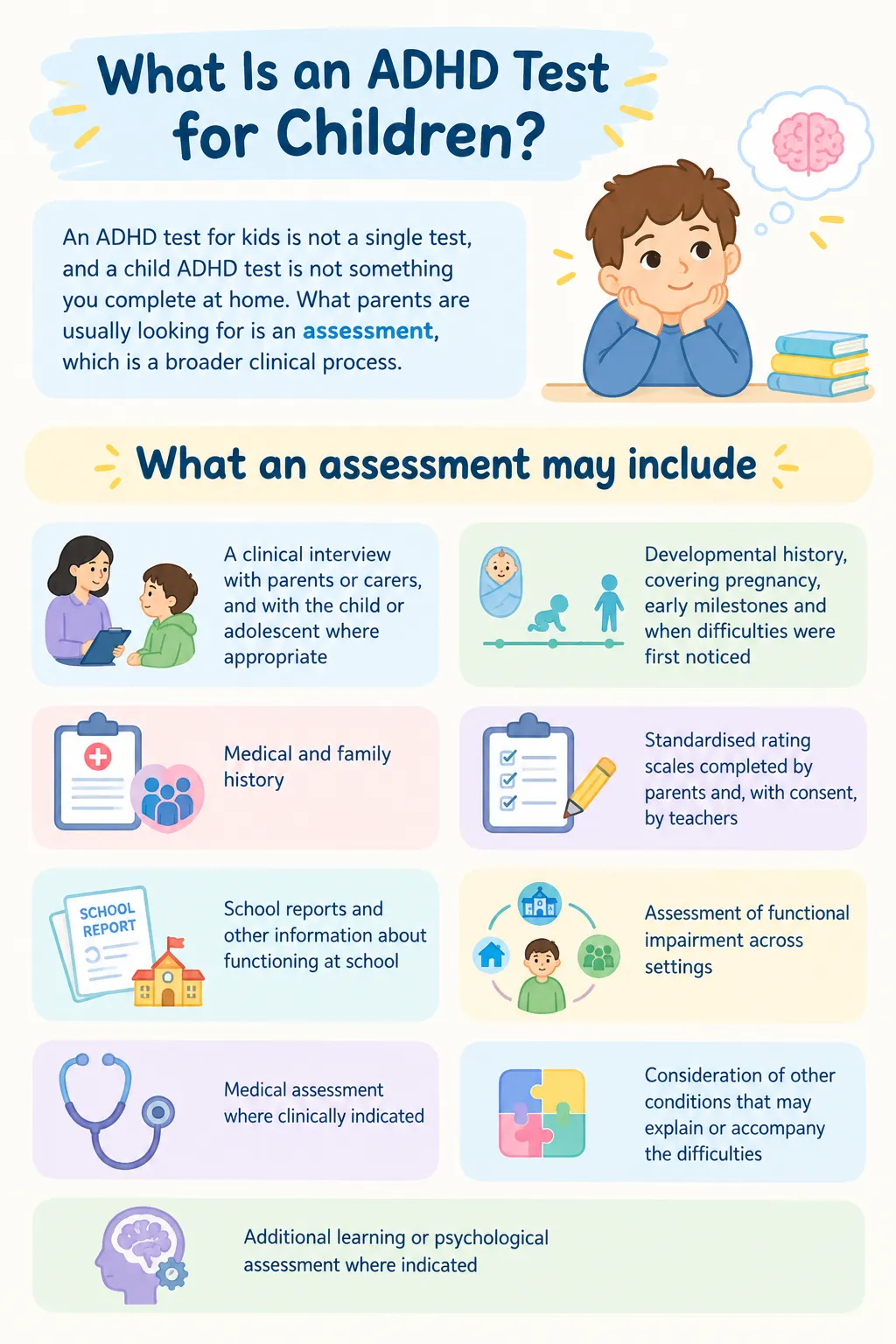
An ADHD test for kids is not a single test, and a child ADHD test is not something you complete at home. What parents are usually looking for is an assessment, which is a broader clinical process.
What an assessment may include
- A clinical interview with parents or carers, and with the child or adolescent where appropriate
- Developmental history, covering pregnancy, early milestones and when difficulties were first noticed
- Medical and family history
- Standardised rating scales completed by parents and, with consent, by teachers
- School reports and other information about functioning at school
- Assessment of functional impairment across settings
- Medical assessment where clinically indicated
- Consideration of other conditions that may explain or accompany the difficulties
- Additional learning or psychological assessment where indicated
What it does not involve
There is no blood test, brain scan or single medical test that establishes ADHD. Diagnosis is based on clinical assessment using diagnostic criteria, history, information from multiple settings and consideration of other possible explanations. Australia’s clinical guideline is explicit that diagnosis should not be based solely on rating scales or observational data (Australian ADHD Professionals Association, 2022).
Who Can Assess ADHD in Children in Australia?
ADHD assessments for children and adolescents may involve paediatricians, child and adolescent psychiatrists, psychologists, and GPs or nurse practitioners with appropriate ADHD diagnostic training. The clinician should be appropriately registered, trained in DSM or ICD diagnostic assessment, and experienced in ADHD assessment or appropriately supervised (Australian ADHD Professionals Association, 2022).
Arrangements differ between states and territories and have been changing.
The Referral Pathway
- Book a GP appointment, ideally a longer one, and say what you want to discuss when you book.
- The GP will discuss your concerns, take a history and consider other explanations. They may also consider hearing, vision, sleep and other medical factors where clinically indicated, because difficulties in these areas can resemble or worsen ADHD symptoms.
- If assessment is appropriate, the GP can arrange a referral. A referral is generally relevant to Medicare rebates on specialist appointments rather than being universally required.
- The assessing clinician conducts the assessment, usually across one or more appointments.
- Depending on the service, you may receive a written report setting out the findings and recommendations.
Can I contact an ADHD service directly?
You can ask a service about its referral requirements before booking. A GP referral may still be required for Medicare rebate purposes even where a service accepts direct enquiries.
Public and Private Assessment
| Public | Private |
| Availability varies by location and service | Usually more direct access |
| Eligibility criteria may apply | Usually fee for service |
| Waiting periods can be significant | Costs vary by clinician and service |
| May involve hospital or community services | May involve paediatricians, psychiatrists or psychologists |
Availability, eligibility and referral requirements differ by state and by service. Check with the specific provider rather than assuming a national rule applies.
What ADHD Rating Scales Are Used?
Parents and teachers may be asked to complete standardised ADHD rating scales. Examples used in Australia include the Vanderbilt ADHD Diagnostic Rating Scale, Conners and SNAP (Australian ADHD Professionals Association, 2022).
These questionnaires help clinicians assess symptoms across settings in a structured way. They cannot establish an ADHD diagnosis on their own.
Why Clinicians Ask About Early Childhood
ADHD symptoms need to have been present before age 12 under DSM-5 criteria. This is why clinicians ask about preschool behaviour, early school reports, developmental history and when difficulties were first noticed.
It does not mean a diagnosis had to be made in childhood. It means evidence of the pattern needs to trace back that far.
How to Involve the School
Teacher information matters because diagnostic criteria require evidence that difficulties appear in more than one setting, and information from multiple reporters helps establish whether symptoms and impairment occur across settings (Australian ADHD Professionals Association, 2022). Most guidance says teacher input is helpful without explaining how to get it, which is the part parents actually need.
Before the referral
Ask the classroom teacher for a meeting rather than raising it at pickup. Ask what they observe rather than leading with ADHD: how your child manages independent work, follows multi-step instructions, transitions between activities, and how their output compares with their apparent understanding.
What to request
- Recent and past school reports, particularly the written comments rather than the grades
- Any records of concerns raised previously, including in earlier years
- Whether the school has an internal wellbeing or learning support process that has already noted anything
- Whether the teacher would be willing to complete a rating scale if the assessing clinician sends one
If the school does not agree
This happens, and it does not stop an assessment. A child who copes at school and struggles at home is a recognised pattern, particularly in children capable enough to compensate. Describe what you observe, when it happens, and what it costs. Because assessment draws on information from multiple settings, a difference between settings is itself information rather than a contradiction to be resolved first.
How Assessment Differs by Age
| Age | What assessment relies on most | What is harder |
| Preschool | Parent report and observation | ADHD can be considered in young children, but assessment requires particularly careful consideration of developmental expectations, because activity, impulsivity and short attention spans can be typical at this age |
| Primary school | Parent and teacher rating scales across settings | Distinguishing ADHD from learning difficulties, which frequently co-occur |
| Early secondary | Parent, teacher and the young person’s own account | Difficulties often shift to organisation and independent work, which are less visible than behaviour |
| Older teens | The young person’s own report becomes central | Separating ADHD from adolescence, and from anxiety or low mood that may have developed alongside |
For adolescents specifically, time is generally set aside to see both the young person and the parents or carers, and private time with the adolescent may be appropriate. Parent and teen accounts can differ, which is useful information rather than a problem. School information can also become harder to obtain in older adolescents, since they are taught by several teachers rather than one.
How Long Does an ADHD Assessment Take?
This is two different questions, and they are often confused.
The assessment itself
A detailed clinical interview may take two to three hours and can be divided across several appointments (Australian ADHD Professionals Association, 2022). Additional time may be needed to obtain teacher information, review school reports or assess possible co-occurring conditions.
The wait to be seen
Waiting times vary considerably by state, provider and whether the service is public or private. Ask about expected timeframes when you are referred, so you can plan around them.
How Much Does ADHD Testing Cost in Australia?
Costs vary substantially, so treat any single figure with caution.
- GP consultations may be bulk billed or involve a gap payment, depending on the practice
- Private specialist and psychologist assessment fees vary considerably by clinician and service
- Medicare rebates may apply to eligible services, depending on referral and eligibility
- Public services may have different eligibility criteria and waiting arrangements
- Assessment reports may be charged separately from appointments by some providers
Ask the provider about the total cost of the assessment, including any report, before booking.
Preparing Your Child
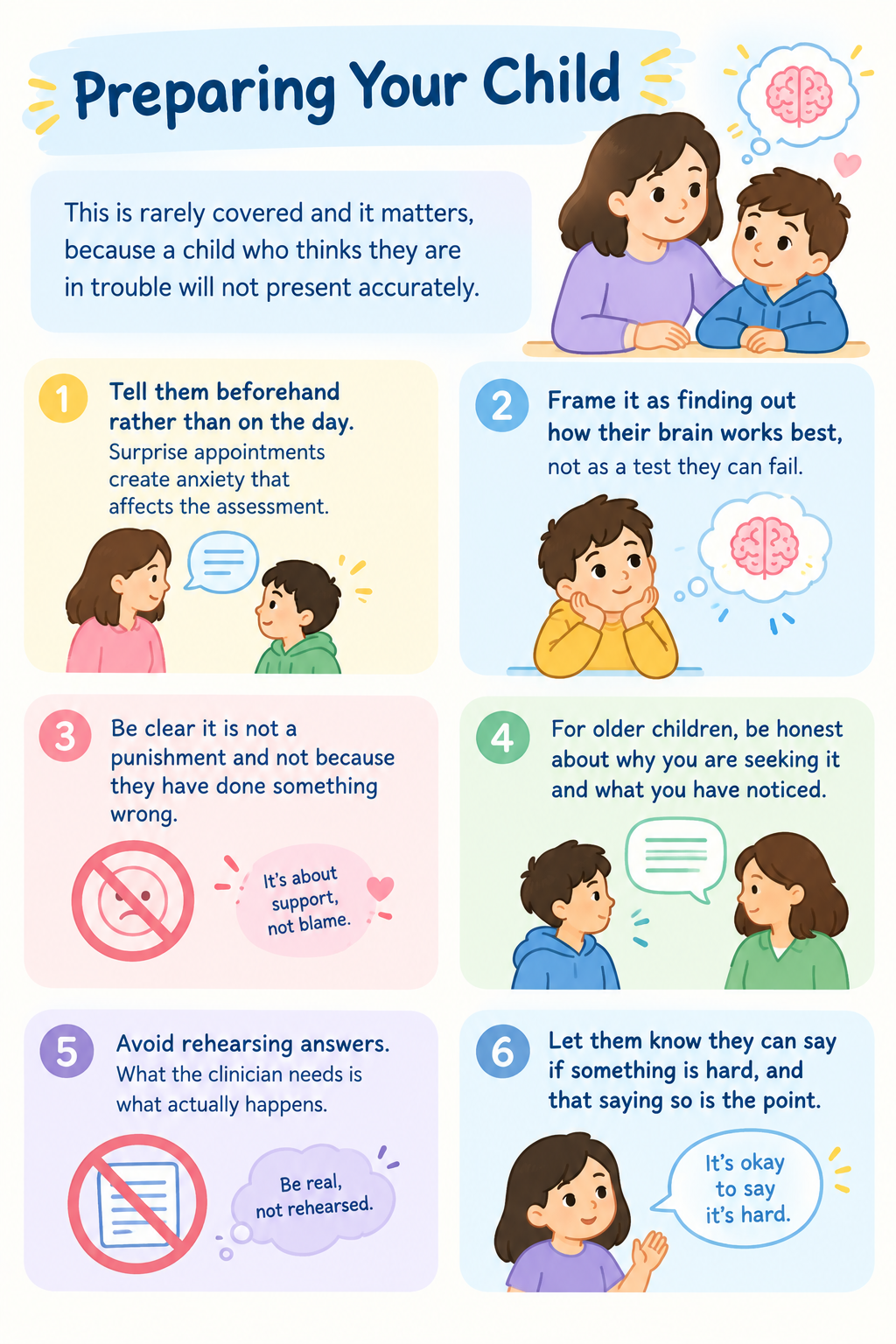
This is rarely covered and it matters, because a child who thinks they are in trouble will not present accurately.
- Tell them beforehand rather than on the day. Surprise appointments create anxiety that affects the assessment
- Frame it as finding out how their brain works best, not as a test they can fail
- Be clear it is not a punishment and not because they have done something wrong
- For older children, be honest about why you are seeking it and what you have noticed
- Avoid rehearsing answers. What the clinician needs is what actually happens
- Let them know they can say if something is hard, and that saying so is the point
For teenagers specifically
Adolescents often resist assessment because they read it as being labelled. It helps to involve them in the decision rather than presenting it as settled, and to be clear that the outcome is information rather than a verdict. A teenager who feels assessed against their will is less likely to report accurately.
What to Bring
- School reports across several years, including the written comments
- Any previous assessments, even for something else
- A list of current medicines and relevant medical or developmental history, including previous diagnoses
- Notes on what happens, how often, in which settings, and what the consequence is
- A record of what you have already tried and whether it helped
- Information about family history, since ADHD runs strongly in families
- Details of sleep, since sleep difficulties in children can present as inattention and increased activity
Specific examples carry more weight than descriptions of traits. Homework takes two hours with an adult sitting beside them tells a clinician more than they find homework hard.
While You Are Waiting
Support does not have to wait for a diagnosis. Many classroom adjustments can be discussed based on observed need, and it is worth asking the school what is available now: seating, chunked instructions, extra time, movement breaks, or a written record of homework. Structure, routine and clear expectations help many children regardless of what an assessment eventually finds.
What Happens After the Assessment
Depending on the service, you may receive a written assessment report setting out the findings, whether ADHD criteria were met, the symptom profile, functional impacts and recommendations.
The recommendations section is the part parents most often underuse. It typically includes suggestions for school, and it is the document that supports a conversation about adjustments.
- Share the report, or the relevant sections, with the school rather than assuming they will ask
- Request a meeting to discuss what adjustments are available
- Ask how any agreed adjustments will be recorded and reviewed
- Keep a copy, since it will be relevant again at transitions such as changing schools
Where a child has a disability, the Disability Standards for Education 2005 provide a framework for reasonable adjustments and participation in education. The specific adjustments available depend on the student’s circumstances and the education provider’s processes.
If the Assessment Does Not Identify ADHD
This is a common and valid outcome, and it is not a dismissal.
Assessment considers other conditions that may explain or accompany the difficulties, including learning and language difficulties, sleep problems, anxiety and mood difficulties, autism, intellectual disability, hearing difficulties and, where clinically relevant, other neurological conditions. A clear answer about what is happening is more useful than continuing to wonder.
Related Guides
- Online ADHD tests in Australia
- Do I have ADHD? Making sense of your own symptoms
- What causes ADHD: genetics, brain development and environment
- Free Adhd Test Adults
- The Full Symptom Picture of ADHD.
References
- Australian ADHD Professionals Association. Australian Evidence-Based Clinical Practice Guideline for Attention Deficit Hyperactivity Disorder (ADHD). Released October 2022. Sections on assessment and diagnosis. adhdguideline.aadpa.com.au
- Healthdirect Australia. Attention deficit hyperactivity disorder (ADHD). healthdirect.gov.au
- Australian Psychological Society. How is ADHD assessed in children? psychology.org.au
- Royal Children’s Hospital Melbourne. Attention deficit hyperactivity disorder (ADHD). Kids Health Info. rch.org.au
- Disability Standards for Education 2005 (Cth). legislation.gov.au
- American Psychiatric Association. Diagnostic and Statistical Manual of Mental Disorders, Fifth Edition, Text Revision (DSM-5-TR). 2022.
Last reviewed: September 2026. Next scheduled review: September 2027. This article is general information and is not a substitute for individual medical advice, assessment or diagnosis.