

Can You Drive With ADHD in Australia?
Yes. ADHD is not an automatic barrier to holding a licence. Australia’s Assessing Fitness to Drive standards name ADHD and assess it under the general framework for psychiatric conditions, based on an individual’s actual functional impairment rather than the diagnosis alone. Research does associate ADHD with elevated crash risk, which is a reason to take specific precautions rather than to stop driving. Reporting requirements differ by state and territory; check with your own licensing authority.
Driving relies heavily on sustained attention through repetitive stretches, quick shifting when conditions change, planning and impulse control. Those are areas that can be affected in some people with ADHD, though the effects vary considerably from person to person. This guide covers what the evidence actually shows, how Australian licensing works, and what helps. For the wider adult picture, see the guide to ADHD in adults.
What the Evidence Shows
Research does associate ADHD with elevated crash risk, and Australia’s clinical guideline lists risky driving among the functional impacts associated with ADHD in adulthood (Australian ADHD Professionals Association, 2022). Searches about ADHD car accidents usually come back to one question: how much higher is the risk? The size of that association is smaller than the figures that circulate online, and it depends heavily on how the research was done.
What research shows
The most widely cited synthesis is a meta-analysis of 16 studies, pooling 32 results, published in Accident Analysis and Prevention. It found a relative crash risk of 1.36 for drivers with ADHD compared with drivers without it, falling to 1.23 once the analysis controlled for exposure, meaning once it accounted for how much each group actually drove (Vaa, 2014). That is an increase, and it is a modest one.
That meta-analysis is also useful for what it corrects. The often-repeated claim that drivers with ADHD carry close to a fourfold crash risk traces back to a misreading of a single 1993 study, in which the elevated risk reflected co-occurring oppositional defiant and conduct disorder rather than ADHD itself. In the pooled data, drivers with ADHD and a co-occurring disorder showed a relative risk of 1.86, while drivers with ADHD alone showed 1.31 (Vaa, 2014). Co-occurring conditions carry a meaningful part of the risk that often gets attributed to ADHD on its own.
A 2026 systematic review and meta-analysis in Advances in Therapy pooled four studies and reported roughly 93 per cent higher odds of motor vehicle accidents among adults with diagnosed but untreated ADHD compared with controls. The authors reported significant heterogeneity between the included studies, and the review did not include a formal risk-of-bias assessment, a structured grading of evidence certainty, or sensitivity and subgroup analyses. It shows an association within the studies it included rather than establishing that a lack of treatment itself causes crashes.
An example from newer naturalistic research
One recent study measured driving directly rather than relying on self-report or licensing records. Using data from the Longitudinal Research on Aging Drivers project, researchers followed 2,832 drivers aged 65 to 79 for up to 44 months, using in-vehicle recording devices alongside annual assessments. Compared with drivers without ADHD, drivers with ADHD in this older cohort showed:
- 74 per cent higher risk of a vehicle crash, at 27 versus 13.5 crashes per million miles driven
- 102 per cent higher risk of a traffic ticket, at 22 versus 10 per million miles driven
- 7 per cent higher risk of hard-braking events
The limits of that study matter as much as its findings. Only 75 of the 2,832 participants had an ADHD diagnosis, so the ADHD subgroup is small, and the participants were older United States drivers rather than adults with ADHD generally. It is best read as an example of newer naturalistic evidence in an age group research had largely skipped, not as the headline figure for ADHD crash risk overall. These are population-level associations rather than predictions about any individual driver.
What this means in practice
An elevated group-level risk is a reason to drive deliberately and to address the specific contributors, in the same way that knowing fatigue raises crash risk is a reason to manage fatigue rather than to stop driving. Driving with ADHD is not inherently unsafe, effects vary considerably between individuals, and most of the contributing factors below can be reduced.
| Question | What the evidence and standards say |
| Does ADHD affect driving? | It can affect sustained attention, planning, emotional regulation and impulse control |
| Is crash risk higher? | Pooled research finds an association with increased risk, in the order of 1.2 to 1.4 times |
| Does everyone with ADHD drive less safely? | No. Effects vary considerably between individuals |
| Does an ADHD diagnosis remove a licence? | No |
| Is ADHD named in Australia’s standards? | Yes, within the psychiatric conditions chapter of Assessing Fitness to Drive |
| Are there separate ADHD licensing criteria? | No. Assessment follows the general psychiatric conditions framework |
| Are commercial standards different? | Yes. A higher threshold generally applies |
| Does sleep matter? | Yes. Excessive daytime sleepiness can impair driving independently of ADHD |
Why ADHD Affects Driving
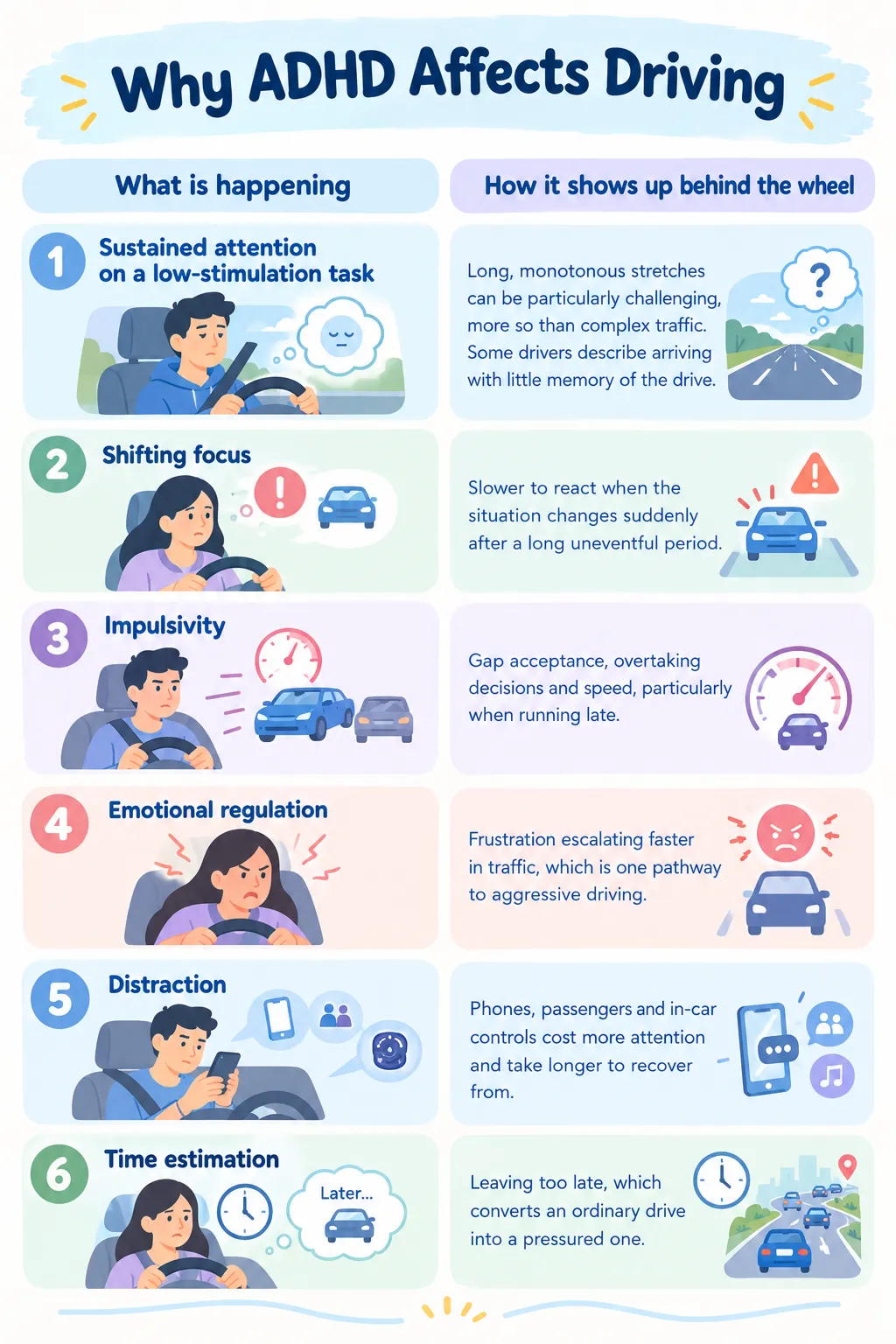
Australia’s Assessing Fitness to Drive standards identify the relevant difficulties directly. People with ADHD may be more prone to angry, aggressive and risky driving behaviour, and may have difficulty with planning, organising and prioritising tasks and with sustaining or shifting focus (Austroads).
| What is happening | How it shows up behind the wheel |
| Sustained attention on a low-stimulation task | Long, monotonous stretches can be particularly challenging, more so than complex traffic. Some drivers describe arriving with little memory of the drive |
| Shifting focus | Slower to react when the situation changes suddenly after a long uneventful period |
| Impulsivity | Gap acceptance, overtaking decisions and speed, particularly when running late |
| Emotional regulation | Frustration escalating faster in traffic, which is one pathway to aggressive driving |
| Distraction | Phones, passengers and in-car controls cost more attention and take longer to recover from |
| Time estimation | Leaving too late, which converts an ordinary drive into a pressured one |
Signs ADHD may be affecting your driving
None of these is diagnostic on its own, and everyone has an occasional bad drive. A pattern of them is worth taking seriously, and worth raising with your GP or treating clinician, who will also consider your driving history and your actual driving needs.
- Repeated near misses, or near misses you only register afterwards
- Speeding you did not intend and did not notice at the time
- Traffic infringements accumulating rather than happening occasionally
- Little memory of familiar stretches on a route you drive often
- Repeated lane drift or lane errors
- Phone and in-car distraction incidents that keep recurring despite intending to stop
- Continuing to drive while clearly sleepy rather than stopping
- Anger escalating quickly in ordinary traffic
- More than one minor collision within a short period
Falling Asleep While Driving
ADHD and falling asleep while driving is one of the most searched ADHD driving questions, and it deserves a direct answer. ADHD falling asleep while driving is a serious safety issue, and it is not something to manage with willpower or coffee.
If you are falling asleep while driving:
Do not continue driving. Stop somewhere safe as soon as you can. Recurring excessive daytime sleepiness is a reason for medical assessment rather than a problem to work around at the wheel.
Several things stack up here. Sleep problems are common alongside ADHD: a 2024 study of 3,691 adults attending a specialist ADHD clinic found that around 60 per cent screened positive for at least one sleep disorder, most often delayed sleep phase syndrome, insomnia and restless legs. That was a specialist clinic population rather than a general one, so it is not a prevalence figure for everyone with ADHD, but it does show how often the two occur together. Long, monotonous drives can make sustained alertness particularly difficult, especially for a driver who is already fatigued. Untreated sleep disorders such as obstructive sleep apnoea also occur alongside ADHD and independently cause daytime sleepiness.
- Falling asleep while driving, or micro-sleeps you notice afterwards, is a reason to see a GP rather than to adjust your driving habits
- Ask specifically about sleep assessment. Daytime sleepiness that persists despite adequate time in bed is not explained by ADHD alone
- Do not drive when you have had materially less sleep than usual. Fatigue impairs driving in ways drivers consistently underestimate
- Stopping to sleep is the only thing that reverses fatigue. Fresh air, radio and caffeine delay it briefly at best
Licensing: Assessing Fitness to Drive
Australia’s national medical standards for driver licensing are set out in Assessing Fitness to Drive, published by Austroads and applied by each state and territory licensing authority.
- ADHD is named explicitly in the psychiatric conditions section of the standards
- Austroads includes additional information on assessing ADHD within the psychiatric conditions chapter, but does not set separate ADHD-specific licensing criteria. Assessment follows the general psychiatric conditions framework, which is individualised and based on a person’s actual functional impairment rather than on a diagnosis by itself
- The standards note these impairments are particularly important for commercial vehicle drivers, who are assessed against a higher threshold generally
- Where a person is prescribed medication for ADHD, the standards indicate that this should be stated in the advice provided to the driver licensing authority
The practical implication is that having ADHD does not by itself put a licence at risk. What is assessed is whether, in your case, the functional effects of the condition affect your ability to drive safely, alongside your medical and driving history and your actual driving needs.
The current edition of Assessing Fitness to Drive is the 2022 standard. The National Transport Commission has begun a review of the standards running from 2026 to 2028, with Austroads supporting the process on behalf of member agencies, so some details may change. Check the current edition and your licensing authority’s guidance rather than relying on any summary, including this one.
Do I have to tell the licensing authority?
Austroads states that drivers have a legal responsibility to report to their driver licensing authority any health condition or disability that may affect their ability to drive safely. How that responsibility is implemented, including the forms, thresholds and review processes, is administered by each state and territory. Because the detail differs by jurisdiction and changes over time, this article does not attempt to state the rule for where you live.
- Check the current requirements with your own state or territory driver licensing authority, which Austroads lists alongside the standards
- Ask your treating clinician what they advise in your circumstances; they are also the person who would provide advice to the authority if it is needed
- Insurance can be affected by whether obligations were met, so this is worth resolving properly rather than leaving unclear
- Commercial and heavy-vehicle drivers should assume the requirements are stricter and check before it becomes an issue
This is general information, not legal advice or a fitness-to-drive assessment.
Does ADHD medication affect driving?
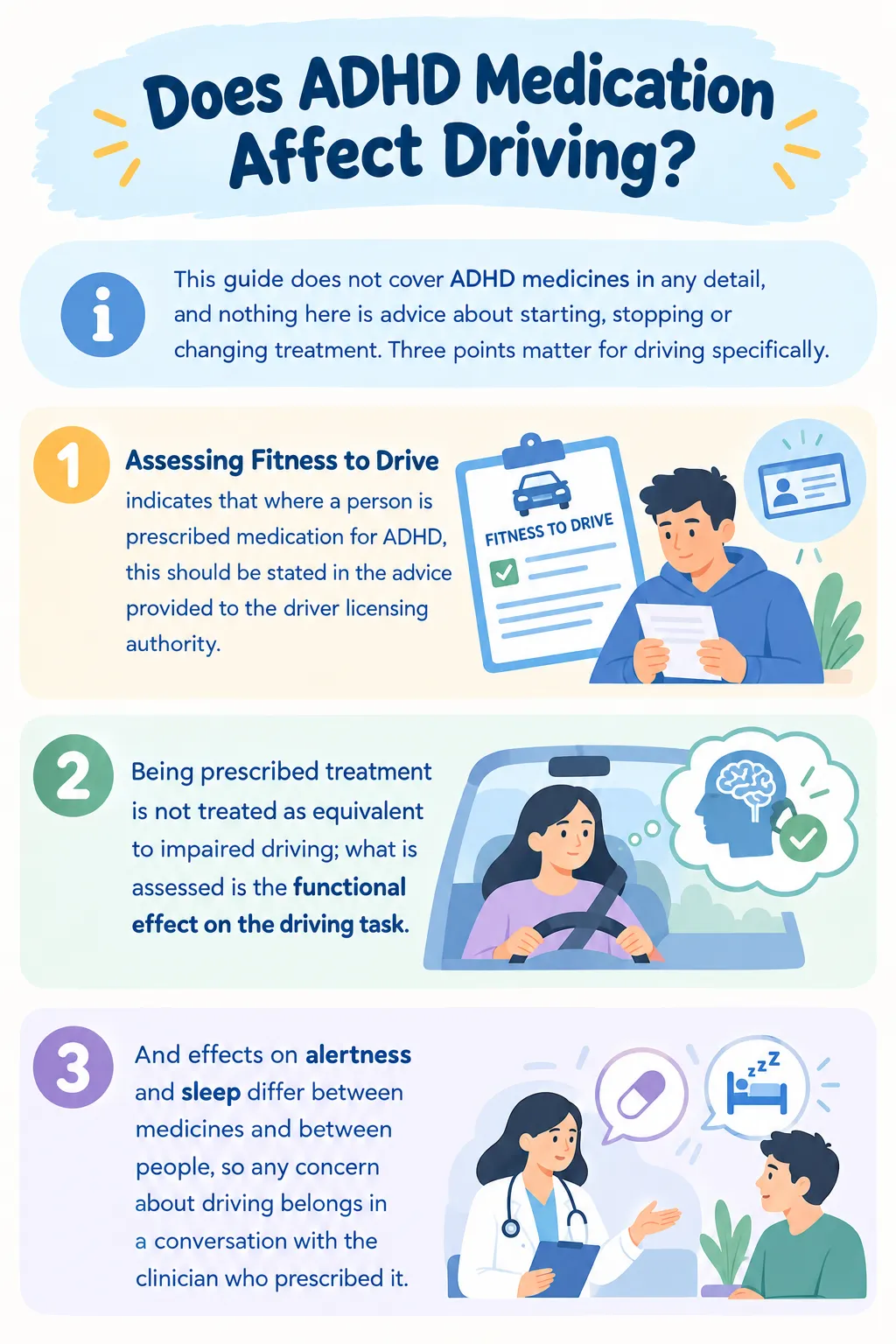
This guide does not cover ADHD medicines in any detail, and nothing here is advice about starting, stopping or changing treatment. Three points matter for driving specifically. Assessing Fitness to Drive indicates that where a person is prescribed medication for ADHD, this should be stated in the advice provided to the driver licensing authority. Being prescribed treatment is not treated as equivalent to impaired driving; what is assessed is the functional effect on the driving task. And effects on alertness and sleep differ between medicines and between people, so any concern about driving belongs in a conversation with the clinician who prescribed it.
For what treatment involves more generally, see the guide to ADHD treatment in Australia.
What Actually Helps
- Leave earlier than feels necessary. Time pressure contributes to a lot of risky decisions, and it is among the most controllable factors on this list
- Phone out of reach and on do-not-disturb before you start, not once you are moving
- Use navigation even on familiar routes, because the prompts provide external structure on exactly the drives where attention drifts most
- Break long drives with real stops, planned in advance rather than taken when you notice you need one
- Keep the car set up before driving: everything you need within reach, nothing needing to be found at 100 kilometres per hour
- Notice the frustration escalation early. If traffic is winding you up, that is the point to lengthen following distance deliberately
- Treat sleep as a driving issue, because it is the single biggest modifiable contributor here
Learner and provisional drivers
Young drivers already carry elevated crash risk from inexperience, and ADHD may add to it. Extra supervised practice beyond the logged minimum, deliberate exposure to varied conditions, and honest conversations about phones and passengers tend to be worth more than a restriction imposed without explanation. For families, this is a topic to raise before the licence rather than after an incident.
Everyday Safety Beyond Driving
The same mechanisms show up elsewhere, usually in small ways that matter more in aggregate than individually.
- Kitchen and appliance safety, where leaving something on is a working-memory failure rather than carelessness
- Keys, wallets and documents, where a consistent single location removes most of the problem
- Medication and appointment schedules, where external systems work and intention does not
- Crossing roads and cycling while distracted, which is the same attention issue without the vehicle around you
The general principle is the one that applies everywhere in ADHD: build the safeguard into the environment so it does not depend on you remembering at the moment it matters.
If you are concerned that ADHD is affecting your driving, discuss your symptoms, your sleep, any prescribed treatment and your driving history with your GP or treating clinician. That conversation is also the right place to work out what, if anything, needs to be reported.
Related Guides
- Impulsivity and hyperactivity in ADHD
- Emotional dysregulation and rejection sensitivity in ADHD
- ADHD in teenagers
- Is ADHD a disability, a disorder or a difference?
References
- Assessing Fitness to Drive for commercial and private vehicle drivers, 2022. Psychiatric conditions chapter, including attention-deficit/hyperactivity disorder and its relevance to the driving task. austroads.gov.au
- Columbia University Mailman School of Public Health. Research on ADHD and motor vehicle crashes in older adult drivers, drawing on the Longitudinal Research on Aging Drivers (LongROAD) project: 2,832 drivers aged 65 to 79 followed for up to 44 months. publichealth.columbia.edu
- Australian ADHD Professionals Association. Australian Evidence-Based Clinical Practice Guideline for Attention Deficit Hyperactivity Disorder (ADHD). Released October 2022. Functional impact in adulthood, including risky driving. adhdguideline.aadpa.com.au
- Healthdirect Australia. Attention deficit hyperactivity disorder (ADHD). healthdirect.gov.au
- Vaa T. ADHD and relative risk of accidents in road traffic: a meta-analysis. Accident Analysis and Prevention, 2014;62:415-425. Sixteen studies, 32 results; relative risk 1.36 overall and 1.23 controlling for exposure.
- The Impact of Untreated Attention-Deficit/Hyperactivity Disorder on Motor Vehicle Accidents: A Systematic Review and Meta-Analysis. Advances in Therapy, 2026. Four pooled studies; significant heterogeneity reported and no formal risk-of-bias assessment.
- van der Ham M, Bijlenga D, Bohmer M, Beekman ATF, Kooij S. Sleep Problems in Adults With ADHD: Prevalences and Their Relationship With Psychiatric Comorbidity. Journal of Attention Disorders, 2024. 3,691 adults attending a specialist clinic.
- National Transport Commission and Austroads. Review of the Assessing Fitness to Drive standards, 2026 to 2028. austroads.gov.au
Last reviewed: September 2026. Next scheduled review: September 2027. This article is general information and is not a substitute for individual medical advice, assessment or diagnosis.