

Can an Online ADHD Test Diagnose ADHD?
No. Online ADHD tests are screening tools. They can help identify whether further assessment may be appropriate, but they cannot establish an ADHD diagnosis. Diagnosis requires a broader clinical assessment of symptoms, developmental history, functional impact and other possible explanations, conducted by an appropriately trained clinician (Australian ADHD Professionals Association, 2022).
An ADHD test usually means an ADHD questionnaire that asks about symptoms associated with attention, hyperactivity and impulsivity. The important question is not simply what score you receive, but what that score can, and cannot, tell you.
This guide covers what online ADHD tests measure, how to read a result, which instruments clinicians use, and how ADHD assessment works in Australia.
ADHD Test vs ADHD Assessment: What Is the Difference?
An ADHD test usually refers to a screening questionnaire or another individual measure. An ADHD assessment is the broader clinical process used to determine whether ADHD criteria are met and whether another condition may better explain the symptoms.
A screening test can be one component of an assessment, but it is not equivalent to an assessment. Australia’s clinical guideline states that rating scales are useful adjuncts but should not be used alone to diagnose ADHD (Australian ADHD Professionals Association, 2022).
Screening Is Not Diagnosis
| Screening | Diagnostic assessment | |
| Purpose | Identifies whether further assessment may be warranted | Determines whether diagnostic criteria are met |
| Typical input | Self-report or informant responses | Clinical interview, developmental history, rating scales, functional impact and other relevant information |
| Output | A screening result | A clinical diagnosis, or another explanation |
| Alternative explanations | Not adequately assessed | Considered as part of assessment |
| Can it diagnose ADHD? | No | Yes, when conducted by an appropriately trained clinician |
A positive screening result means your responses meet the threshold used by that screening tool for further assessment. It does not establish that ADHD is the cause of those symptoms.
What Does an Online ADHD Test Actually Measure?
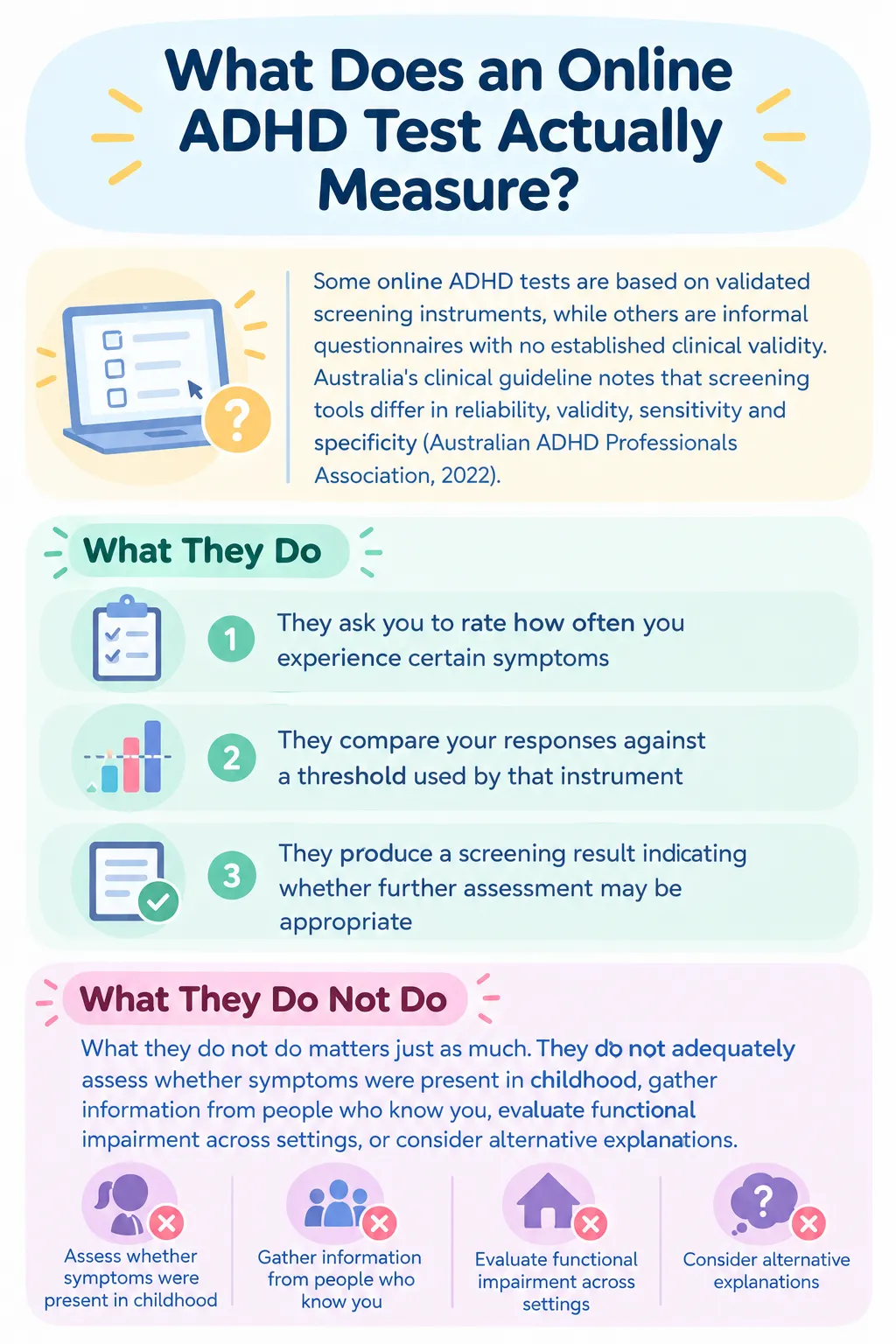
Some online ADHD tests are based on validated screening instruments, while others are informal questionnaires with no established clinical validity. Australia’s clinical guideline notes that screening tools differ in reliability, validity, sensitivity and specificity (Australian ADHD Professionals Association, 2022).
- They ask you to rate how often you experience certain symptoms
- They compare your responses against a threshold used by that instrument
- They produce a screening result indicating whether further assessment may be appropriate
What they do not do matters just as much. They do not adequately assess whether symptoms were present in childhood, gather information from people who know you, evaluate functional impairment across settings, or consider alternative explanations.
What Does an ADHD Test Score Mean?
A screening score tells you how your responses compare with the threshold used by that particular instrument. It does not represent the percentage chance that you have ADHD.
A score of 80 percent does not mean an 80 percent chance of ADHD
Some online tests present results as a likelihood or percentage of having ADHD. Screening instruments do not produce probabilities of diagnosis, and a result framed that way should be treated with caution.
The score can be useful background information, but it is only one part of assessment. Your developmental history, current symptoms, functional impact and other relevant information are usually more important for determining what the result means clinically.
Can an ADHD Test Be Wrong?
Yes, in both directions. Australia’s clinical guideline explicitly identifies false positives and false negatives as limitations of ADHD screening tools (Australian ADHD Professionals Association, 2022).
False positive
A false positive occurs when a person screens positive but does not ultimately meet diagnostic criteria for ADHD. This can happen because ADHD symptoms overlap with other conditions and circumstances, including anxiety, depression, sleep problems and other mental health or medical conditions.
False negative
A false negative occurs when a person screens below the threshold even though a full assessment may later identify ADHD. Self-report screening can miss difficulties when symptoms are under-reported, compensated for, interpreted differently by the person completing the questionnaire, or less obvious in their current environment.
A screening score is not a definitive rule-out test. If you have persistent difficulties that affect functioning, particularly if your experiences are not well captured by the questionnaire, discuss them with a clinician even if the online result was below the screening threshold.
How Accurate Are ADHD Screening Tests?
Even a validated ADHD screener does not have one universal accuracy rate. Sensitivity and specificity can vary depending on the population being screened and the clinical context. Australia’s clinical guideline notes that screening performance can differ across clinical groups, including people with depression, substance use disorders and bipolar disorder (Australian ADHD Professionals Association, 2022).
Why Can an Online ADHD Test Feel Extremely Accurate?
ADHD screening questions describe common difficulties such as losing focus, procrastinating, forgetting tasks, interrupting or struggling with organisation. These experiences can occur for many reasons, so recognising yourself in a questionnaire does not establish the underlying cause.
That recognition is worth taking seriously as a prompt. It is not evidence of a diagnosis.
Which ADHD Screening Tools Are Used?
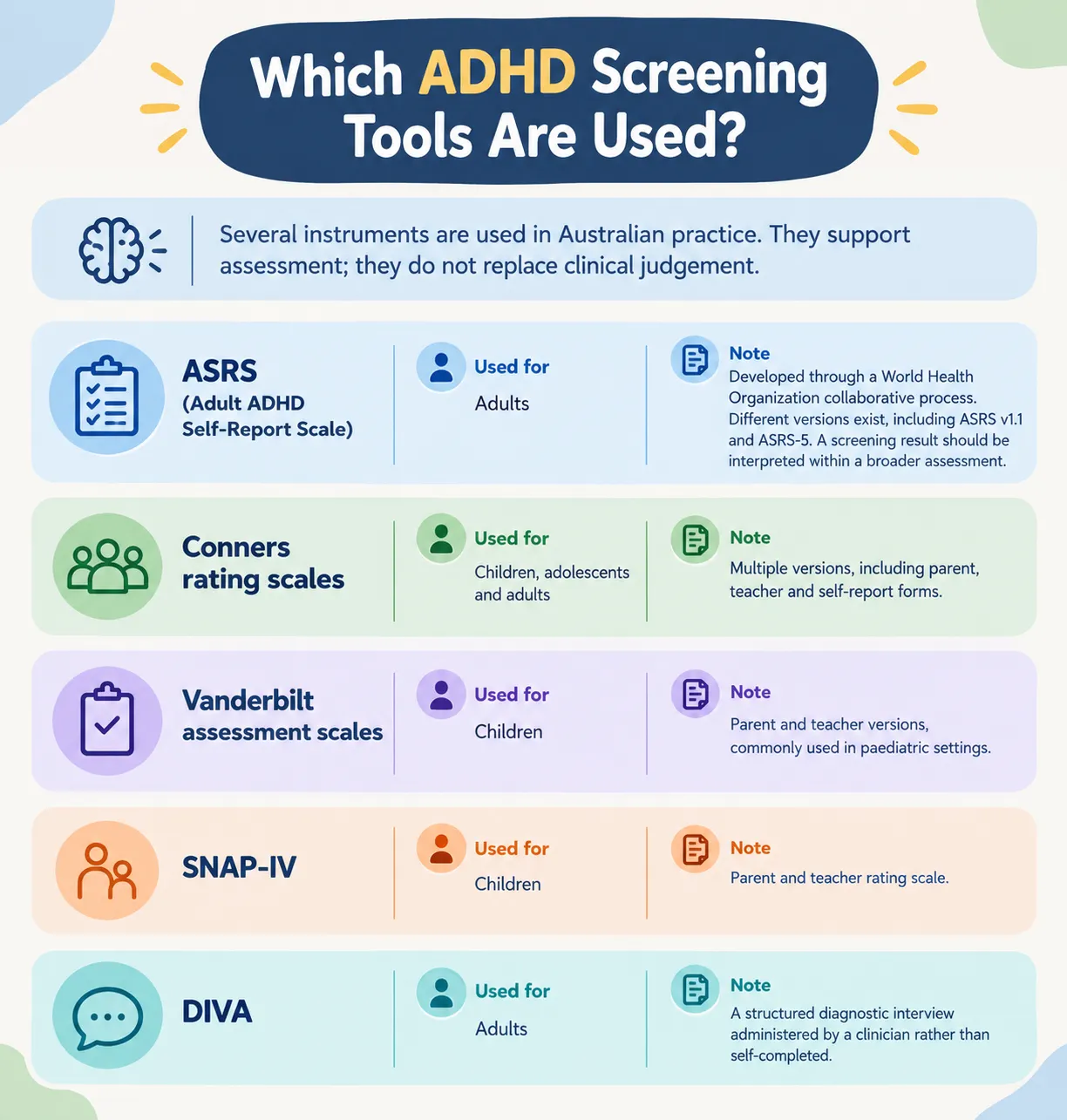
Several instruments are used in Australian practice. They support assessment; they do not replace clinical judgement.
Our guide to ADHD rating scales covers what each instrument measures and how results are used.
Can Computerised Attention Tests Diagnose ADHD?
No. Some services offer computerised tasks, sometimes described as objective ADHD testing. These tests measure performance on specific computer-based tasks involving attention, response control or related cognitive processes.
They cannot establish whether a person’s difficulties represent ADHD across everyday settings. Australia’s clinical guideline states that computerised cognitive assessments, neuroimaging and EEG do not increase diagnostic accuracy beyond appropriate clinical assessment and rating scales (Australian ADHD Professionals Association, 2022). No questionnaire, app, computerised attention task or brain scan can establish an ADHD diagnosis on its own.
Is There a Free ADHD Test Online?
Yes. Some validated ADHD screening questionnaires are available without payment. However, free does not mean diagnostic.
Before completing an online questionnaire, check which instrument it uses, who provides it, how your information is handled and whether the result is clearly described as a screening result rather than a diagnosis. Our guide to free ADHD tests for adults covers which screeners are genuinely validated, including the main ADHD test for adults options.
What Should You Check Before Taking an Online ADHD Test?
| Check | Why it matters |
| Named instrument | Lets you identify what is actually being measured |
| Validation information | Helps distinguish established tools from informal quizzes |
| Clear screening disclaimer | Prevents diagnostic misunderstanding |
| Privacy information | Shows how your responses are handled |
| No unnecessary data collection | Screening does not require your address or phone number |
| Clear next steps | Helps you interpret the result appropriately |
| Transparent provider | Establishes accountability for the content |
| No forced purchase | A validated screener has no reason to withhold your result |
What Should You Do With Your ADHD Test Result?
Treat a positive result as a prompt rather than an answer.
- Book a GP appointment, ideally a longer one, and say what you want to discuss when you book.
- Write down specific examples rather than traits: what happens, how often, in which settings, and what the consequence is.
- Gather anything from childhood you can, such as school reports or what a parent remembers.
- Note what you have already tried, and whether it helped.
- Bring the screening result if you like, and expect the conversation to cover your history as well.
How to Get Tested for ADHD in Australia
For most people the pathway starts with a GP, who can discuss your history, consider other explanations and identify appropriate referral options.
Who can assess ADHD in Australia depends on your age, location, clinician qualifications and the purpose of the assessment. Psychiatrists, paediatricians and psychologists may be involved in ADHD assessment, while the role of appropriately trained GPs can vary by jurisdiction and current regulatory arrangements.
Check the current position where you live
Australian ADHD assessment arrangements have been changing and differ between states and territories. Check the current requirements in your state or territory before booking an assessment.
Depending on your history and symptoms, a clinician may consider medical assessment or investigations if there is reason to look for another condition contributing to the difficulties. These investigations are not a diagnostic test for ADHD itself.
What Happens During an ADHD Assessment?
- A detailed developmental and personal history, including whether symptoms were present before age 12, even if the person was not diagnosed during childhood
- Standardised rating scales completed by you, and often by a parent, partner or someone who has known you a long time
- Evidence about how difficulties present across more than one setting
- Assessment of functional impact across social, academic, occupational and daily-life functioning
- Consideration of alternative and co-occurring explanations, including anxiety, depression, sleep disorders, trauma, autism and specific learning disorders
Is there one test for ADHD?
No. ADHD does not have a single blood test, brain scan or questionnaire that can establish the diagnosis. Assessment involves a broader clinical evaluation of symptoms, developmental history, functional impact and other possible explanations.
Is ADHD Testing Different for Adults and Children?
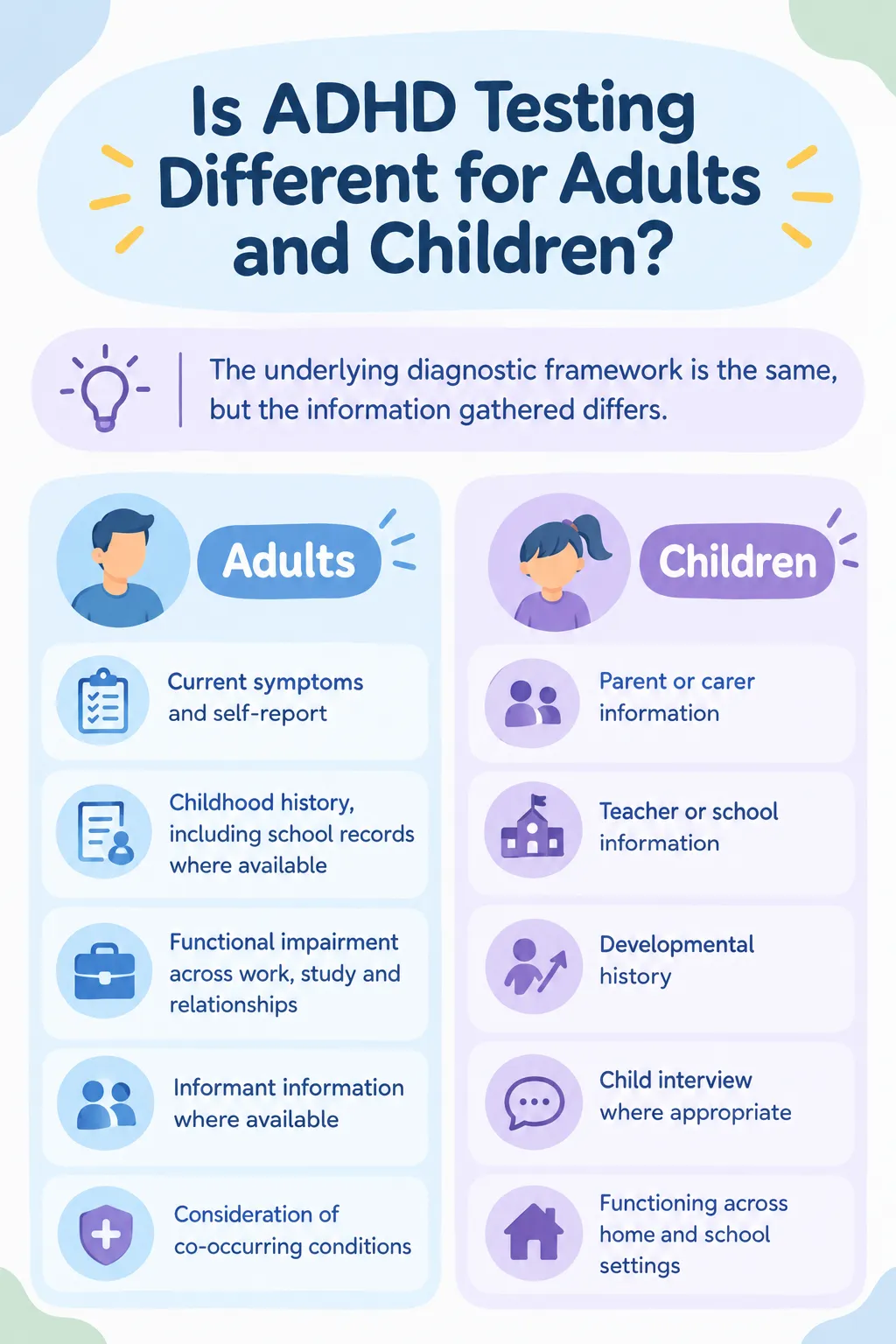
The underlying diagnostic framework is the same, but the information gathered differs.
| Adults | Children |
| Current symptoms and self-report | Parent or carer information |
| Childhood history, including school records where available | Teacher or school information |
| Functional impairment across work, study and relationships | Developmental history |
| Informant information where available | Child interview where appropriate |
| Consideration of co-occurring conditions | Functioning across home and school settings |
Assessment of children usually draws on information from multiple sources, including the child, parents or carers, and teachers or others who observe the child in different settings. Our guide to ADHD testing for children and teens covers what to expect.
Related Guides
- Do I have ADHD? Making sense of your own symptoms
- ADHD test for women
- ADHD test for children and teens
- ADHD symptoms the full symptom picture
- ADHD, IQ, intelligence and giftedness
References
- Australian ADHD Professionals Association. Australian Evidence-Based Clinical Practice Guideline for Attention Deficit Hyperactivity Disorder (ADHD). Released October 2022. Sections on screening and identification, and on assessment and diagnosis. adhdguideline.aadpa.com.au
- Kessler RC, Adler L, Ames M, et al. The World Health Organization Adult ADHD Self-Report Scale (ASRS): a short screening scale for use in the general population. Psychological Medicine. 2005;35(2):245–256.
- Ustun B, Adler LA, Rudin C, et al. The World Health Organization Adult Attention-Deficit/Hyperactivity Disorder Self-Report Screening Scale for DSM-5. JAMA Psychiatry. 2017;74(5):520–527.
- American Psychiatric Association. Diagnostic and Statistical Manual of Mental Disorders, Fifth Edition, Text Revision (DSM-5-TR). 2022.
- World Health Organization. International Classification of Diseases, 11th Revision (ICD-11). 6A05 Attention deficit hyperactivity disorder. icd.who.int
Last reviewed: September 2026. Next scheduled review: September 2027. This article is general information and is not a substitute for individual medical advice, assessment or diagnosis.