

What Is ADHD Burnout?
ADHD burnout is a community term describing exhaustion that follows sustained effort to compensate for ADHD difficulties. It is not a clinical diagnosis and does not appear in DSM-5-TR or ICD-11. Fatigue is commonly reported by people with ADHD, and it has several possible contributors including sleep difficulties, co-occurring conditions and the cognitive effort of compensation.
ADHD and fatigue come up together constantly, and ADHD tiredness is one of the most commonly reported experiences in the condition. It is also one of the least covered. Symptom lists describe attention and activity. They do not explain why someone with ADHD can be exhausted by a day that looked unremarkable from outside.
This guide covers what ADHD burnout describes, why fatigue and ADHD are so often reported together, what overstimulation involves, and when tiredness points somewhere other than ADHD. That last section matters, because fatigue is a symptom of many things and several of them are treatable.
What ADHD Burnout Describes
ADHD burnout is a descriptive term from ADHD communities rather than clinical literature. It does not appear in DSM-5-TR or ICD-11 (American Psychiatric Association, 2022; World Health Organization, ICD-11), and a clinician cannot diagnose it.
What people describe is a state of depletion following a prolonged period of compensating: masking difficulties, maintaining systems that take effort, working longer than peers for the same output, and managing the consequences of things that slipped. ADHD exhaustion of this kind is described as accumulating rather than arriving, and people often report feeling ADHD exhausted well before they name it.
| Term | Status |
| ADHD burnout | Community term. Not clinical, not diagnostic |
| Occupational burnout | Classified in ICD-11 as an occupational phenomenon rather than a medical condition, and specific to the work context |
| ADHD fatigue | Descriptive. Fatigue itself is a recognised symptom across many conditions |
| Overstimulation | Descriptive. Not part of ADHD diagnostic criteria |
The distinction from occupational burnout is worth noting. ICD-11 defines burnout specifically in relation to chronic workplace stress. What people describe as ADHD burnout is broader, is not limited to work, and is not the same construct.
ADHD Burnout Symptoms People Describe
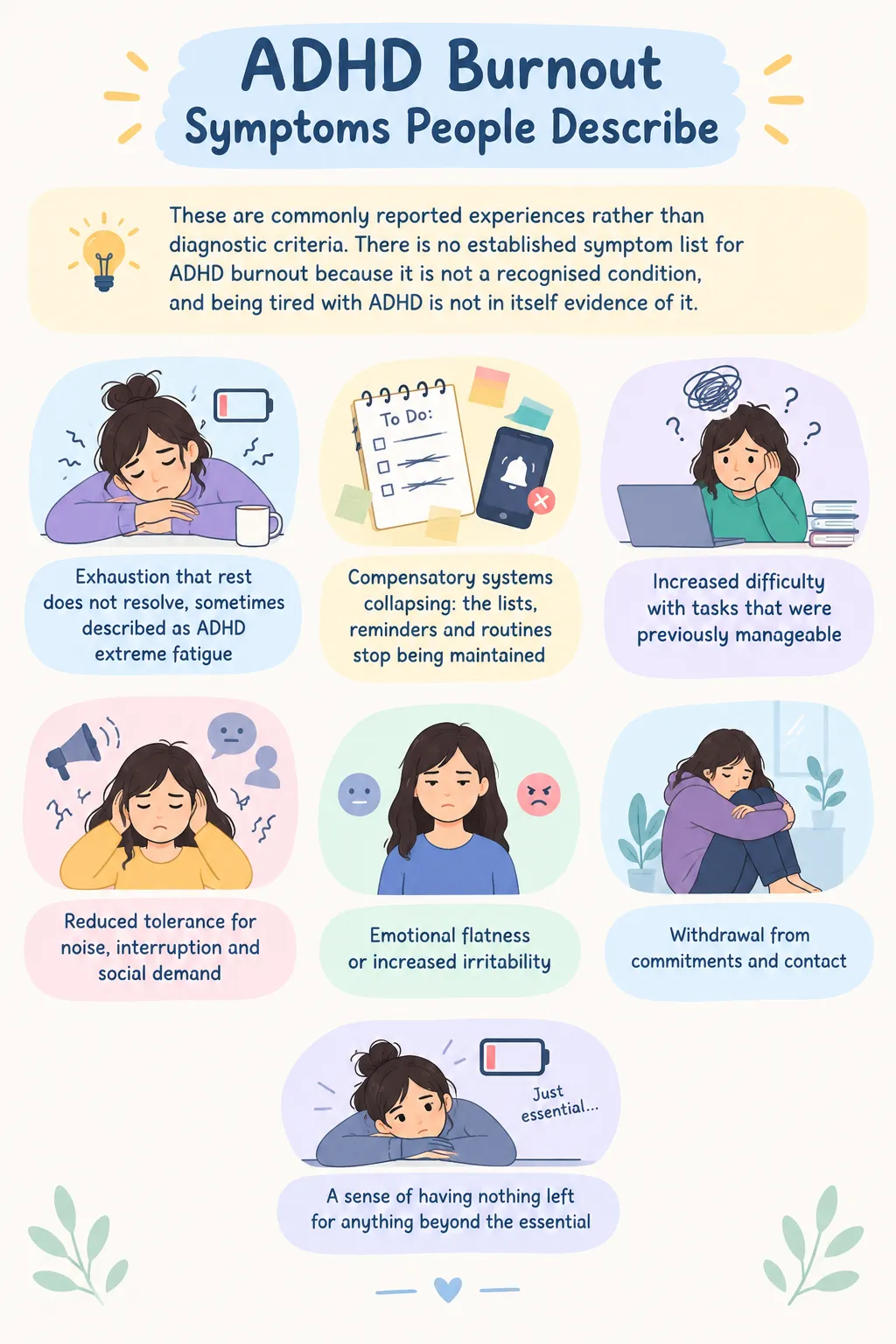
These are commonly reported experiences rather than diagnostic criteria. There is no established symptom list for ADHD burnout because it is not a recognised condition, and being tired with ADHD is not in itself evidence of it.
- Exhaustion that rest does not resolve, sometimes described as ADHD extreme fatigue
- Compensatory systems collapsing: the lists, reminders and routines stop being maintained
- Increased difficulty with tasks that were previously manageable
- Reduced tolerance for noise, interruption and social demand
- Emotional flatness or increased irritability
- Withdrawal from commitments and contact
- A sense of having nothing left for anything beyond the essential
ADHD and exhaustion of this kind can be persistent. Where these features continue, or are accompanied by low mood, hopelessness or loss of interest in things you usually enjoy, that warrants discussion with a clinician. Those features point beyond tiredness ADHD explanations alone.
Why ADHD Fatigue Is So Common
Several factors are proposed as contributors to ADHD and tiredness. These are explanatory models rather than established mechanisms, and more than one usually applies. ADHD lack of energy, ADHD and lethargy and ADHD and tiredness are all described in these terms.
| Contributor | What it involves |
| Cognitive effort of compensation | Producing comparable output through deliberate systems and sustained attention costs more than doing it automatically |
| Sleep difficulties | Sleep difficulties are common in people with ADHD and can independently affect daytime energy, attention and mood (AADPA, 2022; NICE NG87) |
| Co-occurring conditions | Anxiety and depression frequently occur alongside ADHD and both produce fatigue (AADPA, 2022) |
| Emotional load | Managing frustration, self-criticism and the consequences of difficulties uses capacity |
| Irregular routines | Inconsistent sleep, eating and activity patterns affect energy independently |
| Hyperfocus cycles | Intense sessions without breaks, food or water, followed by depletion |
Sleep deserves particular attention because it is both common and addressable. Because sleep affects daytime energy, attention and mood, identifying and addressing sleep difficulties can be an important part of improving daytime functioning (Australian ADHD Professionals Association, 2022).
ADHD Overstimulation and Sensory Load
ADHD overstimulation describes feeling overwhelmed by sensory or cognitive input: noise, activity, conversation, competing demands, or several of these at once.
It is worth being precise here. Sensory sensitivity is not part of the ADHD diagnostic criteria. Sensory hyperreactivity is included among the restricted and repetitive behaviour criteria for autism, and ADHD and autism co-occur frequently, which accounts for part of the overlap. ADHD and sensory issues are commonly discussed together, but the relationship is not the same as it is in autism.
Difficulty managing competing sources of information can be consistent with ADHD, particularly when attention regulation is already demanding. Where that is the case, background noise and activity are harder to screen out, which increases cognitive load and contributes to depletion over a day.
Overstimulation and burnout
People commonly describe reduced tolerance for sensory and social input as one of the earlier signs that capacity is depleted. The tolerance that existed last month is not a fixed quantity.
ADHD Burnout vs Normal Tiredness
Normal tiredness usually follows a recognisable demand and improves with adequate rest. What people describe as ADHD burnout is more often a broader period of depletion after sustained compensation, where ordinary routines and coping systems become harder to maintain.
However, there is no clinical diagnostic test that distinguishes ADHD burnout from ordinary fatigue. The distinction described here is how people use the terms, not a clinical boundary. Persistent or unexplained exhaustion should therefore be assessed rather than assumed to be ADHD-related.
ADHD Burnout Recovery
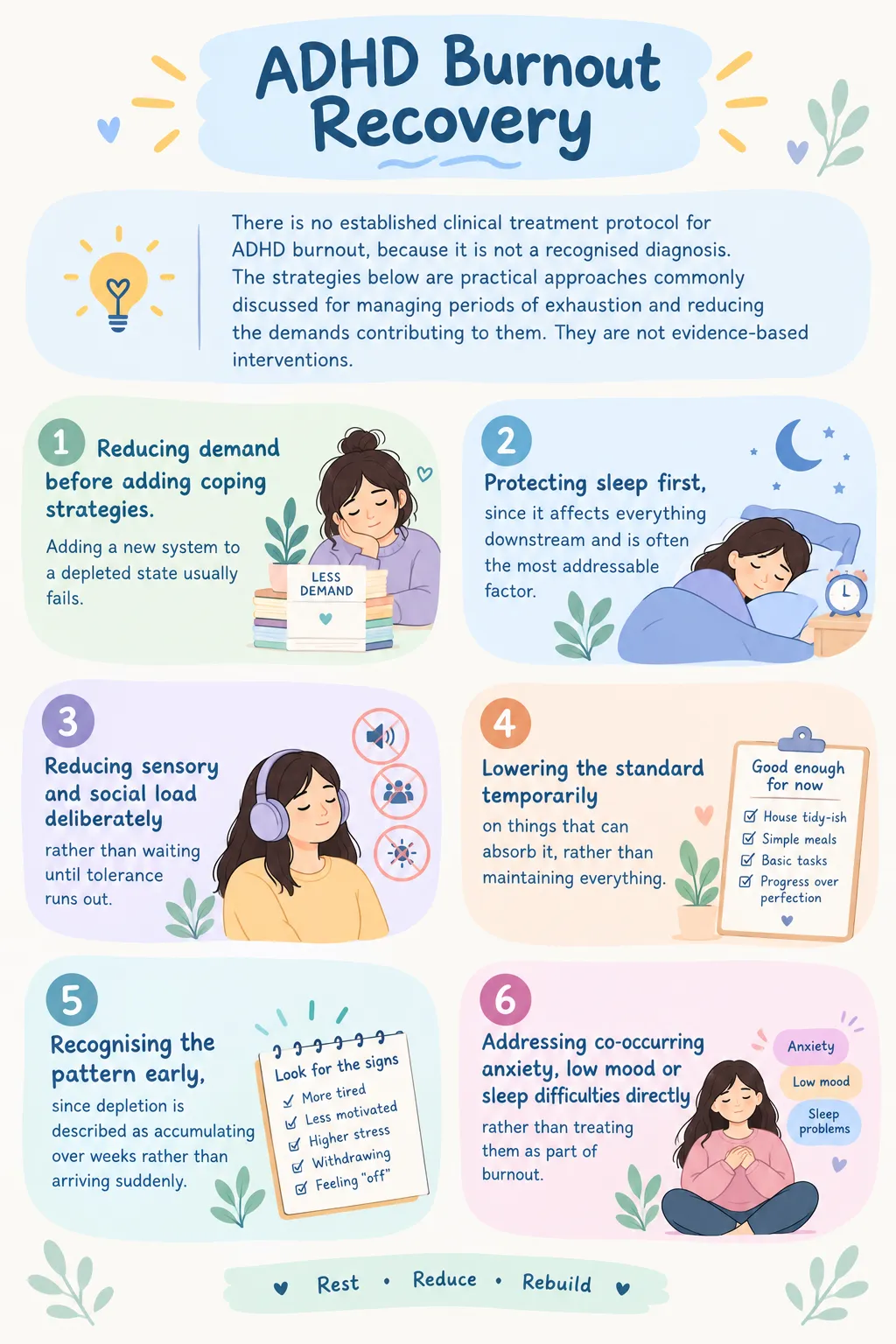
There is no established clinical treatment protocol for ADHD burnout, because it is not a recognised diagnosis. The strategies below are practical approaches commonly discussed for managing periods of exhaustion and reducing the demands contributing to them. They are not evidence-based interventions.
- Reducing demand before adding coping strategies. Adding a new system to a depleted state usually fails
- Protecting sleep first, since it affects everything downstream and is often the most addressable factor
- Reducing sensory and social load deliberately rather than waiting until tolerance runs out
- Lowering the standard temporarily on things that can absorb it, rather than maintaining everything
- Recognising the pattern early, since depletion is described as accumulating over weeks rather than arriving suddenly
- Addressing co-occurring anxiety, low mood or sleep difficulties directly rather than treating them as part of burnout
Where exhaustion is significantly affecting work, study, relationships or daily functioning, that is worth raising with a clinician rather than managing alone. Support options are a matter for you and your treating clinician.
When Fatigue Is Not ADHD Burnout
This is the most important section on this page. Fatigue has many possible causes and several are treatable. Attributing persistent exhaustion to ADHD burnout without assessment risks missing something else.
These patterns overlap considerably and are not diagnostic rules. A clinician considers the full history, duration, severity, functional impact and co-occurring symptoms.
| Possible contributor | Why it matters |
| Depression | Fatigue is a core feature. Loss of interest, low mood and changes in sleep and appetite point here |
| Sleep disorders | Sleep apnoea, insomnia and restless legs are all treatable and all produce daytime exhaustion |
| Iron deficiency or anaemia | Common, easily tested, and a frequent cause of persistent fatigue |
| Thyroid conditions | Produce fatigue, concentration difficulty and mood change. Identified by blood test |
| Chronic fatigue and post-viral conditions | Have distinct features and require specific assessment |
| Other medical causes | Persistent unexplained fatigue warrants medical assessment rather than self-attribution |
If exhaustion has been persistent, has changed recently, or is not explained by circumstances, see a GP. Blood tests and a physical assessment rule out several treatable causes quickly.
ADHD Burnout and Autistic Burnout
Both are community terms and neither is a clinical diagnosis. Autistic burnout is more established in community and some research literature, and is usually described in relation to sustained masking and sensory load. ADHD burnout is described more in relation to sustained compensation for executive difficulties.
For people who are both ADHD and autistic, which is common, the distinction is often academic. What matters is the depletion and what is driving it.
Related Guides
- ADHD paralysis, procrastination and executive dysfunction
- ADHD, emotional dysregulation and rejection sensitivity
- ADHD hyperfocus and hyperfixation
- ADHD symptoms in adults
- Types and severity levels of ADHD
References
- Australian ADHD Professionals Association. Australian Evidence-Based Clinical Practice Guideline for Attention Deficit Hyperactivity Disorder (ADHD). Released October 2022. adhdguideline.aadpa.com.au
- American Psychiatric Association. Diagnostic and Statistical Manual of Mental Disorders, Fifth Edition, Text Revision (DSM-5-TR). 2022.
- World Health Organization. International Classification of Diseases, 11th Revision (ICD-11). QD85 Burnout; 6A05 Attention deficit hyperactivity disorder. icd.who.int
- National Institute for Health and Care Excellence (NICE). Attention deficit hyperactivity disorder: diagnosis and management. NG87.
- World Health Organization. QD85 Burnout. ICD-11 for Mortality and Morbidity Statistics. Classified as an occupational phenomenon, not a medical condition. icd.who.int
- Bijlenga D, Vollebregt MA, Kooij JJS, Arns M. The role of the circadian system in the etiology and pathophysiology of ADHD. ADHD Attention Deficit and Hyperactivity Disorders. 2019;11(1):5–19. doi:10.1007/s12402-018-0271-z
- Hvolby A. Associations of sleep disturbance with ADHD: implications for treatment. ADHD Attention Deficit and Hyperactivity Disorders. 2014;7(1):1–18. doi:10.1007/s12402-014-0151-0
Last reviewed: September 2026. Next scheduled review: September 2027. This article is general information and is not a substitute for individual medical advice, assessment, or diagnosis. If you think you or your child may have ADHD, speak with your GP about a referral pathway.