
What Are ADHD Symptoms in Kids?
The same 18 diagnostic symptoms as at any age, across inattention and hyperactivity-impulsivity. Children require at least six symptoms in a domain, present for six months or more, appearing in more than one setting, and interfering with functioning or development (Australian ADHD Professionals Association, 2022). Diagnosis in very young children is difficult, because high activity and short attention are typical of normal development.
Most parents arrive at this question the same way: a teacher has raised something, or a pattern at home has stopped feeling like a phase. Both are reasonable reasons to look into it.
This guide covers how the diagnostic symptoms present at different ages, what distinguishes them from typical development, why assessment in toddlers is genuinely difficult, and what to do if you are concerned. Search phrasings vary and the question does not: ADHD symptoms in children, signs of ADHD in kids, ADHD kids symptoms, symptoms of ADHD in kids, ADHD in kids symptoms, ADHD in children symptoms, ADHD signs in children, ADHD symptoms in childhood, symptoms of childhood ADHD and signs and symptoms of childhood ADHD all point at the same thing.
What the Criteria Require in Children
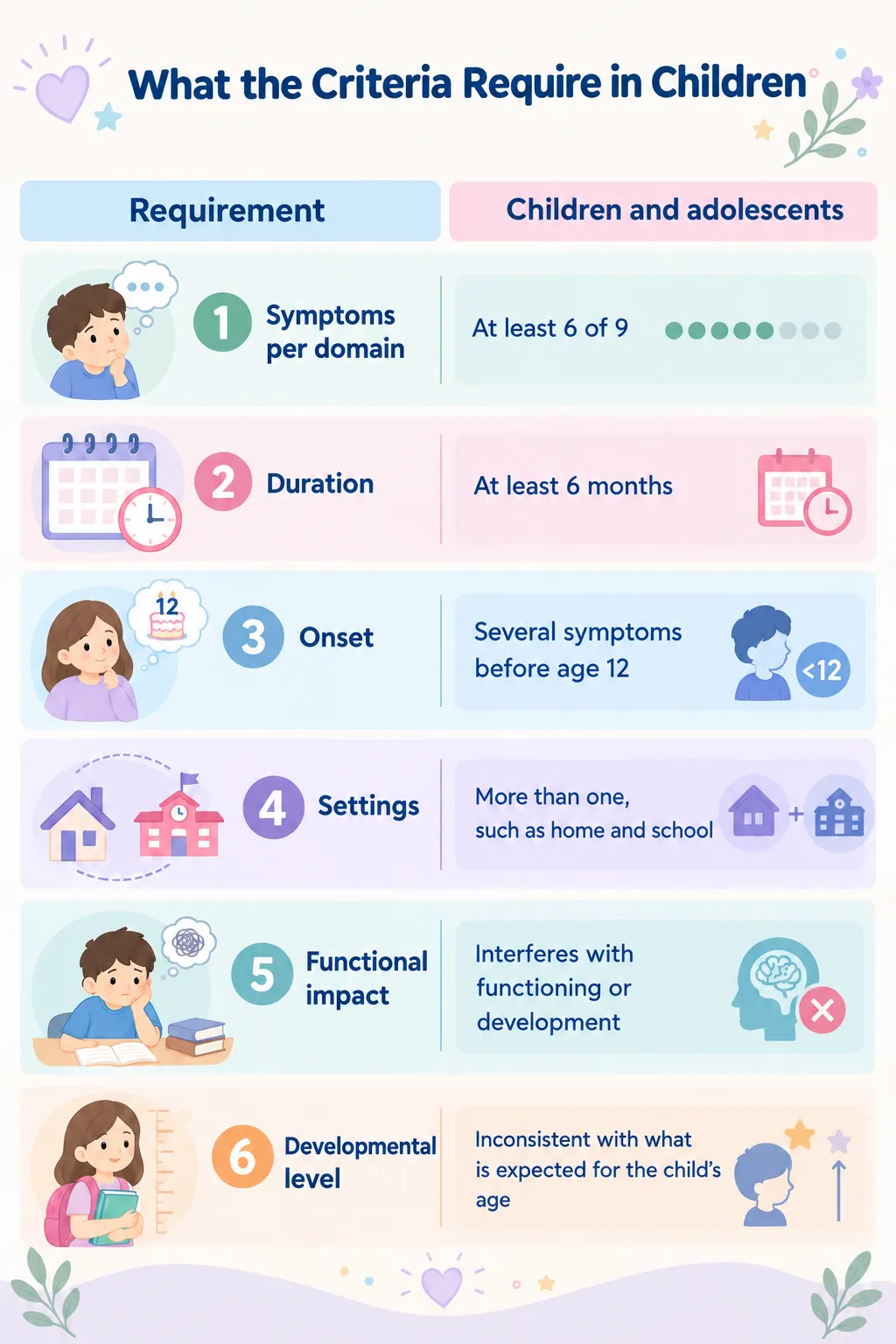
| Requirement | Children and adolescents |
| Symptoms per domain | At least 6 of 9 |
| Duration | At least 6 months |
| Onset | Several symptoms before age 12 |
| Settings | More than one, such as home and school |
| Functional impact | Interferes with functioning or development |
| Developmental level | Inconsistent with what is expected for the child’s age |
The last two rows do most of the work. Almost every young child is distractible, restless and forgetful at times. What matters is whether the pattern is out of step with their developmental stage, and whether it is getting in the way rather than simply being noticeable.
The requirement for more than one setting is also significant. Difficulties that appear only at school, or only at home, or only with one teacher, point somewhere other than ADHD.
Inattention in Children
How the nine inattention symptoms commonly present in children. These are illustrative descriptions paraphrased for general information, not verbatim diagnostic criteria.
- Careless mistakes in schoolwork that are not explained by not understanding the material
- Difficulty staying with lessons, reading, or extended activities
- Appearing not to listen when spoken to directly, even without obvious distraction
- Starting tasks and drifting: homework begun and abandoned, instructions half completed
- Difficulty organising: messy bag and desk, poor time management, missed steps in sequences
- Avoiding homework and extended written work, often with visible resistance to starting
- Losing things repeatedly: school materials, jumpers, drink bottles, equipment
- Easily distracted by what is happening around them
- Forgetfulness in daily routines: chores, permission slips, taking things to school
Hyperactivity and Impulsivity in Children
- Fidgeting, squirming, difficulty keeping hands and feet still
- Leaving their seat when they are expected to stay in it
- Running or climbing when it is not appropriate for the situation
- Difficulty playing or doing activities quietly
- Constant movement, often described by parents as never winding down
- Talking a great deal, including at times when others are talking
- Calling out answers before questions are finished
- Difficulty waiting: in queues, in games, for a turn to speak
- Interrupting conversations or joining other children’s games uninvited
Hyperactive-impulsive symptoms are more externally visible than inattentive ones, which is generally why they are more likely to prompt a referral. That visibility is about who gets noticed, not about who has ADHD.
Signs of ADHD by Age
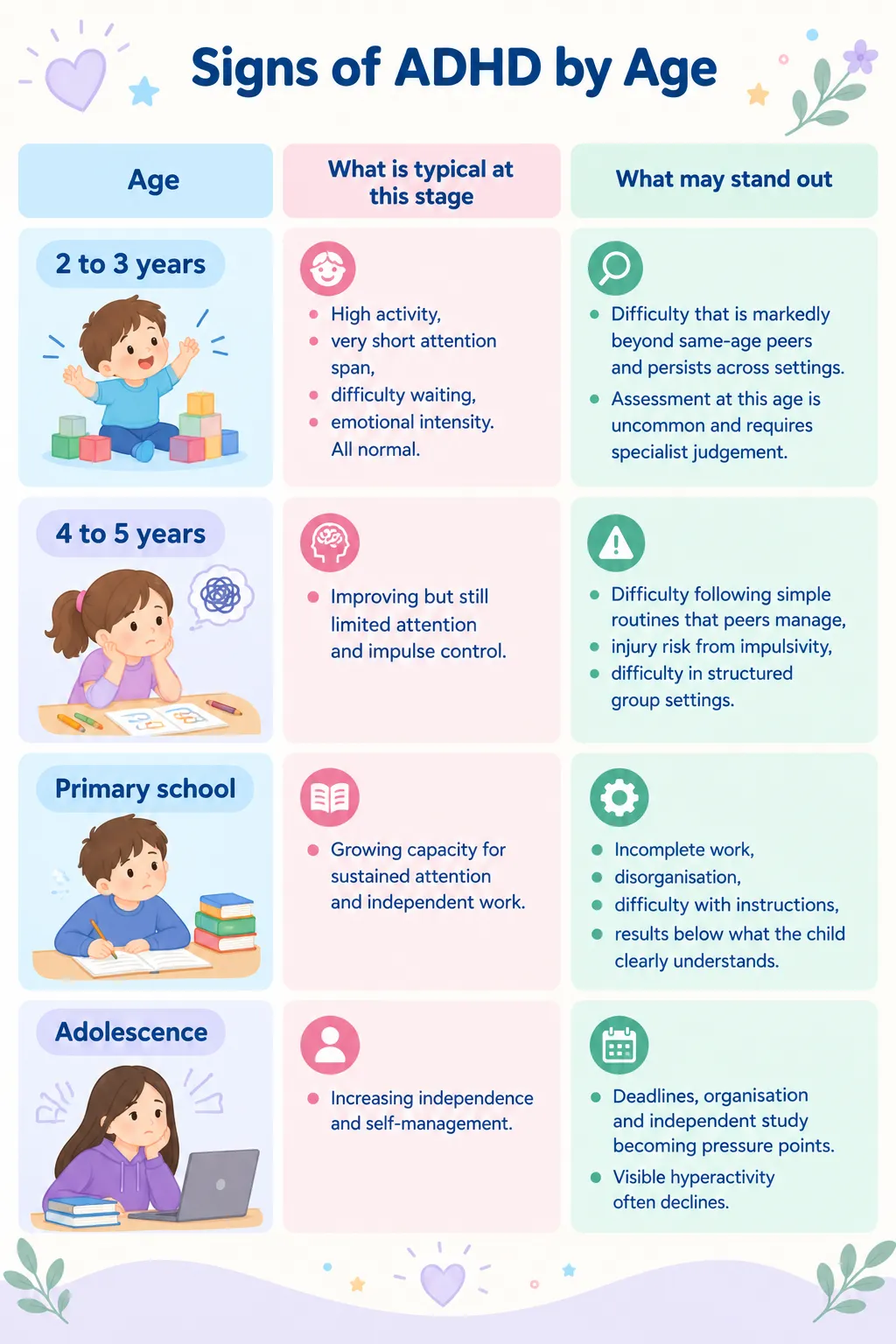
Symptoms of ADHD in childhood do not change with age. What changes is what they collide with, and how easy they are to distinguish from typical development. The table below is general context for interpreting behaviour at each stage. It is not a list of developmental milestones, and children vary widely within every age band.
| Age | What is typical at this stage | What may stand out |
| 2 to 3 years | High activity, very short attention span, difficulty waiting, emotional intensity. All normal | Difficulty that is markedly beyond same-age peers and persists across settings. Assessment at this age is uncommon and requires specialist judgement |
| 4 to 5 years | Improving but still limited attention and impulse control | Difficulty following simple routines that peers manage, injury risk from impulsivity, difficulty in structured group settings |
| Primary school | Growing capacity for sustained attention and independent work | Incomplete work, disorganisation, difficulty with instructions, results below what the child clearly understands |
| Adolescence | Increasing independence and self-management | Deadlines, organisation and independent study becoming pressure points. Visible hyperactivity often declines |
Can a Toddler Have ADHD?
Signs of ADHD in 2 year olds, signs of ADHD in 4 year old children and similar searches are among the most common questions parents ask, and they deserve a direct answer rather than a checklist.
ADHD can be present in early childhood, but diagnosis at this age is genuinely difficult and is not routinely made. The reason is straightforward: high activity levels, very short attention spans, impulsivity and difficulty waiting are all typical of normal development in toddlers and preschoolers. Distinguishing an ADHD pattern from ordinary development requires specialist judgement and usually a period of observation.
Signs of ADHD in 2, 3 and 4 year olds
There is no reliable checklist for this age group, and any content offering one should be treated with caution. What clinicians look for is difficulty that is markedly beyond same-age peers, present across settings, and causing genuine impairment rather than inconvenience. If you have concerns about a very young child, a GP or child health nurse is the right starting point.
Signs of ADHD in infants are not something clinicians assess for. ADHD is not diagnosed in infancy, because attention regulation and impulse control develop across early childhood and there is no established basis for identifying the condition at that stage. Concerns about an infant’s development are worth raising with a child health nurse or GP, though they will not be assessed as ADHD.
Signs of ADHD in Boys and Girls
The diagnostic criteria are identical. What differs is which presentations are more commonly identified.
Signs of ADHD in boys are more often hyperactive-impulsive, which is more externally visible and more likely to disrupt a classroom. ADHD symptoms in boys, sometimes searched as ADHD symptoms child boy, are therefore more likely to prompt a referral. Boys are more commonly identified in childhood than girls, which is generally attributed to this difference in visibility rather than to a confirmed difference in underlying rates.
Girls more commonly present with predominantly inattentive symptoms, which produce far less disruption. Australia’s clinical guideline notes that girls and women are at risk of under-recognition, particularly where symptoms are predominantly inattentive (Australian ADHD Professionals Association, 2022). A quiet child who is not finishing work rarely triggers a referral in the way a disruptive one does.
ADHD Symptoms in Teens
Signs of ADHD in teens often appear at the point where previously managed difficulties stop being manageable. Adolescence is a common time for ADHD to become apparent for the first time.
- Visible hyperactivity often declines, replaced by restlessness or difficulty with stillness
- Organisation and deadline management become the pressure point as work becomes more independent
- Difficulty with long-term assignments where structure is not externally imposed
- Emotional intensity and conflict, which can be difficult to separate from adolescence itself
- Impulsivity carrying higher stakes than it did in primary school
- Anxiety or low mood emerging alongside, often after years of unexplained underperformance
Distinguishing ADHD from ordinary adolescence is a genuine clinical challenge. The distinguishing questions are whether the pattern predates adolescence, appears across settings, and is disproportionate to circumstances.
What Is Not ADHD in Children
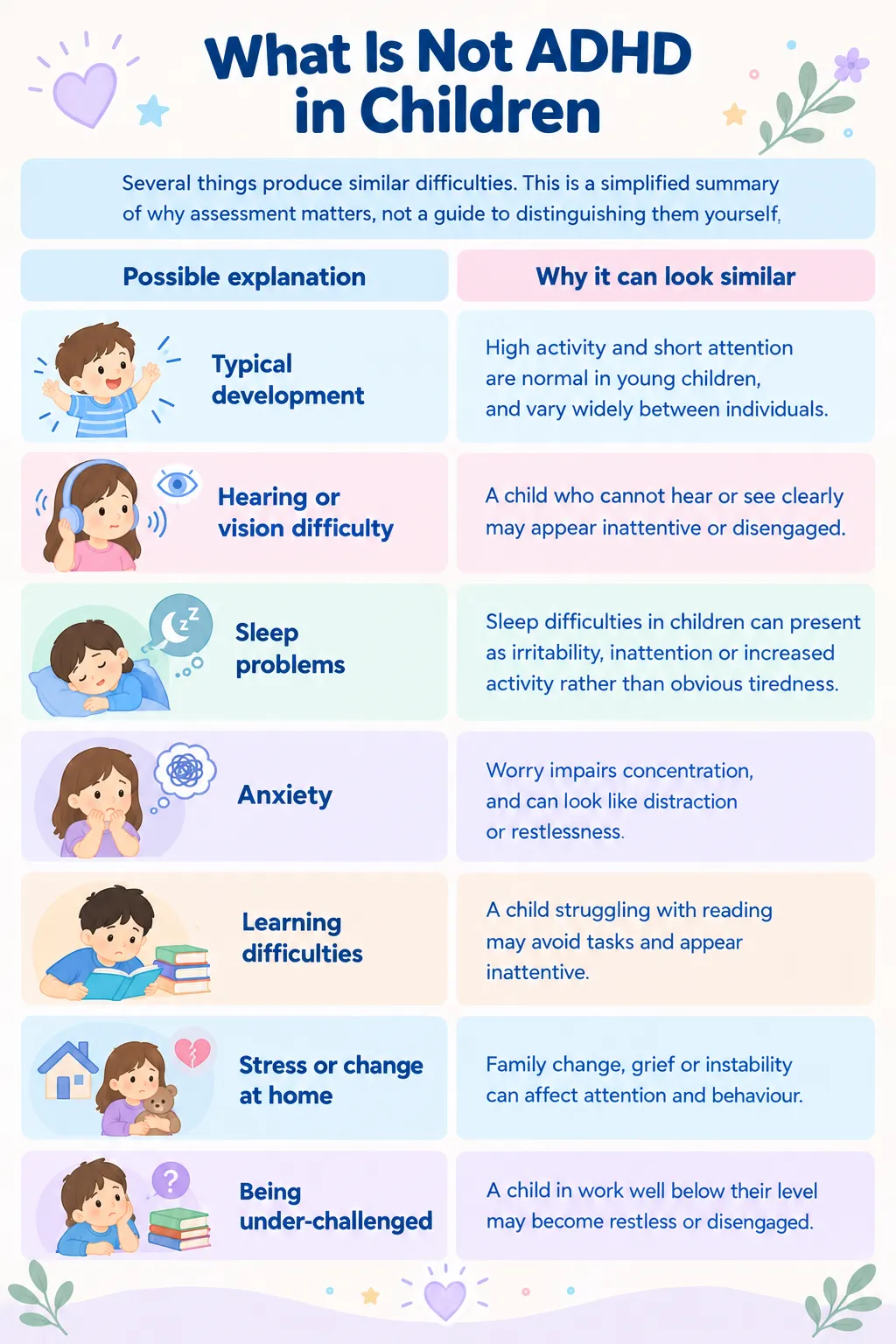
Several things produce similar difficulties. This is a simplified summary of why assessment matters, not a guide to distinguishing them yourself.
| Possible explanation | Why it can look similar |
| Typical development | High activity and short attention are normal in young children, and vary widely between individuals |
| Hearing or vision difficulty | A child who cannot hear or see clearly may appear inattentive or disengaged |
| Sleep problems | Sleep difficulties in children can present as irritability, inattention or increased activity rather than obvious tiredness |
| Anxiety | Worry impairs concentration, and can look like distraction or restlessness |
| Learning difficulties | A child struggling with reading may avoid tasks and appear inattentive |
| Stress or change at home | Family change, grief or instability can affect attention and behaviour |
| Being under-challenged | A child in work well below their level may become restless or disengaged |
Several of these also occur alongside ADHD rather than instead of it, which is common. Identifying one does not rule out the other.
What to Do If You Are Concerned
- Note specifics rather than impressions. What happens, how often, in which settings, and what the consequence is.
- Ask the school what they observe. Difficulties present at school and at home carry more weight than difficulties in one setting.
- Rule out the simple things first. Hearing and vision checks are quick and are worth doing.
- Speak with your GP or child health nurse, who can discuss referral pathways.
- Bring school reports and any written feedback to the appointment.
Assessment in children typically involves information from parents and teachers, standardised rating scales, developmental history and observation. Rating scales support assessment but are not, on their own, sufficient to establish a diagnosis.
On waiting and worrying
Support for difficulties does not have to wait for a diagnosis. Classroom adjustments, routine, structure and clear expectations help many children regardless of whether ADHD is eventually identified. Speak with the school about what is available now.
What Happens at a Child’s Assessment
Knowing roughly what to expect makes the process less daunting, for parents and for children.
- A developmental history, covering pregnancy, early milestones, and when difficulties were first noticed
- Standardised rating scales completed by parents and, with consent, by teachers. These support assessment but are not, on their own, sufficient to establish a diagnosis
- Information about how the child functions at school, often through a form sent to the teacher
- Observation and direct interaction with the child, depending on age and setting
- Consideration of alternative and co-occurring explanations, including sleep, hearing, vision, anxiety and learning difficulties
Timeframes vary considerably by state, provider and whether the assessment is public or private. Waits for children’s services in Australia are frequently measured in months. Ask about expected timeframes when you are referred, so you can plan around them.
Support at school while you wait
A formal diagnosis is not required for many classroom adjustments. Under the Disability Standards for Education 2005, education providers have obligations to make reasonable adjustments for students with disability, and schools can often put practical supports in place based on observed need rather than a diagnostic label.
It is worth asking the school directly what is available now: seating, chunked instructions, extra time, movement breaks, or a written record of homework. Many of these help regardless of what an assessment eventually finds.
Related Guides
- ADHD symptoms: the full symptom picture
- ADHD symptoms in women and girls
- Types, presentations and severity levels of ADHD
- What causes ADHD: genetics, brain development and environment
- ADHD in Australia: the complete guide
References
- Australian ADHD Professionals Association. Australian Evidence-Based Clinical Practice Guideline for Attention Deficit Hyperactivity Disorder (ADHD). Released October 2022. adhdguideline.aadpa.com.au
- American Psychiatric Association. Diagnostic and Statistical Manual of Mental Disorders, Fifth Edition, Text Revision (DSM-5-TR). 2022.
- National Institute for Health and Care Excellence (NICE). Attention deficit hyperactivity disorder: diagnosis and management. NG87.
- Royal Children’s Hospital Melbourne. Attention deficit hyperactivity disorder (ADHD). rch.org.au
- Disability Standards for Education 2005 (Cth). legislation.gov.au
Last review: August 2026. Next scheduled review: August 2027. This article is general information and is not a substitute for individual medical advice, assessment or diagnosis.