
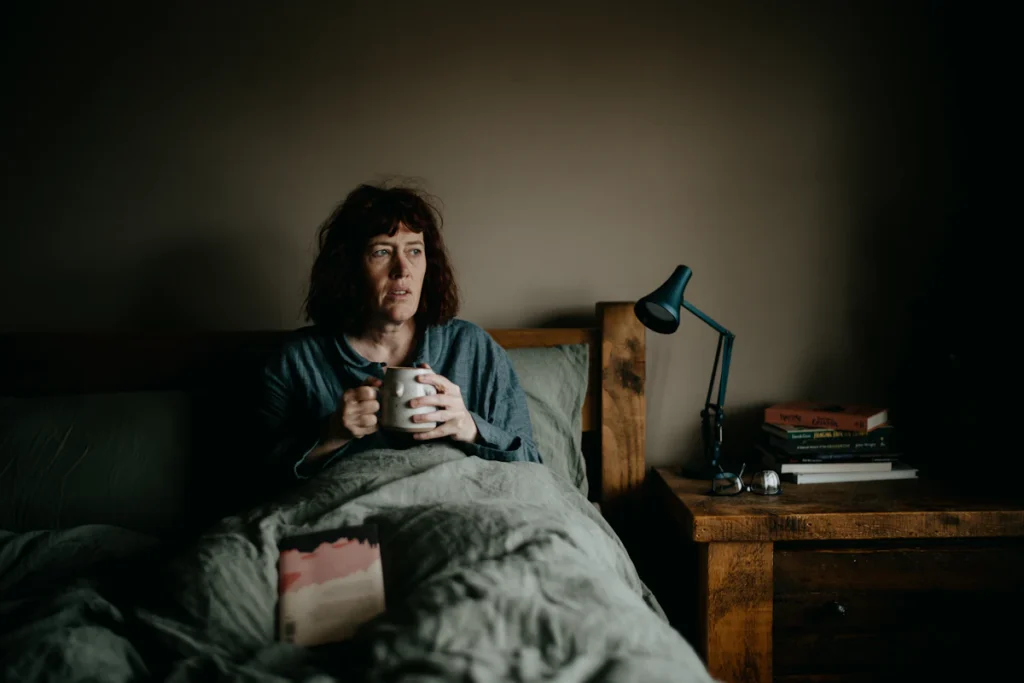
The day is done, the house is quiet, and your mind switches on. Every worry you pushed aside comes back at once. Or you drift off, only to wake at 3am with your heart pounding. If anxiety at night is familiar, you are not alone, and there is a lot you can do.
This guide explains why anxiety tends to feel worse at night and how to settle your body and mind for sleep. If night-time anxiety is wearing you down, anxiety support with an AHPRA-registered practitioner is available by phone or video.
Why is anxiety worse at night?
Anxiety often feels worse at night because there are fewer distractions, so worries have more space. Tiredness makes it harder to think calmly, and lying still makes you more aware of body sensations. Worrying about not sleeping then adds a second layer of anxiety.
- Fewer distractions. Without work, screens or people, the mind turns inward.
- A tired brain. Fatigue weakens the part of the brain that calms fear.
- Body awareness. In the quiet, you notice your heartbeat and breathing more.
- Problem-solving mode. Night feels like the time to “sort things out”, but tired thinking turns into worry.
- Sleep pressure. Watching the clock and fearing tomorrow’s tiredness adds stress.
Signs of night-time anxiety
Night-time anxiety shows up as a busy mind and an alert body just when you want to switch off. Some people struggle to fall asleep, while others wake at 3 am with a sudden jolt of dread. Common signs include:
- Racing thoughts as soon as your head hits the pillow
- Replaying the day or rehearsing tomorrow
- A racing heart or tight chest in bed
- Trouble falling asleep, or waking and not getting back to sleep
- Waking suddenly with fear or panic
- Dreading bedtime
Waking up with anxiety at night
Some people wake suddenly with a pounding heart, sweating, breathlessness and intense fear. This is called nocturnal panic. It happens during non-dreaming sleep and is different from a nightmare, because there is no frightening dream before it. It is common in panic disorder, with studies finding 44 to 71 percent of people with panic disorder have had at least one (Craske and Tsao, 2005).
Nocturnal panic is frightening but not dangerous. It usually settles within minutes. If you wake gasping or choking often, or snore loudly, see a GP, as sleep apnoea can cause similar symptoms.
Waking early with dread or worry, sometimes called morning anxiety, is also common. Cortisol naturally rises in the early morning, which can add to it.
What is sleep anxiety?
Sleep anxiety is worry or fear about sleep itself. You may fear not sleeping, worry about how you will cope tomorrow, or dread bedtime. This fear keeps the brain alert, making sleep harder, and the cycle repeats. Breaking it means taking the pressure off sleep itself.
| Anxious thought at night | A calmer way to see it |
|---|---|
| “If I don’t sleep now, tomorrow will be a disaster.” | “I’ve coped on less sleep before. Rest still helps.” |
| “I need to solve this tonight.” | “I’ll write it down and deal with it tomorrow.” |
| “My heart is racing, something’s wrong.” | “It’s adrenaline. It will slow as I relax.” |
How to calm anxiety at night
Small changes before and during bedtime add up. Try a few for two weeks before judging what works. The aim is to give your nervous system clear signals that the day is over. A steady routine, a cool, dark room and a plan for racing thoughts all help.
Before bed
- Set a worry window. Earlier in the evening, spend 15 minutes writing worries and possible next steps.
- Wind down for an hour. Dim lights, put screens away and do something calm.
- Avoid late caffeine and alcohol. Both disrupt sleep and raise night-time anxiety.
- Keep a regular wake time. This anchors your body clock, even after a bad night.
In bed
- Breathe slowly. Breathe in for four, out for six, for a few minutes.
- Body scan. Move attention slowly from toes to head, letting each area soften.
- Use a gentle distraction. Picture a familiar walk in detail, or name animals from A to Z.
- Turn the clock away. Checking the time adds pressure.
If you cannot sleep
If you have been awake for what feels like 20 minutes, get up and do something quiet in dim light. Return to bed when you feel sleepy. This teaches your brain that bed is for sleep, not worry.
Treatment for anxiety and sleep problems
Cognitive behavioural therapy for insomnia (CBT-I) is a structured program that changes the thoughts and habits that keep you awake. A meta-analysis of 20 trials found it helped adults fall asleep faster and sleep more efficiently, with benefits that lasted (Trauer and colleagues, 2015).
Treating the underlying anxiety also improves sleep. Cognitive behavioural therapy (CBT) for anxiety and CBT-I can work well together. Meditation can also help, as explained in our guide to meditation for anxiety.
Daytime habits that help night-time anxiety
What you do during the day shapes how anxious you feel at night. Light, movement, caffeine and how you handle worries all affect your body clock and stress levels. These daytime habits make it easier to wind down by bedtime:
- Get morning daylight to set your body clock.
- Exercise regularly, but finish intense workouts a few hours before bed.
- Avoid long daytime naps.
- Deal with small worries during the day so they do not pile up.
Our guide to anxiety coping strategies has more daytime tools.
What are night-time panic attacks?
A night-time panic attack, also called nocturnal panic, wakes you suddenly from sleep with a racing heart, breathlessness and intense fear. There is often no dream or clear trigger. These attacks usually peak within minutes and are not dangerous, though they can be very frightening.
Nocturnal panic tends to strike during lighter stages of sleep. It is linked to panic disorder and responds well to CBT (Craske and Tsao). Fear of another attack can make people dread bedtime, which then feeds sleep anxiety.
A 30-minute wind-down routine
A set routine before bed tells your brain that the day is finished and it is safe to switch off. Following the same steps each night matters more than which steps you choose. Here is a simple 30-minute routine you can adapt to suit your evening.
| Time before bed | What to do |
|---|---|
| 30 minutes | Screens off, lights dimmed, tomorrow’s to-do list written down |
| 20 minutes | Warm shower, then comfortable sleepwear |
| 10 minutes | Slow breathing or a short body scan |
| In bed | Read something light on paper until your eyes feel heavy |
When to get help
Seek support if anxiety keeps you awake most nights, you wake in panic often, or poor sleep is affecting your mood and daily life. See a GP if you snore loudly or wake gasping. Those can be signs of sleep apnoea, which needs its own assessment.
Truewell’s AHPRA-registered practitioners help people with anxiety and sleep problems, by phone or video. Complete the eligibility check online. If you are awake in distress and fear for your safety, phone 000, or Lifeline’s 24/7 line on 13 11 14.
The bottom line
- Anxiety at night is common because the mind has fewer distractions and a tired brain worries more.
- Nocturnal panic attacks are frightening but not dangerous.
- Fear of not sleeping can create its own cycle of sleep anxiety.
- A worry window, wind-down routine and slow breathing help you settle.
- CBT-I and treatment for anxiety can improve sleep long term.
Tonight, write down three worries an hour before bed, with one small next step for each. Then close the notebook until morning.
Sources checked (November 2026): Craske and Tsao (2005); Trauer and colleagues (2015); DSM-5-TR (2022); Andrews and colleagues (2018) and Hofmann and Smits (2008).
References
- Craske MG, Tsao JCI. Assessment and treatment of nocturnal panic attacks. Sleep Med Rev. 2005;9(3):173–184. doi:10.1016/j.smrv.2004.11.003
- Trauer JM, Qian MY, Doyle JS, Rajaratnam SMW, Cunnington D. Cognitive behavioral therapy for chronic insomnia: a systematic review and meta-analysis. Ann Intern Med. 2015;163(3):191–204. doi:10.7326/M14-2841
- American Psychiatric Association. Diagnostic and Statistical Manual of Mental Disorders, Fifth Edition, Text Revision (DSM-5-TR). Washington, DC: APA; 2022.
- Andrews G, Bell C, Boyce P, et al. Royal Australian and New Zealand College of Psychiatrists clinical practice guidelines for the treatment of panic disorder, social anxiety disorder and generalised anxiety disorder. Aust N Z J Psychiatry. 2018;52(12):1109–1172. doi:10.1177/0004867418799453
- Hofmann SG, Smits JAJ. Cognitive-behavioral therapy for adult anxiety disorders: a meta-analysis of randomized placebo-controlled trials. J Clin Psychiatry. 2008;69(4):621–632. doi:10.4088/JCP.v69n0415
This article is general information for an Australian audience and is not medical advice. Always talk to a registered health practitioner about your own situation. If you are in crisis or feel unsafe, call 000 or Lifeline on 13 11 14 (24 hours, 7 days).
Last reviewed: November 2026: By Truewell Clinic Team