

Is ADHD Different in Women?
There is no separate female subtype of ADHD, and when symptoms are assessed by clinical interview, meta-analysis does not find significant differences in core symptom severity between females and males. Some symptom-level differences are reported, particularly in childhood, and how visible those symptoms are to the adults around a child differs considerably. What is best established is a difference in recognition: girls are referred and diagnosed less often than boys, the gap narrows by adulthood, and the diagnostic criteria were developed on a sample that was only about a fifth female.
At a Glance
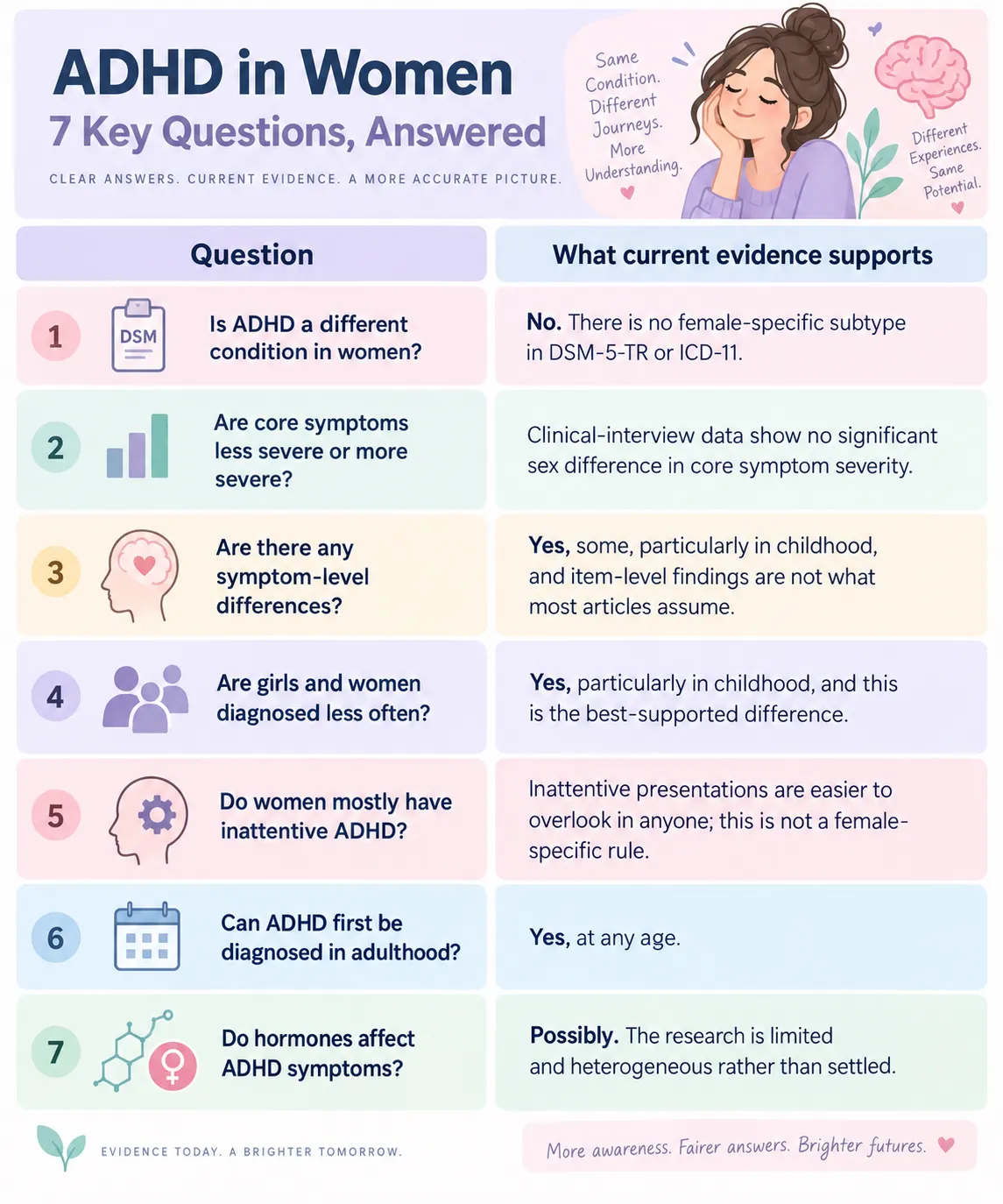
| Question | What current evidence supports |
| Is ADHD a different condition in women? | No. There is no female-specific subtype in DSM-5-TR or ICD-11 |
| Are core symptoms less severe or more severe? | Clinical-interview data show no significant sex difference in core symptom severity |
| Are there any symptom-level differences? | Yes, some, particularly in childhood, and item-level findings are not what most articles assume |
| Are girls and women diagnosed less often? | Yes, particularly in childhood, and this is the best-supported difference |
| Do women mostly have inattentive ADHD? | Inattentive presentations are easier to overlook in anyone; this is not a female-specific rule |
| Can ADHD first be diagnosed in adulthood? | Yes, at any age |
| Do hormones affect ADHD symptoms? | Possibly. The research is limited and heterogeneous rather than settled |
ADHD in women is one of the most written-about topics in mental health right now, and much of what circulates treats female ADHD as a distinct variant with its own symptom list. ADHD in females is diagnosed using the same criteria as in males. The research supports something narrower than the popular version, and for most women reading this, something more useful. This guide covers what actually differs, why girls and women get missed, how it shows up across a lifetime, and what to do next in Australia. Symptom-level detail belongs in the guide to ADHD symptoms in women, and the assessment pathway in late ADHD diagnosis in women.
Is ADHD Actually Different in Women?
What research shows about symptom severity
A 2024 systematic review and meta-analysis pooled 52 studies covering 18,408 people, 8,423 female and 9,985 male, to compare the severity of core ADHD symptoms between the sexes (Psychological Medicine, 2024). The result depended on how symptoms were measured. On rating scales, males showed slightly more hyperactivity and impulsivity in childhood, and men slightly more inattention in adulthood, all at small effect sizes. On clinical interview, there were no significant differences in any symptom domain, in children or in adults.
The authors point out what separates those two answers: the rating-scale studies were mostly community samples, and the interview studies mostly clinical ones. The apparent sex difference in symptom severity tracks who is doing the rating and where, more than it tracks the symptoms themselves.
What research shows about particular symptoms
Severity is not the only question. An item-level systematic review of 13 studies looked at which individual symptoms differ rather than at totals (Lim and colleagues, BJPsych Open, 2024). In children with ADHD, males were more likely to show fidgeting and difficulty remaining seated, while females showed higher rates of excessive talking and interrupting. Girls with ADHD also endorsed more mind-wandering and more parent-reported impairment, including friendship difficulties, than girls without ADHD.
That finding is more interesting than the version usually repeated. The symptoms reported more often in girls are hyperactive-impulsive ones, not inattentive ones. They are simply the hyperactive-impulsive symptoms that adults are most likely to read as personality rather than as a reason to refer. The review’s authors note the small number of direct investigations and inconsistent findings on impairment, so this is a direction of evidence rather than a settled picture.
What is well established
The ADHD difference between men and women with the strongest evidence behind it concerns identification rather than presentation. A 2024 Lancet Psychiatry review examining why females are less likely to be diagnosed in childhood reported an ADHD male to female ratio of roughly 4 to 1 in clinical samples against about 2 to 1 in community samples (Martin, Lancet Psychiatry, 2024). The gap between who has ADHD and who gets seen for it is the finding. By adulthood the ratio moves closer to 2 to 1 or 1 to 1, which is what late diagnosis looks like in aggregate. An international expert consensus statement reported the same pattern from referral data, with clinical referral ratios ranging from 3 to 1 up to 16 to 1 against roughly 3 to 1 in community samples (Young and colleagues, BMC Psychiatry, 2020).
The Lancet review assessed the competing explanations. Established diagnostic practice and sociocultural factors had the strongest support, and biological explanations the least, though the review treats them as contributing together rather than selecting one. It also notes something structural: the diagnostic criteria were developed from a field-trial sample that was only about 21 per cent female, so the descriptive language of ADHD was calibrated largely on boys.
What this means in practice
This is not a debunking of women’s experience; it is a shift in where the explanation sits. The evidence does not suggest that ADHD in women is an unrecognisable variant. It suggests that referral patterns, diagnostic practice and social expectation together made assessment less likely, and that the symptoms most visible in girls are often the ones adults interpret as character.
| Common claim | What the evidence supports |
| ADHD presents completely differently in women | Overstated. Core symptom severity appears more similar than popular descriptions suggest; some symptom-level differences are reported, particularly in childhood |
| Women are underdiagnosed and diagnosed later than men | Strongly supported. Clinical samples run about 4 to 1 male to female against about 2 to 1 in community samples, and the gap narrows by adulthood |
| The diagnostic criteria were built mainly on boys | Supported. The field-trial sample used to develop the criteria was about 21 per cent female |
| Women mostly have inattentive ADHD | Inattentive symptoms may be easier to overlook, but mostly inattentive should not be treated as a female-specific rule |
| Female ADHD is a separate type of ADHD | Not supported. No female-specific subtype exists in recognised diagnostic systems |
Presentations, Not Types
Types of ADHD in women: there are three recognised presentations, and they apply to everyone.
- Predominantly inattentive presentation
- Predominantly hyperactive-impulsive presentation
- Combined presentation
Presentation can change across a lifetime, which is why it is described as a current presentation rather than a permanent type. Inattentive ADHD in women receives the most attention in writing on this topic. The defensible version of that claim is that inattentive presentations are easier to overlook in anybody, and women are over-represented among people who were overlooked. The criteria themselves are set out in the DSM-5 criteria for ADHD.
ADD versus ADHD in women
ADD vs ADHD in women is a common source of confusion. ADD was the earlier term and was retired when the criteria were revised: what used to be called ADD is now described as ADHD, predominantly inattentive presentation. Someone using the older word is usually describing inattentive ADHD without significant hyperactivity, which is a real picture with an out-of-date name rather than a separate condition.
The seven types, and ring of fire
The 7 types of ADHD in women framework, including the ring of fire ADHD in women label, comes from a commercial SPECT brain-imaging model developed by Daniel Amen and the Amen Clinics. Those categories are not recognised ADHD presentations in DSM-5-TR, in ICD-11, or in Australia’s clinical practice guideline.
The use of SPECT imaging to diagnose psychiatric conditions has also been criticised in the psychiatric literature for lacking the published validation expected of a diagnostic classification system. Writing in the American Journal of Psychiatry, Adinoff and Devous noted the absence of empirical data supporting those diagnostic claims and recorded that an offer to conduct a blinded study of diagnostic accuracy was declined (American Journal of Psychiatry, 2010).
The experiences those labels describe are not imaginary. A diagnosis or treatment plan built on them is simply not built on the evidence base Australian clinicians work from.
Why Girls Get Missed
Why is ADHD underdiagnosed in women? The Australian clinical practice guideline identifies girls and women as a group who may go unrecognised or be diagnosed late, pointing to lower clinical suspicion, less noticeable hyperactivity and impulsivity, more prominent inattention, and a tendency for anxiety and depression to be diagnosed instead. The guideline discusses this in its narrative review of high-risk groups rather than as a formally graded recommendation, because the evidence review did not identify graded evidence for this group (Australian ADHD Professionals Association, 2022).
Several mechanisms are proposed, and they operate together rather than singly:
- Referral usually begins with an adult finding a child’s behaviour difficult to manage, which selects for the symptoms that disrupt a classroom. ADHD in girls more often shows up as difficulty that is inward or social rather than disruptive
- The hyperactive-impulsive symptoms reported more often in girls, such as talking a great deal and interrupting, are more readily interpreted as sociability or rudeness than as symptoms
- Compensatory strategies can mask or overshadow underlying difficulty, which the international consensus statement identifies as a specific barrier to recognition (Young and colleagues, 2020)
- Academic results that look acceptable rarely prompt assessment, however much effort they cost
- Co-occurring anxiety or low mood can become the presenting problem
When anxiety or depression gets diagnosed first
This pattern has a name in clinical practice: diagnostic overshadowing, where a visible condition absorbs the clinical attention and an underlying one is not examined. It is common in this group because anxiety and low mood are both genuinely more likely alongside unrecognised ADHD and more likely to be what brings someone to a GP in the first place.
The point is not that those diagnoses are usually wrong. Anxiety and depression frequently co-occur with ADHD and often need treating in their own right. The point is that a diagnosis of one is not evidence against the other, and Australia’s guideline specifically emphasises considering differential diagnosis and co-occurring conditions, because either can be missed when the other is present.
Teenage years
Parents often notice something change in adolescence. ADHD in teenage girls and ADHD in teenage females can look different from the childhood picture because organisational demand rises at exactly the point where adult-provided structure thins out, and the gap between capability and output can widen quickly. What that period looks like is covered in ADHD in teenagers.
Masking and What It Costs
Masking is not a formal diagnostic construct. It is a descriptive term for compensatory and concealing strategies: rehearsing conversations, over-preparing, arriving early to compensate for the times you will not, apologising pre-emptively, maintaining systems that only just hold. It overlaps with several related things that are worth separating, because they have different implications.
| Term | What it describes |
| Compensation | Strategies that genuinely offset a difficulty, such as writing everything down |
| Masking or camouflaging | Concealing difficulty from others, whether or not the difficulty is offset |
| Coping strategies | Managing the consequences of difficulty after the fact |
| Symptom suppression | Actively holding behaviour in, such as sitting still through restlessness |
Two things follow. The first is that compensation can make assessment harder, because the person in front of a clinician is the compensated version, and the international consensus statement names this as a barrier to recognition. The second is that sustaining it takes effort, and many women describe that effort as exhausting rather than as a symptom in itself.
How ADHD Shows Up in Adult Women
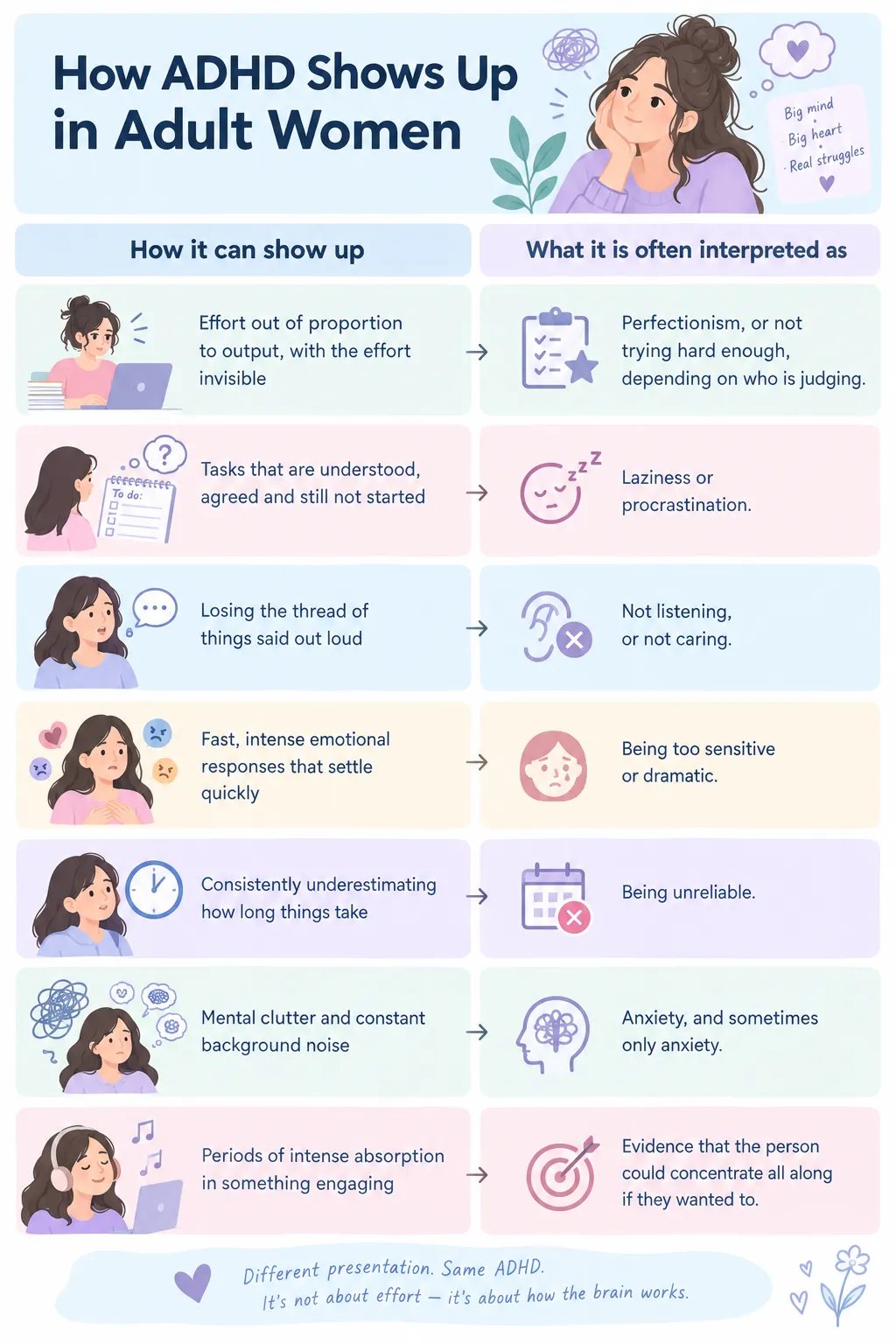
What does ADHD look like in women?
How does ADHD present in women, in practice? Much of what makes ADHD in adult women hard to spot is that the difficulty has been absorbed into a life rather than displayed. The column on the right below describes how these difficulties are commonly interpreted by others, not a clinical classification.
| How it can show up | What it is often interpreted as |
| Effort out of proportion to output, with the effort invisible | Perfectionism, or not trying hard enough, depending on who is judging |
| Tasks that are understood, agreed and still not started | Laziness or procrastination |
| Losing the thread of things said out loud | Not listening, or not caring |
| Fast, intense emotional responses that settle quickly | Being too sensitive or dramatic |
| Consistently underestimating how long things take | Being unreliable |
| Mental clutter and constant background noise | Anxiety, and sometimes only anxiety |
| Periods of intense absorption in something engaging | Evidence that the person could concentrate all along if they wanted to |
None of these is specific to women, and none of them diagnoses anything. What can ADHD be mistaken for in women is worth taking seriously in both directions. ADHD can overlap with, and frequently co-occurs with, anxiety, depression, bipolar disorder and personality-related difficulties, and some symptoms look similar across all of them. It also runs the other way: not every attention problem is ADHD. Assessment needs to consider both ADHD and alternative or co-occurring explanations, which is why it is a job for a clinician rather than a checklist. The detail list in undiagnosed and misdiagnosed ADHD.
High-functioning ADHD
High functioning ADHD in women is not a diagnosis in DSM-5-TR or ICD-11. It is an informal phrase describing someone who appears to function well despite significant effort, compensation or impairment in some areas. It is worth naming because it is one of the common reasons women are told they cannot have ADHD, and because good results are not evidence against impairment. Australia’s guideline frames functioning across psychological, social, academic, occupational and daily-life domains, so difficulty in some areas alongside achievement in others is a recognised picture rather than a contradiction.
Untreated ADHD in adult women
Untreated ADHD in female adults does not have a single trajectory. The impacts people describe are usually cumulative rather than dramatic, and they vary widely: underemployment relative to capability for some, financial administration that never gets on top of itself for others, relationships strained by forgotten commitments, and a long-running assumption that the problem is character. These are possible cumulative impacts rather than an expected course. The practical territory is covered across ADHD at work, ADHD and money and ADHD and relationships.
Across a Lifetime
Hormonal life stages
Some studies suggest ADHD symptoms may change across the menstrual cycle, including during the luteal phase, and PMDD appears more common in women with ADHD. A 2025 systematic review in the Journal of Attention Disorders identified 11 studies on sex hormones and ADHD in females and described the evidence as largely suggestive, limited by small samples and heterogeneous methods and populations (Osianlis and colleagues, 2025). This is an emerging area rather than a settled one, and it has its own guide: ADHD, hormones and the menstrual cycle.
Pregnancy and motherhood
Self-reported experience during pregnancy varies in every direction. Swedish population register data covering 773,047 women found postpartum depression and anxiety substantially more common in mothers with ADHD, with much of that difference accounted for by co-occurring conditions and sociodemographic factors once adjusted (Andersson and colleagues, 2023). See ADHD, pregnancy, postpartum and motherhood.
Midlife and later
Does ADHD get worse with age? Women describe midlife as a difficult stretch often enough that it is worth answering carefully. ADHD does not progress as a condition. What can increase is the difficulty it causes, and many women report their forties and fifties as the point where that happens. That is reported experience rather than established population-level evidence: the 2025 systematic review identified no peer-reviewed empirical studies meeting its inclusion criteria on hormones and ADHD symptoms across the menopausal transition, and called for research across a wider range of hormonal milestones including menopause. ADHD in older women is also under-recognised for a generational reason: the diagnosis was rarely applied to girls when they were girls.
What Often Comes With It
Co-occurring conditions are common in ADHD generally and are part of why women are misread. Anxiety and depression are frequently diagnosed first. Sleep difficulty is common. Two areas deserve specific mention, with the evidence stated precisely.
Self-injury: a 2026 systematic review and meta-analysis of 14 studies covering nearly 30,000 people found people with ADHD had about 2.25 times the odds of non-suicidal self-injury compared with people without ADHD, and reported higher rates among girls and women with ADHD than among boys and men with ADHD (Psychiatry Research, 2026). The authors are explicit that this does not make self-harm inevitable in ADHD, and frame the finding as a case for early screening and supportive care.
Eating difficulties: systematic review evidence associates ADHD with elevated rates of eating disorders across the lifespan (Nazar and colleagues, 2016). Meta-analytic evidence summarised in the 2020 expert consensus statement did not find that risk differed by sex, so this is best described as an ADHD-associated risk rather than a female-specific one.
If any of this describes you:
Please raise it with your GP or another clinician you trust, whether or not you pursue an ADHD assessment. Support is available and these difficulties respond to treatment. If you need to talk to someone now, Lifeline is on 13 11 14 at any hour, and 000 in an emergency.
When ADHD and a co-occurring condition overlap, assessing both helps a clinician understand which difficulties are attributable to which condition and whether additional treatment is needed. Australia’s guideline emphasises this in both directions, because either condition can be missed when the other is present.
What to Do Next in Australia
For ADHD in women, Australia’s pathway is the same one anyone else follows. Is ADHD more common in women than the diagnosis figures suggest? On the community-sample evidence, very likely, which is part of why it is worth pursuing rather than assuming you would already have been identified.
Screening is not diagnosis
Australia’s guideline distinguishes screening from diagnostic assessment. A screening questionnaire can indicate whether further assessment may be worthwhile; it cannot establish an ADHD diagnosis, and a high score is not a result to act on by itself. What self-screening tools can and cannot tell you is covered in the ADHD test for women guide.
Who assesses ADHD
The guideline describes ADHD clinical interviews as usually carried out by clinicians experienced in the diagnosis of developmental and mental health disorders, such as paediatricians, psychiatrists and psychologists. It does not prescribe a single professional pathway. In practice a GP is a useful starting point, particularly for referral options, differential diagnosis and anything that should be ruled out first, but pathways, costs and waiting times vary considerably by clinician, service and jurisdiction.
What helps the appointment
- Say plainly that you want to be assessed for ADHD and why, rather than leading with the anxiety or the exhaustion
- Bring evidence from childhood if you can: school reports, a parent’s recollection, anything that speaks to what you were like before you learned to compensate
- Document the difficulties you experience, when they began, and how they affect different areas of life, because assessment turns on impairment across settings
- Ask about referral options, waiting times and cost before committing
- If you have been told you cannot have ADHD because you did well at school or hold down a job, that is not a diagnostic criterion, and seeking another opinion is reasonable
What this article does not establish:
None of this means women and men experience ADHD identically. It means the evidence for large differences in core symptom severity is weaker than the evidence for differences in recognition, referral and diagnosis, and that some symptom-level differences are reported while the research on female-specific contexts such as hormonal life stages remains limited.
Related Guides
- ADHD in adults: the complete Australian guide
- ADHD burnout: what it is and how it differs from tiredness
- What actually happens in an ADHD assessment
References
- A systematic review and meta-analysis comparing the severity of core symptoms of attention-deficit hyperactivity disorder in females and males. Psychological Medicine, 2024. 52 studies, 18,408 participants. PMID 39494848.
- Lim AXH, Williams T, Horstmann L, Thapar A, Martin J. An item-level systematic review of the presentation of attention deficit hyperactivity disorder (ADHD) in females. BJPsych Open, 2024. 13 included studies. PMID 39952337.
- Martin J. Why are females less likely to be diagnosed with ADHD in childhood than males? Lancet Psychiatry, 2024;11(4):303-310. doi:10.1016/S2215-0366(24)00010-5. PMID 38340761.
- Young S, Adamo N, Asgeirsdottir BB, and colleagues. Females with ADHD: an expert consensus statement taking a lifespan approach providing guidance for the identification and treatment of attention-deficit/hyperactivity disorder in girls and women. BMC Psychiatry, 2020;20:404. doi:10.1186/s12888-020-02707-9. PMID 32787804.
- Osianlis E, Thomas EHX, Jenkins LM, Gurvich C. ADHD and sex hormones in females: a systematic review. Journal of Attention Disorders, 2025. 11 included studies; evidence described as largely suggestive and limited.
- Non-suicidal self-injury in individuals with attention-deficit/hyperactivity disorder: a systematic review and meta-analysis with age- and sex-stratified findings. Psychiatry Research, 2026;358. 14 studies, approximately 30,000 participants; pooled odds ratio 2.25. PMID 41633106.
- Nazar BP, Bernardes C, Peachey G, Sergeant J, Mattos P, Treasure J. Attention-deficit/hyperactivity disorder and eating disorders across the lifespan: a systematic review of the literature. International Journal of Eating Disorders, 2016. PMID 27693587.
- Adinoff B, Devous M. Scientifically unfounded claims in diagnosing and treating patients. American Journal of Psychiatry, 2010;167(5):598. PMID 20439400.
- Andersson A and colleagues. Depression and anxiety disorders during the postpartum period in women diagnosed with attention deficit hyperactivity disorder. Journal of Affective Disorders, 2023.
- Australian ADHD Professionals Association. Australian Evidence-Based Clinical Practice Guideline for Attention Deficit Hyperactivity Disorder (ADHD). Released October 2022. High-risk groups, screening and identification, and diagnosis chapters. adhdguideline.aadpa.com.au
- American Psychiatric Association. Diagnostic and Statistical Manual of Mental Disorders, Fifth Edition, Text Revision. Three presentations of ADHD; ADD retired as a diagnostic term.
Last reviewed: September 2026. Next scheduled review: September 2027. This article is general information and is not a substitute for individual medical advice, assessment or diagnosis.