

How Is ADHD Treated?
Australia’s clinical guideline frames ADHD treatment as individualised. Treatment can involve pharmacological approaches, non-pharmacological approaches, or both, and the guideline states there is insufficient evidence to determine a generally optimal sequence between them. Decisions are made around the person’s needs and preferences, symptom severity, degree of impairment, and practical factors including availability, cost and potential harms (Australian ADHD Professionals Association, 2022). Treatment does not cure ADHD. It aims to reduce impairment and improve functioning.
ADHD treatment is not one decision. It is a set of options that get combined differently for different people, reviewed, and changed when they are not working. This guide maps the whole landscape: what the options are, what the guideline recommends, how decisions get made in Australia and what to expect from review. It is the overview page for this topic, and the supporting guides go deeper on each part. For how ADHD is identified in the first place, see how ADHD is diagnosed in Australia.
This article does not cover medication. It names it as one of the treatment categories, because a map that leaves it out would be misleading, and it does not describe, compare or recommend any medicine. That conversation belongs with a qualified prescriber.
Is ADHD a Disease?
ADHD is often described as a disease, and the framing is worth correcting because it changes what treatment is expected to do.
ADHD is classified as a neurodevelopmental condition rather than a disease. It appears in DSM-5-TR and ICD-11 among the neurodevelopmental disorders, alongside autism and learning disorders, with diagnostic criteria requiring several symptoms to have been present before age 12. Symptoms and functional impact can change considerably across development and circumstances, but the condition is not acquired in the way an illness is, and there is nothing to eradicate.
That matters practically. A disease model leads people to expect treatment to remove the condition and to judge it a failure when it does not. A developmental model sets a different and more achievable target: reducing impairment, improving functioning and quality of life, and closing the gap between what someone is capable of and what they are able to do.
What ADHD Treatment Is Trying to Achieve
- Reducing the core symptoms of inattention, hyperactivity and impulsivity where they cause difficulty
- Improving day-to-day functioning at work, in study, at home and in relationships
- Reducing functional impairment, which is the thing diagnosis established in the first place
- Addressing co-occurring conditions, which are common and which affect how well anything else works
- Building skills and systems that were never developed, particularly in people diagnosed late
- Reducing the secondary damage: the self-criticism, avoidance and lowered expectations that accumulate over years of unexplained difficulty
Symptom reduction and functional improvement are related but not identical, and the second is usually what people actually care about. The guideline frames treatment around functioning and quality of life, so it is worth being explicit with your clinician about which outcomes matter to you. Concrete goals work better than general ones:
- Fewer missed deadlines, or assignments handed in complete
- Fewer errors at work, or less time spent correcting them
- A sleep routine that holds through the week
- Household admin that gets done before it becomes a problem
- Fewer arguments that start from forgotten or unfinished things
- Study or work that takes closer to the time it should
These are the kinds of outcomes that can actually be reviewed later. A general sense of whether things feel better is much harder to act on.
The Multimodal Principle
This is the idea that most coverage misses by presenting the options as a choice between competing alternatives.
In the evidence the guideline reviewed, combined pharmacological and non-pharmacological treatment performed better than either approach alone, and clinicians should consider combined treatment where it is available, feasible and cost-effective. The same guideline also states there is insufficient evidence to determine a generally optimal sequence, and recognises that sometimes only one of the two will be needed, suitable or available (Australian ADHD Professionals Association, 2022).
The practical consequence is that treatment is planned individually rather than following a fixed formula. For some people that means a combination; for others a single approach is what is needed or what is accessible. ADHD treatments are best read as components that can be assembled differently, and the assembly is expected to change over time as circumstances, demands and priorities change.
The Treatments for ADHD at a Glance
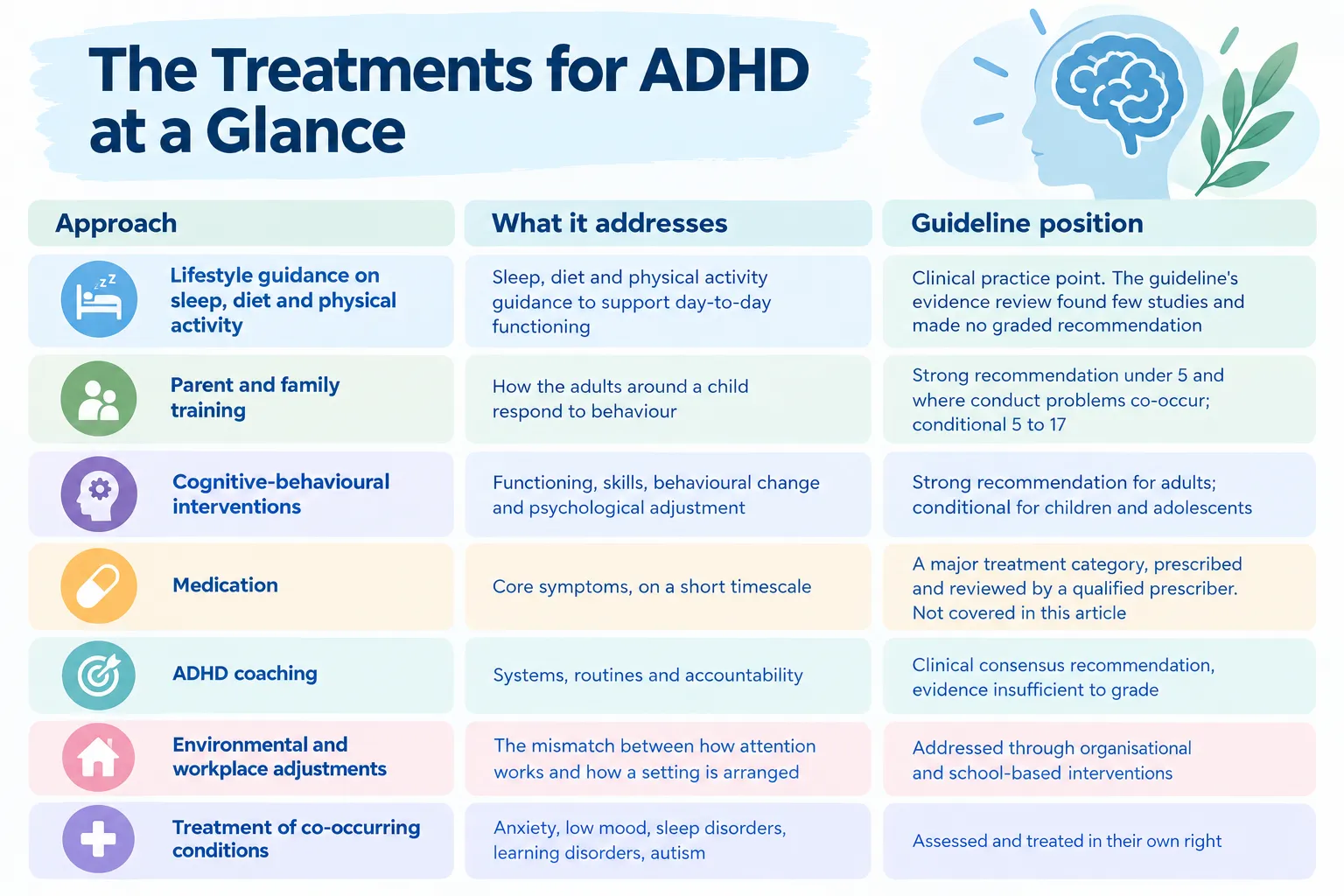
| Approach | What it addresses | Guideline position |
| Lifestyle guidance on sleep, diet and physical activity | Sleep, diet and physical activity guidance to support day-to-day functioning | Clinical practice point. The guideline’s evidence review found few studies and made no graded recommendation |
| Parent and family training | How the adults around a child respond to behaviour | Strong recommendation under 5 and where conduct problems co-occur; conditional 5 to 17 |
| Cognitive-behavioural interventions | Functioning, skills, behavioural change and psychological adjustment | Strong recommendation for adults; conditional for children and adolescents |
| Medication | Core symptoms, on a short timescale | A major treatment category, prescribed and reviewed by a qualified prescriber. Not covered in this article |
| ADHD coaching | Systems, routines and accountability | Clinical consensus recommendation, evidence insufficient to grade |
| Environmental and workplace adjustments | The mismatch between how attention works and how a setting is arranged | Addressed through organisational and school-based interventions |
| Treatment of co-occurring conditions | Anxiety, low mood, sleep disorders, learning disorders, autism | Assessed and treated in their own right |
A note on medication
Medication is one of the main treatment categories for ADHD and a large part of what the clinical guideline covers. It is prescribed, monitored and reviewed by a qualified prescriber, and whether it is appropriate depends on age, presentation, severity, co-occurring conditions, medical history and your own preferences. This article does not describe, compare or recommend any medicine, and nothing here should be read as advice for or against it. If you want to discuss it, that conversation belongs with your GP, paediatrician or psychiatrist.
Treating ADHD without drugs
Non-pharmacological treatment is a genuine option with a real evidence base, and the strength of that evidence varies considerably between approaches. ADHD treatment without drugs is covered in full in the guide to managing ADHD without medication, including what the evidence shows about supplements, diets, neurofeedback and natural remedies. The short version is that the approaches with the strongest support are behavioural and psychological rather than products.
Therapeutic treatment for ADHD
Cognitive-behavioural intervention carries the strongest non-pharmacological recommendation for adults in the Australian guideline. What the sessions involve, which other therapies have evidence, who provides them and what Medicare covers are set out in the guide to therapy for ADHD.
ADHD help and support
Support is not treatment, and for many people it does as much work. National helplines, free peer support groups and coaching are covered in the guide to ADHD coaching and support in Australia. If you are looking for ADHD support Australia provides outside the clinical system, that is where the organisations and contact details are.
How ADHD Treatment Decisions Are Made
The guideline is specific about this, and it is worth knowing what you are entitled to expect from the conversation.
- Decisions should centre on the person’s needs and preferences, taking account of symptom severity, degree of impairment, and the views of the person and their family
- A shared decision-making model should be used, rather than a plan being handed down
- People with ADHD should be involved in decisions about their own care, appropriate to their age and developmental stage
- Clinicians should fully inform the person about the options for care, including the benefits and possible adverse effects of each
- Where symptoms are severe and services are limited, the sequence in which things are started may differ from the ideal
That last point is worth understanding. The order in which treatments are introduced is a clinical decision influenced by severity, urgency and what is actually available locally, not a fixed sequence that applies to everyone.
Access is part of the decision rather than a separate problem. What is recommended and what is feasible can differ, because access to ADHD assessment and treatment varies between states and territories, between public and private services, and with clinician availability, waiting times, geography and cost. The guideline itself identifies availability, cost and potential harms among the factors treatment decisions should account for. If cost or waiting time is the obstacle, saying so changes what a clinician will suggest.
Questions worth asking
- What are all the options, including the ones you are not recommending, and why?
- What is this particular option expected to change, and by when?
- How will we know whether it is working, and what are we measuring?
- What are the possible adverse effects or downsides?
- When will we review this, and what would make us change the plan?
- What happens if it does not work?
ADHD Treatment by Age
Young children under 5
The most strongly supported intervention is not delivered to the child. Parent and family training carries a strong recommendation, and the work is with the adults, on structured and consistent responses to behaviour. Lifestyle guidance on sleep, diet and activity applies at every age and matters particularly here.
Children 5 to 17
Parent and family training is conditionally recommended, and more intensive programs carry a strong recommendation where oppositional defiant disorder or conduct disorder co-occurs. Cognitive-behavioural interventions could be offered. School-based and organisational support runs alongside, arranged separately from clinical treatment.
Adolescents
Cognitive-behavioural interventions should be offered. Adolescence also brings a transition worth planning for, as the young person moves from having decisions made for them towards making their own. The guideline’s position that people with ADHD should be involved in decisions about their care, appropriate to age and developmental stage, is particularly relevant here (Australian ADHD Professionals Association, 2022).
Adults
Cognitive-behavioural intervention carries a strong recommendation. For adults diagnosed late, a substantial part of treatment is skills and systems that were never built, plus addressing the beliefs formed over decades of unexplained difficulty. Coaching and workplace adjustments are frequently part of the picture.
Older adults
ADHD does not stop at a particular age, and the Australian guideline explicitly includes adults aged 65 and over within its scope (Australian ADHD Professionals Association, 2022). Diagnosis later in life is increasingly recognised. As with any treatment planning in later life, other health conditions, other medicines already being taken and a different pattern of daily demands are all things a clinician would take into account.
Inattentive ADHD Treatment
Predominantly inattentive ADHD treatment, sometimes searched as ADHD PI treatment, raises a reasonable question: does treatment differ when hyperactivity is not part of the picture?
The Australian guideline does not set out separate treatment recommendations by presentation, so the treatment categories are the same. What may differ in practice is emphasis, and what the person is likely to have arrived with. The points below are clinical considerations rather than evidence-based differences in what is recommended.
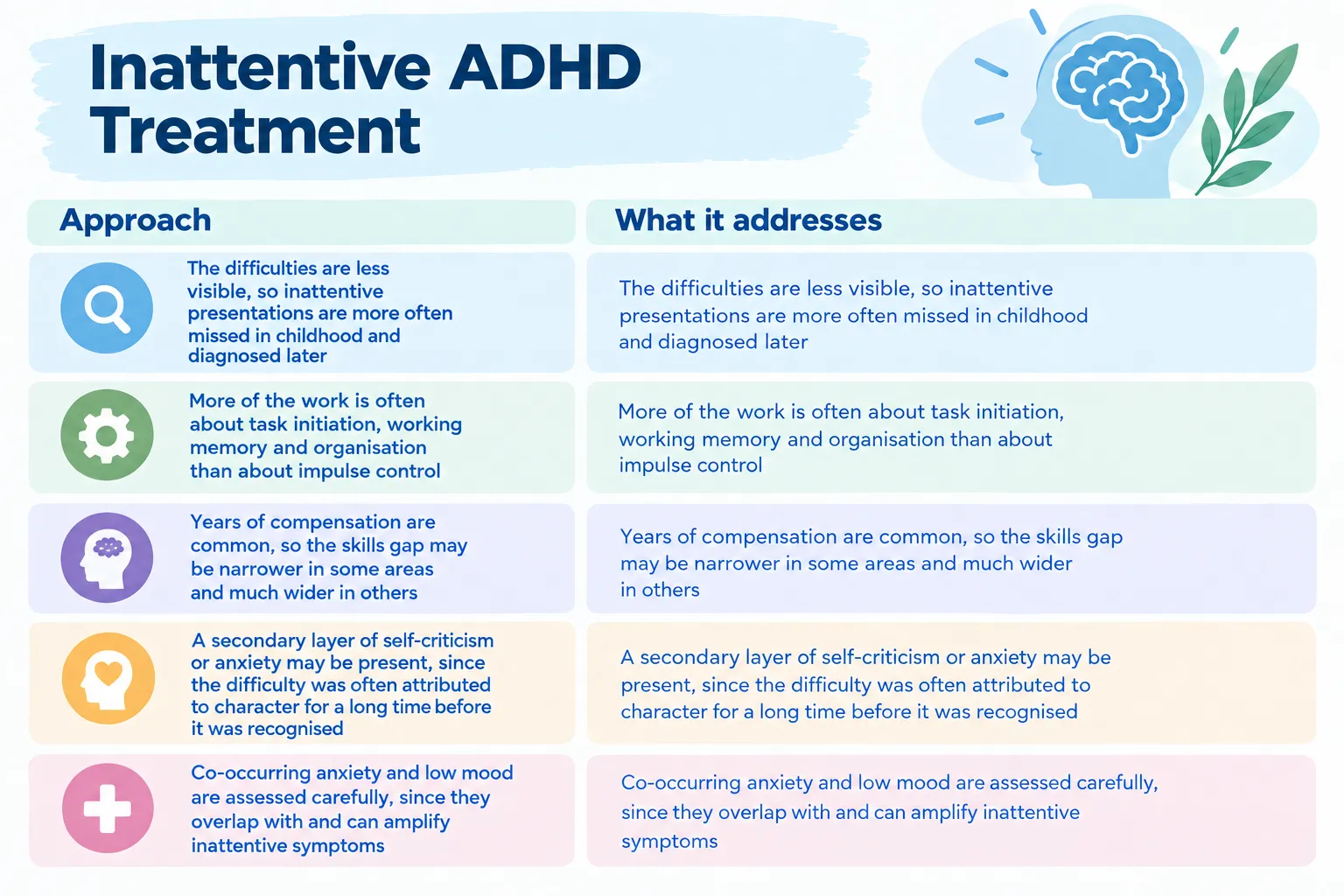
- The difficulties are less visible, so inattentive presentations are more often missed in childhood and diagnosed later
- More of the work is often about task initiation, working memory and organisation than about impulse control
- Years of compensation are common, so the skills gap may be narrower in some areas and much wider in others
- A secondary layer of self-criticism or anxiety may be present, since the difficulty was often attributed to character for a long time before it was recognised
- Co-occurring anxiety and low mood are assessed carefully, since they overlap with and can amplify inattentive symptoms
Treatment for ADD ADHD is the same question asked with older terminology. ADD is a former name for what is now diagnosed as ADHD, most often the inattentive presentation, and the treatment landscape is identical. The guide to ADD versus ADHD covers the terminology.
Co-Occurring Conditions
Co-occurring conditions are common in ADHD and they change treatment planning, which is why assessment looks for them rather than assuming ADHD explains everything.
The guideline notes that cognitive-behavioural interventions play an important role in addressing co-occurring conditions including substance use, autism, anxiety and depression (Australian ADHD Professionals Association, 2022). Sleep problems, anxiety and low mood can also affect functioning in their own right and may need to be assessed and treated alongside ADHD rather than treated as secondary to it.
Where a condition was identified before ADHD was, earlier treatment was not necessarily wrong; it addressed what was visible at the time.
Monitoring, Review and Changing the Plan
Treatment effects should be monitored for effectiveness, including treatment-specific outcomes and adverse effects, and the guideline notes that different interventions operate on different timelines (Australian ADHD Professionals Association, 2022). The guideline does not set fixed timeframes, and how quickly anything shows depends on the person and the intervention. The table below describes how progress is usually assessed rather than how long any approach should take.
| Approach | How progress is usually judged |
| Sleep, exercise and routine changes | Change tends to be cumulative rather than sudden, so it is judged over a period rather than session to session |
| Cognitive-behavioural intervention | Across a structured course, with change appearing in habits and functioning rather than within sessions |
| Parent and family training | Over a program, with early changes often appearing in the parent’s response before the child’s behaviour |
| Coaching | Over an engagement, judged by whether the systems are actually being used |
| Environmental and workplace adjustments | Judged by whether the specific barrier has been removed, since the change is to the demand rather than the person |
- Agree in advance what you are measuring, and prefer concrete things over a general sense of improvement
- Bring specific examples to review appointments rather than an overall impression
- Report what is not working as plainly as what is, since a plan that is not reviewed honestly cannot be adjusted
- Expect the plan to change as demands change, particularly at transitions such as starting high school, university or a new role
- Adverse effects, including from non-pharmacological approaches, are worth raising rather than tolerating
When ADHD Treatment Is Not Working
A treatment that is not producing what you hoped for is information rather than a dead end, and the guideline’s emphasis on monitoring and adjustment exists for this reason. Before concluding that an approach has failed, there are a few things worth checking with your clinician.
- Has it had enough time? Different interventions show change on different timelines, and some are judged over a course rather than week to week
- Was it used consistently? Engagement and adherence affect outcomes, and an approach that was not really applied has not really been tested
- Was the target outcome the right one? A treatment aimed at one thing will not necessarily move another
- Are adverse effects limiting it? These are worth raising rather than tolerating, including for non-pharmacological approaches
- Is another condition contributing? Co-occurring anxiety, low mood, sleep problems or a learning disorder may need attention in their own right
- Does the approach need adjusting rather than replacing? Often the intervention is reasonable and the way it is being applied is what needs to change
- Would another component help alongside it? Treatment is planned as a combination for many people, and adding is not the same as starting again
Choosing one approach is not a permanent decision. Plans are expected to be reviewed and changed, and revisiting something you previously ruled out is a normal part of that rather than a reversal.
Can ADHD Be Cured?
There is currently no established treatment that cures ADHD. It is a neurodevelopmental condition, and while symptoms and functional impact can change considerably across the lifespan, no treatment is understood to remove the condition. What treatment changes is how much difficulty it causes, which for many people is substantial. The guide to managing ADHD without medication looks at this question in more detail, including why claims that a product can cure ADHD should be treated cautiously.
Getting Started With ADHD Treatment in Australia
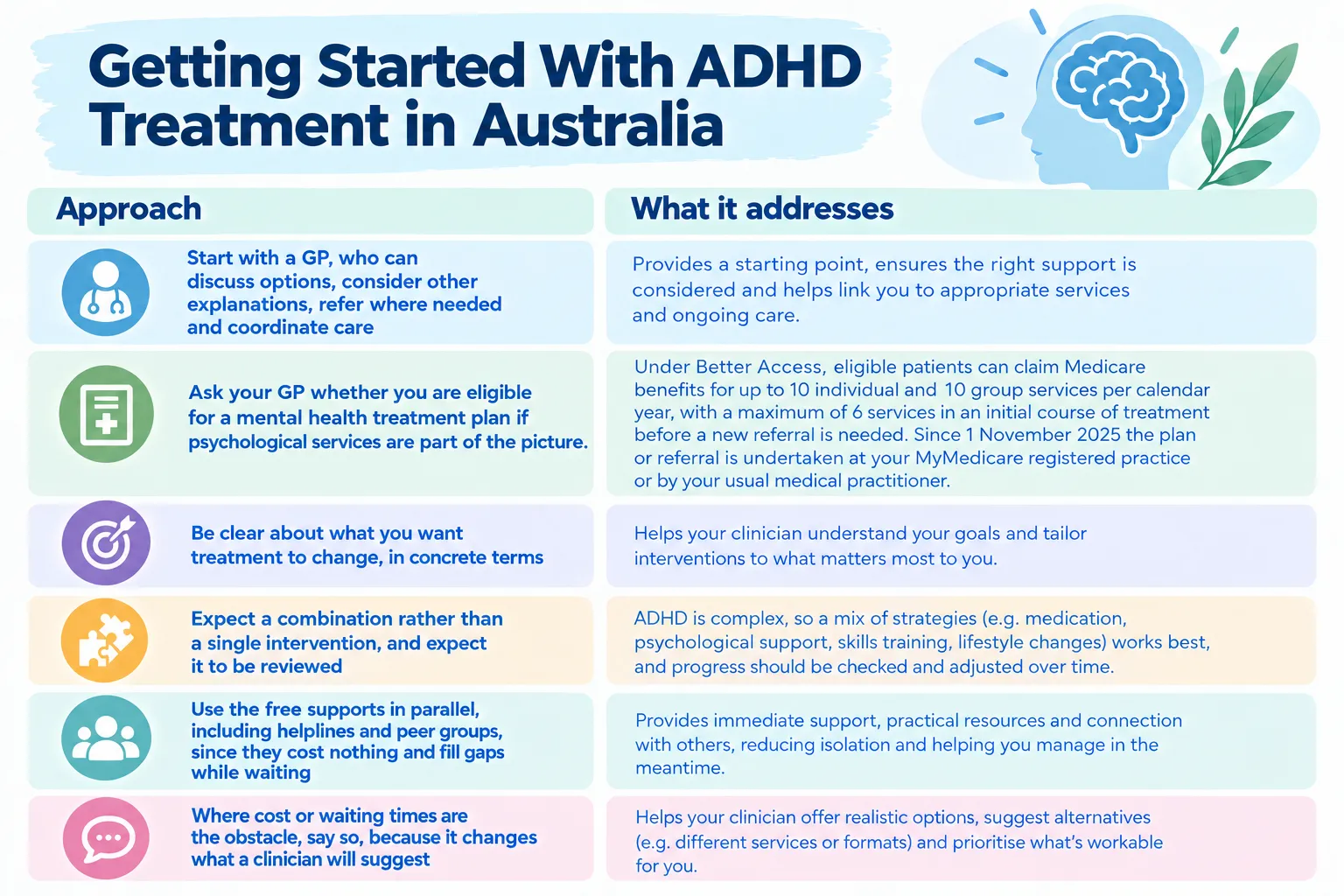
- Start with a GP, who can discuss options, consider other explanations, refer where needed and coordinate care
- Ask your GP whether you are eligible for a mental health treatment plan if psychological services are part of the picture. Under Better Access, eligible patients can claim Medicare benefits for up to 10 individual and 10 group services per calendar year, with a maximum of 6 services in an initial course of treatment before a new referral is needed. Since 1 November 2025 the plan or referral is undertaken at your MyMedicare registered practice or by your usual medical practitioner
- Be clear about what you want treatment to change, in concrete terms
- Expect a combination rather than a single intervention, and expect it to be reviewed
- Use the free supports in parallel, including helplines and peer groups, since they cost nothing and fill gaps while waiting
- Where cost or waiting times are the obstacle, say so, because it changes what a clinician will suggest
ADHD and treatment are an ongoing relationship rather than a course that finishes. ADHD management continues, and the useful question at any review is not whether the condition has gone, but whether the gap between capability and outcome is narrower than it was.
Related Guides
- Is ADHD a disability, a disorder or a difference?
- ADHD, IQ, intelligence and giftedness
- ADHD symptoms in adults: the complete Australian guide
References
- Australian ADHD Professionals Association. Australian Evidence-Based Clinical Practice Guideline for Attention Deficit Hyperactivity Disorder (ADHD). Released October 2022. Chapters on treatment and support, multimodal treatment, and non-pharmacological interventions. adhdguideline.aadpa.com.au
- Australian ADHD Professionals Association. Clinical treatment overview factsheet. 2024. adhdguideline.aadpa.com.au
- American Psychiatric Association. Diagnostic and Statistical Manual of Mental Disorders, Fifth Edition, Text Revision (DSM-5-TR). 2022. Neurodevelopmental disorders.
- World Health Organization. International Classification of Diseases, 11th Revision (ICD-11). 6A05 Attention deficit hyperactivity disorder. icd.who.int
- Australian Government Department of Health, Disability and Ageing. Better Access initiative, including the Better Access redesign from 1 November 2025. health.gov.au
- Services Australia. Allied health referrals for mental health treatment services. Initial course of treatment and annual service limits. servicesaustralia.gov.au
- Healthdirect Australia. Attention deficit hyperactivity disorder (ADHD). healthdirect.gov.au