

Is ADHD Overdiagnosed or Underdiagnosed?
The evidence points both ways, and researchers disagree. A 2021 Australian-led review of 334 studies concluded there is evidence of overdiagnosis in children and adolescents, particularly those with milder symptoms (Kazda et al., JAMA Network Open, 2021). Other reviews have argued the evidence does not support systematic overdiagnosis. Both overdiagnosis in some groups and underdiagnosis in others can be true at the same time.
Undiagnosed ADHD, misdiagnosed ADHD and overdiagnosed ADHD are three different claims that get argued as though they were one. They are not interchangeable, and separating them makes the debate considerably clearer.
| Claim | What it means |
| Undiagnosed | People who meet criteria but have never been assessed or identified |
| Misdiagnosed as ADHD | People diagnosed with ADHD whose difficulties are better explained by something else |
| Misdiagnosed as something else | People with ADHD who were diagnosed with another condition instead |
| Overdiagnosed | A population-level claim that diagnoses are being made where the harms outweigh the benefits |
| False positive / false negative | The two ways a diagnostic decision can be wrong: a diagnosis given where ADHD is not present, or missed where it is |
Overdiagnosis is not the same as misdiagnosis, and the difference is the level they operate at. Overdiagnosis is a population or epidemiological concept: it describes diagnoses that are technically correct against criteria but where identification may not benefit the person, judged across a group. Misdiagnosis is an individual concept: it describes a particular person’s diagnosis being wrong. A false positive is a diagnosis given where the condition is not present; a false negative is a diagnosis missed where it is. Overdiagnosis concerns the balance of these across a population, not any one person’s case.
The Case That ADHD Is Overdiagnosed
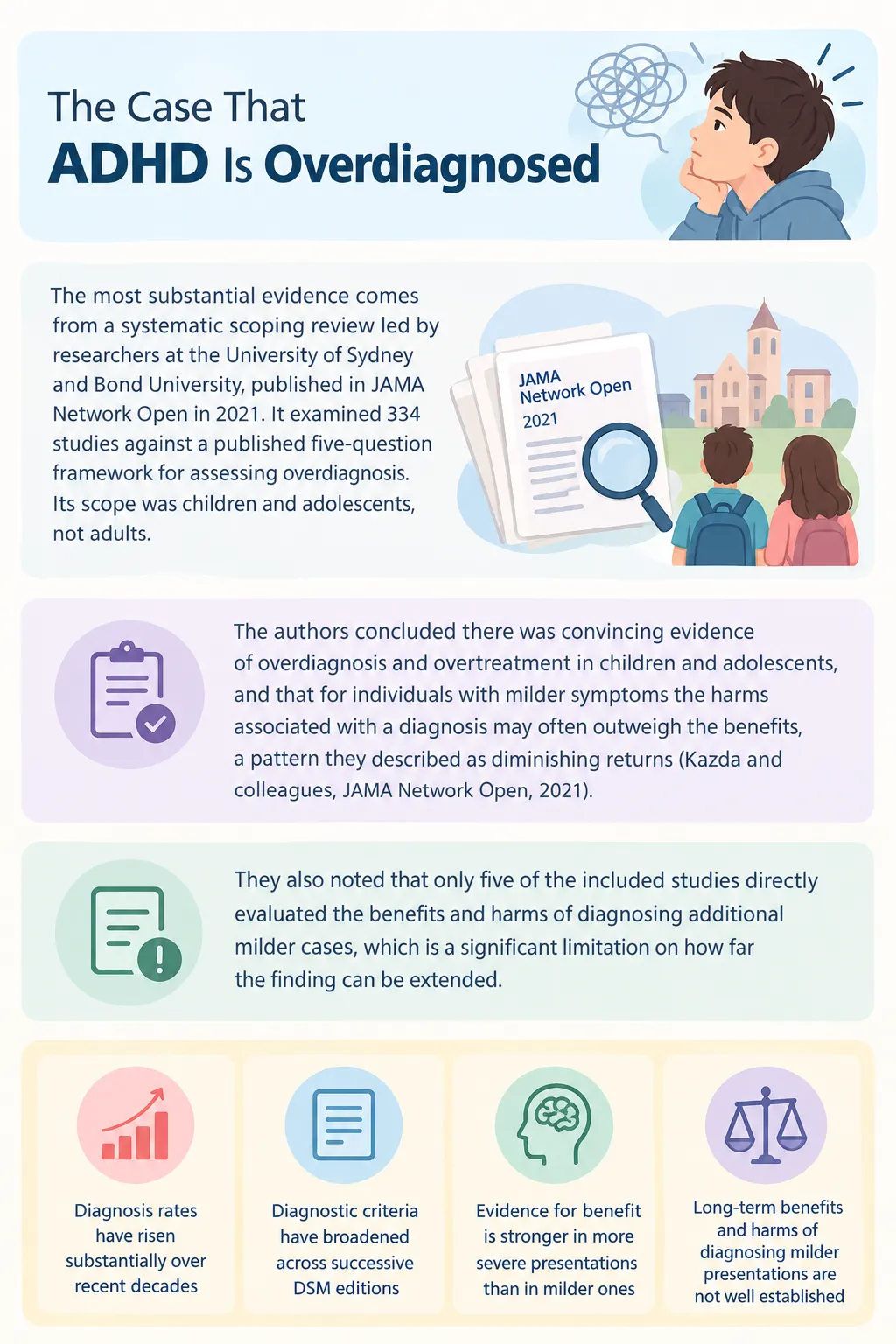
The most substantial evidence comes from a systematic scoping review led by researchers at the University of Sydney and Bond University, published in JAMA Network Open in 2021. It examined 334 studies against a published five-question framework for assessing overdiagnosis. Its scope was children and adolescents, not adults.
The authors concluded there was convincing evidence of overdiagnosis and overtreatment in children and adolescents, and that for individuals with milder symptoms the harms associated with a diagnosis may often outweigh the benefits, a pattern they described as diminishing returns (Kazda and colleagues, JAMA Network Open, 2021). They also noted that only five of the included studies directly evaluated the benefits and harms of diagnosing additional milder cases, which is a significant limitation on how far the finding can be extended.
- Diagnosis rates have risen substantially over recent decades
- Diagnostic criteria have broadened across successive DSM editions
- Evidence for benefit is stronger in more severe presentations than in milder ones
- Long-term benefits and harms of diagnosing milder presentations are not well established
The authors were explicit that evidence gaps remain and that further research is needed, particularly on long-term outcomes for young people with milder symptoms.
The Case Against Systematic Overdiagnosis
Other researchers have reached different conclusions using different framings, though the most frequently cited counterargument is now some years old.
An earlier review, published in 2007, argued that for ADHD to be overdiagnosed the number of false positives would have to substantially exceed the number of false negatives. Reviewing prevalence studies and research on diagnostic accuracy available at that time, the authors concluded there was not sufficient justification for the claim that ADHD is systematically overdiagnosed, and noted that this conclusion is not generally reflected in public perception or media coverage (Sciutto and Eisenberg, Journal of Attention Disorders, 2007). It remains useful as historical context, and it predates both the broadened DSM-5 criteria and the more recent overdiagnosis literature.
- Rising diagnosis rates can reflect improved recognition rather than inflation
- Specific groups remain under-recognised, which counts on the other side of the ledger
- Diagnosed prevalence in many populations remains at or below estimated true prevalence
- Public perception of overdiagnosis runs ahead of the evidence for it
Why Both Can Be True at Once
Overdiagnosis and underdiagnosis are often treated as opposites, which is what makes the evidence look contradictory.
At population level they are not opposites. They describe different groups. A system can simultaneously identify too readily in one population and miss too often in another. In false-positive and false-negative terms, a diagnostic system can produce a high rate of one in a particular group and a high rate of the other in a different group at the same time.
| More likely to be over-identified | More likely to be under-identified |
| Younger children relative to their school year cohort | Girls and women, particularly with inattentive presentations |
| Children with milder symptoms | Adults who were never assessed as children |
| Presentations that disrupt a classroom | Quieter presentations that produce no disruption |
| Settings with rapid or low-threshold assessment | People who compensated successfully for years |
Australia’s clinical guideline specifically identifies girls and women as a group at risk of under-recognition, and notes they may be more likely to receive another diagnosis such as anxiety or depression (Australian ADHD Professionals Association, 2022). That coexists with the overdiagnosis findings rather than contradicting them, because the two describe different populations.
The Relative Age Effect
A child’s age relative to their classmates is a recurring finding in this literature, although the size and interpretation of the effect vary between studies.
Research across several countries has found that children who are youngest in their school year are more likely to be diagnosed and treated for ADHD than the oldest in the same year. A 2019 systematic review and a 2024 meta-analysis of 32 studies both reported this association, though the meta-analysis also reported substantial heterogeneity between studies. A 2026 study reported repeated null findings in its own elementary-school analyses, which shows the literature is not uniform. The proposed mechanism is that in young children a few months of development makes a visible difference, and comparison is being made against classmates rather than against developmental norms.
Where the effect is present, it does not mean those diagnoses are all wrong. It suggests relative immaturity can sometimes be read as a disorder, which is the kind of pattern overdiagnosis concerns describe. Given the mixed findings, it is better treated as a reason for care in assessing young children than as a settled result.
Undiagnosed ADHD in Adults
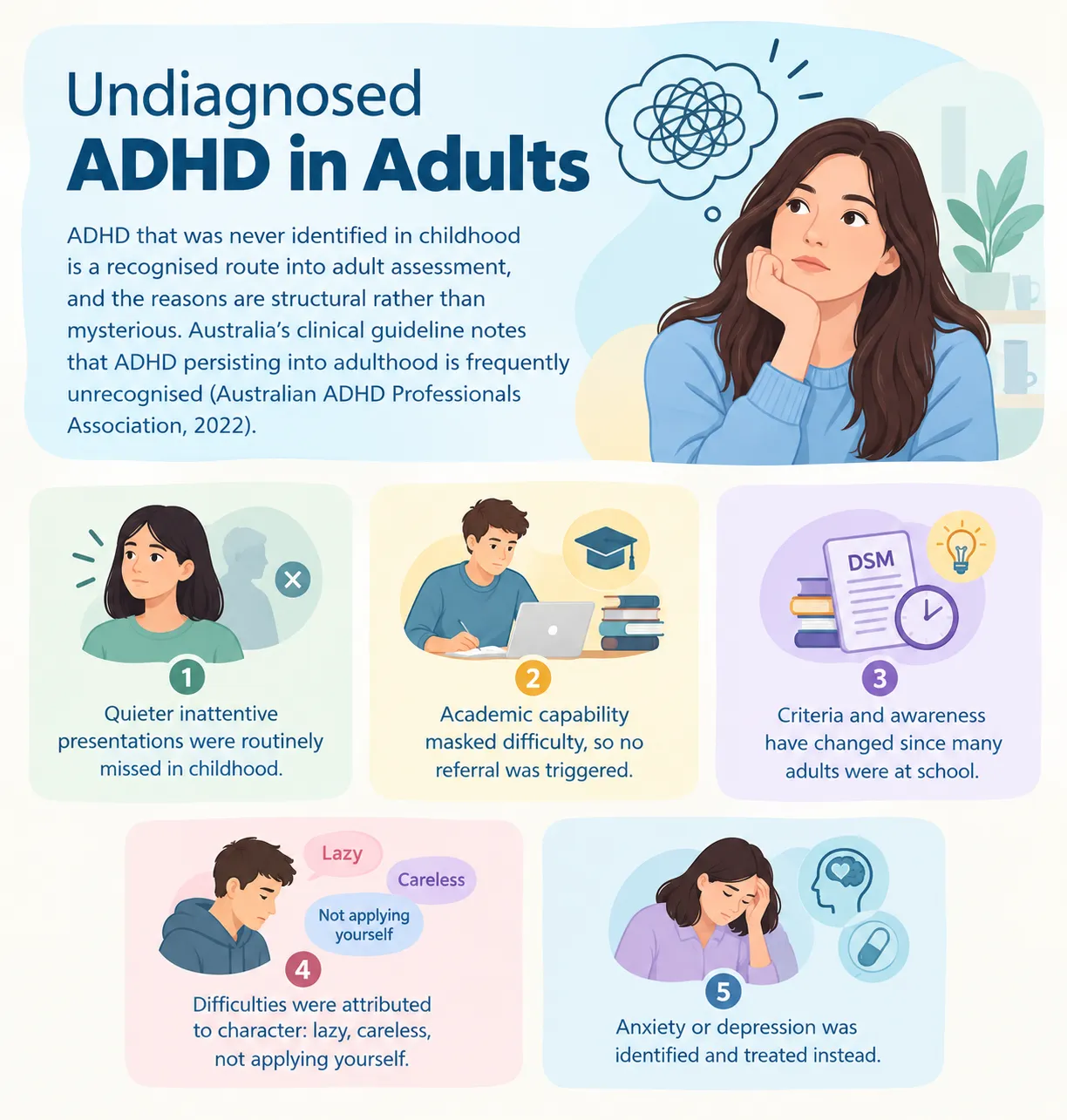
ADHD that was never identified in childhood is a recognised route into adult assessment, and the reasons are structural rather than mysterious. Australia’s clinical guideline notes that ADHD persisting into adulthood is frequently unrecognised (Australian ADHD Professionals Association, 2022).
- Quieter inattentive presentations were routinely missed in childhood
- Academic capability masked difficulty, so no referral was triggered
- Criteria and awareness have changed since many adults were at school
- Difficulties were attributed to character: lazy, careless, not applying yourself
- Anxiety or depression was identified and treated instead
What accumulates is usually consequences rather than symptoms: a persistent gap between capability and outcomes, unfinished projects, and self-criticism that hardened into an explanation. Our guide to ADHD symptoms in adults covers this in more depth.
Misdiagnosis in Both Directions
Diagnosed with ADHD when something else fits better
Anxiety, depression, sleep disorders, trauma-related conditions, thyroid disorders and sustained stress can all produce overlapping difficulties. A rushed assessment that does not consider these carefully can land on ADHD when another explanation fits better.
Diagnosed with something else when it was ADHD
The opposite error also occurs and is less discussed. Australia’s clinical guideline notes that girls and women may be more likely to receive a diagnosis such as anxiety or depression where ADHD is the underlying pattern (Australian ADHD Professionals Association, 2022). How often this happens relative to the first error is not established. Treating the anxiety was not wrong; it addressed what was visible.
What reduces both errors is the same thing: an assessment that covers the components clinical guidance describes. Australia’s clinical guideline sets out clinical and psychosocial assessment, developmental, mental health and medical history, observer information, functional impairment and consideration of alternative and co-occurring conditions (Australian ADHD Professionals Association, 2022). Where any of those is absent, the clinician is working from less information, in either direction.
ADHD Self-Diagnosis
ADHD self diagnosis has become common. The question here is narrow: what self-identification can and cannot establish. Making sense of your own symptoms in the first place is covered separately in the guide to whether you might have ADHD.
Recognising yourself in a description is a reasonable reason to seek assessment. It cannot establish that symptoms have been present since childhood, appear across settings, cause functional impairment, or are not better explained by something else. Those judgements require information you do not have about yourself, and comparison you cannot make.
The concern is not that people who self-identify are wrong. Many are not. It is that self-diagnosis cannot distinguish between ADHD and the several other conditions that produce similar experiences, which is the part that determines what actually helps.
What This Means If You Are Seeking Assessment
- A thorough assessment is the answer to both concerns. It reduces the risk of a diagnosis that does not fit, and the risk of a genuine pattern being missed
- Ask what alternative explanations were considered. A clinician should be able to answer this
- Ask what the assessment will cover. Clinical guidance describes developmental history, current symptoms, functional impairment, alternative explanations and information from other sources where appropriate. Duration alone does not determine quality; the components do
- Equally, be cautious of being dismissed on grounds that do not rule ADHD out, such as doing well at school or not being visibly hyperactive
- A conclusion of not ADHD is a valid outcome, and often identifies something more directly addressable
The pillar guide sets out what a comprehensive ADHD assessment involves and what a diagnosis has to establish.
If You Are Unsure About an ADHD Diagnosis
Questioning a diagnosis you have already received is reasonable, and it is a conversation to have with the clinician who made it rather than a reason to discard it.
- Ask how the diagnosis was established and what evidence it rested on
- Ask what alternative explanations were considered and how they were ruled out or ruled in as co-occurring
- Ask whether developmental history was taken and what it drew on
- Ask whether functional impairment was assessed, and across which settings
- Raise anything that was not available at the time, such as school records or an informant who can now be contacted
- Seek another appropriately qualified assessment where uncertainty remains
Clinical assessment does not work like a laboratory test with a single cut-off. Some diagnostic uncertainty is normal, and a clinician should be able to explain what the formulation rests on and where it is less certain.
How to Read the Evidence on This Question
Coverage of this debate tends to quote single studies without saying what kind of evidence they are. Broadly, the weight runs in this order:
- Clinical guidelines, such as the Australian ADHD guideline, which synthesise evidence and are developed for a specific health system
- Systematic reviews and meta-analyses, which pool multiple studies but depend on the quality and consistency of what they pool
- Individual cohort or observational studies, which can show associations but not causes
- Expert commentary and media interpretation, which is the level most public debate about ADHD overdiagnosis happens at
Population, country and date matter as much as the finding. The 2021 review concerned children and adolescents, not adults, and a finding in one school system does not automatically transfer to another.
Related Guides
- ADHD symptoms in women and girls
- ADHD statistics and prevalence in Australia
- What actually happens in an ADHD assessment
References
- Kazda L, Bell K, Thomas R, McGeechan K, Sims R, Barratt A. Overdiagnosis of attention-deficit/hyperactivity disorder in children and adolescents: a systematic scoping review. JAMA Network Open. 2021;4(4):e215335. doi:10.1001/jamanetworkopen.2021.5335
- Sciutto MJ, Eisenberg M. Evaluating the evidence for and against the overdiagnosis of ADHD. Journal of Attention Disorders. 2007;11(2):106–113. PMID 17709814
- Australian ADHD Professionals Association. Australian Evidence-Based Clinical Practice Guideline for Attention Deficit Hyperactivity Disorder (ADHD). Released October 2022. adhdguideline.aadpa.com.au
- American Psychiatric Association. Diagnostic and Statistical Manual of Mental Disorders, Fifth Edition, Text Revision (DSM-5-TR). 2022.
- Systematic review of relative age and ADHD symptoms, diagnosis and medication. 2019. PMID 30293121
- Systematic review and meta-analysis of relative age in attention-deficit/hyperactivity disorder and autism spectrum disorder, covering 32 studies. 2024. PMID 38767699
- Younger-for-grade children are not at greater likelihood for ADHD diagnosis during elementary school: repeated evidence of a null relative age effect. 2026. PMID 41668340
- Healthdirect Australia. Attention deficit hyperactivity disorder (ADHD). healthdirect.gov.au