

How Is ADHD Diagnosed in Women?
Through clinical assessment covering developmental history, symptoms across settings, functional impairment and other possible explanations. There is no separate diagnostic test or diagnostic criteria for women. The core assessment framework is the same, but clinicians need to consider how symptoms present across different ages, settings and individuals, including masking and compensation that contribute to under-recognition in girls and women (Australian ADHD Professionals Association, 2022).
Most women who reach ADHD testing for women have already spent time wondering. Often something specific triggered it: a child’s diagnosis, a period where coping stopped working, or reading something that described a life they recognised.
This guide covers what assessment involves, how it works in Australia, how to prepare, and what to do if you are not taken seriously. Our guide to ADHD symptoms in women covers how presentation differs.
Is There a Separate ADHD Test for Women?
No. There is no validated female ADHD test, no separate ADHD test female version, and no gender-specific diagnostic criteria. The instruments used are the same ones used for everyone, and searches for a female ADHD test or an ADHD test for adult women usually return informal questionnaires rather than validated scales.
The core diagnostic criteria are not gender-specific, but clinicians should consider how symptoms may present differently across individuals and life stages. That is where the real difference lies.
Can an ADHD Screening Test Diagnose ADHD?
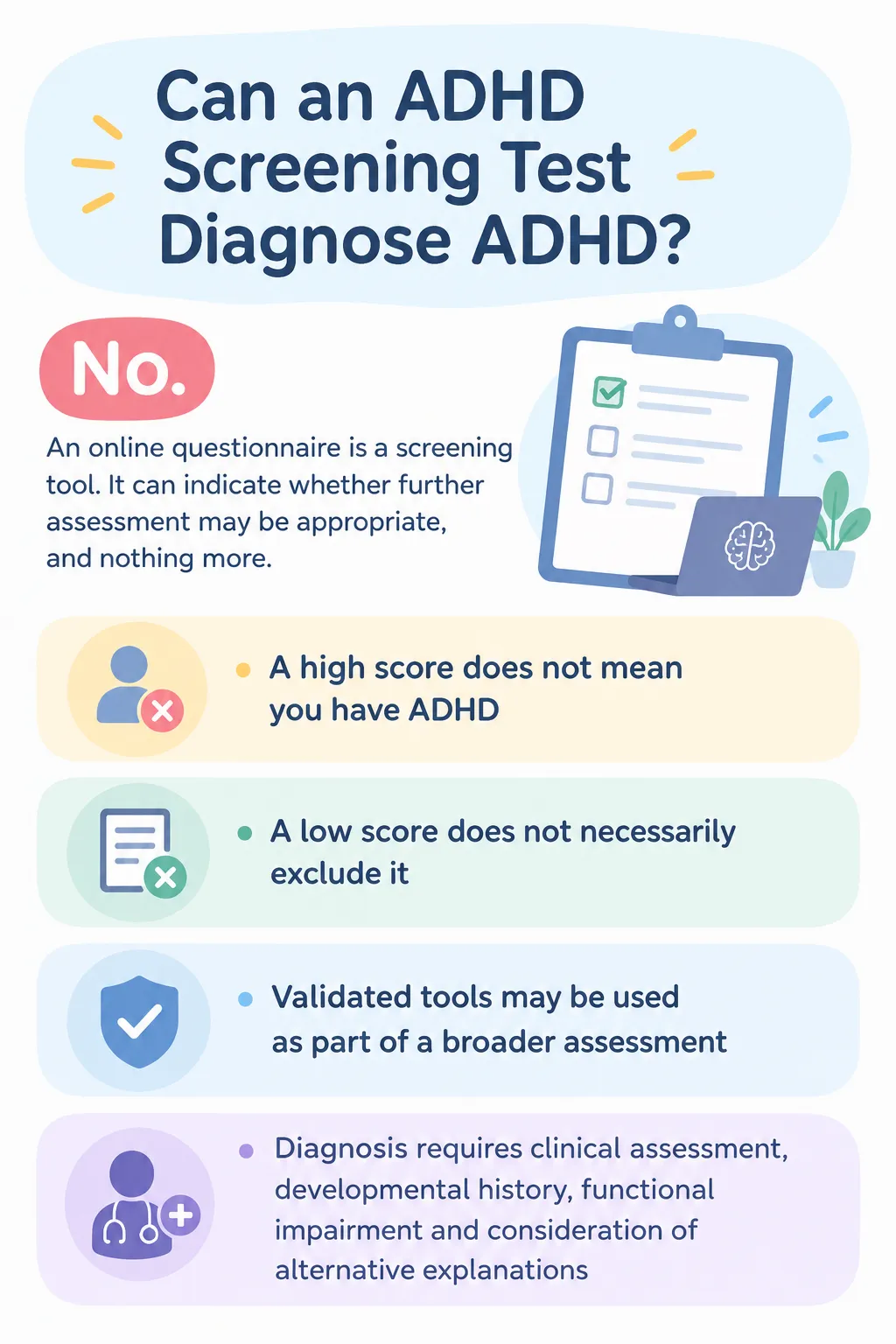
No. An online questionnaire is a screening tool. It can indicate whether further assessment may be appropriate, and nothing more.
- A high score does not mean you have ADHD
- A low score does not necessarily exclude it
- Validated tools may be used as part of a broader assessment
- Diagnosis requires clinical assessment, developmental history, functional impairment and consideration of alternative explanations
Australia’s clinical guideline states that rating scales are useful adjuncts and that diagnosis should not be based solely on them (Australian ADHD Professionals Association, 2022). Our pillar guide covers what ADHD tests can and cannot tell you.
Why ADHD Can Be Missed in Women
Australia’s clinical guideline identifies girls and women as a group at risk of under-recognition (Australian ADHD Professionals Association, 2022). Three related concepts explain much of why.
Masking
Deliberately or semi-consciously concealing difficulties or behaviours so they are not visible to others.
Compensation
Building systems that allow you to function despite underlying difficulties: lists, alarms, routines, preparation, rehearsal.
Overcompensation
Using substantially more time, effort or mental energy than expected to achieve an apparently ordinary outcome.
Two people arrive at work on time
One leaves home normally. The other sets three alarms, prepares everything the night before, leaves forty-five minutes early, and spends the commute anxious about being late. The outcome is identical. The functional burden is not. Assessment is interested in the second thing.
Inattentive presentations produce less disruption than hyperactive-impulsive ones, which affects who gets referred in childhood. Academic capability compounds this: a student who is capable enough to keep up rarely triggers a referral, however much effort it is taking.
Why Self-Report Scales Can Under-Detect in Women
- Rating scales ask how often something happens, not what it costs
- Comparison is internal. If you have always been this way, your rating is against your own baseline
- Compensation shows up in effort rather than in outcomes, and questionnaires measure outcomes
- Symptom wording drawn from classroom behaviour translates poorly to adult women’s lives
- Under-reporting is common in people told for years that their difficulties were character rather than condition
How to answer more accurately
Answer for what happens without the systems you have built, not with them. If you would forget the appointment without three reminders, the honest answer is that you forget appointments.
What ADHD Assessment for Women Involves
A thorough assessment includes clinical and psychosocial assessment, developmental, mental health and medical history, observer information, and medical assessment where clinically indicated (Australian ADHD Professionals Association, 2022).
- A clinical interview covering current difficulties and how they affect daily life.
- Developmental history, covering early childhood, school and when difficulties were first noticed.
- Mental health, medical and family history, since ADHD runs strongly in families.
- Standardised rating scales completed by you, and often by a partner, parent or someone who has known you a long time.
- Discussion of how difficulties present across different settings, such as work, home and relationships.
- Assessment of functional impairment, including what maintaining your current functioning actually requires.
- Consideration of alternative and co-occurring explanations.
What the Clinician Is Actually Trying to Establish
Behind the process, the clinician is answering a fixed set of questions.
- Are symptoms consistent with ADHD present?
- Have they been persistent rather than recent?
- Did relevant difficulties begin during childhood?
- Do they occur across more than one setting?
- Do they cause clinically meaningful functional impairment?
- Could another condition better explain them?
- Are other conditions present alongside ADHD?
What an ADHD diagnosis needs to establish
Symptoms consistent with ADHD; present for at least six months; evidence of onset during childhood; occurring across relevant settings; causing clinically meaningful impairment; and not better explained by another condition.
Functional Impairment: The Question Behind the Questions
Assessment is framed around symptoms plus functional impairment rather than symptom presence alone (Australian ADHD Professionals Association, 2022). This is the part women most often under-report, because years of compensation make the cost feel normal.
Areas clinicians consider include work performance, study, household administration, finances, parenting responsibilities, relationships, time management, organisation, emotional regulation and maintaining routines.
The useful question is not whether you recognise the symptoms. It is what these difficulties actually cost you.
Can You Have ADHD and Still Be Successful?
Yes. Academic or professional success does not exclude ADHD. External achievement can coexist with significant internal effort, and compensation can conceal difficulties from everyone including the person themselves.
Diagnosis depends on the overall clinical pattern and impairment, not on whether someone appears to be managing. The term high-functioning ADHD is commonly used online, but it is not a formal ADHD presentation and does not appear in diagnostic criteria.
Why ADHD May Become More Noticeable in Adulthood
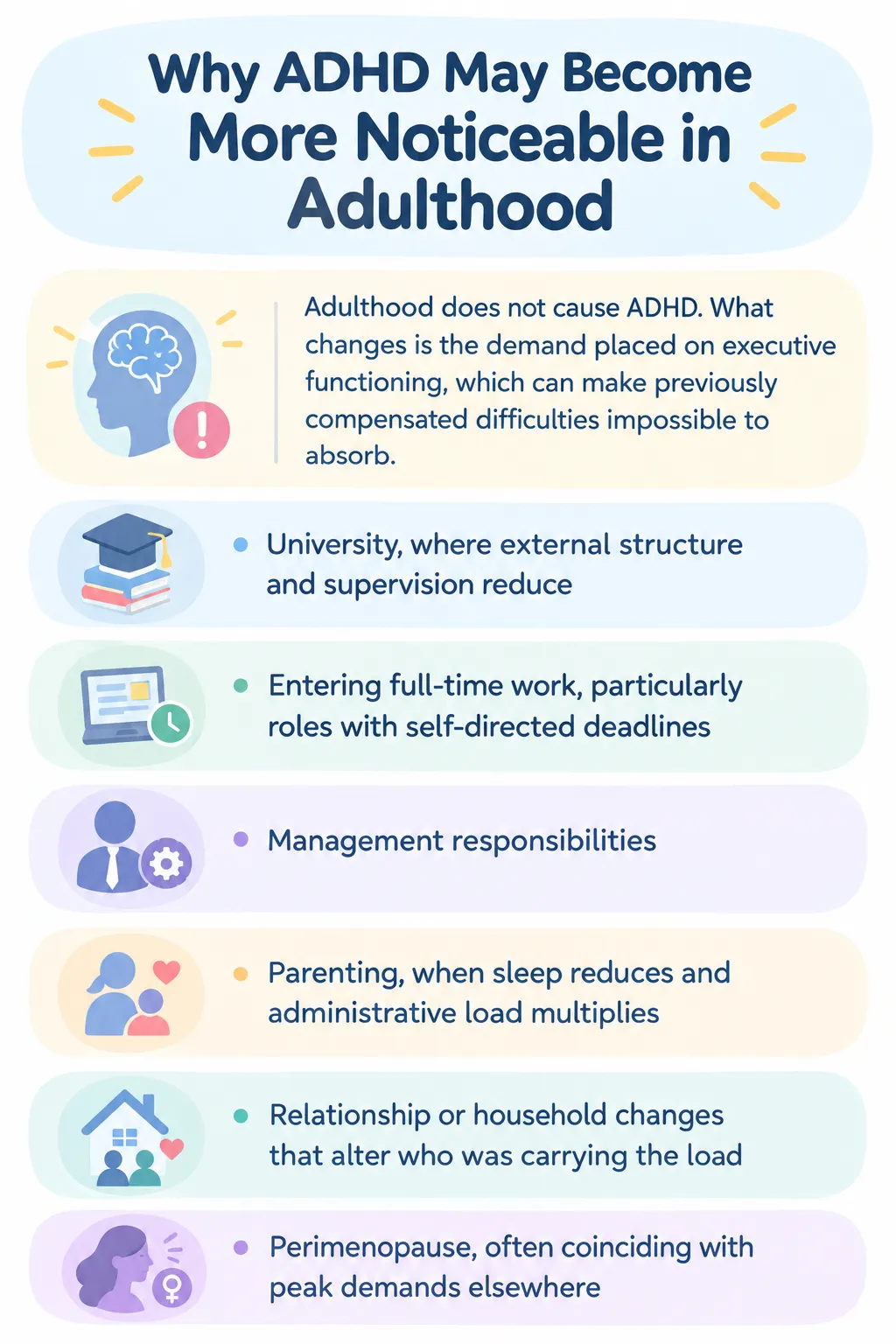
Adulthood does not cause ADHD. What changes is the demand placed on executive functioning, which can make previously compensated difficulties impossible to absorb.
- University, where external structure and supervision reduce
- Entering full-time work, particularly roles with self-directed deadlines
- Management responsibilities
- Parenting, when sleep reduces and administrative load multiplies
- Relationship or household changes that alter who was carrying the load
- Perimenopause, often coinciding with peak demands elsewhere
What Clinicians Look For in Your Childhood History
Diagnostic criteria require evidence of onset during childhood. For many women this is the hardest part of assessment.
School reports for girls who were not disruptive often say things like chatty, disorganised, could apply herself more, or does not always finish work. Those descriptions are relevant evidence, even though they do not sound like it. What clinicians are looking for is not a record of hyperactivity but a record of a pattern.
- School reports, particularly comments rather than grades
- Anything a parent or older sibling remembers about how you were as a child
- Old assessments, even for something else
- Your own specific memories: what was difficult, what took longer, what you avoided
- Whether anyone in your family has ADHD
What if I do not have childhood records?
Tell the clinician. They can use the available developmental history and other evidence when considering whether the required childhood history is supported. Absence of records does not prevent assessment.
How ADHD Assessment Works in Australia
Who can assess ADHD?
ADHD assessment can involve psychologists, psychiatrists, paediatricians and other appropriately trained clinicians, depending on age, location, service and the purpose of assessment. Clinical interviews are usually conducted by clinicians experienced in developmental and mental health disorders. The clinician’s qualifications and scope of practice matter more than the profession label alone, and arrangements differ between states and territories.
Where to start
For most people the practical first step is seeing a doctor, who can discuss your concerns and refer to a psychologist or psychiatrist where appropriate. A referral is generally relevant to Medicare rebates rather than being universally required, and requirements vary by service.
How long does an assessment take?
A detailed clinical interview may take two to three hours and may be arranged across several sessions, although structure varies considerably by clinician and setting (Australian ADHD Professionals Association, 2022).
Cost and waiting times
Fees vary significantly between providers. Medicare rebates depend on the service, the clinician and your eligibility, and private assessment may involve substantial out-of-pocket costs. Waiting times vary by provider, location and whether the pathway is public or private. Check fees, rebate eligibility and expected timeframes before booking.
Hormones and Assessment Timing
Australia’s clinical guideline notes that symptoms may vary during the menstrual cycle and across reproductive stages, while also noting that the evidence in this area is limited (Australian ADHD Professionals Association, 2022).
Because some women report symptom changes across the cycle and through pregnancy, postpartum and perimenopause, it can be useful to tell your clinician about noticeable patterns. This is not a separate diagnostic test and is not required for an ADHD assessment.
How to Prepare for Your Assessment
| Instead of | Bring |
| I am disorganised | I have missed three appointments this year despite calendar reminders |
| I procrastinate | I did the tax return at 11pm the night before, as I have every year |
| I struggle at work | I work an extra hour daily to produce what colleagues produce in normal hours |
| I was always distracted at school | My reports said I was capable but did not finish work |
| I get overwhelmed | I cancelled twice last month because the day had too many separate things in it |
Also worth noting: what you have already tried, whether it helped, and what happens when the systems you rely on are disrupted.
Questions to Ask Your Clinician
- What makes you think ADHD is or is not likely in my case?
- What alternative explanations have you considered?
- Was an inattentive presentation specifically considered?
- How did you interpret my childhood history?
- What evidence would support or argue against ADHD here?
- If ADHD is not diagnosed, what do you think explains these difficulties?
If You Are Not Taken Seriously
This is common enough that it is worth planning for, and it is not a reason to stop.
- Ask what specifically led to that conclusion
- Describe function rather than symptoms. What you cannot do is harder to dismiss than what you feel
- Bring an informant if you can. A partner or parent describing what they observe carries weight
- You are entitled to seek a second opinion, and doing so is reasonable
Doing well at school, having strong academic ability or not being visibly hyperactive does not by itself rule out ADHD. These factors should be considered alongside developmental history, symptoms and functional impact.
What Happens After the Assessment
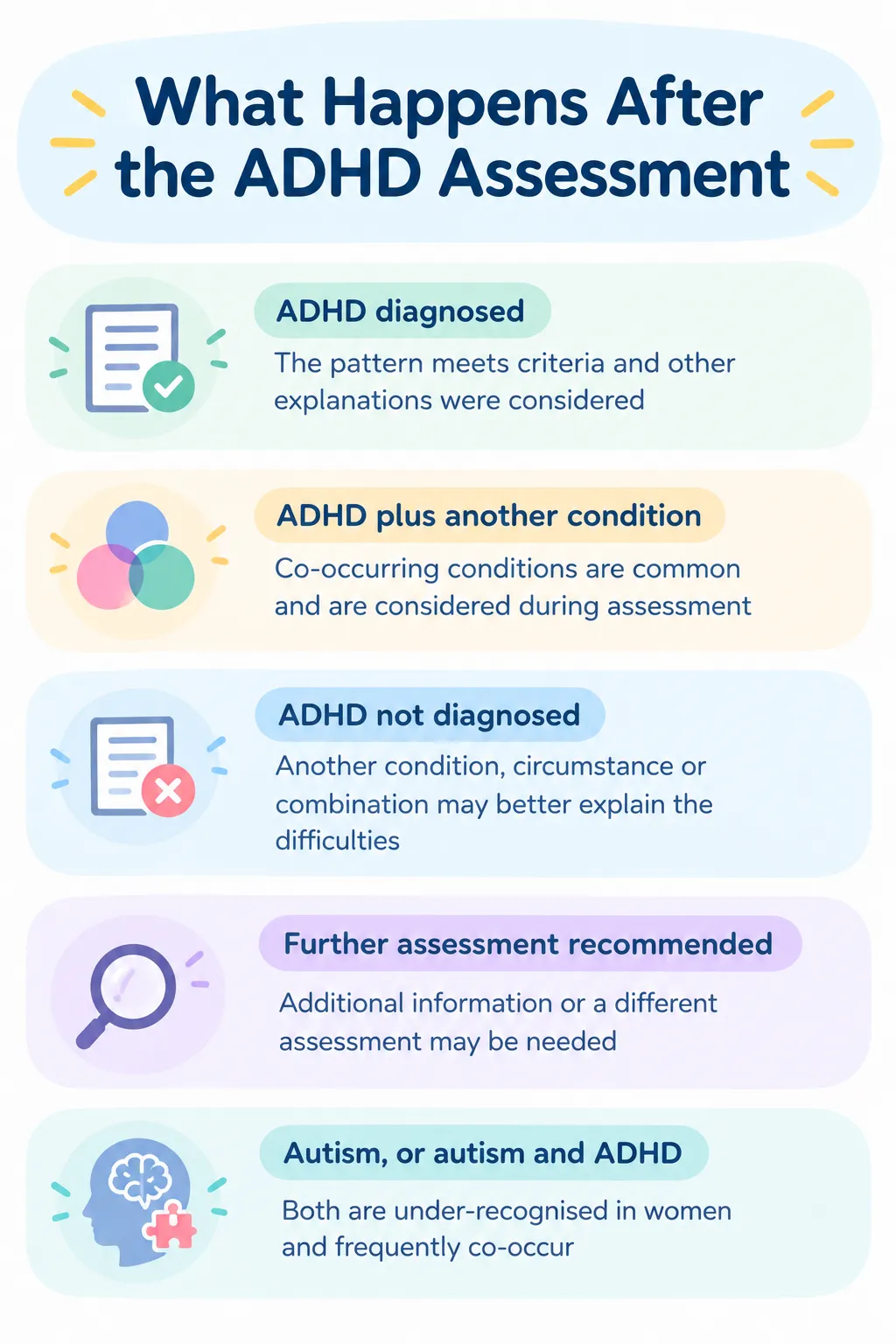
| Outcome | What it means |
| ADHD diagnosed | The pattern meets criteria and other explanations were considered |
| ADHD plus another condition | Co-occurring conditions are common and are considered during assessment |
| ADHD not diagnosed | Another condition, circumstance or combination may better explain the difficulties |
| Further assessment recommended | Additional information or a different assessment may be needed |
| Autism, or autism and ADHD | Both are under-recognised in women and frequently co-occur |
A diagnosis is not the only useful outcome. A well-conducted assessment should clarify what is contributing to the difficulties and what further support or assessment may be appropriate.
Why Other Conditions Are Considered
Assessment is not simply checking whether you recognise the symptoms. It is determining whether ADHD best explains the overall pattern.
| Possible contributor | Why it can overlap |
| Anxiety | Concentration problems, restlessness, racing thoughts |
| Depression | Reduced concentration, motivation and energy |
| Sleep disorders | Daytime inattention, fatigue and executive difficulties |
| Autism | Executive function and social difficulties can overlap |
| Trauma-related conditions | Concentration, arousal and emotional symptoms can overlap |
| Medical conditions | Some medical conditions and nutritional deficiencies can contribute to fatigue or concentration difficulties, so a clinician may consider medical causes where indicated |
Some women seeking ADHD assessment have previously been treated for anxiety, depression or another condition. That treatment may have been appropriate while leaving the question of ADHD unresolved.
Related Guides
- ADHD questionnaires and rating scales
- Do I have ADHD? Making sense of your own symptoms
- Inattentive ADHD (formerly known as ADD)
- Free Adult ADHD screening questionnaires.
- ADHD Symptoms The Full Symptom Picture
References
- Australian ADHD Professionals Association. Australian Evidence-Based Clinical Practice Guideline for Attention Deficit Hyperactivity Disorder (ADHD). Released October 2022. Sections on high-risk groups, assessment and diagnosis. adhdguideline.aadpa.com.au
- Healthdirect Australia. Attention deficit hyperactivity disorder (ADHD). healthdirect.gov.au
- Young S, Adamo N, Asgeirsdottir BB, et al. Females with ADHD: an expert consensus statement taking a lifespan approach providing guidance for the identification and treatment of attention-deficit/hyperactivity disorder in girls and women. BMC Psychiatry. 2020;20:404. PMC7422602
- American Psychiatric Association. Diagnostic and Statistical Manual of Mental Disorders, Fifth Edition, Text Revision (DSM-5-TR). 2022.
Last reviewed: September 2026. Next scheduled review: September 2027. This article is general information and is not a substitute for individual medical advice, assessment or diagnosis.