

What Is an ADHD Questionnaire?
An ADHD questionnaire, or rating scale, is a structured set of questions about symptoms, completed by the person or by someone who knows them well. Clinicians use them to gather information in a consistent, comparable way. Australia’s clinical guideline states that rating scales are useful adjuncts but should not be used alone to diagnose ADHD (Australian ADHD Professionals Association, 2022).
An ADHD checklist and an ADHD questionnaire usually mean the same thing: a set of symptom questions with a structured way of scoring the answers. Searches for a checklist for ADHD, an adult ADHD questionnaire, an ADHD adult questionnaire or an ADHD questionnaire Australia all describe the same category of instrument. The useful distinction is not between the words, but between the instruments themselves, which differ in who completes them, what age group they were designed for, and how the results are used.
This guide covers the main scales used in Australian practice. Our pillar guide covers what ADHD tests can and cannot tell you, and our guide to free ADHD tests covers which screeners are available without payment.
Why Clinicians Use Rating Scales At All
Rating scales are not shortcuts. They do specific things that an unstructured conversation does not.
- They ensure the same questions are asked every time, rather than depending on what comes up
- They allow comparison against normed populations, which gives a score context
- They can be completed by more than one person, which is how informant information is gathered systematically
- They can be repeated over time, which makes change measurable
- They produce a record that can be shared between clinicians
Their limitation is not that they are unreliable. It is that they answer one part of a larger question. A scale can tell you how someone rates their symptoms. It cannot establish whether those symptoms began in childhood, appear across settings, cause impairment, or are better explained by something else.
The Main ADHD Questionnaires
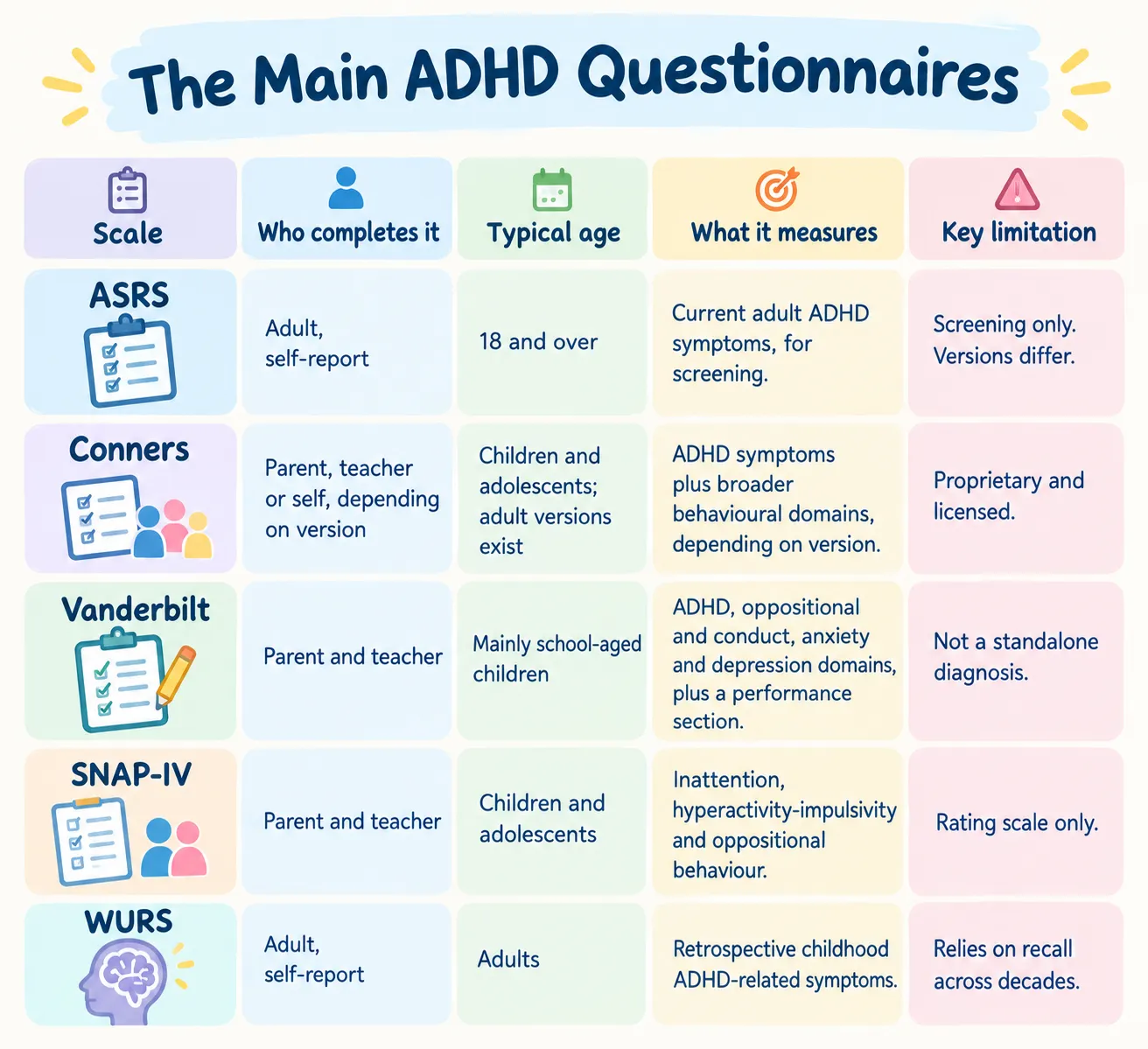
| Scale | Who completes it | Typical age | What it measures | Key limitation |
| ASRS | Adult, self-report | 18 and over | Current adult ADHD symptoms, for screening | Screening only. Versions differ |
| Conners | Parent, teacher or self, depending on version | Children and adolescents; adult versions exist | ADHD symptoms plus broader behavioural domains, depending on version | Proprietary and licensed |
| Vanderbilt | Parent and teacher | Mainly school-aged children | ADHD, oppositional and conduct, anxiety and depression domains, plus a performance section | Not a standalone diagnosis |
| SNAP-IV | Parent and teacher | Children and adolescents | Inattention, hyperactivity-impulsivity and oppositional behaviour | Rating scale only |
| WURS | Adult, self-report | Adults | Retrospective childhood ADHD-related symptoms | Relies on recall across decades |
Which ADHD Questionnaire Is Used for Each Age Group?
Which ADHD questionnaire is used for adults?
Three instruments do different jobs. The ASRS covers current adult symptoms. The WURS asks adults to recall childhood symptoms, which supports the developmental history required for adult diagnosis. DIVA is a clinician-administered structured interview rather than a questionnaire you complete yourself.
Which ADHD questionnaire is used for children?
Parent and teacher rating scales are central, because criteria require evidence across settings. Vanderbilt covers ADHD alongside oppositional, conduct, anxiety and depression domains and a performance section. Conners provides broader behavioural assessment. SNAP-IV rates ADHD and oppositional symptoms. The scale chosen depends on the clinician, the child’s age, the setting and the purpose of assessment.
Which ADHD questionnaire is used for preschool children?
Assessment at this age requires particular developmental judgement and should not rely on a checklist alone.
Which ADHD questionnaire is best?
There is no single best ADHD questionnaire. The appropriate instrument depends on age, who is providing the information, and what the clinician is trying to assess. A scale that suits an adult self-reporting current symptoms is not the scale that suits a teacher rating a nine-year-old.
ASRS: The Adult ADHD Self-Report Scale
The ASRS was developed through a World Health Organization collaborative process and published by Kessler and colleagues in 2005. It is one of the most widely recognised adult ADHD screening questionnaires.
- It is a self-report scale, completed by the adult themselves
- The full version contains eighteen items corresponding to the diagnostic symptom domains
- Shorter screening versions exist, and different versions use different scoring approaches
- ASRS-5 is a separate six-question scale published in 2017 to align screening with DSM-5. It is not the same as the earlier ASRS Part A
Which version are you looking at?
ASRS versions can be confusing because more than one instrument is in use. The original ASRS v1.1 is an 18-item checklist developed around DSM-IV criteria, with Part A containing six screening questions and Part B the remaining twelve. The later ASRS-5 is a separate six-item screening scale developed to align with DSM-5. If you are using an ASRS online, check which version it is and follow that version’s scoring instructions rather than a cutoff quoted elsewhere.
The ASRS is copyrighted by New York University and its developers. Reputable sources reproduce it with attribution.
Conners Rating Scales
The Conners scales are a family of instruments rather than a single questionnaire. Versions exist for parents, teachers and self-report, across children, adolescents and adults.
They cover a broader range than ADHD symptoms alone, which is part of their value. A Conners assessment can flag co-occurring difficulties that a narrow ADHD checklist would miss. They are commercial instruments, which means they are not freely available in the way the ASRS or Vanderbilt scales are, and they are generally administered through a clinician or psychologist.
Vanderbilt Assessment Scales
The Vanderbilt Assessment Scales are publicly available and are widely used as part of paediatric ADHD assessment. Parent and teacher versions exist, which matters because diagnostic criteria require evidence that difficulties appear in more than one setting.
Alongside ADHD symptoms, the Vanderbilt scales include items relating to oppositional behaviour, conduct difficulties, anxiety and depression, and a performance section covering academic and social functioning. That performance section is significant: it is one of the ways functional impact is assessed rather than symptoms alone.
ADHD Checklists for Women and Girls
There is no separate validated ADHD checklist for women or girls. The instruments above are used for everyone, and searches for an ADHD in women checklist, an ADHD women checklist, an ADHD checklist women, an ADHD in girls checklist or an inattentive ADHD in girls checklist usually return informal lists rather than validated scales.
That does not make the underlying concern unreasonable. Australia’s clinical guideline notes that girls and women are at risk of under-recognition, particularly where symptoms are predominantly inattentive (Australian ADHD Professionals Association, 2022). What follows from that is not a different questionnaire, but care in interpretation: a self-report scale can under-represent difficulties in someone who has compensated for years, or who is comparing themselves to their own history rather than to anyone else’s.
Our guide to ADHD symptoms in women covers how presentation differs, and our guide to ADHD testing for women covers what to raise at assessment.
ADHD Questionnaires for Children
Assessment of children draws on information from multiple sources, including parents or carers, teachers or others who observe the child across settings, and the child themselves where appropriate.
This is why a childhood ADHD questionnaire, or an ADHD questionnaire for a child, is usually completed by adults around the child rather than by the child alone. Parent and teacher versions of the same scale allow comparison across settings, which is directly relevant to the diagnostic requirement for difficulties in more than one environment. A childhood ADHD checklist and an ADHD symptoms in children checklist describe the same thing.
Checklists for very young children
Searches for a 4 year old ADHD checklist are common. High activity, short attention span and impulsivity are typical of normal development at that age. The question is whether the pattern is developmentally inappropriate, persistent, occurs in relevant settings and causes meaningful impairment. Assessment in preschool children requires specialist judgement rather than a checklist. If you are concerned about a young child, speak with a GP or child health nurse.
What a Score Does and Does Not Mean
| A score can | A score cannot |
| Indicate whether symptoms meet a screening threshold | Establish a diagnosis |
| Provide a structured record of reported symptoms | Confirm symptoms began in childhood |
| Support structured comparison across informants or over time, depending on the instrument | Assess functional impairment on its own |
| Support a clinician’s assessment | Rule out alternative or co-occurring conditions |
Australia’s clinical guideline is explicit that diagnosis should not be based solely on rating scales (Australian ADHD Professionals Association, 2022). A score is information, not a conclusion.
What Does an ADHD Questionnaire Score Mean?
What does a positive score mean?
A positive screening score means the person’s responses are consistent with symptoms that warrant further assessment. It does not mean the person has ADHD. The clinician still needs to consider developmental history, symptoms across settings, functional impairment and other possible explanations.
What does a negative score mean?
A score below a screening threshold does not necessarily rule out ADHD, particularly where symptoms are subtle, have been compensated for, or are affected by the setting in which they are observed.
Why questionnaires produce both false positives and false negatives
Symptoms associated with ADHD also occur with anxiety, depression, sleep problems, stress, learning difficulties and other conditions, which can produce a positive screen in someone who does not have ADHD. Conversely, someone may score below a threshold despite experiencing significant difficulties. Australia’s clinical guideline discusses sensitivity, specificity and false positives and negatives as limitations of screening tools (Australian ADHD Professionals Association, 2022). This is why clinicians interpret questionnaire results alongside history, functioning and other evidence.
From Questionnaire to Diagnosis
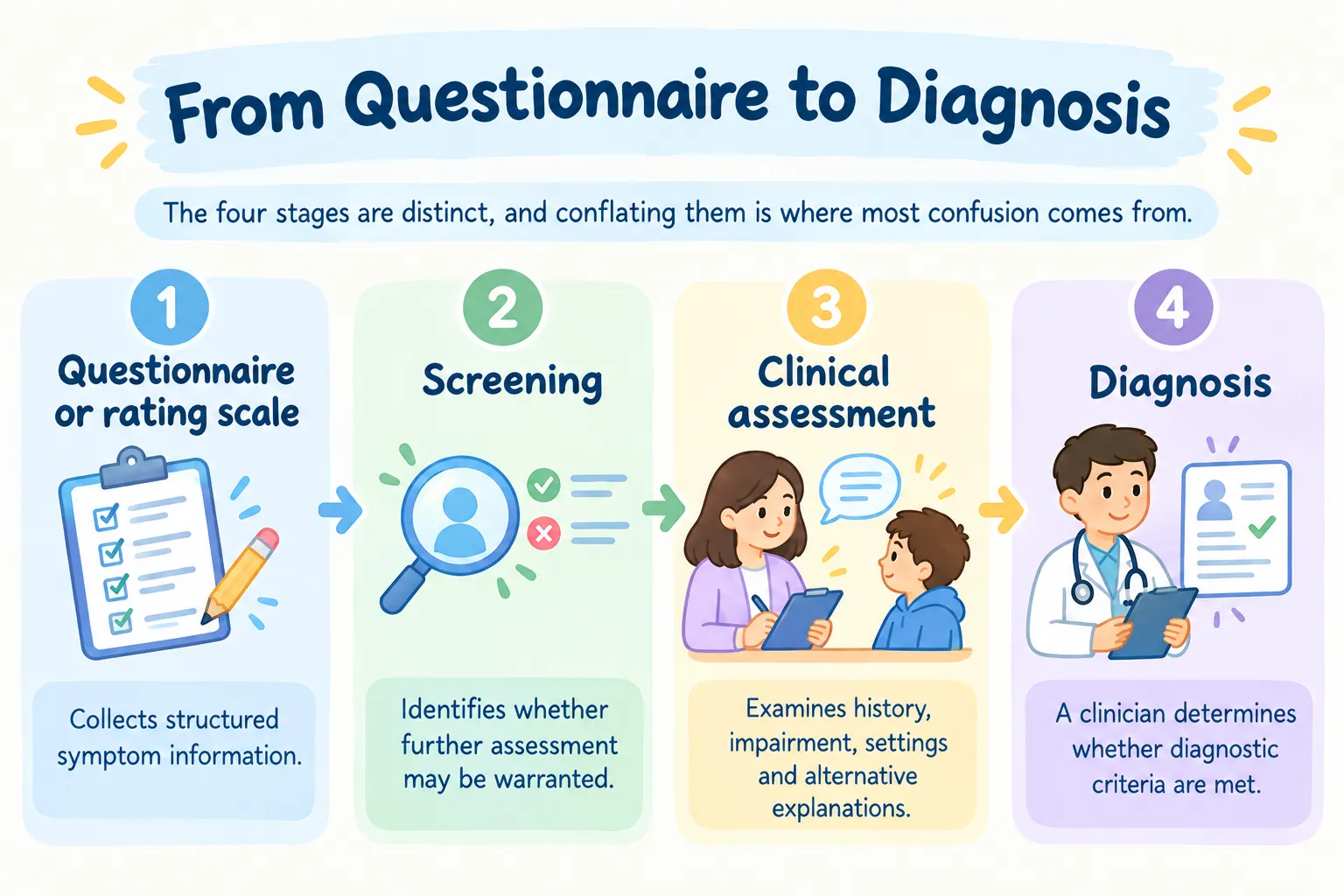
The four stages are distinct, and conflating them is where most confusion comes from.
| Stage | What happens |
| Questionnaire or rating scale | Collects structured symptom information |
| Screening | Identifies whether further assessment may be warranted |
| Clinical assessment | Examines history, impairment, settings and alternative explanations |
| Diagnosis | A clinician determines whether diagnostic criteria are met |
Why Two People Can Score the Same Person Differently
When parent and teacher ratings disagree, or when a partner rates someone differently from how they rated themselves, that is not a failure of the instrument.
- Different settings genuinely produce different behaviour, which is part of what assessment is looking at
- Observers notice different things. A teacher sees sustained work; a parent sees transitions and evenings
- Self-report is affected by comparison. People rate against their own baseline rather than against others
- Recent circumstances influence ratings in both directions
Discrepancies between informants are clinically informative rather than a problem to be resolved before assessment.
Should You Complete a Questionnaire Before Seeing a GP?
It is reasonable, and completing an ADHD questionnaire beforehand can help you organise your thinking. People search for ADHD questionnaire adults and ADHD questionnaire for adults Australia expecting a local instrument. Australian clinicians use established rating scales and assessment instruments, many of which were developed internationally and are also used in Australian practice. What is more useful to bring is specificity: what happens, how often, in which settings, and what the consequence is.
If you have school reports, old assessments or a family member who remembers your childhood, those carry weight that a self-completed score does not.
Related Guides
- Free ADHD tests for adults: where to find a validated screener
- Do I have ADHD? Making sense of your own symptoms
- ADHD test for women
- ADHD test for children and teens
References
- Australian ADHD Professionals Association. Australian Evidence-Based Clinical Practice Guideline for Attention Deficit Hyperactivity Disorder (ADHD). Released October 2022. Sections on screening and identification, and on assessment and diagnosis. adhdguideline.aadpa.com.au
- Kessler RC, Adler L, Ames M, et al. The World Health Organization Adult ADHD Self-Report Scale (ASRS): a short screening scale for use in the general population. Psychological Medicine. 2005;35(2):245–256.
- Ustun B, Adler LA, Rudin C, et al. The World Health Organization Adult Attention-Deficit/Hyperactivity Disorder Self-Report Screening Scale for DSM-5. JAMA Psychiatry. 2017;74(5):520–527.
- Ward MF, Wender PH, Reimherr FW. The Wender Utah Rating Scale: an aid in the retrospective diagnosis of childhood attention deficit hyperactivity disorder. American Journal of Psychiatry. 1993;150(6):885–890. PMID 8494063
- American Psychiatric Association. Diagnostic and Statistical Manual of Mental Disorders, Fifth Edition, Text Revision (DSM-5-TR). 2022.
Last reviewed: September 2026. Next scheduled review: September 2027. This article is general information and is not a substitute for individual medical advice, assessment or diagnosis.