

Is There a Free ADHD Test for Adults?
Yes. The Adult ADHD Self-Report Scale (ASRS), developed with the World Health Organization, is freely available and is the screener most widely used with adults. It indicates whether your symptoms warrant proper assessment. It does not diagnose ADHD, and no free test can. Diagnosis requires clinical assessment by a qualified practitioner.
Searching for a free ADHD test, an ADHD free test, an add adhd test for adults or a test for adhd adults returns hundreds of results, and most of them are not screening instruments. They are questionnaires written by whoever built the website, often designed to produce a result that encourages you to book something.
This guide covers which free screeners are genuinely validated, how to take one so the result means something, and how to read your score honestly. Our pillar guide covers what online ADHD tests can and cannot tell you in general terms, and our guide to ADHD rating scales covers how each instrument works.
Which Free ADHD Tests Are Actually Validated?
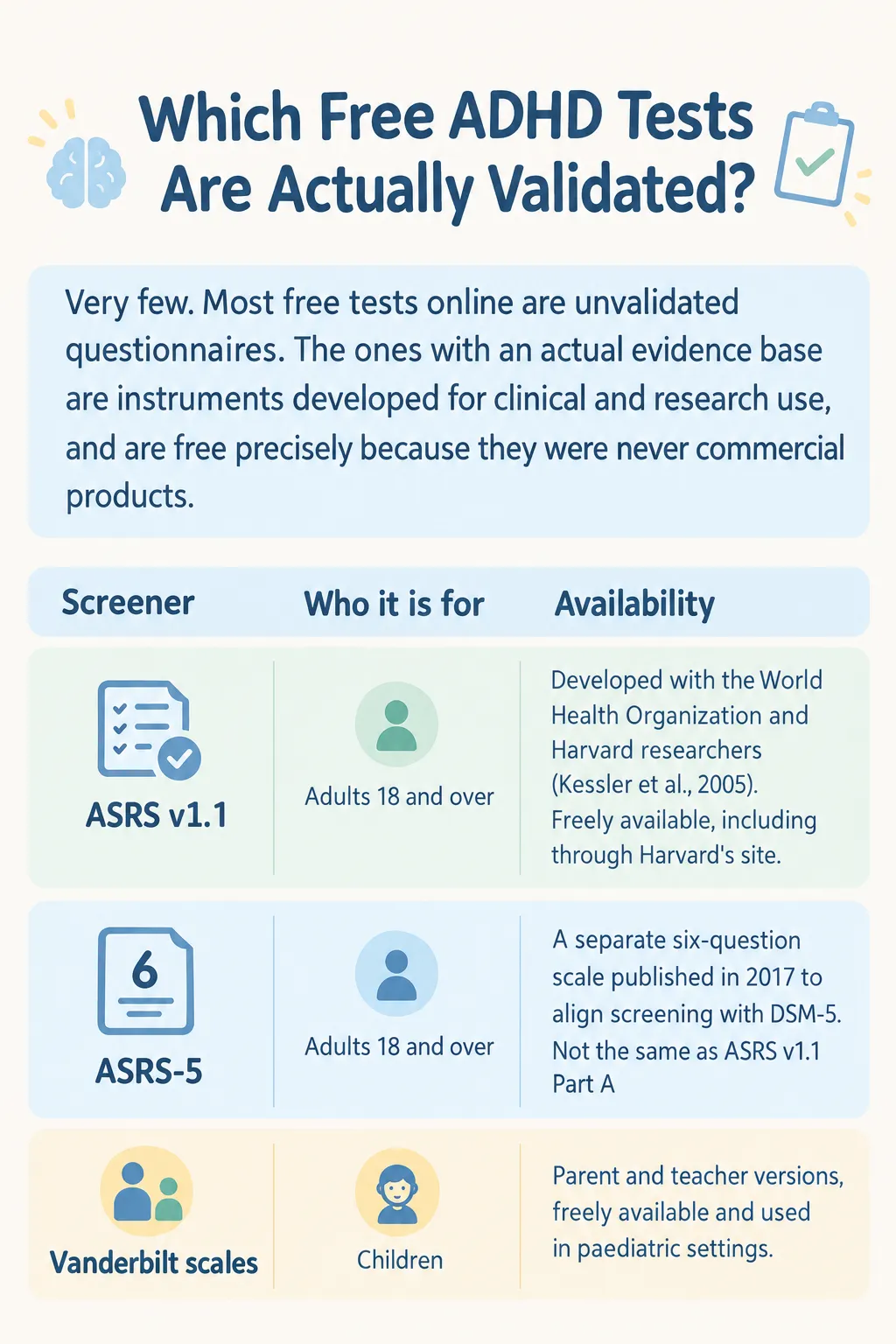
Very few. Most free tests online are unvalidated questionnaires. The ones with an actual evidence base are instruments developed for clinical and research use, and they are free precisely because they were never commercial products.
Two things worth knowing about the ASRS. It exists in more than one version, and the scoring guidance has been updated since the original release, so different sites apply different thresholds. Follow the scoring instructions that come with the version you use rather than a cutoff quoted elsewhere.
The ASRS is copyrighted by New York University and its developers. Reputable sites reproduce it with attribution. A site presenting the questions with no attribution has probably not thought carefully about much else either.
ADHD Quiz or ADHD Test: Is There a Difference?
Not in any meaningful sense. People search for an ADHD quiz, an add adhd quiz, a do i have adhd quiz, an adult ADHD test, an ADHD screener and free testing for ADHD, and in almost every case they want the same thing: a set of questions that indicates whether this is worth pursuing.
The word quiz sometimes signals something shorter and less formal, and often something less rigorous. If a quiz does not tell you which instrument it is based on, treat the result as entertainment rather than information.
How to Take a Self-Test Properly
Self-report is affected by more than you would expect, and a few things make a result more useful.
- Answer for the last six months, not for today. A bad week distorts the picture
- Answer honestly rather than aspirationally. People frequently under-report difficulties they have normalised
- Take it when you are not exhausted, unwell or acutely stressed, since all three affect concentration independently
- Do not read ahead to work out what the questions are getting at
- If you have a partner or family member who knows you well, consider asking how they would answer about you
That last point matters more than people expect. Self-report alone is limited, partly because attention difficulties affect self-monitoring, and partly because people compare themselves to their own history rather than to anyone else’s.
Understanding Your Result
A positive screen
This means the symptoms you reported are common in ADHD, and that further assessment is reasonable. It does not mean you have ADHD. The same symptoms are common in anxiety, depression, sleep disorders, trauma, thyroid conditions and periods of sustained stress.
A negative screen
This does not rule ADHD out. It is less likely on the basis of what you reported, which is a narrower statement than it sounds. Negative screens are more common in people with predominantly inattentive presentations, in people who have compensated successfully for years, and in people who under-report.
A borderline result
Common, and not especially informative either way. What matters more than the number is whether a long-standing pattern is causing difficulty across more than one part of your life.
The question the score does not answer
Screeners measure whether symptoms are present. They do not measure whether those symptoms are causing impairment, whether they have been present since childhood, or whether something else explains them better. Those are the questions that actually determine a diagnosis.
Why Adult Self-Report Is Harder Than It Looks
Adults face a specific difficulty that children do not, and it affects how screeners perform.
- You are reporting on a lifetime pattern you have no comparison for. If you have always been this way, it feels normal
- Years of compensation can mask symptoms in a way that shows up in your effort rather than in your answers
- Recent circumstances leak in. Burnout, poor sleep or a demanding period all inflate scores
- Childhood recall is unreliable at thirty years’ distance, which is why clinicians ask for school reports and speak with family
- Some people over-identify after reading ADHD content, and some under-identify because they do not match the stereotype
None of this makes screeners useless. It means the result is one input among several, which is exactly how clinicians treat it.
Warning Signs in a Free ADHD Test
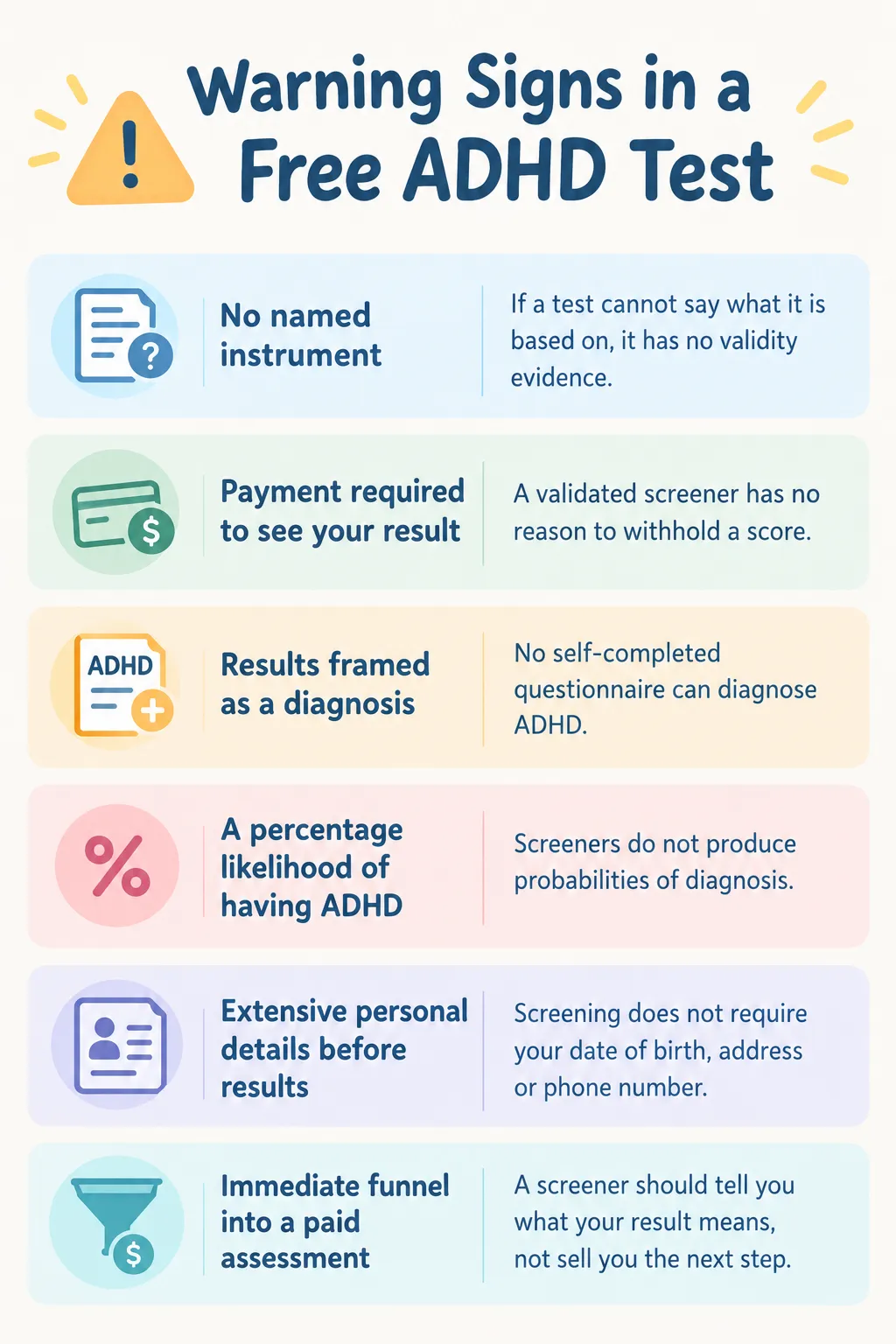
| Sign | Why it matters |
| No named instrument | If a test cannot say what it is based on, it has no validity evidence |
| Payment required to see your result | A validated screener has no reason to withhold a score |
| Results framed as a diagnosis | No self-completed questionnaire can diagnose ADHD |
| A percentage likelihood of having ADHD | Screeners do not produce probabilities of diagnosis |
| Extensive personal details before results | Screening does not require your date of birth, address or phone number |
| Immediate funnel into a paid assessment | A screener should tell you what your result means, not sell you the next step |
What to Do With Your Result
If your result suggests assessment is worth pursuing, the score itself is not the useful part. What a clinician needs is context.
- Book a GP appointment, ideally a longer one, and say what you want to discuss when you book.
- Write down specific examples rather than traits: what happens, how often, in which settings, and what the consequence is.
- Gather anything from childhood you can: school reports, old assessments, or what a parent remembers.
- Note what you have already tried, and whether it helped.
- Bring the screener result if you like, but expect the conversation to focus on your history rather than the number.
If the Result Was Not What You Expected
Two situations come up often and both are worth naming.
If you scored positive and feel unsettled by it, that is a normal reaction to a screener that has just reflected years of difficulty back at you. It is a reason to seek assessment, not a verdict.
If you scored negative and are frustrated because the difficulties are real, take the difficulties seriously rather than the score. A screener that does not identify your pattern has not established that there is no pattern. Speak with a GP about what is actually happening.
Related Guides
- Do I have ADHD? Making sense of your own symptoms
- ADHD test for women
- ADHD symptoms in adults
- ADHD symptoms the full symptom picture
References
- Kessler RC, Adler L, Ames M, et al. The World Health Organization Adult ADHD Self-Report Scale (ASRS): a short screening scale for use in the general population. Psychological Medicine. 2005;35(2):245–256. doi:10.1017/s0033291704002892
- Ustun B, Adler LA, Rudin C, et al. The World Health Organization Adult Attention-Deficit/Hyperactivity Disorder Self-Report Screening Scale for DSM-5. JAMA Psychiatry. 2017;74(5):520–527.
- Australian ADHD Professionals Association. Australian Evidence-Based Clinical Practice Guideline for Attention Deficit Hyperactivity Disorder (ADHD). Released October 2022. adhdguideline.aadpa.com.au
- American Psychiatric Association. Diagnostic and Statistical Manual of Mental Disorders, Fifth Edition, Text Revision (DSM-5-TR). 2022.
Last reviewed: September 2026. Next scheduled review: September 2027. This article is general information and is not a substitute for individual medical advice, assessment or diagnosis.