
What Are ADHD Symptoms in Women?
The diagnostic symptoms are the same for everyone. What differs is presentation and recognition. Women more commonly present with predominantly inattentive symptoms, internalised restlessness rather than visible hyperactivity, and difficulties masked by compensatory effort. Australian clinical guidance notes that girls and women are at risk of under-recognition (Australian ADHD Professionals Association, 2022).
There is no separate diagnostic list of ADHD symptoms in women. Anyone telling you there is has misunderstood how diagnosis works. What is genuinely different is which symptoms tend to be most prominent, how much they are masked, and how likely they are to prompt a referral. Female ADHD symptoms are the same criteria applied to a presentation that is more often missed.
That difference has consequences. Women are commonly assessed for the first time in adulthood, frequently after a child’s diagnosis or at a point where existing coping strategies stop being sufficient.
The way people search reflects this. Adult female ADHD symptoms, adult women ADHD symptoms, ADHD symptoms women and ADHD adult women symptoms are all common phrasings. So are ADHD in adult women symptoms, symptoms of adult ADHD in women, symptoms of ADHD in adult women, ADHD women symptoms and ADHD in women signs. They describe the same thing: a pattern recognised late.
Why ADHD Is Missed in Women and Girls
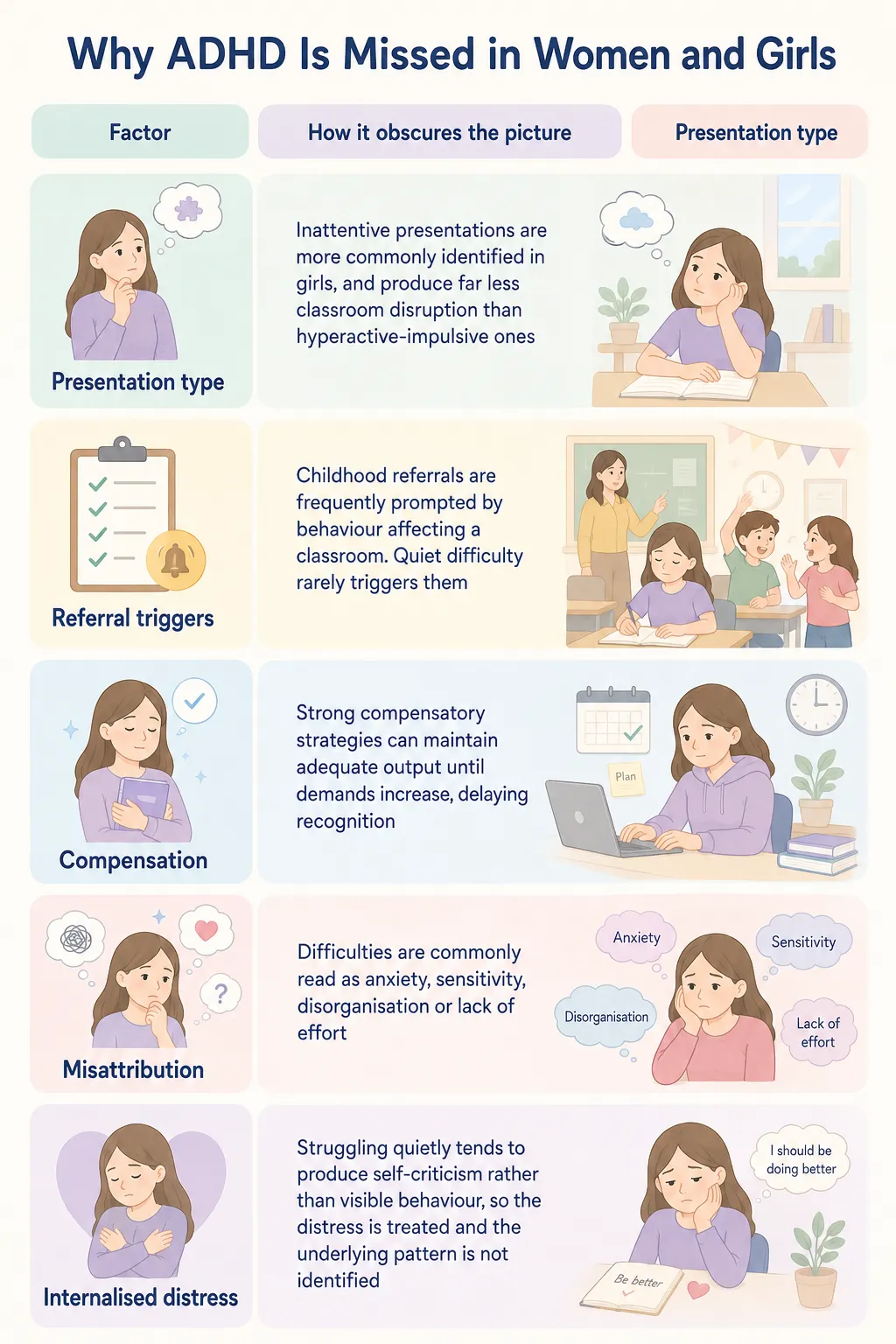
Australia’s clinical guideline explicitly notes that girls and women are at risk of under-recognition, particularly where symptoms are predominantly inattentive (Australian ADHD Professionals Association, 2022). Several factors contribute, and they reinforce each other.
| Factor | How it obscures the picture |
| Presentation type | Inattentive presentations are more commonly identified in girls, and produce far less classroom disruption than hyperactive-impulsive ones |
| Referral triggers | Childhood referrals are frequently prompted by behaviour affecting a classroom. Quiet difficulty rarely triggers them |
| Compensation | Strong compensatory strategies can maintain adequate output until demands increase, delaying recognition |
| Misattribution | Difficulties are commonly read as anxiety, sensitivity, disorganisation or lack of effort |
| Internalised distress | Struggling quietly tends to produce self-criticism rather than visible behaviour, so the distress is treated and the underlying pattern is not identified |
The practical result is that some women reach adulthood with a long history of difficulty and no explanation for it, often having been assessed or treated for something adjacent instead.
How the Symptoms Commonly Present
The 18 diagnostic symptoms are the same. What follows is how ADHD symptoms in adult women and girls are commonly described, which is illustrative rather than diagnostic. Our full symptoms guide covers the criteria themselves.
Inattention
- Rereading the same paragraph repeatedly without retaining it
- Losing track in conversations, particularly in groups, and reconstructing from context
- Difficulty with administrative tasks: forms, appointments, renewals, correspondence
- Starting more than can be finished, with a persistent backlog of open tasks
- Forgetting commitments made in passing, then over-correcting with elaborate systems
- Difficulty sustaining attention on tasks that are important but not engaging
Hyperactivity and impulsivity, internalised
- Mental restlessness rather than physical movement: an internal sense of not being able to settle
- Difficulty relaxing, or feeling uncomfortable with unstructured time
- Talking a great deal, particularly on topics of interest, and interrupting despite intending not to
- Impulsivity appearing in decisions rather than movement: spending, commitments, sudden changes
- Emotional responses that arrive quickly and at full intensity
The hyperactivity criterion in adolescents and adults is explicitly noted as potentially limited to feeling restless rather than visible movement. That wording matters here, because the absence of obvious hyperactivity is one of the most common reasons women rule themselves out.
What Masking Looks Like
Masking describes effort spent concealing difficulty or compensating for it. It is not a diagnostic term and it is not unique to women, but it is central to why ADHD in women symptoms are missed so often. The behaviours below are commonly described by women rather than formally studied as a distinct pattern.
- Elaborate list, reminder and calendar systems that take substantial effort to maintain
- Over-preparation for situations others handle without preparation
- Rehearsing conversations in advance
- Working considerably longer hours than peers to produce comparable output
- Perfectionism as compensation for inconsistency, which makes starting harder
- Apologising habitually for difficulties that have not been named
The cost is usually invisible from outside, which is precisely the problem. What an assessment considers is not only what someone produces, but what it takes to produce it.
High-Functioning ADHD in Women
High-functioning ADHD is not a clinical term and does not appear in diagnostic criteria. It is commonly used to describe people whose difficulties are substantially masked by ability, effort or circumstance.
The phrase causes a specific problem for women seeking assessment. Adequate or strong performance is often treated as evidence against ADHD, when the relevant question is functional impact relative to effort. Someone producing good work at a cost that is not sustainable is not thereby excluded.
What clinicians actually assess
Not whether you are managing, but what managing costs, whether difficulties appear across more than one setting, and whether the pattern traces back to childhood. Performance alone does not rule ADHD in or out.
ADHD Symptoms in Girls and Teenage Females
Signs of ADHD in girls, and ADHD in teenage females symptoms specifically, tend to be quieter than the hyperactive presentation and easier to attribute to personality.
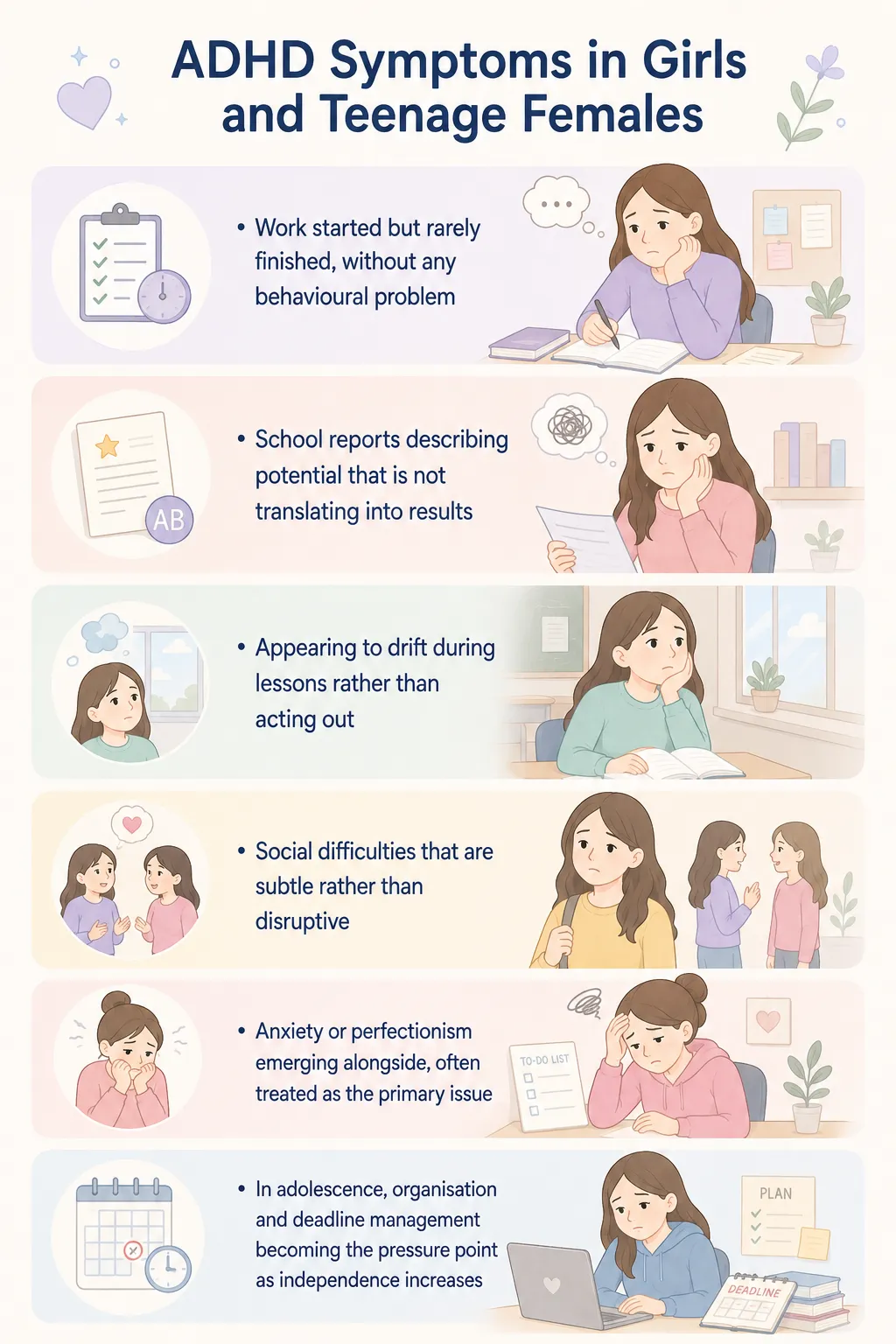
- Work started but rarely finished, without any behavioural problem
- School reports describing potential that is not translating into results
- Appearing to drift during lessons rather than acting out
- Social difficulties that are subtle rather than disruptive
- Anxiety or perfectionism emerging alongside, often treated as the primary issue
- In adolescence, organisation and deadline management becoming the pressure point as independence increases
A useful question for parents and teachers is whether the pattern is consistent across settings and over time, rather than tied to one subject, one teacher or one period. Our parent’s guide covers what to raise and with whom.
Hormones and Symptom Variation
Many women report that symptoms vary across the menstrual cycle and change through pregnancy, postpartum and perimenopause. These are reported experiences described in clinical settings and by women themselves, rather than established findings.
It is worth being clear about the evidence status. The research base in this area is limited compared with other aspects of ADHD, and it is an area where clinical understanding is still developing. That does not make the reported experience less real, and it is reasonable to raise symptom variation with a clinician. It does mean firm claims about mechanisms should be treated cautiously.
Practically, women often first seek assessment during a period of increased demand or hormonal change, because that is when compensation stops being sufficient rather than because the ADHD began then.
What Changes at Different Life Stages
Symptoms do not change, but what they collide with does. Several points in adult life are common triggers for seeking assessment, not because ADHD began then but because compensation stopped covering it.
| Life stage | What commonly increases demand |
| University or first job | External structure disappears. Deadlines become self-imposed and supervision reduces |
| Early parenthood | Sleep reduces, administrative load multiplies, and there is no longer time to compensate |
| A child’s assessment | Recognising your own pattern in your child’s report. One of the most common routes to adult diagnosis |
| Promotion or role change | Management and self-directed work expose executive difficulties that structured roles absorbed |
| Perimenopause | Many women report symptom change during this period, alongside other demands often peaking at the same time |
Recognising yourself in your child’s assessment is not a coincidence and not projection. ADHD runs strongly in families, and it is a well-recognised route to adult identification.
Conditions Frequently Identified Instead
Women with undiagnosed ADHD are commonly assessed or treated for something else first. These conditions genuinely occur, and they also occur alongside ADHD rather than instead of it.
| Condition | Why it is identified first |
| Anxiety | Very common alongside ADHD, and years of undiagnosed difficulty can generate it. Anxiety also impairs concentration on its own |
| Depression | Frequently follows long periods of unexplained underperformance and self-blame |
| Chronic stress or burnout | Presents with the same executive difficulties, so ADHD is not considered |
| Thyroid conditions | Produce fatigue and concentration difficulty, and are appropriately tested for |
| Autism | Substantial overlap, also under-recognised in women, and both can be diagnosed together |
Being treated for anxiety does not mean ADHD was missed. It means the anxiety was identified. Whether something underneath it was also present is a separate question, and a reasonable one to raise if treatment has helped the anxiety without changing the underlying difficulties.
When to Seek Assessment
The practical markers are the same as for anyone, with one addition worth naming.
- The pattern has been present since childhood rather than starting recently
- It appears in more than one area of life
- It is causing difficulty rather than simply being noticeable
- There is a persistent gap between capability and outcomes despite genuine effort
- You have been managing, but the effort required is disproportionate and not sustainable
That last point is the one most commonly dismissed, including by the person themselves. Coping is not evidence against ADHD if coping is costing more than it should.
For most people the first step is a conversation with a GP about referral pathways. It helps to arrive with specifics: examples from childhood, school reports if you have them, and an account of what is currently not working rather than a list of traits.
Related Guides
- ADHD symptoms in adults
- Inattentive ADHD (formerly known as ADD)
- How ADHD is diagnosed in Australia
- What ADHD feels like: living as a person with ADHD
References
- Australian ADHD Professionals Association. Australian Evidence-Based Clinical Practice Guideline for Attention Deficit Hyperactivity Disorder (ADHD). Released October 2022. adhdguideline.aadpa.com.au
- American Psychiatric Association. Diagnostic and Statistical Manual of Mental Disorders, Fifth Edition, Text Revision (DSM-5-TR). 2022.
- May T, et al. The Australian evidence-based clinical practice guideline for attention deficit hyperactivity disorder. Australian and New Zealand Journal of Psychiatry. 2023. doi:10.1177/00048674231166329
- National Institute for Health and Care Excellence (NICE). Attention deficit hyperactivity disorder: diagnosis and management. NG87.
Last reviewed: September 2026. Next scheduled review: September 2027. This article is general information and is not a substitute for individual medical advice, assessment or diagnosis.