

Is ADHD a Disability?
It depends on the framework. Clinically, ADHD is a neurodevelopmental disorder, not an intellectual disability or a mental illness in the usual sense. Legally, ADHD can meet the definition of disability under the Disability Discrimination Act 1992 where it affects functioning, which is what makes workplace and education adjustments relevant. ADHD is not listed on the NDIS access lists, and NDIS eligibility is assessed individually against the disability requirements in the NDIS Act rather than by diagnosis.
This question has three different correct answers depending on who is asking and why, which is exactly why it generates so much confusion. A clinician, an employment lawyer and an NDIS planner will each give you a different one, and none of them are wrong. A note on language before we start: some of the terms people search for, including handicap, are outdated and are no longer used in Australian clinical or legal contexts. They are addressed here because people look for them, not because they are current.
This guide separates the frameworks so you can find the answer that applies to your situation.
The Three Frameworks at a Glance
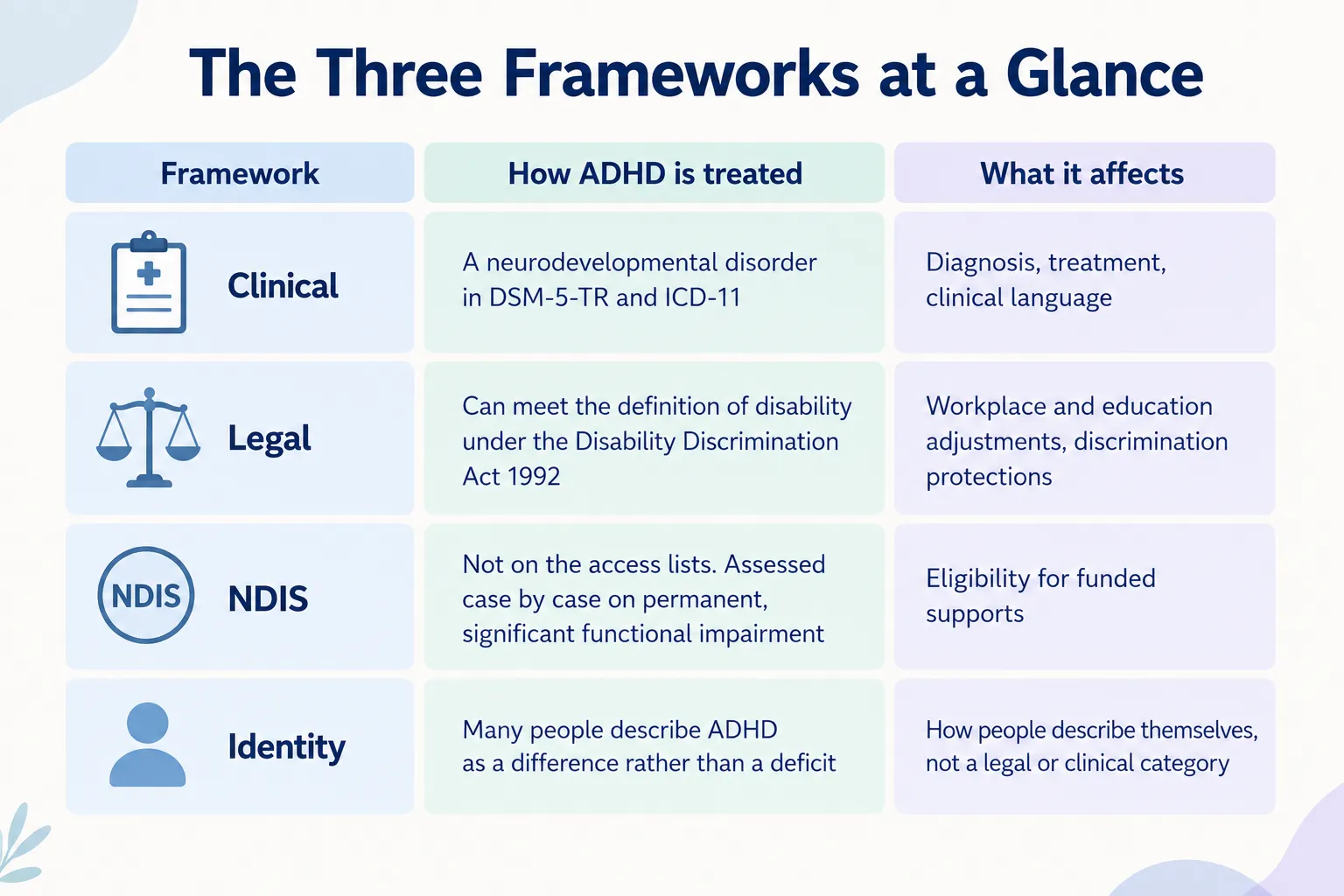
| Framework | How ADHD is treated | What it affects |
| Clinical | A neurodevelopmental disorder in DSM-5-TR and ICD-11 | Diagnosis, treatment, clinical language |
| Legal | Can meet the definition of disability under the Disability Discrimination Act 1992 | Workplace and education adjustments, discrimination protections |
| NDIS | Not on the access lists. Assessed case by case on permanent, significant functional impairment | Eligibility for funded supports |
| Identity | Many people describe ADHD as a difference rather than a deficit | How people describe themselves, not a legal or clinical category |
Is ADHD a Disability Under Australian Law?
It can be. The Disability Discrimination Act 1992 (Cth) uses a broad definition of disability. In summary, and paraphrasing section 4, it includes a disorder, illness or disease affecting a person’s thought processes, perception of reality, emotions or judgement, or resulting in disturbed behaviour. The full statutory wording is available at legislation.gov.au.
ADHD may fall within that definition depending on the person’s circumstances. Where it does, an employer or educational institution must not discriminate on the basis of the condition, and is required to consider reasonable adjustments unless doing so would cause unjustifiable hardship. Whether the Act applies in any individual case is a legal question, and this article is general information rather than legal advice.
What this means in practice
You do not need an NDIS package or a disability pension for the Disability Discrimination Act to apply. The legal test is about the effect of the condition, not about whether any funding body has recognised it. Whether you disclose a diagnosis is your decision, though adjustments usually require some disclosure.
Is ADHD a Mental Illness?
Is ADHD an illness? ADHD is classified as a neurodevelopmental disorder, not as a mental illness in the way that term is usually used. The distinction is about how the condition arises rather than about how serious it is.
- A neurodevelopmental disorder relates to how the brain develops. It is present from early life and is not an episode that begins and resolves.
- Mental illness usually describes conditions with an onset, a course and often a return toward a previous baseline, such as depression or an anxiety disorder.
Two things follow from this. ADHD appears in the same diagnostic manuals as mental health conditions, which is why the terms get used interchangeably in everyday conversation. And the neurodevelopmental classification does not place ADHD outside mental health care: it is commonly assessed and supported by psychiatrists and psychologists, and it frequently co-occurs with anxiety and depression.
So if someone asks whether ADHD is a mental health condition, or is ADHD a mental disability, the practical answer is that it is a recognised health condition managed within mental health and paediatric services, while its formal classification is neurodevelopmental. Is ADHD a medical condition? Yes. It is a diagnosable condition with clinical guidelines for its assessment and treatment.
Is ADHD an Intellectual Disability?
No. These are separate categories and are not related.
Intellectual disability involves significant limitations in intellectual functioning and adaptive behaviour, with onset in the developmental period. ADHD involves difficulties with attention regulation, impulse control and executive function, and is unrelated to intellectual capacity. People with ADHD span the full range of intellectual ability, including well above average.
The two can co-occur, as can ADHD and specific learning disorders such as dyslexia, but one does not imply the other.
Is ADHD a Handicap?
Handicap is an outdated term that is no longer used in Australian clinical, legal or disability contexts. It has largely been replaced by disability, and in health settings by more specific language about impairment and functioning.
People still search the phrase, usually meaning one of two things: whether ADHD counts as a disability for practical purposes, or whether it holds someone back. The first has a legal answer, set out above. The second depends entirely on the person, the demands they face, and what support is in place.
Is ADHD Real?
Yes. ADHD is real, and it is a recognised condition in both major international diagnostic systems, DSM-5-TR and ICD-11. Australia has an NHMRC-approved clinical practice guideline for its assessment and treatment (Australian ADHD Professionals Association, 2022).
The doubt usually comes from three places, and each has an answer.
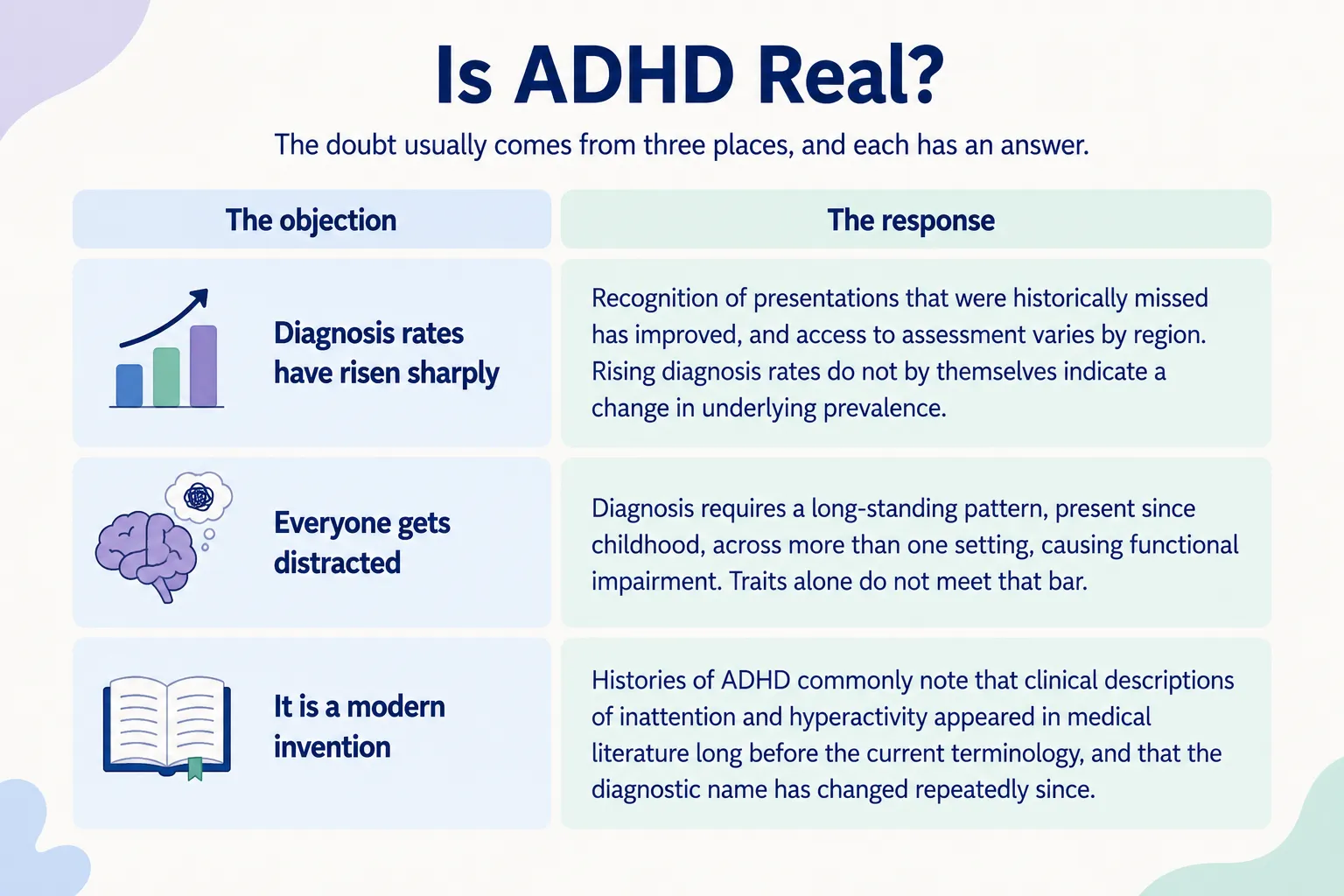
| The objection | The response |
| Diagnosis rates have risen sharply | Recognition of presentations that were historically missed has improved, and access to assessment varies by region. Rising diagnosis rates do not by themselves indicate a change in underlying prevalence. |
| Everyone gets distracted | Diagnosis requires a long-standing pattern, present since childhood, across more than one setting, causing functional impairment. Traits alone do not meet that bar. |
| It is a modern invention | Histories of ADHD commonly note that clinical descriptions of inattention and hyperactivity appeared in medical literature long before the current terminology, and that the diagnostic name has changed repeatedly since. |
ADHD and the NDIS
ADHD does not appear on the NDIS access lists. Those lists identify conditions likely to meet the disability requirements and are used as decision-making guides. Not appearing on a list does not automatically exclude a person from testing access. Eligibility is assessed against the disability requirements set out in section 24 of the National Disability Insurance Scheme Act 2013 (NDIS Act 2013, section 24; ndis.gov.au).
That assessment looks at permanence and functional impact rather than the diagnosis itself. In practice, ADHD alone often does not meet the access test, and access is more commonly achieved where impairment is significant and enduring, or where ADHD occurs alongside another eligible condition such as autism or an intellectual disability. Eligibility is assessed individually and outcomes vary. This article is general information and is not a determination of eligibility.
Check the source, not a summary
NDIS eligibility is decided case by case and the guidance changes. The definitive source is the National Disability Insurance Agency at ndis.gov.au, or a Local Area Coordinator.
Does ADHD Get Worse With Age?
Not typically as a condition, though its effects can feel worse at particular points in life.
Visible hyperactivity commonly becomes less prominent with age. Attention and executive function difficulties more often persist. What changes most is the demands: adult life removes the external structure that school and early work provide, and adds organisational load. Someone who coped adequately at twenty can struggle at thirty-five with a mortgage, a job with distant deadlines and children, without their ADHD having changed at all.
Co-occurring anxiety, depression and sleep difficulties can also make ADHD symptoms harder to manage, which is one reason they are assessed alongside it.
Can You Grow Out of ADHD?
Usually not entirely. Persistence into adulthood is reported in roughly 60 to 86 percent of individuals diagnosed in childhood, as summarised in the paper accompanying Australia’s clinical practice guideline (May et al., Australian and New Zealand Journal of Psychiatry, 2023). Estimates vary considerably depending on how persistence is defined and measured.
What does change is the presentation and the degree of impairment. Some people reach adulthood with symptoms below the diagnostic threshold. Others retain the same difficulties but build environments and systems that reduce their impact, which is a different thing from the condition resolving.
ADHD, Work, Study and Income Support
Is ADHD a disability at work?
It can be. Where ADHD meets the definition under the Disability Discrimination Act 1992, an employer must not discriminate on that basis and is required to consider reasonable adjustments unless they would cause unjustifiable hardship. Adjustments commonly include written rather than verbal instructions, flexible scheduling, quieter work arrangements, or agreed checkpoints on long projects. You choose whether to disclose, though requesting formal adjustments generally requires some disclosure.
Is ADHD a disability at school or university?
The same Act applies to educational institutions. The Disability Standards for Education 2005 set out how education providers must make reasonable adjustments so students with disability can participate on the same basis as others (Disability Standards for Education 2005). What adjustments look like depends on the institution, the course and the student’s assessed needs, and providers generally require documentation from a treating clinician. Examples that are commonly discussed include additional time in assessments, alternative assessment formats and note-taking support, though availability varies by provider.
Can I get Centrelink or the Disability Support Pension for ADHD?
ADHD alone rarely qualifies for the Disability Support Pension. Services Australia sets specific medical and non-medical eligibility rules for DSP, including requirements relating to how a condition is diagnosed, treated and managed, and an assessment of impairment and capacity to work. Eligibility is decided by Services Australia case by case. The current criteria are published at servicesaustralia.gov.au, and this is general information rather than financial advice.
Disorder, Disability or Difference?
All three framings are in use, and people hold different ones for good reasons.
- Disorder is the clinical term, and it is what appears in diagnostic manuals and clinical records.
- Disability is the legal and functional framing, and it is what unlocks adjustments and protections.
- Difference is how many people describe their own experience, particularly those who identify strengths alongside the difficulties.
These are not mutually exclusive. It is entirely coherent to describe ADHD as a neurodevelopmental disorder clinically, claim disability protections at work, and personally think of it as a difference in how your attention works. Which framing is useful depends on what you are trying to do at the time.
Related Guides
- What Is ADHD? Meaning, definition and full form
- ADHD in Australia: the complete guide
- Types, presentations and severity levels of ADHD
- ADHD symptoms in adults: the complete Australian guide
References
- Disability Discrimination Act 1992 (Cth), section 4. legislation.gov.au
- National Disability Insurance Scheme Act 2013 (Cth), section 24. legislation.gov.au
- National Disability Insurance Agency. Access requirements. ndis.gov.au
- Disability Standards for Education 2005 (Cth). legislation.gov.au
- Services Australia. Disability Support Pension eligibility. servicesaustralia.gov.au
- Australian ADHD Professionals Association. Australian Evidence-Based Clinical Practice Guideline for Attention Deficit Hyperactivity Disorder (ADHD). Released October 2022. adhdguideline.aadpa.com.au
- May T, et al. The Australian evidence-based clinical practice guideline for attention deficit hyperactivity disorder. Australian and New Zealand Journal of Psychiatry. 2023. doi:10.1177/00048674231166329
- American Psychiatric Association. Diagnostic and Statistical Manual of Mental Disorders, Fifth Edition, Text Revision (DSM-5-TR). 2022.
Last review: September 2026. Next scheduled review: September 2027. This article is general information and is not a substitute for individual medical advice, assessment or diagnosis.