

What Is the Difference Between ADD and ADHD?
ADD and ADHD are not considered separate conditions in current diagnostic systems. ADHD is a neurodevelopmental disorder and is the current diagnostic term in both DSM-5-TR and ICD-11, which recognise three presentations: predominantly inattentive, predominantly hyperactive-impulsive and combined. ADD is an older term that is no longer used as a separate formal diagnosis. In everyday use it usually refers to what is now described as ADHD, predominantly inattentive presentation (Australian ADHD Professionals Association, 2022).
This question comes up constantly, usually in one of two situations. Someone was diagnosed with ADD years ago and wants to know whether that still counts. Or someone has been reading about ADHD, does not recognise themselves in the hyperactivity, and wonders whether ADD is the thing they actually have.
Both have the same answer, and the distinction is simpler than many search results suggest.
What Each Term Stands For
| Term | Full form | Status |
| ADD | Attention deficit disorder | Historical. No longer a diagnostic term |
| ADHD | Attention deficit hyperactivity disorder | Current. Used in DSM-5-TR and ICD-11 |
| ADHD-PI | ADHD, predominantly inattentive presentation (sometimes abbreviated ADHD-PI) | Current. Not a separate diagnosis, but a presentation specifier |
| ADHD-PI | ADHD, predominantly inattentive presentation | Current. The clinical description closest to what people mean by ADD |
ADD vs ADHD at a Glance
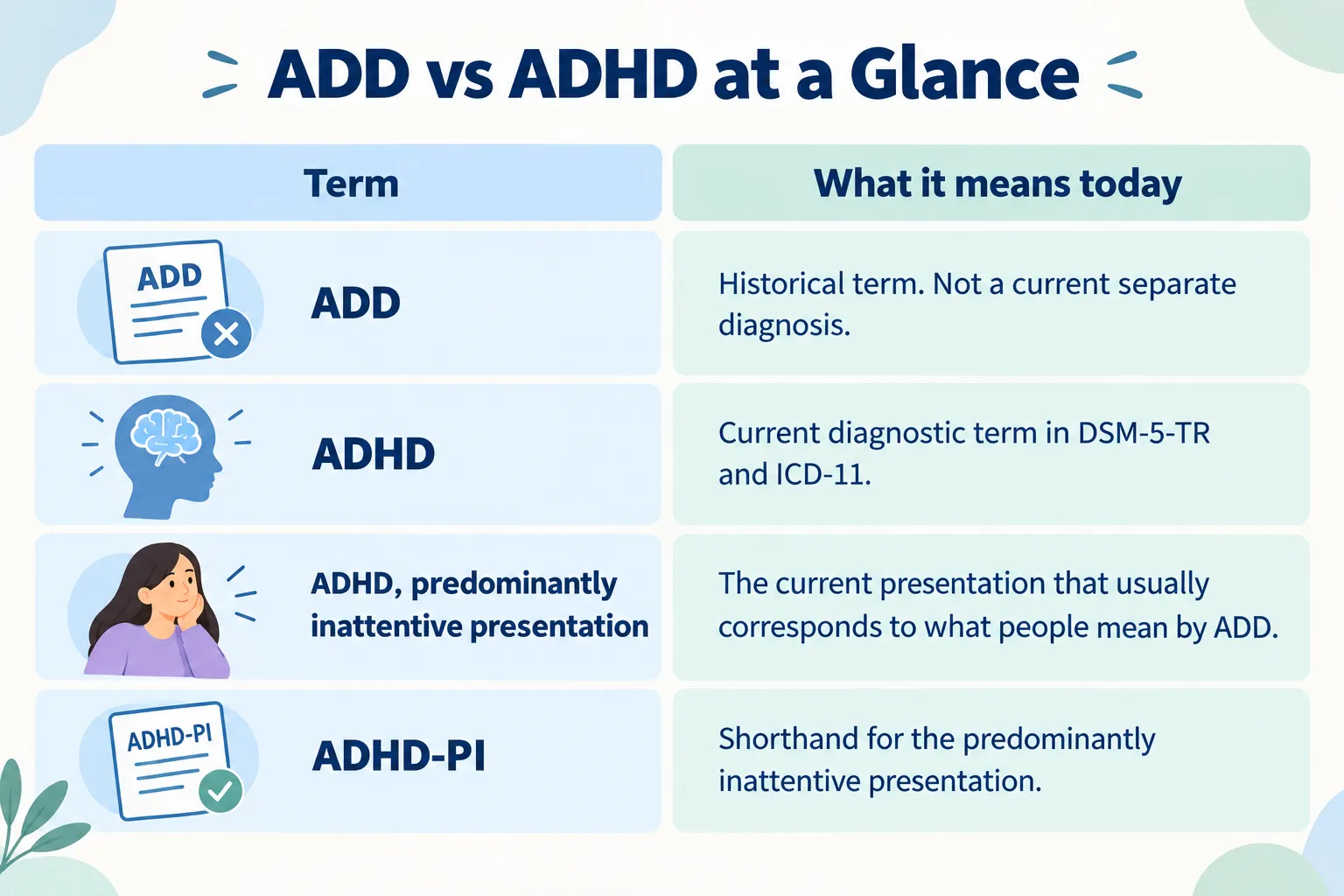
| Term | What it means today |
| ADD | Historical term. Not a current separate diagnosis |
| ADHD | Current diagnostic term in DSM-5-TR and ICD-11 |
| ADHD, predominantly inattentive presentation | The current presentation that usually corresponds to what people mean by ADD |
| ADHD-PI | Shorthand for the predominantly inattentive presentation |
The Short Answer
ADD and ADHD are not two different conditions. They are two terms from different periods of the same diagnostic history.
In everyday use, ADD usually refers to ADHD without prominent hyperactivity. That corresponds most closely to the predominantly inattentive presentation, one of the three recognised ADHD presentations alongside predominantly hyperactive-impulsive and combined (Australian ADHD Professionals Association, 2022). This is an everyday and historical correspondence rather than a literal diagnostic conversion rule.
So the useful reframe is this. The question is not ADD or ADHD. The question is which presentation of ADHD applies, and how much it is affecting your functioning.
Why the Terminology Changed
The terminology changed across successive editions of the Diagnostic and Statistical Manual of Mental Disorders, moving from ADD terminology toward ADHD, and later from subtypes to presentations. The broad sequence is set out below (American Psychiatric Association, DSM editions).
| Edition | Terminology used |
| DSM-III (1980) | Introduced attention deficit disorder, with and without hyperactivity |
| DSM-III-R (1987) | Consolidated into attention-deficit hyperactivity disorder |
| DSM-IV (1994) | Retained ADHD and introduced subtypes, including a predominantly inattentive subtype |
| DSM-5 (2013) and DSM-5-TR (2022) | Retained ADHD; replaced subtypes with presentations |
The reason behind the direction of travel matters more than the dates. Research indicated that inattention and hyperactivity-impulsivity were not best understood as two separate conditions, but as two symptom domains within one condition that can appear in different combinations. Splitting them into ADD and ADHD implied a sharper division than the evidence supported.
The later change from subtype to presentation was made for a related reason: a person’s symptom pattern can change over time, so a permanent category label was misleading. Our guide to types and presentations covers that in more detail.
So Is ADD Still a Valid Diagnosis?
Not as a separate formal diagnostic term in current DSM or ICD classification. If you were diagnosed with ADD before the terminology changed, that diagnosis was valid at the time and reflects the same underlying condition. The closest current description is ADHD, predominantly inattentive presentation.
That said, a diagnosis from decades ago may still be worth revisiting, particularly if it was made in childhood and never reviewed. Symptoms, demands and functional impact all change, and a current assessment describes where you are now rather than where you were at nine.
If someone tells you ADD and ADHD are different conditions
They are describing an older framework, not a current one. Both DSM-5-TR and ICD-11 use ADHD as the single diagnostic term, with presentations describing which symptom domains meet threshold.
Does ADHD Always Involve Hyperactivity?
No. Hyperactivity is not required for every ADHD presentation. Hyperactivity-impulsivity is one of the two symptom domains, and a person can meet criteria for the predominantly inattentive presentation without meeting the threshold for it (Australian ADHD Professionals Association, 2022).
This is the single most consequential point on this page. The ADD-versus-ADHD framing leads people to assume the hyperactivity in the name is a requirement, and that assumption stops them raising it with a clinician.
Why the Old Term Persists
ADD has stayed in circulation for reasons that are mostly practical rather than clinical.
- People diagnosed under the older terminology reasonably still use the word they were given.
- It is shorter and, for people without hyperactivity, it feels more accurate than a name containing the word hyperactivity.
- Older books, websites and school records use it, and that material does not update itself.
- The term can feel confusing for people whose presentation is predominantly inattentive, because hyperactivity may not be a prominent feature
None of this makes ADD wrong to say. It matters when it leads someone to conclude they cannot have ADHD because they were never hyperactive, which is a common and consequential misunderstanding.
Questions People Ask Using Both Terms
What causes ADD or ADHD?
The same factors, because they are the same condition. Genetic factors account for a substantial share of risk, with some early-life environmental factors also associated (Australian ADHD Professionals Association, 2022). Our guide to what causes ADHD covers the research in more depth.
Is ADD or ADHD a mental illness?
ADHD is classified as a neurodevelopmental disorder. It is a recognised health condition and is included in the major diagnostic classification systems, DSM-5-TR and ICD-11. The neurodevelopmental classification reflects that it relates to how the brain develops, and it does not place ADHD outside mental health care.
Is ADD or ADHD a disability?
In Australia, ADHD may fall within the broad definition of disability under the Disability Discrimination Act 1992, depending on the person’s circumstances. The Act covers certain disorders or malfunctions affecting areas such as learning, thought processes, emotions, judgement or behaviour. Whether particular protections or reasonable adjustments apply in employment or education depends on the circumstances.
Are there types of ADD?
Not as such. ADHD has three recognised presentations, and what was called ADD corresponds to the predominantly inattentive one. Our guide to types, presentations and severity levels covers all three.
What Actually Differs Between the Presentations
If ADD and ADHD are the same condition, it is fair to ask what the real distinction is. It sits between the presentations, not between the two names.
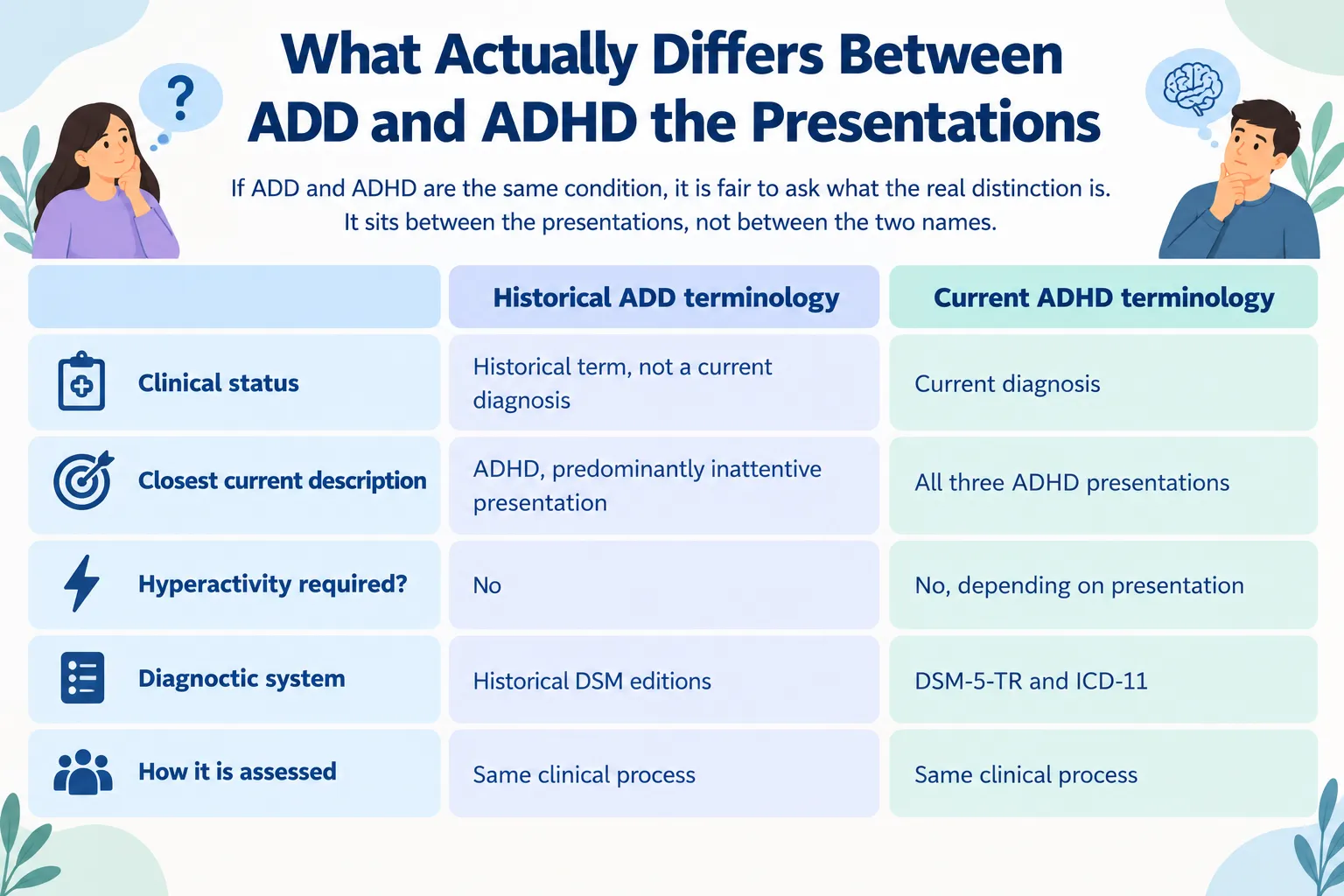
| Historical ADD terminology | Current ADHD terminology | |
| Clinical status | Historical term, not a current diagnosis | Current diagnosis |
| Closest current description | ADHD, predominantly inattentive presentation | All three ADHD presentations |
| Hyperactivity required? | No | No, depending on presentation |
| Diagnostic system | Historical DSM editions | DSM-5-TR and ICD-11 |
| How it is assessed | Same clinical process | Same clinical process |
Both are ADHD. Both are diagnosed through the same clinical process. Neither is more or less legitimate than the other, and severity is recorded separately from presentation.
The Practical Problem With the Old Term
The reason this matters beyond vocabulary is that the ADD-versus-ADHD framing causes people to rule themselves out incorrectly.
- Someone who was never hyperactive concludes ADHD does not apply to them, and never raises it with a GP.
- A parent whose child is quiet assumes ADHD is about disruptive behaviour, so the child is not referred.
- An adult reads a symptom list heavy on hyperactivity, recognises none of it, and stops looking.
Australia’s clinical guideline notes that girls and women are at risk of under-recognition, particularly where symptoms are predominantly inattentive (Australian ADHD Professionals Association, 2022). The ADD framing contributes to that pattern by making inattentive presentations sound like a separate, lesser thing.
Which Term Should You Use?
For a conversation with a GP, a psychiatrist, a school or an employer, ADHD is the term that will be understood without ambiguity, and adding predominantly inattentive if it applies makes the picture clearer.
In informal conversation, people may still use ADD, particularly when referring to a predominantly inattentive presentation. What matters clinically is the symptom pattern, how long it has been present, whether it appears in more than one setting, and how much it is interfering with functioning.
Related Guides
- Inattentive ADHD (formerly known as ADD)
- What Is ADHD? Meaning, definition and full form
- ADHD symptoms: the full symptom picture
References
- Australian ADHD Professionals Association. Australian Evidence-Based Clinical Practice Guideline for Attention Deficit Hyperactivity Disorder (ADHD). Released October 2022. adhdguideline.aadpa.com.au
- American Psychiatric Association. Diagnostic and Statistical Manual of Mental Disorders, Fifth Edition, Text Revision (DSM-5-TR). 2022.
- World Health Organization. International Classification of Diseases, 11th Revision (ICD-11). 6A05 Attention deficit hyperactivity disorder.
- Disability Discrimination Act 1992 (Cth). legislation.gov.au
- May T, et al. The Australian evidence-based clinical practice guideline for attention deficit hyperactivity disorder. Australian and New Zealand Journal of Psychiatry. 2023. doi:10.1177/00048674231166329
Last review: September 2026. Next scheduled review: September 2027. This article is general information and is not a substitute for individual medical advice, assessment or diagnosis.