

Does ADHD Cause Racing Thoughts?
Racing thoughts are not a standalone diagnostic criterion for ADHD, but mental restlessness, mind wandering and rapidly shifting thoughts are recognised experiences in adults with ADHD. Research has specifically linked self-reported racing thoughts with adult ADHD (Martz et al., Psychiatry Research, 2021). They are not unique to ADHD and can occur with anxiety, sleep problems and mood disorders.
ADHD racing thoughts are rapid, crowded or difficult-to-settle thoughts that some adults with ADHD experience as mental restlessness. They are not a standalone ADHD diagnostic criterion, and racing thoughts can also occur with anxiety, insomnia, mood disorders and other conditions.
People describe an ADHD mind that does not stop: several thoughts at once, jumping between loosely connected ideas, difficulty settling into one. Some search for this as ADHD mind vs normal mind. It is one of the most common descriptions of the internal experience of ADHD and one of the least covered in symptom lists, because the diagnostic criteria describe behaviour rather than what it is like inside.
What Do ADHD Racing Thoughts Feel Like?
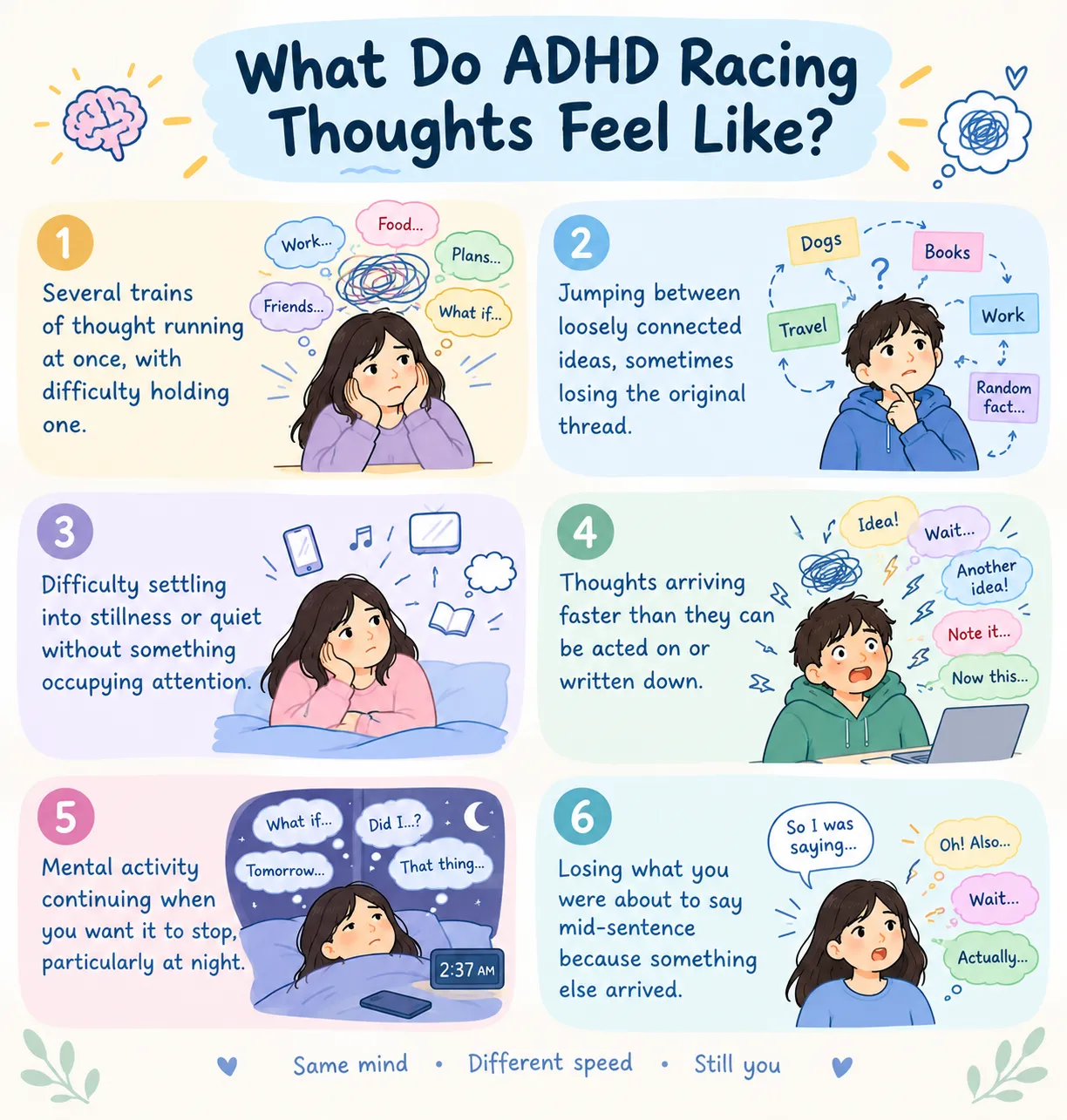
- Several trains of thought running at once, with difficulty holding one
- Jumping between loosely connected ideas, sometimes losing the original thread
- Difficulty settling into stillness or quiet without something occupying attention
- Thoughts arriving faster than they can be acted on or written down
- Mental activity continuing when you want it to stop, particularly at night
- Losing what you were about to say mid-sentence because something else arrived
Australia’s clinical guideline notes that hyperactivity in adults may present as internal restlessness and difficulty relaxing rather than as visible movement (Australian ADHD Professionals Association, 2022). Racing thoughts sit within that broader experience of mental restlessness. The adult diagnostic criteria also note that distractibility explicitly includes being drawn away by unrelated thoughts, not only by external noise.
Racing Thoughts, Overthinking, Rumination and Intrusive Thoughts
These terms are used interchangeably online and mean different things. Separating them is the most useful thing this page can do.
- Racing thoughts: the speed and volume of thoughts, often loosely connected
- Rumination: repeatedly dwelling on the same thought or problem without resolution
- Worry: future-oriented thinking focused on possible threats or negative outcomes
- Intrusive thoughts: unwanted thoughts, images or urges that repeatedly enter awareness
- Mind wandering: attention drifting away from the current task
| Feature | Racing or crowded thoughts | Intrusive thoughts or obsessions |
| Main experience | Thoughts feel fast, numerous or difficult to settle | An unwanted thought, image or urge repeatedly enters awareness |
| Content | May involve ordinary tasks, ideas, memories or unrelated topics | Often unwanted, distressing or inconsistent with the person’s values |
| Pattern | May jump between topics | Often repeatedly returns to the same theme |
| Response | Difficulty slowing or redirecting attention | Distress may lead to avoidance, reassurance-seeking or compulsions |
| Common associations | ADHD, anxiety, sleep problems and other conditions | OCD, anxiety and other mental health conditions |
| Important point | Not diagnostic of ADHD | Not diagnostic of OCD |
Intrusive thoughts can occur in people with ADHD, but they are not specific to ADHD. They are particularly important to assess when they are persistent, distressing, repetitive or accompanied by compulsions. OCD, anxiety disorders and other conditions can involve intrusive thoughts, and ADHD and OCD can also co-occur. People searching for ADHD and intrusive thoughts, or intrusive thoughts and ADHD, are often describing racing or repetitive thinking rather than clinical obsessions.
Is It Racing Thoughts, Overthinking, Worry or Intrusive Thoughts?
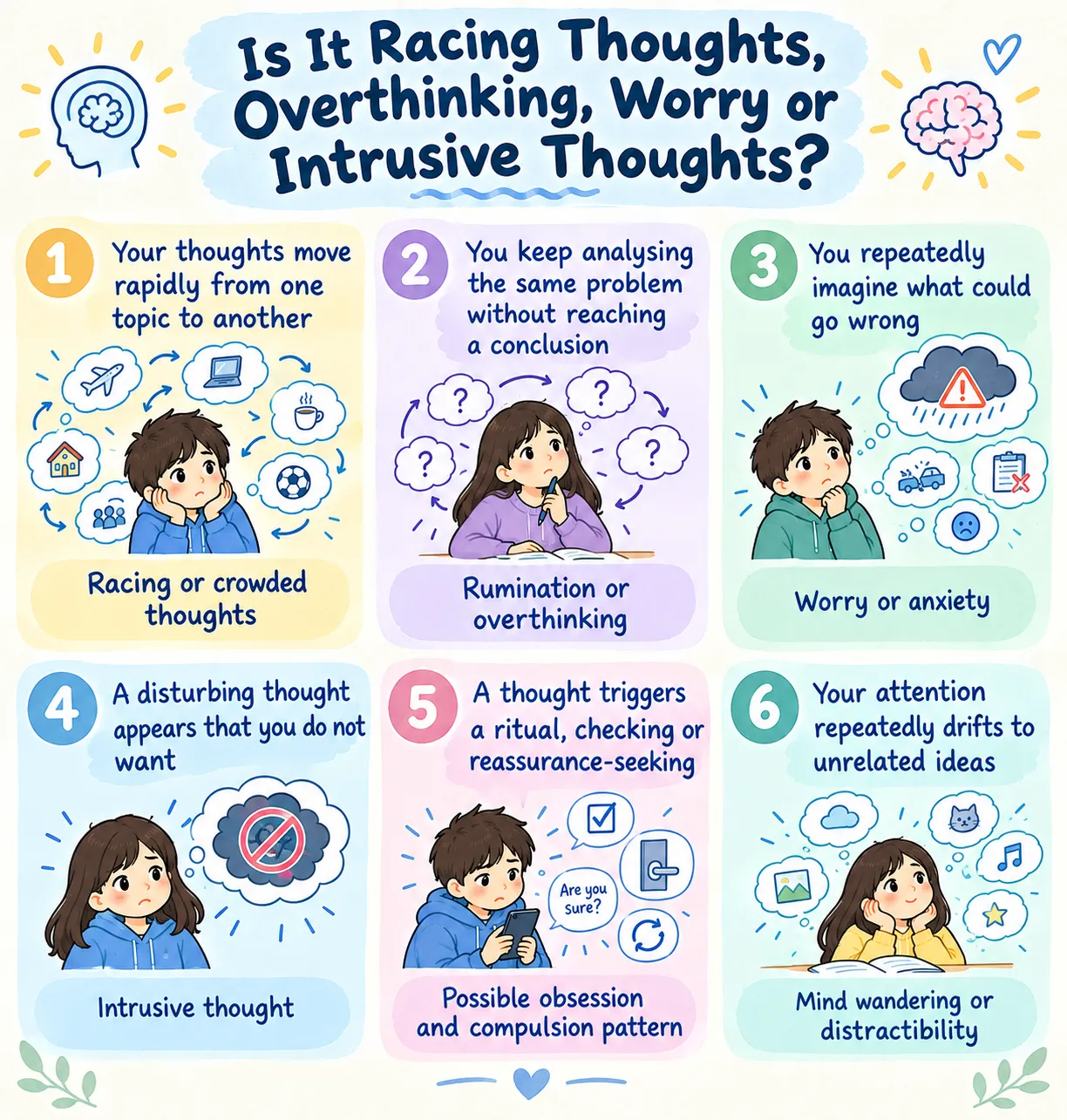
| If your experience is mainly… | It may resemble… |
| Your thoughts move rapidly from one topic to another | Racing or crowded thoughts |
| You keep analysing the same problem without reaching a conclusion | Rumination or overthinking |
| You repeatedly imagine what could go wrong | Worry or anxiety |
| A disturbing thought appears that you do not want | Intrusive thought |
| A thought triggers a ritual, checking or reassurance-seeking | Possible obsession and compulsion pattern |
| Your attention repeatedly drifts to unrelated ideas | Mind wandering or distractibility |
These descriptions are not diagnostic categories. More than one pattern can occur at the same time, and a clinician considers the wider pattern of symptoms, duration, impairment and co-occurring conditions.
ADHD and Overthinking
ADHD and overthinking are commonly described together, though what people mean varies. Some describe analysis that circles without resolving: replaying a conversation, examining a decision from several angles without reaching one. Some people describe becoming intensely absorbed in analysing a particular topic or decision, making it difficult to shift attention away from it.
Overthinking is not specific to ADHD. It is also strongly associated with anxiety and with rumination, and these frequently co-occur. Recent Australian research has examined the relationship between ADHD symptoms, rumination, racing thoughts, depression and anxiety, which reflects how closely these experiences are connected (Devenish et al., Australian Journal of Psychology, 2026).
ADHD Racing Thoughts at Night
Racing thoughts may become more noticeable in the evening and around bedtime. Research in adults with ADHD has found higher self-reported racing thoughts at these times, with greater racing thoughts at bedtime also associated with insomnia severity (Martz et al., Psychiatry Research, 2021).
The practical explanations people describe are straightforward.
- External input drops away, so internal activity becomes more noticeable
- The day’s unresolved items surface once there is nothing else occupying attention
- Lying still without a task is precisely the situation that mental restlessness makes uncomfortable
- Sleep difficulties are common in ADHD, and delayed sleep onset compounds the experience
Where difficulty getting to sleep is persistent, it is worth addressing directly rather than treating it as an inevitable part of ADHD.
ADHD Racing Thoughts and Anxiety
Worry tends to focus on possible future threats or negative outcomes, whereas racing thoughts can involve many unrelated or loosely connected topics. The distinction is not absolute: anxiety can produce rapidly shifting thoughts, and people with ADHD can also experience substantial worry.
Anxiety commonly co-occurs with ADHD, and the 2021 research found racing thoughts in ADHD were associated with anxiety (Martz et al., 2021). In practice this means the question is rarely which one it is, but whether both are present and what each is contributing.
ADHD Racing Thoughts vs Mania or Hypomania
Racing thoughts alone do not establish bipolar disorder. The same research found that self-reported racing thoughts could not reliably differentiate ADHD from bipolar disorder, which is exactly why the wider clinical picture matters (Martz et al., 2021).
What distinguishes a mood episode is the broader pattern, particularly:
- A reduced need for sleep, rather than simply difficulty sleeping
- Unusually elevated or irritable mood
- Markedly increased energy or activity
- Unusually rapid or pressured speech
- Increased goal-directed activity
- Impulsive or risky behaviour beyond the person’s usual pattern
- A clear change from usual functioning, over a defined period
This combination warrants prompt medical assessment. It is not something to research further online.
What Else Can Cause Racing Thoughts?
Racing thoughts are not specific to ADHD. They can occur alongside ADHD or independently of it. A clinician looks at the full pattern, including onset, duration, associated symptoms, sleep, medicines and functional impact. These patterns overlap and are not diagnostic rules.
| Possible explanation | What tends to be different |
| Anxiety | Content is worry-driven and future-focused, often with physical symptoms such as tension or a racing heart |
| Mood episodes | Racing thoughts alongside reduced need for sleep, elevated or irritable mood and increased activity |
| OCD | Specific unwanted intrusive thoughts, usually distressing, often with compulsions performed to reduce distress |
| Insomnia and sleep disorders | Racing thoughts concentrated at bedtime, improving substantially when sleep does |
| Acute stress | Has an identifiable onset and typically settles when the situation does |
| Substance use or withdrawal | Timing relates to use rather than to a long-standing pattern |
Can ADHD Medication Affect Racing Thoughts?
Changes in mental restlessness or racing thoughts after starting, stopping or changing ADHD medication should be discussed with the prescribing clinician. Effects vary between individuals, and racing thoughts may also reflect anxiety, sleep disruption or another condition rather than ADHD itself.
Do not change or stop prescribed medication without medical advice. This article does not provide information about specific medicines or treatment options.
What Can Help When Your Mind Feels Busy?
Things you can try yourself
- Write down unfinished tasks before bed so they do not need to be held in mind
- Externalise reminders rather than relying on recall
- Reduce stimulating content in the hours before sleep
- Use a consistent wind-down routine
- Use a quiet, low-demand activity if silence makes thoughts more noticeable
- Set a deliberate time for the thinking rather than resisting it, which some people find reduces its urgency
These are commonly described approaches rather than evidence-based interventions, and what works varies considerably between individuals.
When self-management is not enough
If racing thoughts are regularly affecting sleep, work, relationships or wellbeing, speak with a GP or an appropriately qualified mental health professional. Management should address the underlying cause rather than assuming the experience is caused by ADHD.
How Is ADHD Diagnosed?
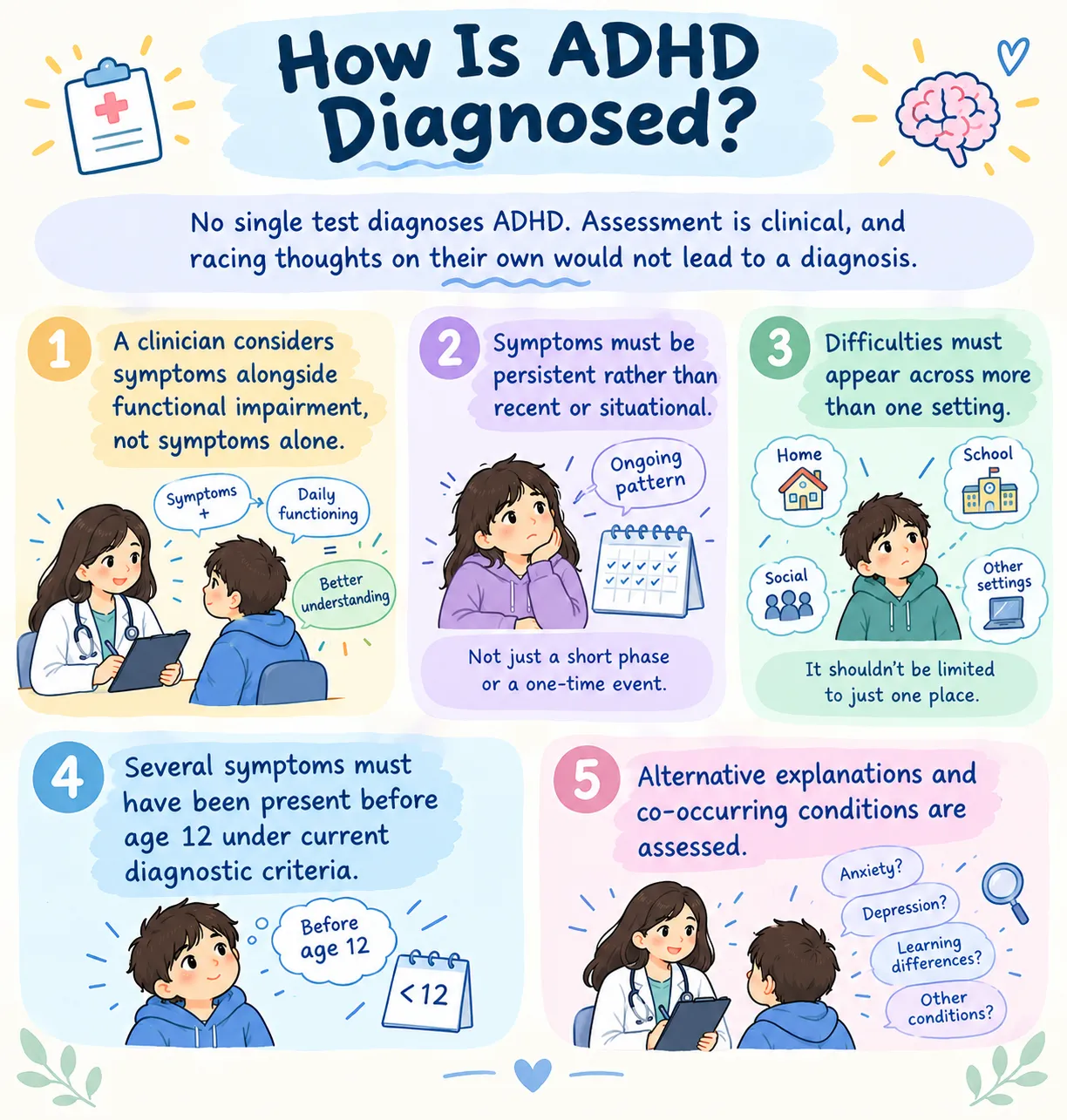
No single test diagnoses ADHD. Assessment is clinical, and racing thoughts on their own would not lead to a diagnosis.
- A clinician considers symptoms alongside functional impairment, not symptoms alone
- Symptoms must be persistent rather than recent or situational
- Difficulties must appear across more than one setting
- Several symptoms must have been present before age 12 under current diagnostic criteria
- Alternative explanations and co-occurring conditions are assessed
Australia has an NHMRC-approved clinical practice guideline for ADHD assessment and support (Australian ADHD Professionals Association, 2022).
When Should You Talk to a GP?
Consider speaking with a GP if racing thoughts are persistent, interfere with sleep or daily functioning, are new or significantly different from your usual experience, or occur alongside anxiety, low mood, unusual changes in energy or reduced need for sleep.
A GP can assess the broader pattern and discuss whether ADHD assessment, mental health support or another medical assessment is appropriate. Medicare-subsidised mental health support is available in Australia through the Better Access initiative, though this is separate from the question of what an ADHD assessment itself costs.
When Racing Thoughts Need Urgent Assessment
Seek emergency help
If there is immediate danger to yourself or someone else, or you cannot keep yourself safe, call 000.
Seek urgent medical assessment
If racing thoughts occur with a dramatically reduced need for sleep, unusually elevated or irritable mood, markedly increased energy or activity, severe behavioural change, severe agitation, or symptoms such as hearing or believing things others do not.
Arrange a GP appointment
If racing thoughts are persistent but not urgent, and are affecting sleep, work or study, relationships or daily functioning.
Related Guides
- ADHD symptoms in adults
- ADHD, emotional dysregulation and rejection sensitivity
- ADHD hyperfocus and hyperfixation
- ADHD Burnout, Fatigue and Overstimulation
- ADHD impulsivity hyperactivity
References
- Martz E, Bertschy G, Kraemer C, Weibel S, Weiner L. Beyond motor hyperactivity: racing thoughts are an integral symptom of adult attention deficit hyperactivity disorder. Psychiatry Research. 2021;301:113988. doi:10.1016/j.psychres.2021.113988
- Martz E, Weibel S, Weiner L. Disentangling racing thoughts from mind wandering in adult attention deficit hyperactivity disorder. Frontiers in Psychology. 2023;14:1166602. doi:10.3389/fpsyg.2023.1166602
- Devenish B, et al. The role of rumination and racing thoughts in co-occurrence of ADHD symptoms, depression and anxiety symptoms. Australian Journal of Psychology. 2026. doi:10.1080/00049530.2026.2679669
- Australian ADHD Professionals Association. Australian Evidence-Based Clinical Practice Guideline for Attention Deficit Hyperactivity Disorder (ADHD). Released October 2022. adhdguideline.aadpa.com.au
- American Psychiatric Association. Diagnostic and Statistical Manual of Mental Disorders, Fifth Edition, Text Revision (DSM-5-TR). 2022.
- Australian Government Department of Health, Disability and Ageing. Better Access initiative. health.gov.au
Last reviewed: September 2026. Next scheduled review: September 2027. This article is general information and is not a substitute for individual medical advice, assessment or diagnosis.