

Does Therapy Help ADHD?
Cognitive-behavioural intervention carries the strongest non-pharmacological recommendation in Australia’s clinical guideline for adults with ADHD, and a conditional recommendation for children and adolescents (Australian ADHD Professionals Association, 2022). ADHD therapy does not treat the underlying neurodevelopmental differences. What it targets is the practical and emotional consequences: starting tasks, planning, estimating time, and the self-criticism that builds up over years.
Therapy for ADHD is frequently described either as the alternative to other treatment or as a soft add-on to it. Neither is accurate. It has a specific job, a reasonable evidence base, and a shape that differs from therapy for anxiety or depression. This guide covers what the approaches are, what a session actually involves, who provides ADHD therapy in Australia and what Medicare covers. For the wider set of options, see the guide to managing ADHD without medication.
At a Glance
- Adults: ADHD-specific cognitive-behavioural intervention carries a strong recommendation in the Australian guideline, although the certainty of the underlying evidence is rated low
- Adolescents: cognitive-behavioural interventions should be offered, conditionally
- Children: cognitive-behavioural interventions could be offered, alongside parent and family training
- DBT and mindfulness: evidence exists and is developing, but is less established than the guideline-backed CBT recommendation
Is ADHD a Psychological Disorder?
This question comes up often, and the answer explains why therapy works the way it does for ADHD.
ADHD is classified as a neurodevelopmental condition, not a psychological one. It appears in DSM-5-TR under neurodevelopmental disorders alongside autism and learning disorders, and in ICD-11 under the same grouping, with diagnostic criteria requiring several symptoms to have been present before age 12.
That classification is sometimes read as meaning psychological therapy is beside the point. It is not, and the reason is worth being precise about. Psychological therapy is not intended to reverse the underlying neurodevelopmental condition. What it works on is what sits alongside it: the strategies a person uses, the systems they have or have not developed, the beliefs formed after years of unexplained difficulty, and the psychological distress those beliefs carry. These factors can contribute substantially to the day-to-day impact ADHD has on functioning. Australia’s clinical guideline describes ADHD-specific cognitive-behavioural interventions as generally targeting functional and behavioural change, psychological distress and related mental health factors rather than directly targeting ADHD symptomatology (Australian ADHD Professionals Association, 2022).
What the Australian Guideline Recommends
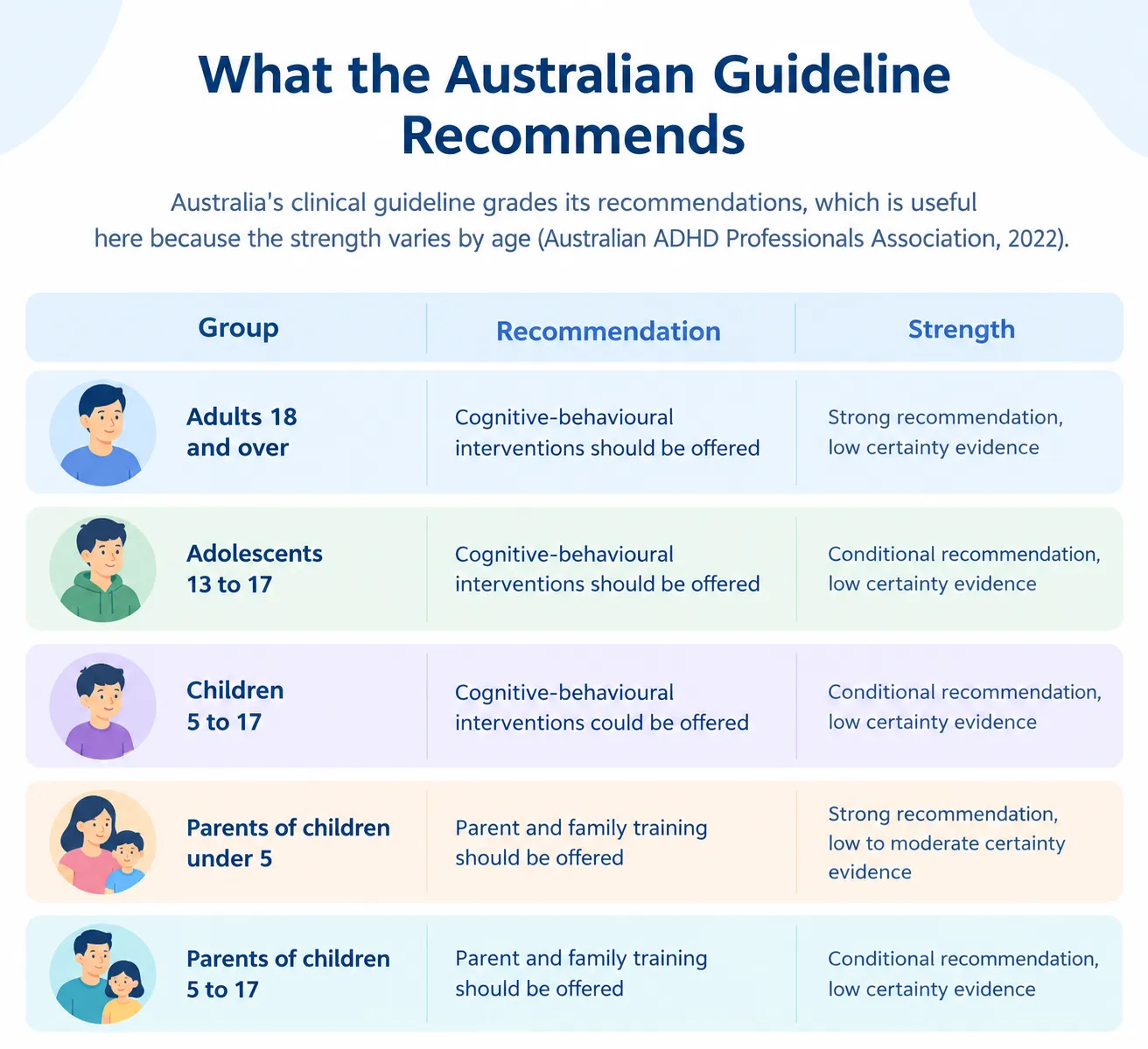
Australia’s clinical guideline grades its recommendations, which is useful here because the strength varies by age (Australian ADHD Professionals Association, 2022).
| Group | Recommendation | Strength |
| Adults 18 and over | Cognitive-behavioural interventions should be offered | Strong recommendation, low certainty evidence |
| Adolescents 13 to 17 | Cognitive-behavioural interventions should be offered | Conditional recommendation, low certainty evidence |
| Children 5 to 17 | Cognitive-behavioural interventions could be offered | Conditional recommendation, low certainty evidence |
| Parents of children under 5 | Parent and family training should be offered | Strong recommendation, low to moderate certainty evidence |
| Parents of children 5 to 17 | Parent and family training should be offered | Conditional recommendation, low certainty evidence |
A strong recommendation resting on low certainty evidence is a specific thing: the expert panel judged the likely benefit worth acting on, while acknowledging the trials are not conclusive. That is an honest position, and it is more than most therapies for ADHD can claim.
What Makes CBT ADHD-Specific?
This is the distinction that matters most when choosing a practitioner. Generic CBT and ADHD-adapted CBT are not the same product. Australia’s clinical guideline specifies that cognitive-behavioural interventions for adults should be specific to the needs of adults with ADHD, strengths-based and empowering (Australian ADHD Professionals Association, 2022). In practice, adaptation means the therapy accounts for:
- Attention and working-memory demands, including how much can realistically be held across a session and between them
- Executive-function and planning difficulties, rather than assuming a plan agreed in session will be carried out
- Task initiation, which is often the actual sticking point rather than motivation
- Time management and time estimation
- Environmental structure, since changing the setting is frequently more effective than changing the effort
- ADHD-related self-concept, built over years of unexplained difficulty
- Co-occurring conditions, which may need to be addressed alongside
A practitioner who is experienced in CBT but not in ADHD may deliver the generic version well and still miss these. It is a reasonable thing to ask about directly.
What CBT for ADHD Actually Involves
CBT and ADHD are a better fit than the generic form of the therapy suggests, provided the therapy is adapted. Standard CBT for depression works largely on the content of thoughts. ADHD cognitive therapy, and cognitive therapy for ADHD more broadly, spends more time on the mechanics of getting things done, because many of the day-to-day difficulties involve functioning, organisation and behavioural implementation. The guideline defines cognitive-behavioural interventions broadly, including education, environmental modification, behavioural modification and psychological adjustment or cognitive restructuring.
What sessions target
- Task initiation: the gap between knowing what to do and being able to start it
- Time perception and estimation, which can be difficult for some people with ADHD and may contribute to problems with planning and deadlines
- Breaking multi-step work into units small enough to begin
- Building external systems, so that remembering does not depend on remembering
- Managing distraction and the cost of switching back after an interruption
- Emotional regulation, including the intensity and speed of emotional responses
- The belief layer: the conclusions drawn after years of failing at ordinary things, which tend to be about character rather than about mechanism
CBT exercises for ADHD
Sessions generally involve between-session work, because the point is changing what happens on a Tuesday rather than what happens in the room. Programs differ, and depending on the programme, behavioural and cognitive strategies may include:
- Time logging: recording how long tasks actually take against the estimate, until the estimate improves
- Task breakdown: taking something avoided and reducing it to a first step small enough to be uninteresting
- Implementation intentions: deciding in advance exactly when and where something will happen, rather than intending to do it generally
- Thought records adapted to ADHD, which examine conclusions such as being lazy or unreliable against the actual evidence
- Environmental audits: identifying the specific friction points that reliably derail you
- Reward scheduling that is proximate rather than distant, since delayed reward is structurally harder to work towards with ADHD
A course is typically time-limited rather than open-ended. Reviews of cognitive-behavioural treatment for adult ADHD report benefits on core symptoms and on functioning, with the caveats about trial quality that the guideline itself notes.
Other Therapies for ADHD
DBT for ADHD
Dialectical behaviour therapy was developed for emotion regulation difficulties, which makes DBT therapy for ADHD conceptually relevant where emotion-regulation difficulties are prominent. A 2025 meta-analysis of randomised controlled trials, covering 8 trials and 850 participants, reported moderate reductions in ADHD symptoms and improvement in quality of life compared with controls. The evidence base remains considerably smaller than for cognitive-behavioural interventions, and Australia’s clinical guideline makes no separate recommendation for DBT.
Mindfulness for ADHD
ADHD and mindfulness is a developing literature, and mindfulness ADHD groups are now offered by a number of Australian services. The current evidence comes from a 2025 systematic review and meta-analysis of 10 controlled studies in adults with ADHD, which found statistically significant improvements in self-reported symptoms, observer-rated symptoms and functioning, while effects on emotional wellbeing and mindfulness skills remained inconclusive.
An earlier 2019 systematic review of 13 studies and 753 adults reported larger effects but was explicit about its limitations: most studies lacked a suitable control group, over half showed high attrition, sample sizes were insufficient for meta-analysis and overall certainty was low. Taken together, the evidence for mindfulness-based interventions in adults with ADHD is promising but still developing, and the studies varied in design and intervention. It does not establish mindfulness as equivalent to guideline-backed ADHD-specific cognitive-behavioural intervention. Meditation for ADHD is often harder to start than to sustain, and shorter, movement-based or guided formats tend to suit ADHD better than long silent practice.
Metacognitive therapy
A group-based approach focused specifically on time management, organisation and planning. It overlaps heavily with adapted CBT and is sometimes what is actually delivered under that name.
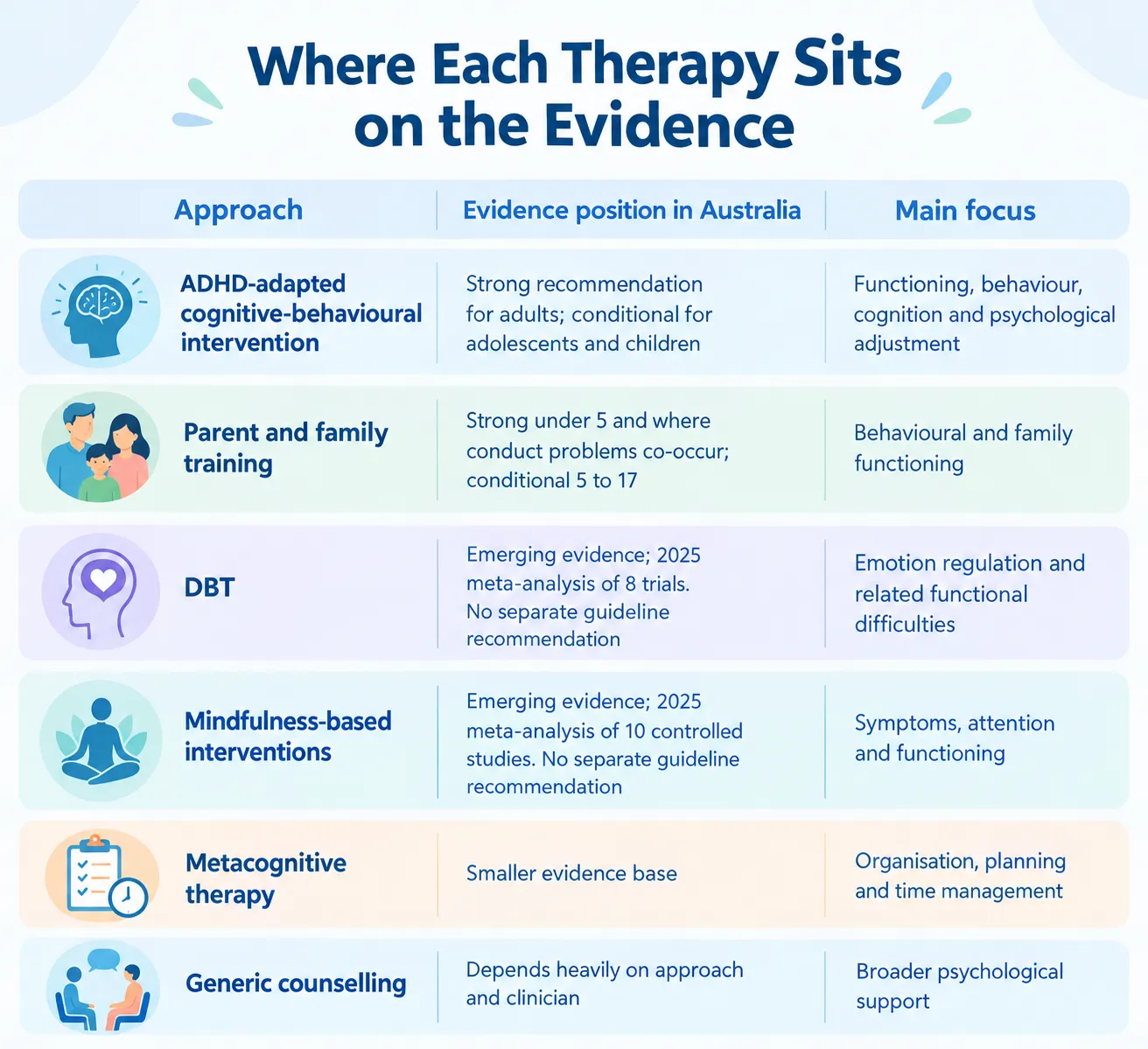
Where Each Therapy Sits on the Evidence
| Approach | Evidence position in Australia | Main focus |
| ADHD-adapted cognitive-behavioural intervention | Strong recommendation for adults; conditional for adolescents and children | Functioning, behaviour, cognition and psychological adjustment |
| Parent and family training | Strong under 5 and where conduct problems co-occur; conditional 5 to 17 | Behavioural and family functioning |
| DBT | Emerging evidence; 2025 meta-analysis of 8 trials. No separate guideline recommendation | Emotion regulation and related functional difficulties |
| Mindfulness-based interventions | Emerging evidence; 2025 meta-analysis of 10 controlled studies. No separate guideline recommendation | Symptoms, attention and functioning |
| Metacognitive therapy | Smaller evidence base | Organisation, planning and time management |
| Generic counselling | Depends heavily on approach and clinician | Broader psychological support |
Alternative and holistic therapy for ADHD
Alternative therapy for ADHD covers a wide range, from approaches with modest evidence to products with none. Holistic therapy for ADHD is a more useful idea when it means addressing sleep, environment, skills and support together rather than expecting one intervention to carry everything. It is less useful as a label attached to a treatment that has not been tested. Ask what the evidence is, and ask specifically rather than generally.
ADHD Psychology: Who Provides Therapy in Australia
Several professions deliver ADHD therapy, and what they can do differs. AHPRA regulates the registered health professions and protects titles such as psychologist, occupational therapist and medical practitioner, and registration for those can be checked on the AHPRA public register. Counselling and psychotherapy are not regulated in the same way.
| Practitioner | What they typically provide |
| Registered psychologist | Psychological assessment and therapy, including CBT adapted for ADHD |
| Clinical psychologist | As above, with additional postgraduate training in mental health conditions. The Medicare rebate depends on the specific MBS item and provider eligibility rather than the title alone |
| Psychiatrist | Medical specialist. Assessment, diagnosis and management, including therapy in some practices |
| Paediatrician | Medical specialist for children and adolescents. Usually works alongside psychological services rather than providing psychotherapy directly |
| Accredited mental health social worker or occupational therapist | Eligible to provide some subsidised mental health services. Occupational therapy is particularly relevant to daily function and routines |
| Counsellor or psychotherapist | Counselling and psychotherapy are not among the registered health professions regulated through AHPRA, so these titles are not protected in the same way. Ask about qualifications, ADHD-specific training and whether any rebate applies |
When people search for ADHD psych services they usually mean one of the first three. It is reasonable to ask a practitioner directly how much ADHD-specific work they do, because general therapeutic training does not automatically include it.
Medicare, Cost and Access
Under the Australian Government’s Better Access initiative, eligible patients can claim Medicare benefits for up to 10 individual and 10 group allied mental health services each calendar year, with a maximum of 6 services in an initial course of treatment before a new referral is required. Eligible providers are clinical psychologists, registered psychologists, occupational therapists and social workers. Referral pathways include a GP or prescribed medical practitioner under the relevant arrangement, or direct referral by a psychiatrist or paediatrician.
Better Access arrangements were redesigned from 1 November 2025. Mental health treatment plans, referrals and reviews are now undertaken at a patient’s MyMedicare registered practice or by their usual medical practitioner, defined as the practitioner who has provided or is likely to provide the majority of their services. Patients can still see other practitioners for mental health support. Separate MBS items for mental health treatment plan reviews were removed, with GPs using time-tiered general attendance items instead.
- Eligibility is assessed by the referring clinician rather than assumed, so ask your GP directly whether you qualify
- The rebate is a contribution rather than full cover in most private practices, so ask about the gap fee before booking
- Rebates differ between registered and clinical psychologists
- Ten individual services per calendar year is a limit on subsidised services, not on services. Treatment can continue beyond it without a Medicare benefit
- Your practitioner must provide a written report to the referring medical practitioner after each course of treatment
- Telehealth has its own eligibility conditions, including distance requirements in some areas
- Some workplaces offer employee assistance programs, and universities commonly provide free counselling to students
Availability, fees and Medicare eligibility vary between practitioners and locations, and arrangements change. Confirm the current position with your GP or the provider before committing. Medicare information on this page was checked in September 2026.
Therapy for Children and Adolescents
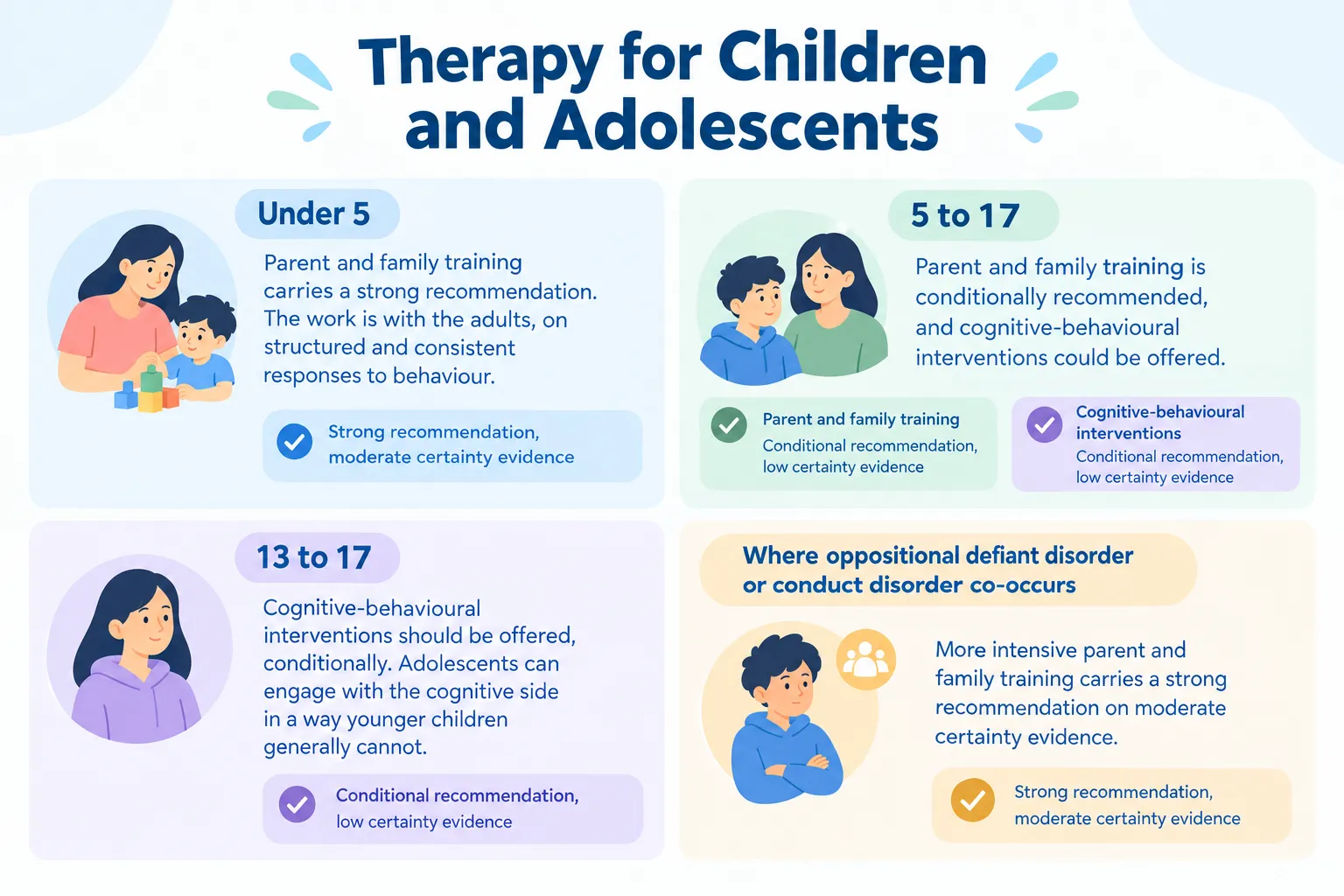
The structure shifts by age, and for the youngest children the most strongly supported intervention is not delivered to the child at all.
- Under 5: parent and family training carries a strong recommendation. The work is with the adults, on structured and consistent responses to behaviour
- 5 to 17: parent and family training is conditionally recommended, and cognitive-behavioural interventions could be offered
- 13 to 17: cognitive-behavioural interventions should be offered, conditionally. Adolescents can engage with the cognitive side in a way younger children generally cannot
- Where oppositional defiant disorder or conduct disorder co-occurs, more intensive parent and family training carries a strong recommendation on moderate certainty evidence
School-based support runs alongside therapy rather than instead of it, and is usually arranged separately.
What Therapy Does Not Do
Being clear about this makes it easier to judge whether a course of therapy is doing what you hoped.
- It is not intended to eliminate the underlying neurodevelopmental condition, although symptoms, coping and functional impairment can change over time
- It does not usually produce rapid change, since the work is largely about building habits and systems
- It is not a substitute for a conversation with your treating clinician about the full range of treatment options
- Co-occurring sleep problems, anxiety or depression may affect functioning and may need to be assessed and treated alongside ADHD, which is why they are assessed rather than assumed
- For ADHD-specific goals, therapy is more likely to be useful when the clinician adapts the approach to ADHD-related functional difficulties
How to Find an ADHD Therapist in Australia
- Ask your GP, who can refer and who often knows local practitioners with ADHD experience
- Ask the practitioner how much of their work is ADHD-specific, and what model they use
- Ask whether the approach is structured and time-limited or open-ended, and which you want
- Check registration on the AHPRA public register
- Ask about the fee, the rebate and the gap before the first appointment
- ADHD support organisations and peer groups often maintain informal lists of practitioners people have found useful
Related Guides
- ADHD treatment in Australia: the full picture
- ADHD coaching and support in Australia
- Emotional dysregulation and rejection sensitivity in ADHD
- How ADHD is diagnosed in Australia: the full process
- Is ADHD a disability, a disorder or a difference?
References
- Australian ADHD Professionals Association. Australian Evidence-Based Clinical Practice Guideline for Attention Deficit Hyperactivity Disorder (ADHD). Released October 2022. Chapter 4, cognitive-behavioural interventions and parent/family training. adhdguideline.aadpa.com.au
- Australian Government Department of Health, Disability and Ageing. Better Access initiative, including the Better Access redesign from 1 November 2025. health.gov.au
- Australian Health Practitioner Regulation Agency. Registered health professions and protected titles. ahpra.gov.au
- Services Australia. Allied health referrals for mental health treatment services. Eligible providers, initial course of treatment and annual limits. servicesaustralia.gov.au
- American Psychiatric Association. Diagnostic and Statistical Manual of Mental Disorders, Fifth Edition, Text Revision (DSM-5-TR). 2022. Neurodevelopmental disorders.
- World Health Organization. International Classification of Diseases, 11th Revision (ICD-11). 6A05 Attention deficit hyperactivity disorder. icd.who.int
- Mindfulness-based interventions for adults with ADHD: a systematic review and meta-analysis of 10 controlled studies. 2025. PMID 40958241
- Behavioral and cognitive impacts of mindfulness-based interventions on adults with attention-deficit hyperactivity disorder: a systematic review. 2019. 13 studies, 753 adults. PMID 31093302
- Dialectical behavioural therapy for adult attention deficit/hyperactivity disorder: a meta-analysis of randomised controlled trials. 2025. 8 trials, 850 participants. PMID 40513141
- Better Health Channel, Victoria. Attention deficit hyperactivity disorder (ADHD): therapies. betterhealth.vic.gov.au