

How Do I Know If I Have ADHD?
You cannot know from a list or a questionnaire. What distinguishes ADHD from ordinary difficulty is a long-standing pattern present since childhood, appearing across more than one setting, and causing meaningful impairment. Only a clinical assessment can determine whether criteria are met and whether something else explains the difficulties better.
Do I have ADHD, or have I got ADHD, is a question most people arrive at the same way. Something clicked while reading, or someone raised it, and now a set of long-standing difficulties has a possible name attached to it. That is an unsettling place to be, and the internet is not good at resolving it.
Do I have ADD ADHD, or is this something else? This guide is about making sense of your own experience: what actually distinguishes ADHD from ordinary difficulty, what does and does not count as evidence, and how to decide whether assessment is worth pursuing. Our pillar guide covers what online ADHD tests can and cannot tell you, and our symptoms guide covers the diagnostic criteria.
The Four Questions That Actually Matter
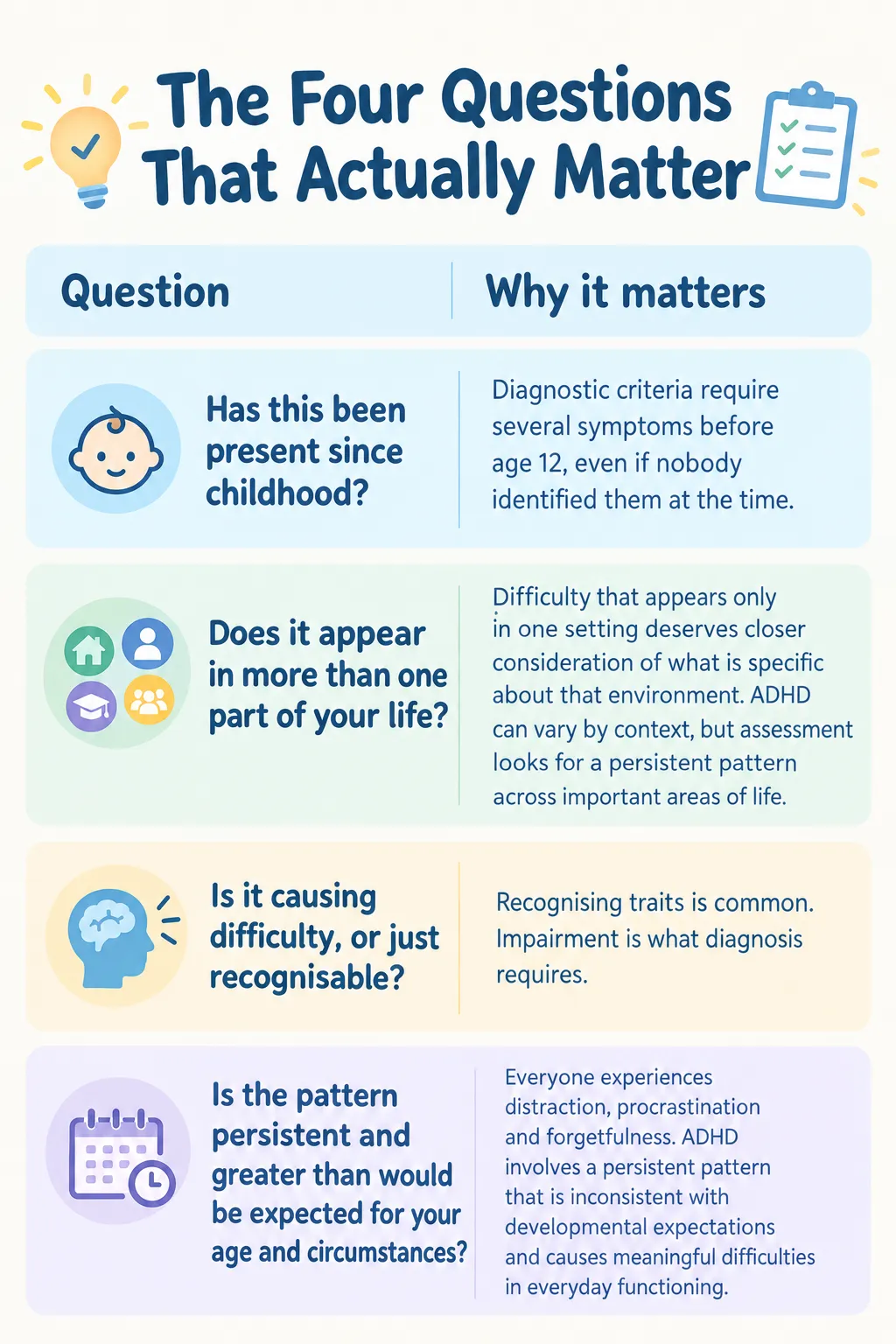
How to know if I have ADHD is not really a question of symptom counts, although the criteria involve them. The questions that separate a diagnosable pattern from ordinary difficulty are simpler than that.
| Question | Why it matters |
| Has this been present since childhood? | Diagnostic criteria require several symptoms before age 12, even if nobody identified them at the time |
| Does it appear in more than one part of your life? | Difficulty that appears only in one setting deserves closer consideration of what is specific about that environment. ADHD can vary by context, but assessment looks for a persistent pattern across important areas of life |
| Is it causing difficulty, or just recognisable? | Recognising traits is common. Impairment is what diagnosis requires |
| Is the pattern persistent and greater than would be expected for your age and circumstances? | Everyone experiences distraction, procrastination and forgetfulness. ADHD involves a persistent pattern that is inconsistent with developmental expectations and causes meaningful difficulties in everyday functioning |
If your honest answer to most of those is yes, assessment is a reasonable step. If it is no, that does not mean nothing is happening. It means ADHD may not be the explanation.
What Does Not Tell You Whether You Have ADHD
- Recognising yourself in a symptom list. Almost everyone does, because the traits are common
- A high score on an online test. That indicates assessment may be appropriate, not that ADHD is present. Rating scales are only one part of an assessment
- Relating strongly to ADHD content on social media. Content is written to resonate, and resonance is not evidence
- Being able to focus intensely on things you enjoy. This does not rule ADHD in or out
- Doing well at school or work. Compensation is common and often costly
- Not being hyperactive. Hyperactivity is not required for every presentation
- Someone telling you that you definitely have it, or definitely do not
None of these are useless observations. They are reasons to look further rather than conclusions.
Why It Is Hard to Assess Yourself
Self-assessment is genuinely difficult here, for reasons that have nothing to do with intelligence or honesty.
- You have no comparison. If you have always been this way, it feels like a baseline rather than a difficulty
- You compare yourself to your own history rather than to other people
- Compensation hides the difficulty in your effort rather than your outcomes, and effort is invisible to everyone including you
- Recent circumstances leak in. Burnout, poor sleep or a demanding period produce the same experiences temporarily
- Childhood recall is unreliable at distance, which is why clinicians ask for school reports and speak with family
- Reading about ADHD changes how you interpret your own memories, in both directions
Both errors are common
Some people conclude they have ADHD after reading content that resonates. Others rule themselves out because they do not match the stereotype, particularly if they were never hyperactive or did well academically. Neither conclusion is reliable without assessment.
What Would Actually Point Toward ADHD
Clinicians look for a pattern rather than individual traits. What tends to be informative:
- A persistent gap between capability and outcomes, sustained over years rather than during one difficult period
- The same difficulties appearing in school reports, past jobs and current life
- Feedback from different people at different times describing similar things
- Difficulties that continued through periods when circumstances were good
- A family history, since ADHD runs strongly in families
- Difficulty that has required compensation rather than simply being tolerated
What is more useful than any of this is specificity. A clinician can work with what happens, how often, in which settings, and what the consequence was. They can do considerably less with a list of traits.
What If I Only Notice It When Life Gets Harder?
This is one of the most common versions of the question, and the answer is not simply that you are stressed.
Increased demands can expose long-standing difficulties that were previously compensated for. Executive function requirements change substantially at particular points, and the difficulty does not appear then so much as become impossible to absorb.
- University or a first job, where external structure and supervision reduce
- Full-time work, particularly roles with self-directed deadlines
- Becoming a parent, when sleep reduces and administrative load multiplies
- Remote or unsupervised work, which removes the scaffolding an office provides
- A promotion into management or self-employment
- Relationship or living changes that alter who was absorbing the load
This does not establish ADHD. Sustained stress and burnout produce similar experiences without it. What assessment looks at is whether there is evidence of a pattern before the demands increased, rather than only after.
ADHD Is More Than Recognising Symptoms
Having several ADHD-like traits does not automatically mean you have ADHD. Assessment considers whether symptoms are causing clinically meaningful difficulties in areas such as work, study, relationships, family life or daily responsibilities.
Australia’s clinical guideline emphasises impairment, participation and quality of life rather than symptom presence alone (Australian ADHD Professionals Association, 2022). This is why two people can describe similar experiences and reach different conclusions at assessment: one has built an environment that absorbs the difficulty and the other has not.
What Else Could It Be?
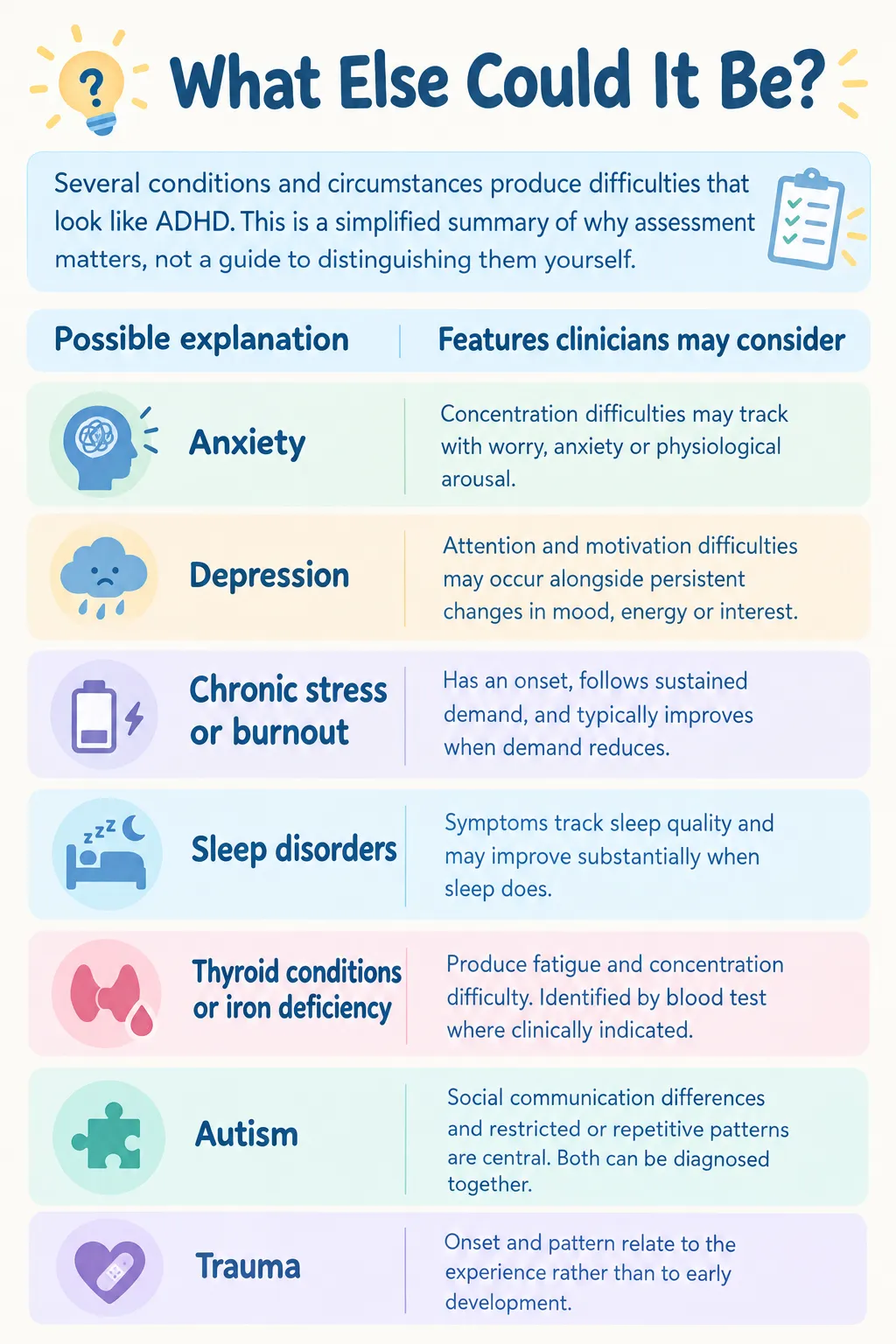
Several conditions and circumstances produce difficulties that look like ADHD. This is a simplified summary of why assessment matters, not a guide to distinguishing them yourself.
| Possible explanation | Features clinicians may consider |
| Anxiety | Concentration difficulties may track with worry, anxiety or physiological arousal |
| Depression | Attention and motivation difficulties may occur alongside persistent changes in mood, energy or interest |
| Chronic stress or burnout | Has an onset, follows sustained demand, and typically improves when demand reduces |
| Sleep disorders | Symptoms track sleep quality and may improve substantially when sleep does |
| Thyroid conditions or iron deficiency | Produce fatigue and concentration difficulty. Identified by blood test where clinically indicated |
| Autism | Social communication differences and restricted or repetitive patterns are central. Both can be diagnosed together |
| Trauma | Onset and pattern relate to the experience rather than to early development |
Several of these also occur alongside ADHD rather than instead of it, which is common. Identifying one does not rule out the other.
Do I Have ADHD? Questions People Ask
How do I know if I have ADHD as a woman?
Do I have ADHD, female presentation included? The criteria are identical, but presentation and recognition differ. Australia’s clinical guideline notes that girls and women are at risk of under-recognition, particularly where symptoms are predominantly inattentive (Australian ADHD Professionals Association, 2022). If you have ruled yourself out because you were never disruptive, that is worth revisiting. Our guide to ADHD symptoms in women covers this in depth.
How do I know if my child has ADHD?
Assessment of children draws on information from parents, teachers and the child, across more than one setting. What is worth noting is whether the pattern is consistent across settings and over time rather than tied to one subject, one teacher or one period. Our parent’s guide covers what to raise and with whom.
Can I have ADHD if nobody noticed as a child?
Yes, and it is common. ADHD does not need to have been diagnosed during childhood. What matters for diagnosis is establishing that the relevant symptoms were present before age 12. Some people were not identified because their difficulties were subtle, compensated for, or not disruptive enough to trigger a referral, and Australia’s clinical guideline recognises that people may not come to clinical attention until after childhood (Australian ADHD Professionals Association, 2022).
How do I find out if I have ADHD?
How do you find out if you have ADHD? Through clinical assessment. The practical first step for most people in Australia is a GP appointment, where you can discuss your history and referral options.
If You Decide to Pursue Assessment
What helps a clinician is not a conviction that you have ADHD. It is a clear account of what is happening.
- Book a GP appointment, ideally a longer one, and say what you want to discuss when you book.
- Write down specific examples rather than traits: what happens, how often, in which settings, and what the consequence is.
- Gather what you can from childhood: school reports, old assessments, or what a parent remembers.
- Note what you have already tried, and whether it helped.
- Be prepared to discuss other possibilities, since ruling them in or out is part of the process.
If Assessment Is Not Accessible Right Now
Assessment can be expensive and waits can be long, and that is a real barrier rather than an excuse.
Two things are worth knowing. Support for difficulties does not always require a diagnosis: workplace and educational adjustments, sleep, structure and reducing decision load help many people regardless of what an assessment eventually finds. And if difficulties are affecting your mental health, that is worth raising with a GP on its own terms, separately from the ADHD question.
If the Answer Turns Out to Be No
This happens, and it is worth preparing for. An assessment that does not identify ADHD has not established that your difficulties are imaginary. It has narrowed down what is causing them.
Assessment may identify another condition, a co-occurring difficulty, or a circumstance that better explains some or all of the difficulties. Either outcome is more useful than continuing to wonder.
References
- Australian ADHD Professionals Association. Australian Evidence-Based Clinical Practice Guideline for Attention Deficit Hyperactivity Disorder (ADHD). Released October 2022. adhdguideline.aadpa.com.au
- American Psychiatric Association. Diagnostic and Statistical Manual of Mental Disorders, Fifth Edition, Text Revision (DSM-5-TR). 2022.
- World Health Organization. International Classification of Diseases, 11th Revision (ICD-11). 6A05 Attention deficit hyperactivity disorder. icd.who.int
- Healthdirect Australia. Attention deficit hyperactivity disorder (ADHD). healthdirect.gov.au
Last reviewed: September 2026. Next scheduled review: September 2027. This article is general information and is not a substitute for individual medical advice, assessment or diagnosis.