

What Are the Signs of ADHD?
Commonly recognised signs include difficulty starting tasks, losing track mid-conversation, unreliable time estimation, restlessness, impulsive decisions and a persistent gap between capability and output. These are traits people notice in themselves. They are not the same as diagnostic symptoms, which require duration, childhood onset, presence across settings and functional impairment.
There is a difference between signs and symptoms that matters more than it sounds. With ADHD, the signs are what you notice. Symptoms are what a clinician assesses against criteria. Almost everyone recognises some ADHD characteristics in themselves, and that recognition is where most people start, which is fine as a starting point and unreliable as a conclusion.
This guide covers the traits of ADHD people most commonly recognise, what separates a trait from a symptom, and when recognition is worth acting on. Signs and symptoms ADHD content often blurs the two, which is where most of the confusion comes from. Our full symptoms guide covers the diagnostic criteria themselves.
Traits Versus Symptoms
This distinction does most of the work on this page.
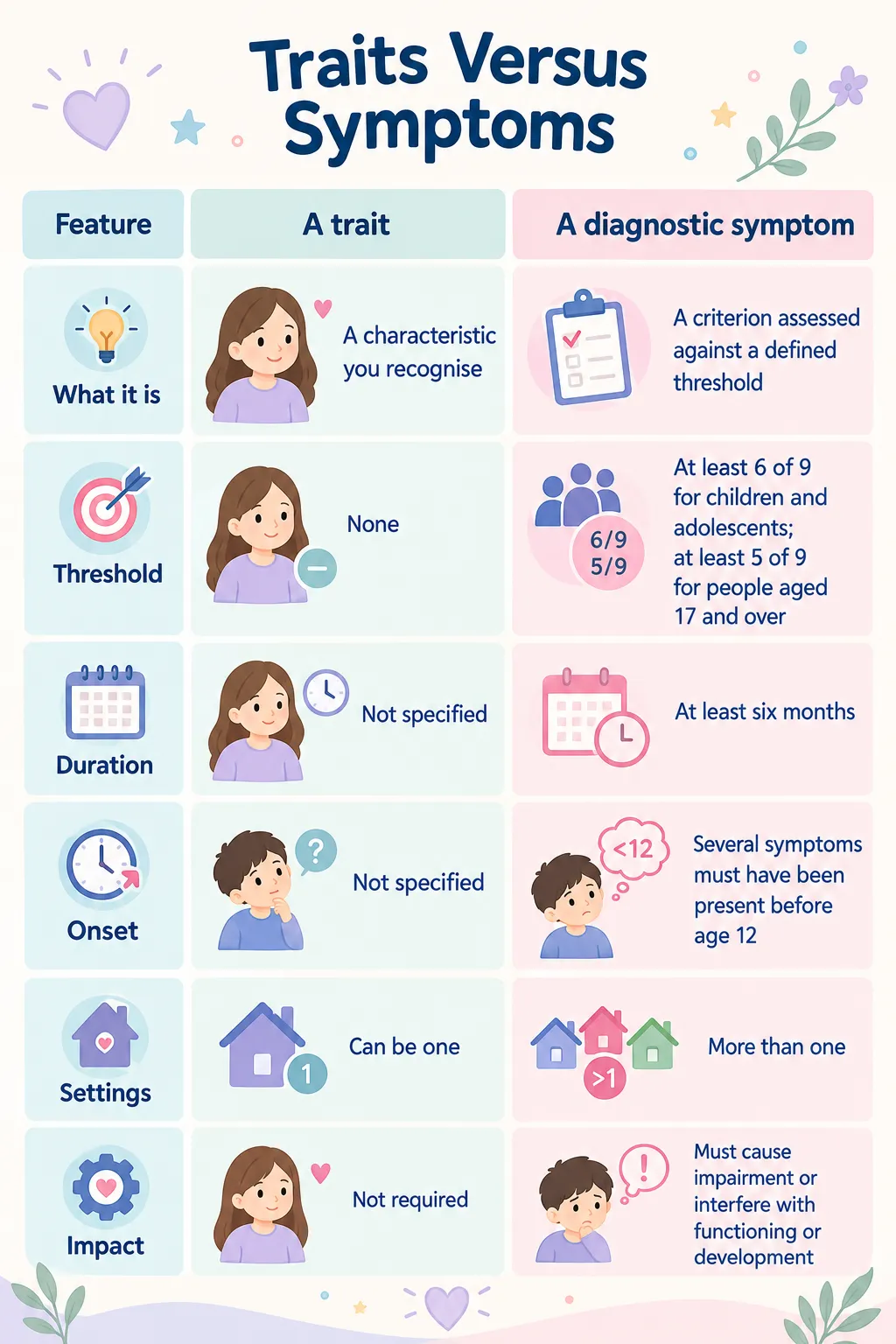
| Feature | A trait | A diagnostic symptom |
| What it is | A characteristic you recognise | A criterion assessed against a defined threshold |
| Threshold | None | At least 6 of 9 for children and adolescents; at least 5 of 9 for people aged 17 and over |
| Duration | Not specified | At least six months |
| Onset | Not specified | Several symptoms must have been present before age 12 |
| Settings | Can be one | More than one |
| Impact | Not required | Must cause impairment or interfere with functioning or development |
Recognising four or five traits on a list is common and means very little on its own. What distinguishes ADHD is not whether the traits are present but whether they are long-standing, cross-situational and causing difficulty disproportionate to circumstances.
ADHD Traits People Most Commonly Recognise
The traits below describe experiences commonly associated with ADHD and often recognised by people before they seek an assessment. They are illustrative rather than diagnostic, they are not additional diagnostic criteria, and not everyone with ADHD experiences all of them.
Attention and focus
- Reading a page and retaining nothing, then rereading it with the same result
- Losing the thread mid-conversation and reconstructing it from context
- Difficulty with anything that is important but not interesting
- Periods of intense concentration on highly engaging activities, sometimes lasting much longer than expected. This type of intense focus is commonly described in ADHD, but it is not itself a diagnostic criterion
Starting and finishing
- Knowing exactly what to do, wanting to do it, and being unable to begin
- A backlog of projects that were started well
- Momentum disappearing near completion, particularly once the task stops being new
- A five-minute task and a two-hour task feeling equally difficult to start
Time and organisation
- Consistently misjudging how long things take, in both directions
- Deadlines that feel distant right up until they are imminent
- Elaborate systems built to compensate, which take effort to maintain
- Losing everyday items at a rate that stands out
Movement and impulsivity
- Restlessness that is internal rather than visible, particularly in adults
- Difficulty relaxing, or discomfort with unstructured time
- Interrupting despite intending not to
- Decisions made faster than they were considered: purchases, commitments, changes
Emotion and self-perception: associated experiences
- Strong or rapidly changing emotional reactions that can be difficult to regulate
- Sensitivity to perceived criticism or rejection, which some people with ADHD report
- Some people describe a long-standing gap between what they understand they can do and what they consistently manage to complete. This can be a reason to investigate rather than evidence of ADHD itself
- Self-criticism that has hardened into an explanation: lazy, careless, not trying
Emotional signs in ADHD are commonly reported and are recognised in Australian clinical guidance as associated with the condition, although they are not part of the formal diagnostic criteria (Australian ADHD Professionals Association, 2022).
ADHD Indicators in Adults Versus Children
ADHD-related difficulties can look different across childhood and adulthood as developmental expectations and daily demands change.
| Trait | In children | In adults |
| Restlessness | Visible movement, difficulty staying seated | Internal restlessness, difficulty relaxing |
| Inattention | Incomplete schoolwork, instructions half followed | Missed emails, meetings that do not register, unfinished projects |
| Disorganisation | Messy bag, lost equipment | Administrative backlog, missed appointments, unopened mail |
| Impulsivity | Calling out, difficulty waiting turn | Impulsive spending, commitments, sudden decisions |
Childhood ADHD signs are more often noticed by other people. Adult signs, or ADHD indicators in adults, are more often noticed by the person themselves, frequently after a period where demands increased.
Why Recognising Signs Is Not Enough
This is the honest limitation of every signs list, including this one.
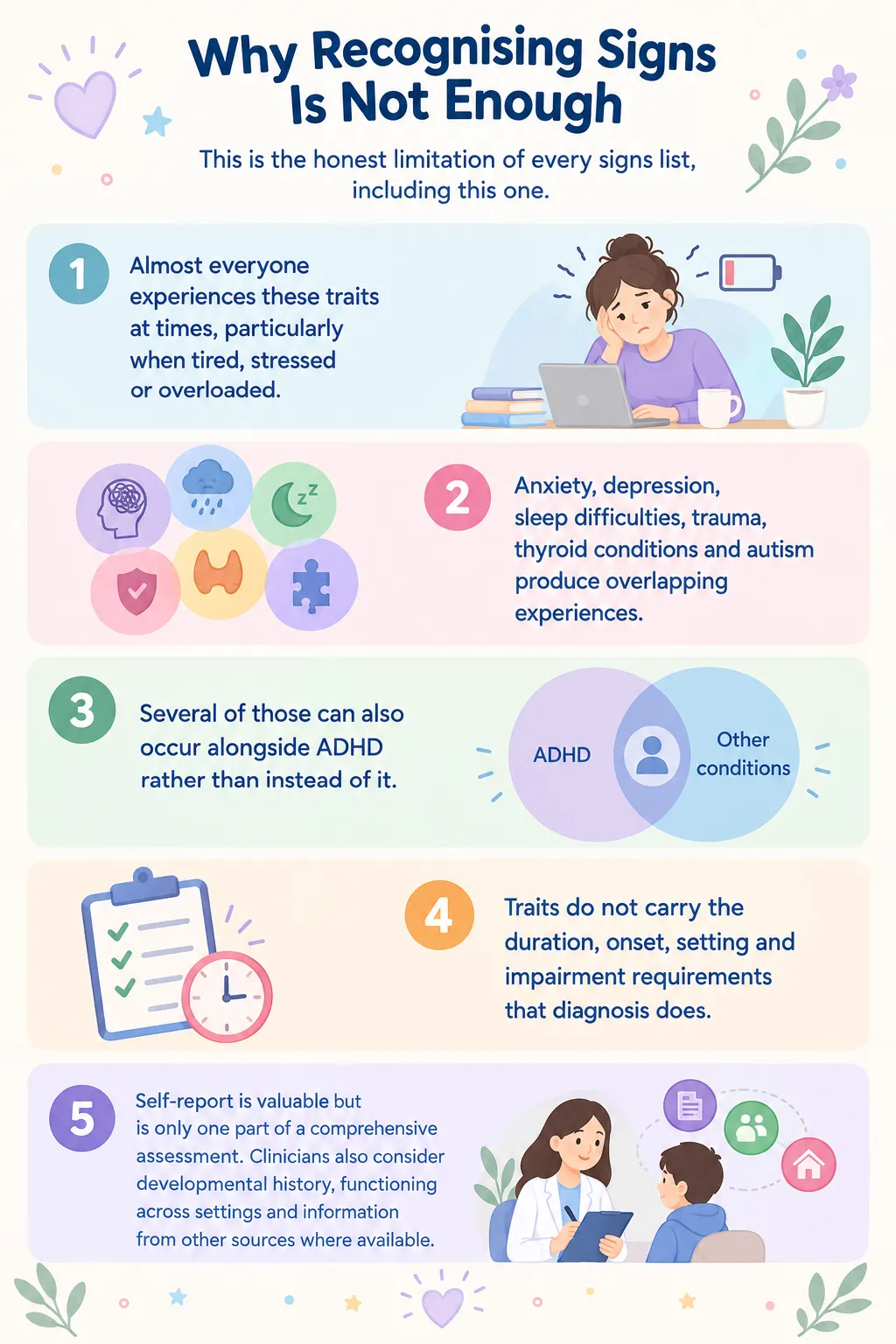
- Almost everyone experiences these traits at times, particularly when tired, stressed or overloaded
- Anxiety, depression, sleep difficulties, trauma, thyroid conditions and autism produce overlapping experiences
- Several of those can also occur alongside ADHD rather than instead of it
- Traits do not carry the duration, onset, setting and impairment requirements that diagnosis does
- Self-report is valuable but is only one part of a comprehensive assessment. Clinicians also consider developmental history, functioning across settings and information from other sources where available
None of this makes it pointless to recognise the signs. ADHD assessment usually starts with someone noticing something. Recognition is a reason to seek assessment rather than a substitute for one.
When ADHD Signs Are Worth Discussing With a Professional
The practical threshold is not how many items you recognised. It is whether the pattern meets these conditions.
- There is evidence that similar difficulties were present during childhood, even if they were not recognised as ADHD at the time.
- Similar difficulties are evident across more than one setting or area of life.
- It is causing difficulty rather than simply being recognisable.
- There is a persistent gap between capability and outcomes despite genuine effort.
- You are managing, but the effort required is disproportionate and not sustainable.
If several of those apply, a conversation with a GP about referral pathways is a reasonable next step. It helps to arrive with specifics: examples from childhood, school reports if you have them, and an account of what is currently not working rather than a list of traits.
What Signs Lists Get Wrong
| Common framing | The problem with it |
| Numbered lists of relatable traits | Almost everyone recognises several. Recognition is not a threshold |
| Signs presented as diagnostic | Traits do not carry duration, onset, setting or impairment requirements |
| Focus on visible hyperactivity | Can miss predominantly inattentive presentations, which may be less externally visible |
| Adult signs described in childhood language | Adults reading about climbing on furniture reasonably rule themselves out |
| Online quizzes framed as answers | Screeners indicate whether to seek assessment. They do not diagnose |
Related Guides
- ADHD symptoms in adults
- ADHD symptoms in women and girls
- ADHD symptoms in children and toddlers
- What ADHD feels like: living as a person with ADHD
- ADHD, IQ, intelligence and giftedness
References
- Australian ADHD Professionals Association. Australian Evidence-Based Clinical Practice Guideline for Attention Deficit Hyperactivity Disorder (ADHD). Released October 2022. adhdguideline.aadpa.com.au
- American Psychiatric Association. Diagnostic and Statistical Manual of Mental Disorders, Fifth Edition, Text Revision (DSM-5-TR). 2022.
- National Institute for Health and Care Excellence (NICE). Attention deficit hyperactivity disorder: diagnosis and management. NG87.
Last reviewed: September 2026. Next scheduled review: September 2027. This article is general information and is not a substitute for individual medical advice, assessment or diagnosis.